Karl Peterjohn

Sedgwick County commissioners vote Democratic

by Bob Weeks on January 11, 2012

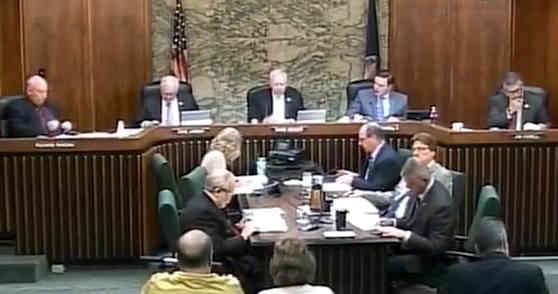
This morning the Sedgwick County Commission voted to select member Tim Norton of Haysville as chairman for the upcoming year. Norton, a Democrat, received the votes of two of the board’s four Republican members: Those of outgoing Chairman Dave Unruh and .

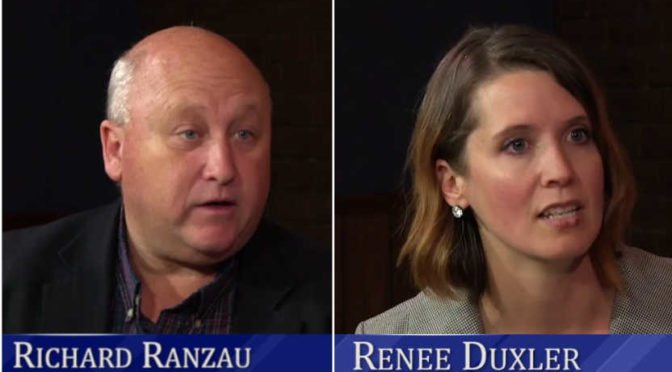
Commissioner Karl Peterjohn nominated Richard Ranzau for the position, but he received only two votes.

It may be remarkable that a board with a four to one majority in one party elected a member of the minority party to serve as chair, or it may simply be a reflection of the actual ideological makeup of the board. Peterjohn and Ranzau consistently take stances and make votes that favor limited government and free markets, while Unruh and Skelton generally join with the politically-liberal Norton on most issues. The chairman is more than just a ceremonial position, as the chairman presides over commission meetings. On many agenda items, the commission is not obligated to hear testimony from citizens, although it must when there are items that have public hearings required by law. It was the practice of Kelly Parks and Peterjohn, when they served as chair, to allow anyone who appeared at meetings to speak. In his term as chair, Unruh was seen as less accommodating, although I think that anyone who really cared to was allowed to speak, sometimes with a gentle admonition to hurry along. It is unknown in what manner Norton will run the meetings while he is chair. A hint: He’s objected to the term “ObamaCare” as pejorative, so I wouldn’t use that word around the courthouse.

For Chairman Pro Tem, the commissioners selected Skelton. Ranzau’s name was placed into nomination by Peterjohn, and he received the same two votes as he did for chairman. The votes for Skelton by Norton and Unruh are surprising. Skelton’s recent behavior has been erratic, even bizarre at times. His recent appearance at the Wichita City Council (video here) brought laughter and guffaws from both the bench and the public. I got the sense, however, the people were laughing at Skelton, not with him.

Unruh’s selection for 2011 Chairman’s award

Chairman Unruh selected Visioneering Wichita as the recipient of the annual Chairman’s award. This organization is in favor of government intervention into the economy — and people’s lives — on a large and increasing scale. Most of the items on its legislative agenda involve more government spending. While Visioneering — its chair Jon Rolph, anyway — denies advocating for increased taxes, Milton Friedman has taught us that it is the level of spending that is the true measure of the size of government. The size of that Visioneering seeks to expand.

{ 6 comments }

Sedgwick County considers a planning grant

by Bob Weeks on September 30, 2011

This week the Sedgwick County Commission considered whether to participate in a HUD Sustainable Communities Regional Planning Grant.

A letter from Sedgwick County Manager Bill Buchanan to commissioners said that the grant will “consist of multi-jurisdictional planning efforts that integrate housing, land use, economic and workforce development, transportation, and infrastructure investments in a manner that empowers jurisdictions to consider the interdependent challenges of economic prosperity, social equity, energy use and climate change, and public health and environmental impact.”

The budget of the grant is $2,141,177 to fund the three-year plan development process, with $1,370,000 from federal funds and $771,177 of “leveraged resources” as a local match. These leveraged resources are in the form of in-kind contributions of staff time, plus $60,000 in cash.

While Sedgwick County will be the grant’s “fiscal agent,” the work will be done by Regional Economic Area Partnership (REAP), an umbrella organization with the mission of, according to its website: “Guide state and national actions that affect economic development in the region and adopt joint actions among member governments that enhance the regional economy.”

REAP’s members include city and county governments in a nine-county area in south-central Kansas. One of its duties is to administer the Kansas Affordable Airfares Program, the program that pays subsidies to airlines to provide service to the Wichita airport. In 2011, Sedgwick County paid $15,272 in “assessments” for its membership in REAP, while the City of Wichita paid $27,192. Governments pay smaller amounts as part of REAP’s water resources program.

The counties that are considering participating in this planning grant are Reno, Harvey, Sedgwick, Sumner, and Butler.

County documents specify the county’s in-kind contribution as $120,707. That consists of portions of the salary and benefits for four existing employees, plus $85,800 in “indirect administration costs.” There is no cash match at this time.

John Schlegel, Director of Planning for the Wichita-Sedgwick County Metropolitan Area Planning Department, told commissioners that the end product of this grant would be the development of a regional plan for sustainable development. He said that we don’t know what the plan would contain, but that the purpose of the grant program is to get regions to work together on sustainability issues. The target area of the grant is a five-county area around Sedgwick County.

He said that examples of issues would be economic development, workforce development, fiscal sustainability such as balanced budgets and spending priorities, and working together to create efficiencies in the region like joint purchasing and cost sharing.

Commissioner Richard Ranzau asked to see a copy of the completed application, but the application is not complete.

In his remarks, Ranzau described the application process, reading from the application document: “The applicant must show a clear connection between the need that they have identified within the region, the proposed approach to address those conditions, and the outcomes they anticipate the plan will produce.” He said that it appears that REAP will do these within the application, but the commission is being asked to approve and commit to these items without having seen them, which he described as irresponsible. He made a motion that action on the grant be delayed until these things are known.

Joe Yager, chief executive officer of REAP, said that last year’s grant application is available on the REAP website, and that is the closest thing to a draft application that is available today. This year’s application is a second year of the program. Last year the commission voted not to participate in the grant by a 3 to 2 vote.

Commissioner Karl Peterjohn wondered if the new planning consortium is a duplication of existing regional authorities. He listed seven different groups, besides REAP, that are involved in planning for the region.

In further remarks, Peterjohn was concerned that smaller counties will have the same voting representation as Sedgwick County, which is many times larger than the small counties.

In response to a question from Peterjohn, Yager said that the current application is for category 1 funds only, which are for planning purposes. If REAP is successful in the application, it could apply for category 2 funds, which are for implementation of a plan.

Answering another question, Yager said that “livability principles,” which applicants must be committed to advance, are providing more transportation choices, promoting equitable and affordable housing, enhancing economic competitiveness, supporting existing communities, coordinating policies and leveraging investments, and valuing communities and neighborhoods. Peterjohn said these principles were not supplied in the information made available to commissioners.

Peterjohn said these principles sound innocuous on their face, but when details are examined, he said he could not support a “Washington-driven agenda” that could not pass the present Congress. He described this effort as part of an “administrative end-around,” baiting us with a federal grant, that will allow Washington, HUD, and EPA to “drive what we do in our community.”

The motion on deferring the item failed on a 2 to 3 vote, with Peterjohn and Ranzau voting for it.

The commission heard from three citizens. In his remarks, John Todd referenced a slide titled “Common Concerns” from a presentation given by REAP. Todd listed these concerns, which include: “A method of Social Engineering to restrict residence in the suburbs and rural areas and force Americans into city centers; a blueprint for the transformation of our society into total Federal control; will enforce Federal Sustainable Development zoning and control of local communities; will create a massive new ‘development’ bureaucracy; will drive up the cost of energy to heat and cool your home; will drive up the cost of gasoline as a way to get you out of your car; and will force you to spend thousands of dollars on your home in order to comply.”

Susan Estes of Americans for Prosperity challenged the attitude of some commissioners, particularly Jim Skelton, which is that approving the planning grant does not commit us to implementing the plan. She told the commissioners “If you know you don’t like the federal government coming in and planning for you, say so now. Let’s get it over with and be upfront and honest to those involved,” referring to the other cities and counties that may participate in the grant and planning process.

She characterized the language that appears in the grant materials as meaning “more control and less liberty.”

In his remarks, Ranzau asked Schlegel what problem we will solve by participating in the grant. Schlegel answered that the purpose of the grant is to “build the greater regional capacity for regions to better compete in what is really becoming a global marketplace.” This is the end product, he said.

Ranzau said that we don’t need more planning, that we have more than enough planning at the present time. This grant, he said, would create another consortium that is unaccountable to the people, as no one is elected to them. The organizations receive tax dollars, and while some elected officials serve on these bodies, it is not the same as being directly accountable to the people. The fact that the grant requires a new consortium to be formed is evidence that the agenda is to circumvent the will of the people, he said.

Ranzau also said that Schlegel told him that “acceptance of this grant will take REAP to another level, because right now they are struggling, and this will help plot the course for REAP.” He said that REAP, which is housed at the Hugo Wall School of Public Affairs at Wichita State University, needs to expand its role and authority in order to give it “something to do.” He said the grant will promote the “progressive agenda” of the Obama administration in this way.

Later Commission Chair Dave Unruh disputed the contention regarding the workload of REAP.

Ranzau also questioned whether we want the federal government to be a “source of solutions” for our local communities. He also questioned one of the stated goals of the program, which is to reduce cost to taxpayers. It’s a new program, he said, and would not reduce the cost to taxpayers.

He further questioned the ability of the grant program to help teach local communities to be fiscally responsible. With federal spending out of control, he said the federal government is not in a position to help in this regard.

He further said that talking in generalities sounds benign, and that he wanted to know what he is committing the county to this year. Repeating the concerns of Peterjohn, Ranzau said that accepting this grant would be accepting the policies of the Obama Administration as our own. He said that in the 2010 elections the people repudiated the agenda of the president, and this grant program is an example of the type of programs people have said they don’t want. It is concern with the agenda behind this grant program that is his greatest concern, he later explained.

Continuing, Ranzau questioned the ability of the federal government to create conditions for sustainable growth: “You’ve got to be kidding me. Look at the vision they now have for growth in this county. It’s a disaster. And now they want to take the same policies that have created and made our current economic situation worse — they want to bring them to our local communities by these sorts of grants.”

Both Ranzau and Peterjohn questioned the ability of this grant to produce affordable housing, citing the government’s role in the ongoing housing crisis.

Ranzau, who has voted against many grants, added that this is the “the worst and most troublesome grant” he’s seen in his time in office, adding that the grant is clearly an agenda created by President Obama. He said there are politicians who ran for office on platforms of limited government and fiscal responsibility, and this grant is an opportunity for them to “act on those values.”

In further discussion, it was brought out that each region makes its own definition of what sustainability means to it, but Yager provided this definition of sustainability: “Meeting the needs of the present without compromising the ability of future generations to meet their own needs.”

In his remarks, Unruh said that Sedgwick County has been involved in sustainability thinking and planning for at least two years. He said this is a strategy that helps the county plan for the future. He asked manager Buchanan if the county had a definition of sustainability. Buchanan replied the County has taken a similar approach to the International City/County Management Association, which he said involves four factors: Economic stability — sufficient jobs and economic development; ensuring that local governments are fiscally healthy so that they can provide quality services; social equity, which he said ensures that the delivery of services in communities is equitable; and the environment, which he said was not about global warming, but rather making sure we’re not wasting natural resources.

Unruh said that we are not opposed to these principles, that these are reasonable activities for elected officials. He added that regionalism is the “whole measuring stick.” We must consider communities close to us when planning, he added. It is reasonable to get these people together on a voluntary and non-binding basis. While he said he didn’t like excess spending at the federal level, it is his money that the federal government is spending, and we should take advantage of this program, adding that we need to plan. If the plans are not acceptable, he said we could simply not adopt them. He disagreed with the contention of Ranzau and Peterjohn that this process causes the county to yield to any master plan developed by the federal government. He again mentioned that we are using our money to develop this plan, and asked our federal officeholders to stop spending money in this way.

He added that he believes in limited government and fiscal responsibility, and that accessing these resources does not make him “hypocritical, insincere, or untruthful.”

In rebuttal to Buchanan, Ranzau said that the grant funding document says that one of the goals is to reduce greenhouse gas emissions, which are believed by many to be a cause of global warming or climate change. The document does mention helping regions “consider the interdependent challenges of … energy use and climate change.” This language was transmitted to commissioners in a letter from Buchanan. Ranzau again said it is important not to downplay the agenda that is associated with the grant funds. In earlier remarks, Ranzau had described how applications would be scored or ranked, and that winning applications would need to conform to the goals of HUD.

The commission voted to approve the grant, with Unruh, Norton, and Skelton voting in favor, and Ranzau and Peterjohn voting against.

Commentary

Discussions such as these, where the role of government and the nature of the proper relationship between the federal government and states, counties, and cities, are a regular feature at Sedgwick County Commission meetings, due to the concerns of Peterjohn and Ranzau. These discussion do not often take place at the Wichita City Council, unless initiated by citizens whose testify on matters.

The remarks of chairman Unruh illustrated one of the important conundrums of our day. Many are opposed to the level of federal (and other government) spending. Polls indicate that more and more people are concerned about this issue. Yet, it is difficult to stop the spending.

In particular, the grant process is thorny. The principled stand of Ranzau, and sometimes Peterjohn, is that we should simply refuse to participate in the spending — both federal and local — that grants imply, and in the process also accepting the strings attached to them. Others, Unruh and Skelton in particular, have what they believe is a pragmatic view, arguing that it is our money that paid for these grant programs, and so by participating in grants we are getting back some of the tax funds we send to Washington. This reasoning allows Unruh to profess belief in limited government and fiscal responsibility while at the same time participating in this spending.

But there is no doubt that accepting federal money such as these grant funds means buying in to at least parts of the progressive Obama agenda, something that I think conservatives like Unruh and Skelton would not do on a stand-alone basis. This is an example of the power and temptation of what appears to be “free” federal money, and Ranzau and Peterjohn are correctly concerned and appropriately wary.

It is even more troublesome to realize that this power over us is exercised using our own money, as Skelton and Unruh rightly recognize, but nonetheless go along.

There may be a legislative solution someday. First, we can elect federal officials who will stop these programs. But the temptation to bring money back to the home district, either through grant programs or old-fashioned pork barrel spending, is overwhelming. Just this week U.S. Senator Jerry Moran, who voted against raising the debt ceiling in August, pledged to find more federal funds to pay for Wichita’s aquifer storage and recovery program.

An example of legislation that may work is a bill recently introduced by U. S. Representative Mike Pompeo of Wichita and others. The bill is H. R. 2961: To amend the Patient Protection and Affordable Care Act to have Early Innovator grant funds returned by States apply towards deficit reduction. The purpose of the bill is to direct the early innovator grant funds that Kansas Governor Sam Brownback returned towards deficit reduction, rather than being spent somewhere else.

The fiscal conservatives who vote to accept federal grant funds should be aware of research that indicates that these grants cause future tax increases. In my reporting on such a study I wrote: This is important because, in their words, “Federal grants often result in states creating new programs and hiring new employees, and when the federal funding for that specific purpose is discontinued, these new state programs must either be discontinued or financed through increases in state own source taxes.” … The authors caution: “Far from always being an unintended consequence, some federal grants are made with the intention that states will pick up funding the program in the future.”

The conclusion to this research paper (Do Intergovernmental Grants Create Ratchets in State and Local Taxes?) states:

Our results clearly demonstrate that grant funding to state and local governments results in higher own source revenue and taxes in the future to support the programs initiated with the federal grant monies. … Most importantly, our results suggest that the recent large increase in federal grants to state and local governments that has occurred as part of the American Recovery and Reinvestment Act (ARRA) will have significant future tax implications at the state and local level as these governments raise revenue to continue these newly funded programs into the future. Federal grants to state and local governments have risen from $461 billion in 2008 to $654 billion in 2010. Based on our estimates, future state taxes will rise by between 33 and 42 cents for every dollar in federal grants states received today, while local revenues will rise by between 23 and 46 cents for every dollar in federal (or state) grants received today. Using our estimates, this increase of $200 billion in federal grants will eventually result in roughly $80 billion in future state and local tax and own source revenue increases. This suggests the true cost of fiscal stimulus is underestimated when the costs of future state and local tax increases are overlooked.

The situation in which we find ourselves was accurately described by economist Walter E. Williams in his recent visit to Wichita. As I reported: “The essence of our relationship with government is coercion,” Williams told the audience. This, he said, represents our major problem as a nation today: We’ve come to accept the idea of government taking from one to give to another. But the blame, Williams said, does not belong with politicians — “at least not very much.” Instead, he said that the blame lies with us, the people who elect them to office in order to get things for us. A candidate who said he would do only the things that the Constitution authorizes would not have much of a chance at being elected.

The further problem is that if Kansans don’t elect officials who will bring federal dollars to Kansas, it doesn’t mean that Kansans will pay lower federal taxes. The money, taken from Kansans, will go to other states, leading to this conundrum: “That is, once legalized theft begins, it pays for everybody to participate.”

We face a moral dilemma, then. Williams listed several great empires that declined for doing precisely what we’re doing: “Bread and circuses,” or big government spending.

{ 3 comments }

Intrust Bank Arena depreciation expense ignored

by Bob Weeks on August 19, 2011

Reports that income earned by the Intrust Bank Arena is down sharply has brought the arena’s finances back into the news. The arena, located in downtown Wichita and owned by Sedgwick County, is deemed to be a success by the county and arena boosters based on “profit” figures generated during its first year of operations. But these numbers are not an honest assessment of the arena’s financial performance.

When the numbers were presented to Sedgwick County commissioners this week, commission chair Dave Unruh said that he is “pleased that we we still are showing black ink.”

He then made remarks that show the severe misunderstanding that he and almost everyone labor under regarding the nature of the spending on the arena: “I want to underscore the fact that the citizens of Sedgwick County voted to pay for this facility in advance. And so not having debt service on it is just a huge benefit to our government and to the citizens, so we can go forward without having to having to worry about making those payments and still show positive cash flow. So it’s still a great benefit to our community and I’m still pleased with this report.”

The contention of Unruh and other arena boosters is that the capital investment of $183,625,241 (not including an operating and maintenance reserve) on the arena is merely a historical artifact, something that happened in the past and that has no bearing today. This attitude, however, disrespects the sacrifices of the people of Sedgwick County and its visitors to raise those funds.

Since it is only one year old, presumably the arena could be sold for something near its building cost, less an allowance for wear and tear. If not, then the county has a lot of explaining to do as to why it built an asset that has no market value.

But even if the arena has no market value — and I suspect that in reality it has very little value — it still has an economic cost that must be recognized, that cost being the sales tax collected to pay for it. While arena boosters dismiss this as past history, the county recognizes this cost each year, and will continue to do so for many years.

The county, however, doesn’t go out of its way to present the complete and accurate accounting of the arena’s cost. Instead, the county and arena boosters trumpet the “profit” earned by the arena for the county according to an operating and management agreement between the county and SMG, a company that operates the arena.

This agreement specifies a revenue sharing mechanism between the county and SMG. Based on the terms of the agreement, Sedgwick County received payment of $1,116,442 for the 2010 year. While described as profit by many — and there was much crowing over the seemingly large amount — this payment does not represent any sort of “profit” or “earnings” in the usual sense. In fact, the introductory letter that accompanies these calculations warns readers that these are “not intended to be a complete presentation of INTRUST Bank Arena’s financial position and results of operations and are not intended to be a presentation in conformity with accounting principles generally accepted in the United States of America.”

That bears repeating: This is not a reckoning of profit and loss in any recognized sense. It is simply an agreement between Sedgwick County and SMG as to how SMG is to be paid.

Commissioner Karl Peterjohn has warned that these figures — and the monthly “profit” figures presented to commissioners — do not include depreciation expense. That expense is a method of recognizing and accounting for the large capital cost of the arena — the cost that arena boosters dismiss.

In April Sedgwick County released that depreciation number in its 2010 Comprehensive Annual Report. The number is pretty big: $4.4 million, some four times the purported “earnings” of the arena.

Any honest accounting or reckoning of the performance of Intrust Bank Arena must take this number into account. Unruh is correct in that this depreciation expense is not a cash expense that affects cash flow. That cash was spent during the construction phase of the arena.

But depreciation expense provides a way to recognize and account for the cost of long-lived assets like buildings over their lifespan. It recognizes and respects the investment of those who paid the sales tax. When we follow standard practices like recognizing the cost of capital assets through depreciation expense, we’re forced to recognize that there’s a $4.4 million gorilla in the room that arena boosters don’t want to talk about.

Using information about arena operations contained in the operations report, we can construct what an actual income statement for the arena would look like, following generally accepted business principles. According to the statement, total operating income for 2010 was $7,005,224. Operating expenses were $4,994,488. Subtracting gives a figure of $2,010,736. This number, however, is not labeled a profit in the report. Instead, the report calls it “Increase in Net Assets Arising from Operating Activities Managed by SMG.”

An accounting of profit would have to subtract the $4.4 million in depreciation expense. Doing that results in a loss of $2,389,264. This — or something like it — is the number we should be discussing when assessing the financial performance of Intrust Bank Arena.

Fiscal conservatives — and sometimes even liberals — often speak of “running government like a business.” As an example, Unruh’s campaign website from last year states “… as a business owner he works hard to apply good business principles to County government …”

But here’s an example of conservative government leaders ignoring a basic business principle in order to paint a rosy picture of a government spending project. Unruh is not alone in doing this.

Without honest discussion of numbers like these, we make decisions based on incomplete and false information. This is especially important as civic leaders agitate for another sales tax or other taxes to pay for more public investment. The sales pitch is that once the tax is collected and the assets paid for, we don’t need to consider the cost. They contend, as is the attitude of Unruh and arena boosters, that we can just sweep it under the rug and pretend it doesn’t exist. This is a false line of reasoning, and citizens ought not to be fooled.

{ 2 comments }

More jobs, but … Today’s jobs reports shows more jobs created than the small number many feared would be reported. Commenting on this is Americans for Limited Government President Bill Wilson: “Today the Labor Department’s announcement of the unemployment report showing 117,000 new jobs created is a testimony to America’s job creators who are fighting hard against the economic headwinds created by Obama’s bullheaded adherence to a failed 1930s economic philosophy. … The drop in the unemployment rate to 9.1 percent though is a false signal as the drop is largely attributable to even more Americans giving up hope of getting a job and dropping out of the workforce. Since Obama has become president, Americans have been leaving the workforce in droves. For them, and the almost 14 million unemployed, Obama’s change has robbed them of hope.”

Sedgwick County budget. Wednesday’s meeting of the Sedgwick County Commission featured some actual legislative action as two fiscally conservative commissioners sought to reign in some county spending as the commissioners considered the 2012 budget. Commissioner Karl Peterjohn offered an amendment that would have reduced county spending by almost $500,000 in net spending reduction by eliminating one county center in health data, eliminating the new county lobbyist position, cutting $125,000 in airline subsidies as well as other business incentive spending, and several smaller categories of county spending. This amendment failed with only Commissioner Richard Ranzau voting with Peterjohn. A second amendment by Peterjohn deleted the new county lobbyist position to save $83,546. This amendment failed by the same vote as the first.

There are emergencies, and then there aren’t. KAKE Television reports that during Wednesday evening’s storm, about 65 percent of the calls handled by the 911 system operators were for non-emergency reasons. “A majority of the calls from the storm were people requesting to be transferred to the electric company,” the station reports. Story and video at Majority Of Emergency Calls Were Non-Emergencies .

Debt ceiling bill seen as feckless. The Cato Institute’s Jagadeesh Gokhale sums it up quite colorfully: “It’s been a frustrating two months watching politicians alternately squirm and spin only to achieve a damp squib of a deal.” He also writes that “The President and leaders in Congress have basically thrown in the towel.” The problems, he writes are “far too little by way of spending cuts, keeps open the possibility of new taxes, and hikes the debt ceiling substantially.” The major problems of Medicare, Medicaid and Social Security were not addressed, he adds. More from Gokhale at The Debt Deal: Failures of Leadership and Resolve. … His colleague Daniel J. Mitchell notes the path American is taking: “America is on a path to becoming a Greek-style welfare state. Thanks to the Bush-Obama spending binge, the burden of federal spending has climbed to about 25% of national economic output, up from only 18.2% of GDP when Bill Clinton left office.” Of the spending cuts, he writes “federal spending will actually be higher every year and that the cuts were based on Washington math (a spending increase becomes a spending cut if outlays don’t climb as fast as some artificial benchmark).” It is thought that spending cuts amount to only $22 billion next year. Out of likely $3.6 trillion budget, that’s 0.6 percent. Mitchell concludes: “One group of people, however, unambiguously got the short end of the stick in this budget deal. Ordinary Americans are caught in the middle. They’re not poor enough to benefit from the federal government’s plethora of income-redistribution programs. But they’re not rich enough to have the clever lobbyists and insider connections needed to benefit from the high-dollar handouts like ethanol subsidies and bank bailouts. Instead, middle-class Americans play by the rules, pay ever-higher taxes, and struggle to make ends meet while the establishment of both parties engages in posturing as America slowly drifts toward a Greek-style fiscal meltdown.” More from Mitchell at Debt Deal: Politicians Win, Middle Class Loses.

Higher fuel standards mean higher death toll. It’s simple physics, writes the Washington Examiner. Weight is the main enemy of fuel economy, so higher fuel economy standards from the government mean lighter cars. This lighter weight translates directly into highway deaths: “In 2003, for example, a National Highway Traffic Safety Administration study estimated that for every 100 pounds of weight taken out of a car weighing under 3,000 pounds, the death rate goes up more than 5 percent; the increase is slightly less than 5 percent for those weighing more than 3,000 pounds. Two years before that, a National Academy of Sciences study estimated that the lighter vehicles required to satisfy CAFE were responsible for as many as 2,600 highway deaths in one year alone. And in 1999, a comprehensive multiple regression analysis by USA Today of the government’s Fatality Analysis Reporting System data concluded that 7,700 people died for every one additional mpg attributable to CAFE regulation.” … Thomas Sowell warned us of this in 2005 when he wrote “Many of the same people who cry ‘No blood for oil!’ also want higher gas mileage standards for cars. But higher mileage standards have meant lighter and more flimsy cars, leading to more injuries and deaths in accidents — in other words, trading blood for oil.” … This is another example of the unintended consequences of regulation, although many times the consequences are intended.

Myths about markets. Tom G. Palmer has a wonderful paper that tackles the criticisms of free markets that have evolved into myths. For example, the first myth is that markets are immoral or amoral. Palmer states the myth: Markets make people think only about the calculation of advantage, pure and simple. There’s no morality in market exchange, no commitment to what makes us distinct as humans: our ability to think not only about what’s advantageous to us, but about what is right and what is wrong, what is moral and what is immoral. His destruction of the myth: “A more false claim would be hard to imagine. For there to be exchange there has to be respect for justice. People who exchange differ from people who merely take; exchangers show respect for the rightful claims of other people. The reason that people engage in exchange in the first place is that they want what others have but are constrained by morality and law from simply taking it. An exchange is a change from one allocation of resources to another; that means that any exchange is measured against a baseline, such that if no exchange takes place, the parties keep what they already have. The framework for exchange requires a sound foundation in justice. Without such moral and legal foundations, there can be no exchange. Markets are not merely founded on respect for justice, however. They are also founded on the ability of humans to take into account, not only their own desires, but the desires of others, to put themselves in the places of others. A restaurateur who didn’t care what his diners wanted would not be in business long. If the guests are made sick by the food, they won’t come back. If the food fails to please them, they won’t come back. He will be out of business. Markets provide incentives for participants to put themselves in the position of others, to consider what their desires are, and to try to see things as they see them. Markets are the alternative to violence. Markets make us social. Markets remind us that other people matter, too.” … The entire paper is at Twenty Myths about Markets.

What are rights? “Individuals have rights. But are they natural? And how do they compare and contrast with legal or constitutional rights? Are legal or constitutional rights similar to those inalienable rights mentioned in the Declaration of Independence? Professor Aeon Skoble distinguishes such constitutional rights, such as the right to vote, from the rights protected by governments and constitutions — natural rights not actually granted by governments themselves. He concludes that legal systems should create rights that are compatible with natural rights.” This video is from LearnLiberty.org, a project of Institute for Humane Studies, and many other informative videos are available.

{ 1 comment }

Job creation at young firms declines

by Bob Weeks on August 1, 2011

A new report by the Kauffman Foundation holds unsettling information for the future of job growth in the United States. Kauffman has been at the forefront of research regarding entrepreneurship and job formation.

Previous Kauffman research has emphasized the importance of young firms in productivity growth. Research by Art Hall found that for the period 2000 to 2005, young firms created nearly all the net job growth in Kansas.

So young firms — these are new firms, and while usually small, the category is not the same as small businesses in general — are important drivers of productivity and job growth. That’s why the recent conclusion from Kauffman in its report Starting Smaller; Staying Smaller: America’s Slow Leak in Job Creation is troubling: “The United States appears to be suffering from a long-term leak in job creation that pre-dates the recession and has the potential to persist for an unknown time. The heart of the problem is a pullback by newly created businesses, the economy’s most critical source of job creation, which are generating substantially fewer jobs than one would expect based on past experience. … This trend has only worsened since the onset of the most recent recession. The cohort of firms started in 2009, for example, is on track to contribute close to a million jobs less in its first five to ten years than historical averages.”

The report mentions two assumptions that are commonly made regarding employment that the authors believe are incorrect:

First, policymakers’ focus on big changes in employment because of events such as a new manufacturing plant or the recruitment of a business to a community ignore the more important fact that our jobs outlook will be driven more by the collective decisions of the millions of young and small businesses whose changing employment patterns are not as easy to see or influence. Second, it is just as easy to be deluded into thinking that the jobs problem will be solved by growth in the number of the self-employed.

The importance of young firms is vital to formulating Kansas economic development policy. Kansas Governor Sam Brownback has incorporated some of the ideas of economic dynamism in his economic plan released in February. The idea of dynamism, as developed by Dr. Art Hall, is that economic development is best pursued by creating a level playing field where as much business experimentation as possible can take place. The marketplace will sort out the best firms. The idea that government economic development agencies can select which firms should receive special treatment is sure to fail. It is failing.

While the governor’s plan promotes the idea of economic dynamism, some of his actual policies, such as retaining a multi-million dollar slush fund for economic development, are contrary to the free marketplace of business experimentation and letting markets pick winning firms.

At the City of Wichita, economic development policy is tracking on an even worse direction. Among city hall bureaucrats and city council members, there is not a single person who appears to understand the importance of free markets and capitalism except for one: council member Michael O’Donnell, who represents district 4 (south and southwest Wichita).

The policy of Wichita is that of explicit crony capitalism, with city leaders believing they have the wisdom to develop policies that recognize which firms are worthy of taxpayer support. And if they want to grant subsidies to firms that don’t meet policies, they find exceptions or write new policies. Elected officials like Wichita Mayor Carl Brewer and city council member Jeff Longwell lust for more tools in the economic development toolbox.

At the Sedgwick County Commission, two of the five members — Karl Peterjohn and Richard Ranzau understand the importance of free markets for economic development. But the city has a much larger role in targeted incentives for economic development, as it is the source of tax increment financing districts, industrial revenue bonds, economic development exemptions, community improvement districts, and other harmful forms on economic interventionism.

{ 0 comments }

This Week in Kansas. On this week’s edition of the KAKE Television public affairs program This Week in Kansas, Ken Ciboski (Associate Professor of Political Science at Wichita State University), John D’Angelo (Arts & Cultural Services Manager for the City of Wichita), and myself join host Tim Brown for a discussion of arts and government funding in Kansas. This Week in Kansas airs in Wichita and western Kansas at 9:00 am Sundays on KAKE channel 10.

Kansas taxes. A short report produced by Americans for Prosperity, Kansas shows some of the reasons why economic growth in Kansas has been sluggish: “Kansas’ state and local tax burden continues to be amongst the highest in the region.” Kansas has fewer private sector jobs than it did ten years ago. And in what should be a grave cause for alarm, Kansas was the only state to have a net loss of private sector jobs over the last year. … A table of figures illustrates that although Oklahoma kept its sales tax rate low and constant while Kansas increased its rate, tax revenue increased much more in Oklahoma. Download the report at AFP-Kansas Income Tax Policy Primer.

Wichita sales tax. Speaking of sales tax and its harmful effect, Wichita seems to want to raise its rate. Proposals have been floated for a sales tax for economic development in general, for increased transit (bus) service, for drainage projects, and for downtown projects. Boosters cite the Intrust Bank Arena as an example of a successful project paid for by a sales tax that disappeared as promised. That’s despite the dreams of Sedgwick County Commissioner Tim Norton: “Then, as that tax was nearing its end, Norton ‘wondered … whether a 1 percent sales tax could help the county raise revenue.’ (‘Norton floats idea of 1 percent county sales tax,’ Wichita Eagle, April 4, 2007)” … Boosters of the arena promote it as a financial success, and there was the presentation to the county of a check for $1,116,442 as its share of the arena’s earnings. This figure, however, does not represent any sort of “profit” or “earnings” in the usual sense. In fact, the introductory letter that accompanies these calculations warns readers that these are “special-purpose financial statements” and “are not intended to be a presentation in conformity with accounting principles generally accepted in the United States of America.” In particular, Commissioner Karl Peterjohn has warned that these figures — and the monthly “profit” figures presented to commissioners — do not include depreciation expense. That expense is a method of recognizing and accounting for the large capital cost of the arena. In April the County released that number, and I believe it has not been reported by any news media. That may be because the number is pretty big — $4.4 million, some four times the purported “earnings” of the arena. … Without honest discussion of numbers like these, we make decisions based on incomplete and false information. Don’t look for many local government leaders and officials to talk about this number, and certainly not the Wichita Eagle editorial page.

Koch criticism backfires — again. For those who follow the issue, it’s no surprise that Lee Fang, a reporter for the liberal think tank Canter for American Progress has come out with another attack on Charles and David Koch. Mark Hemingway of the Weekly Standard reports on this effort: “Think Progress reporter Lee Fang has a long history of being spectacularly wrong. However, there’s a seemingly unending thirst for his breathless demonization of the Koch brothers and other rants about corporate greed among the low IQ end of the liberal spectrum.” Fang disagrees with a recent U.S. Supreme Court decision, and he lambasts the litigators who brought the suit as “heavily financed by right-wing corporate money, particularly from Koch Industries and Walmart.” He also criticizes organizations for not dislosing their donors. Hemingway notes this: “In the case of the Koch brothers, they have been outspoken philosophical libertarians for decades. Their support of free speech over onerous campaign laws is entirely consistent and should not be surprising. However, in the case of Wal-Mart Fang is also astoundingly hypocritical. Because you know who else is a ‘Walton-Funded Group’? Lee Fang’s employer.” And the secret donations that Fang rails against so passionately? Hemingway again: “You know who else accepts ‘secret donations from individuals and corporations’? That’s right — the Center for American Progress.” … For another example of Fang’s reporting, see ThinkProgress and Lee Fang: wrong again.

Tension on debt ceiling issue. In The Wall Street Journal Kimberly Strassel writes that the current debt and spending crisis may lead to an end to farm subsidies, something she described as a “sacred federal spending cow:” “For decades, the House and Senate agriculture committees have been the last redoubts of congressional bipartisanship, liberals and conservatives united in beating back any outside attempts to cut off tens of billions annually for price supports, crop insurance, weather assistance, conservation handouts and nutrition programs. The last real stab at reform was the mid-1990s Freedom to Farm bill. Most of the changes were obliterated by subsequent bailouts and new spending.” … She describes how Arizona Congressman Jeff Flake got a limit of farm subsidies through the Appropriations Committee, but House Agriculture Committee Chairman Frank Lucas used a maneuver to block Flake’s proposal. So much for that effort at reform, blocked by a Republican. Lucas’ website promotes a conservative message, with one post criticizing bailouts. But not for farmers, it seems. … Wichita’s Mike Pompeo is mentioned: “Mr. Pompeo is waiting to see what debt package emerges and says his vote will depend on whether it contains real ‘structural’ reform. But he also tells me he doesn’t intend to let parochial interests cloud his decision. ‘I came here to be a small-government guy every day, and not just when it is spending cuts in somebody else’s district,’ he says.” … Although not mentioned in this article, Tim Huelskamp, who represents the Kansas first district, has been upfront in discussing the need to reduce or eliminate farm subsides, and so far, many farmers seem to be accepting of that. Huelskamp’s district, which covers all of western Kansas (and more), is usually second on the list of congressional districts in terms of total farm subsidies received. For 2009, that figure was $369 million.

Stossel: The Money Hole. A recent episode of John Stossel’s television program is now available on the free hulu service by clicking on The Money Hole. Writes Stossel in his introduction to the show: “We will soon spend ourselves into oblivion. But finally … movement! Budget slashing proposals from Paul Ryan, the Republican Study Committee, Ron Paul, Rand Paul and even Tim Pawlenty! But politicians and real people across the spectrum still resist change. What should government do? What’s its role? What have other countries done? The Money Hole tackles that.”

{ 1 comment }

Kansas judicial selection should be reformed

by Guest Author on February 28, 2011

By Karl Peterjohn.

Removing politics from the Kansas judiciary is about as likely as removing the moo from a cow. In Kansas the there is no transparency and a great deal of discrimination in this back room judicial selection process. Judge Ricard D. Greene’s defense of appellate judge selection (February 24, 2011 Wichita Eagle) in Kansas neglected these odious features in his defense of this terribly flawed system.

I write this as a second-class Kansan who has been disenfranchised in the process of selecting a majority of this powerful governmental committee that is dominated by the members of the Kansas bar and the group that picks who will become its appellate judges. There is no other government panel in Kansas that empowers one small class of special citizens at the expense of the rest of us. I recently asked the Secretary of State’s office for the election results for selecting this powerful state committee’s lawyer members. I was told that information is not available.

Five of the nine members of this powerful committee are elected solely by the members of the Kansas bar. The other four are appointed by the governor. While this committee selection process is used in a number of other states, none of them provide for making a majority of its members are lawyers.

This type of closed door selection process which occurs outside the public’s view is a reason why a few years ago, six of the seven members of the Kansas Supreme Court who had been selected using this process were members of one political party while the seventh who wasn’t, was a friend of the governor (see kansasmeadowlark.com). The latter was judicially reprimanded but that admonishment and the underlying egregious misbehavior that led to this punishment did not keep Lawton Nuss from his current promotion to be the Chief Justice of the Kansas Supreme Court.

Yeah, there aren’t any politics here. Yeah, only the best and the brightest are being added to the court according to Judge Greene. I must note that none of the Eagle’s news coverage of Nuss during his retention election last year mentioned his reprimand or kept the Eagle’s editorial page from endorsing him despite his ex parte abuse with litigants in the Montoy case.

Judicial selection is important and decisions will impact state policy. Must the state spend $853 million more for K-12 schooling to comply with the KS Constitution? Yes says the unanimous supreme court in overruling its own earlier decision. Are state owned casinos constitutional? Yes again, despite the fact that there never was a statewide vote on legalized casinos. Was the Kansas death penalty constitutional? The Kansas Supreme Court overruled itself from an earlier case and said no, but then Attorney General Kline took this case to the US Supreme Court. Kline won in Washington and that decision was reversed.

Today, the politics of the Kansas judiciary are now occurring behind the closed door-back rooms of the bar association. Transparency is non existent when the meetings of the government committee occur behind closed doors and without any public records being recorded from these meetings.

KU law professor Stephen J. Ware has written that this is an inequality that goes against the “one person, one vote” principle of democracies. The power of a vote of a member of the bar is “infinitely more powerful” than the votes of non-lawyers.

When comparing the method of judicial selection in Kansas to other states, Ware said that “Kansas is the only state that gives its bar the power to select the majority of its supreme court nominating commission.”

The Kansas House majority supporting HB 2101 should be praised for eliminating this vestige of elite discrimination by one class of specially empowered citizens. The attorneys and their hand picked judges won’t like this bill, but the politics of judicial selection should be out in public where everyone has a say as well as a clear view, instead of hidden in back rooms. I hope that a majority of the Kansas senate as well as Governor Sam Brownback agree and HB 2101 becomes law as a first step in reforming appellate judicial selection in Kansas.

{ 0 comments }

This week at Wichita City Council. This Tuesday, six speakers have signed up to appear on the public agenda. This is a portion of the meeting where citizens may speak on nearly any topic. Five are speaking on the city’s proposed trash plan, while one is speaking on a city-wide recycling project. … Approval of the city’s legislative agenda will be considered. Probably the greatest threat to economic freedom is this plank: “City of Wichita supports continued use of effective private-public partnerships and the appropriate intervention of state and local governments to spur economic development.” Also the city expresses support for highly subsidized, expensive, and little-used passenger rail service. … Also the council will consider amending the Wichita-Sedgwick County Comprehensive Plan to include Project Downtown: The Master Plan for Wichita. This is the plan that consulting firm Goody Clancy developed for the revitalization of downtown Wichita. The complete agenda report is at Wichita City Council, December 14, 2010.

Sedgwick County Commission this week. On Wednesday the Sedgwick County Commission will vote on its legislative agenda. The agenda, or platform, is not law, but expresses the sentiment or desire of the commission. Last year Commissioner Karl Peterjohn shepherded through the requirement that voters approve all tax rate increases. This year the same language is proposed, but it may not pass. (The proposed language is this: “All local sales tax increases must be approved by voters under Kansas law. All property tax increases that raise the mill levy should also be required to receive voter approval.”) Some commissioners believe that voters elect them to use their judgment to make decisions on taxes, while other commissioners believe voters should have the final say on something as important as this. The agenda and backup material for Wednesday’s meeting is at Sedgwick County Commission, December 15, 2010.

Wichita Eagle: Adopt downtown plan. Today’s Wichita Eagle editorial calls for passage of the downtown master plan recently developed by planning firm Goody Clancy. Rhonda Holman argues that a “busier, richer core” will benefit the town economically, adding that “downtown matters too much to be left to chance.” The idea that the core is essential to progress is taken as a given, but when downtown supporters are questioned, no evidence to support this nostrum is given. Also, this concept of “chance” that Holman doesn’t trust could also be described as a dynamic marketplace of ideas and capital, with many diverse players with dispersed knowledge acting to advance their own self-interest by creating things people will freely buy, all coordinated through the magic of the price system. What Wichita — with Holman’s support — plans to do is to replace this with the bureaucratic and political system.

City planning by “Those Who Know Best.” “While the fixations of trendy planners might not register on the list of things that average Americans think about, these new utopian land-use ideals are filtering down into government agencies and city councils, and might eventually impact the way we all live.” Writing in the Orange County Register, Steven Greenhut quotes the definition of New Urbanism: “New Urbanism is the most important planning movement this century, and is about creating a better future for us all. It is an international movement to reform the design of the built environment, and is about raising our quality of life and standard of living by creating better places to live. New Urbanism is the revival of our lost art of place-making, and is essentially a reordering of the built environment into the form of complete cities, towns, villages and neighborhoods …” He warns: “Whenever some ideologue claims to offer the most important thing since sliced bread and then promises to reorder my life around it, we should all get nervous.” (The downtown Wichita planners do not use the term “New Urbanism,” but they share the same characteristics and goals.) And even more strongly: “The New Urbanists claim to want to give our lives meaning by creating superior urban forms of living, yet they miss the most meaningful things in life because they emphasize architecture over people. Like all totalitarians, they assume that what they prefer is so good and noble that they have the moral right to impose it on everybody else. The rest of us need to take notice now, so there is still time to oppose it.”

Anderson appointment criticized. KU political science professor Burdett Loomis criticizes the appointment of Steven J. Anderson to be the new Kansas budget director, branding him an “ideologue” that has made “broadside attacks on public education.” Anderson believes in limited government, and his “attacks” on public — let’s be clear here — government schools are advocating school choice through vouchers. In states where vouchers are used, evidence is that public schools improve in response to the competition from private schools that parents can now actually afford. Plus, the state saves money, too. Loomis also criticizes Anderson for uncovering the large unspent fund balances in many Kansas agencies, balances that Loomis seems to doubt exist. Overall, Loomis presents an argument for the status quo in Kansas government, and the potential for change in the direction of restraining its growth has Loomis — in his own words — “concerned — worried, even.”

{ 5 comments }

Hayek vs. Keynes to be discussed in Wichita

by Bob Weeks on July 26, 2010

This Friday (July 30) the Wichita Pachyderm Club features “A celebration of Milton Friedman’s birthday featuring a discussion of the Friedrich Hayek and the John Maynard Keynes economic schools of thought.”

Presenters will be Karl Peterjohn, Sedgwick County Commissioner, for Hayek, and Bill Miles, WSU Assoc. Professor of Economics For Keynes.

All are welcome to attend Wichita Pachyderm Club meetings. The program costs $10, which includes a delicious buffet lunch including salad, soup, two main dishes, and ice tea and coffee. The meeting starts at noon, although it’s recommended to arrive fifteen minutes early to get your lunch before the program starts.

The Wichita Petroleum Club is on the ninth floor of the Bank of America Building at 100 N. Broadway (north side of Douglas between Topeka and Broadway) in Wichita, Kansas (click for a map and directions). You may park in the garage (enter west side of Broadway between Douglas and First Streets) and use the sky walk to enter the Bank of America building. The Petroleum Club will stamp your parking ticket and the fee will be $1.00. Or, there is usually some metered and free street parking nearby.

{ 1 comment }

Sedgwick County Commissioner disputes Wichita Eagle headline on audit

July 19, 2010

This week controversy arose surrounding a request by two Sedgwick County Commissioners for more information from the county’s auditor, Allen, Gibbs & Houlik, L.C., a public accounting firm.

The financial issue concerns the way that EMS employees are paid and its impact on the county’s budget. Commission chair Karl Peterjohn and Commissioner Kelly Parks asked questions of the county’s auditor. But the issue has grown to become political.

Read the full article →

Second amendment decision not permanent

June 28, 2010

The United States Supreme Court narrowly agreed today that the 2nd Amendment to the U.S. Constitution protects an individuals right to possess firearms. Sadly, this was a narrow, 5-4 decision that could be changed when another 2nd Amendment case works its way to the Court when its membership changes.

Read the full article →

Sedgwick County jail programs are working

June 27, 2010

While making this community as safe as possible from criminal activity is a never ending challenge a major achievement has been accomplished in Sedgwick County. The jail population growth that appeared to be rising inexorably has been reversed in the last nine months.

This is a major success.

Read the full article →

Kansas Governor, Wichita Eagle: why ‘pigs’ at the trough?

May 19, 2010

When the Kansas Chamber of Commerce recently referred to the need to control Kansas government spending and taxes, a few politicians and newspaper editorial writers embellished what the Chamber actually said in order to make their own political points.

Read the full article →

Sedgwick County Commission Chair to speak

April 26, 2010

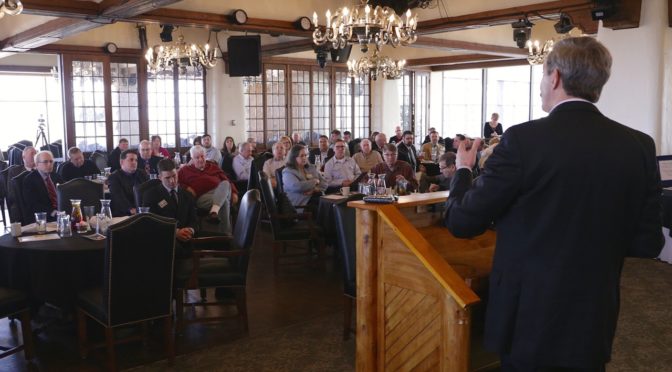
On Friday April 30, Karl Peterjohn will address members and guests of the Wichita Pachyderm Club. Peterjohn is the chair of the Sedgwick County Commission. His topic will be “A view from the county commission.”

Read the full article →

Kansas legislative ratings posted

April 23, 2010

I’ve come into possession of some of the Kansas legislature vote ratings that Karl Peterjohn of the Kansas Taxpayers Network produced. I’ve made available the annual ratings of both the House of Representatives and the Senate back to 1996.

Read the full article →

Kansas legislative scorecards and rankings

April 23, 2010

Kansans need to know the true voting record of members of the legislature. Legislative scorecards or ratings can be a valuable resource for learning about the actions and record of legislators. These ratings are valuable because they record what a legislator actually does. Sometimes that’s different from what legislators say they do. Producing a meaningful [...]

Read the full article →

Karl Peterjohn elected Chairman of Sedgwick County Commission

January 14, 2010

Yesterday members of the Sedgwick County Commission unanimously elected Karl Peterjohn to be their chairman.

Read the full article →

Kansas legislative scorecards, rankings

January 9, 2010

As the 2010 Kansas Legislature prepares to convene, Kansans need to know the true voting record of members of the legislature. Legislative scorecards or ratings can be a valuable resource for leaning about the actions and record of legislators.

Read the full article →

Intrust Bank Arena’s missing name

January 7, 2010

On the commemorative plaque outside the Intrust Bank Arena, in downtown Wichita, there’s a missing name.

Read the full article →

Peterjohn’s Kansas taxpayer protection platform recognized

December 13, 2009

I was pleased to learn of the Sedgwick County Commission’s new legislative platform regarding property taxes. It reads, “All local sales tax increases must be approved by voters under Kansas law. All property tax increases that raise the mill levy should also be required to receive voter approval.”

Read the full article →

Peterjohn presses taxpayer protection platform through Sedgwick County Commission

December 9, 2009

At today’s meeting of the Sedgwick County Commission, commissioners revised the county’s 2010 legislative platform, adding important and groundbreaking taxpayer protection to the platform. The split vote lets voters know without a doubt where commissioners stand on taxpayer protection issues.

Read the full article →

Betty Arnold’s Sedgwick County Commission race: running uphill

September 27, 2009

Last week Betty Arnold, a member of the board of USD 259, the Wichita public school district declared her intent to be a candidate for the Sedgwick County Commission. She’ll be running for the spot currently held by Dave Unruh, who has already filed for re-election.

Read the full article →

More local government 101 in Wichita

September 6, 2009

Here’s a message from John Todd about additional training provided by Americans For Prosperity.

Read the full article →

Wichita Eagle reporting, headlining discussed by commissioners

August 26, 2009

In today’s meeting of the Sedgwick County Commission, Wichita Eagle reporting and editorializing was the subject of an off-agenda item.

Commissioner Gwen Welshimer used this opportunity to read into the record part of a press release she issued yesterday. The entire press release is at the end of this article.

Read the full article →

Wichita downtown arena parking problem

August 8, 2009

The Wichita Eagle editorial written by Rhonda Holman on June 29, 2009 now claims that the new Intrust Arena in downtown Wichita lacks adequate parking. This is a major change by the Eagle editorial board’s position. I have repeatedly asked county staff about the available parking in and around this soon-to-open facility since I became a commissioner in January. I have been repeatedly told by county staff that adequate parking will be available when the Intrust Arena opens next year. The most recent public assurance I have received was only a few days ago.

Read the full article →

Wichita Child Advocacy Center still in business, despite headline

August 8, 2009

A headline in the Thursday August 6, 2009 Wichita Eagle is a little bit misleading: “Sedgwick County budget saves pavilions, denies site for abused kids.”

Recognizing that the reporter who wrote the story probably didn’t write the headline, the fact is that the Sedgwick County Commission didn’t deny a site for the Child Advocacy Center. This Center is still operating. What happened at the meeting is that the county commission declined to grant a last-minute request for funding that would improve the Center’s office quarters.

Read the full article →

Sedgwick County Manager Bill Buchanan should be dismissed

July 22, 2009

Last year a political science professor, a keen observer of Kansas politics, told me that city or county managers shouldn’t be in office more than four or five years. After that, he said, they gain too much power. They know too much: all the secrets, where the bodies are buried. Think of J. Edgar Hoover and his reign, which is what it was.

If managers are to serve their councils or commissions — instead of the other way around — sometimes a change needs to be made, just for the sake of change.

Read the full article →

Sedgwick County solid waste fee criticized

June 19, 2009

Today’s by Rhonda Holman is a two-fer. Two issues for the price of one column, and two issues she’s wrong on.

She criticizes Commissioner Karl Peterjohn and Board Chairman Kelly Parks for the opposition of a solid waste management fee that would add a relatively small amount to property tax bills.

Read the full article →

Lack of information clouds Sedgwick County industrial park plans

May 21, 2009

At yesterday’s meeting of the Board of Sedgwick County Commissioners, questions about a proposed industrial park development reveal that there’s still a long way to go before all issues are uncovered, much less understood.

At the meeting, Chris Chronis, Chief Financial Officer for Sedgwick County, presented information and responded to questions. While Mr. Chronis was thorough in some areas, even some basic information and understanding is missing.

Read the full article →

Here’s what the Wichita Chamber of Commerce could do

May 14, 2009

Today’s Wichita Eagle has a story wondering if economic conditions have affected local chambers of commerce. (Has economy affected area chambers?)

The context of this, besides the current economic conditions, is the shift of the local chamber of commerce away from promoting free markets, limited government, and capitalism.

Read the full article →

On the wall of Karl Peterjohn’s office

March 25, 2009

Earlier this week I stopped by the Sedgwick County Courthouse to visit with newly-elected commissioner Karl Peterjohn. Next month I’ll have a feature about Peterjohn’s first few months in office. Until then, here’s a photograph I took of a cartoon that hangs on the wall of his office (click to view a larger version):

Read the full article →