Wichita and Kansas schools

School

A new video from Kansas Policy Institute highlights the fact that Kansas schools have low standards. Additionally, the standards have been changed so that it appears students are doing better.

For its trouble, KPI will likely be criticized by the Kansas public school education bureaucracy and newspaper editorial writers. They will accuse KPI of branding Kansas students and teachers as failures.

But it’s not the students and teachers who set the standards. It’s the Kansas public school education bureaucracy that does that. Their constituencies — Democrats, moderate Republicans, superintendents, the teachers unions — will defend these bureaucrats.

Or is it those who look to find the truth, and advocate for the necessary reforms?

{ 0 comments }

Kansas school choice defeated

by Bob Weeks on March 26, 2013

The Kansas House of Representatives has failed, both in committee and on the floor, to pass legislation enabling tax credit scholarships for low-income and special needs students. This marks a low point in the legislative session, and it appears that Kansas schoolchildren will need to wait another year to have the same freedom and opportunity that children in many states enjoy.

Listening to the debate was an experience in frustration at the arguments of defenders of the status quo and the inability of reformers to counter. An example is Representative Jim Ward of Wichita. In his remarks, Ward started by saying he had to “categorically reject” the arguments that schools are not meeting the needs of students, and that we are not educating world-class students. He mentioned several examples, adding that our public schools are doing an excellent job.

Rep. Ward’s anecdotal evidence aside, the broader picture of Kansas schools is not as glowing. Many in Kansas say that our schools are much better than Texas schools. They cite National Assessment of Educational Progress (NAEP) test scores. When reporting scores for all students, Kansas has the highest scores, except for one tie. But when we look at subgroups, all the sudden the picture is different: Texas has the best scores in all cases, except for two ties. Similar patterns exist for previous years. See Kansas school test scores, in perspective for tables.

kansas-texas-naep-test-scores-2011

Kansas students, considering the entire state, score better than Texas students, that is true. It is also true that Texas white students score better than Kansas white students, Texas black students score better than Kansas black students, and Texas Hispanic students score better than or tie Kansas Hispanic students. The same pattern holds true for other ethnic subgroups.

Comparing Kansas to the nation: Kansas does better than the national average in all cases. But if we look at the data separated by racial/ethnic subgroups, something different becomes apparent: Kansas lags behind the national average in some of these areas. See Kansas school supporters should look more closely for tables.

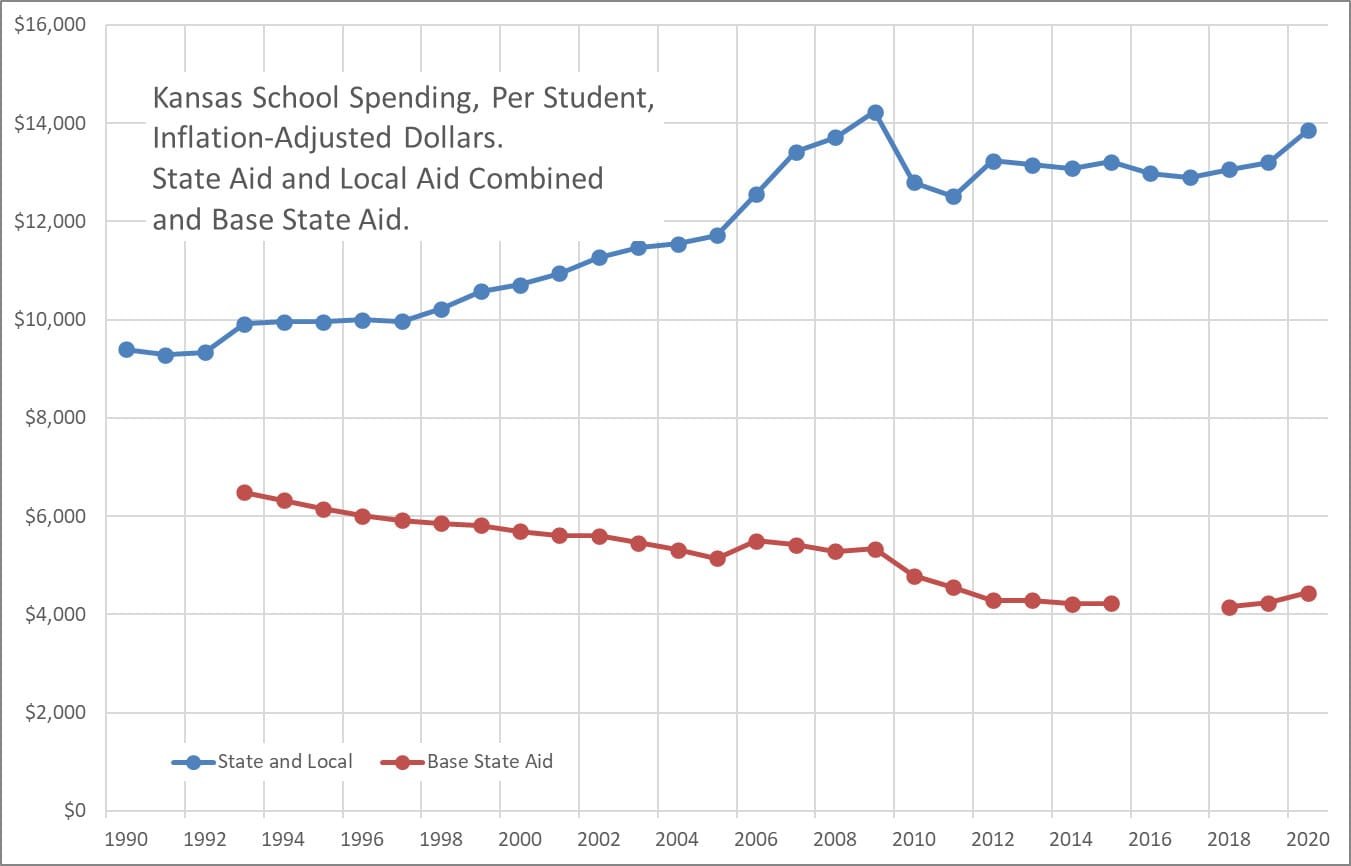
Ward then claimed that Kansas schools are “operating on a per-pupil funding from 1992.” I don’t have figures going back that far, but as can be seen in the following chart, school spending has been rising over the long haul, even when allowing for inflation.

Kansas school spending per student, adjusted for CPI

While Rep. Ward spun a tale of a handful of very expensive special education students, he — like other public school spending advocates — wants you to ignore the entirety of school spending and just focus on a small part of that spending.

Ward then turned to the purported lack of accountability and oversight of the schools that might receive tax credit scholarship money. He praised how the state holds Kansas public schools accountable.

The reality, however, is different. First, Kansas has low standards, compared to other states.

Further, Kansas standards have declined over the years. Last year Kansas Commissioner of Education Diane DeBacker wrote that she is proud of student achievement in Kansas: “Since 2001, the percentage of students statewide who perform in the top three levels on state reading assessments has jumped from about 60 percent to more than 87 percent. In math, the jump has been from just more than 54 percent to nearly 85 percent.”

This rise in performance, however, is only on tests that the Kansas education establishment controls. On every measure of student performance that is independent, this rising trend in student achievement does not appear. In some measures, for some recent years, the performance of Kansas students has declined.

How can it be that one series of tests scores are rising, but not others? Kansas school administrators don’t have a good answer for this. But there is a good reason: The Kansas test scores are subject to manipulation for political reasons.

In 2006 Kansas implemented new tests, and the state specifically warns that comparisons with previous years — like 2001 — are not valid. A KSDE document titled Kansas Assessments in Reading and Mathematics 2006 Technical Manual states so explicitly: “As the baseline year of the new round of assessments, the Spring 2006 administration incorporated important changes from prior KAMM assessments administered in the 2000 — 2005 testing cycle. Curriculum standards and targets for the assessments were changed, test specifications revised, and assessed grade levels expanded to include students in grades 3-8 and one grade level in high school. In effect, no comparison to past student, building, district, or state performance should be made.” (emphasis added.)

Despite this warning, DeBacker and Kansas school superintendents make an invalid statistical comparison. This is not an innocent mistake.

On other tests, only 28 percent of Kansas students are ready for college-level work in all four subjects the ACT test covers. While this result was slightly better than the national average, it means that nearly three-fourths of Kansas high school graduates need to take one or more remedial college courses.

Is this the accountability that Kansans like Rep. Ward are promoting? Compared to the accountability that parents can exercise when they have a credible threat of sending their child to a different school?

Kansas now faces the danger of falling behind other states in school reform measures such as charter schools, schools choice, teacher tenure reform, and collective bargaining reform. Somehow, other states are able to implement reforms that we in Kansas will not.

{ 2 comments }

Once again we see the Kansas public school establishment dodging the facts about Kansas school spending. An example from yesterday was provided by Kansas House of Representatives Minority Leader Paul Davis on his Facebook page. Here’s what he posted:

Paul Davis Facebook Posting

Rep. Davis, it’s not the governor that makes claims regarding the level of school spending in Kansas. The Kansas State Department of Education compiles and reports spending numbers. For those who can’t navigate the KSDE website to find spending numbers, I’ve provided them here, and also at the end of this article.

From this table we can see that after peaking in fiscal year 2009, state aid to schools fell in 2010. Since then it has risen each year, in both total dollars spent and dollars spent per pupil. (By the way, who was governor when state aid to schools fell?)

Rep. Davis may be referring to base state aid per pupil when making his argument. That number has fallen. But as you can see, total State of Kansas spending on schools has been rising after falling under a previous governor’s administration. Readers should also note that as Kansas state aid to schools fell, federal aid rose, almost making up the difference.

I would also remind the minority leader that tax cuts do not have a cost that needs to be paid for. It is government that has a cost. Reducing taxes lets people keep more of what is rightfully theirs, and that is always good.

Paul Davis Facebook Posting

Then: A reader left a comment wondering whether the school spending figures included mandatory KPERS payments. These are payments to the Kansas Public Employees Retirement System. These payments are part of the cost of having employees, as long as schools want to provide a retirement plan to their employees. Rep. Davis’ response is correct. The state sends funds to school districts, which the districts then send to KPERS. These funds, then, are included in total school spending figures.

Which is how it should be. How should the comment “it definitely doesn’t all go to classrooms” and Davis’ response be interpreted? The education spending establishment would like us to ignore that spending. But it’s money that’s spent. It’s part of the expense of having teachers. So does it go to the classroom? You be the judge.

{ 1 comment }

Teachers union members to be proud of

by Bob Weeks on March 4, 2013

Critics of public schools usually explain that they’re not faulting individual teachers. Instead, they target their criticism at the teachers union, bureaucratic school administration, or “the system” in general.

So when we observe the actions of teachers, we’re correct to wonder if they’re acting as citizens, or as teachers representing their school districts, or as union members, or in some other role. This issue is important when we take notice of the actions of teachers at a recent meeting of the South-Central Kansas Legislative Delegation in Wichita.

Here’s a message tweeted during that meeting from Judy Loganbill, a Wichita school teacher and until this year, a member of the Kansas House of Representatives:

This salty language inspired by political conflict: Is that Judy Loganbill citizen, teacher of young children, or union member speaking?

This glee spilled over to Facebook:

Wichita teachers on Facebook

Randy Mousley is president of United Teachers of Wichita, the Wichita teachers union. Parents of Wichita schoolchildren might be interested in knowing which role he’s assuming when taking credit for his invention: Citizen, union leader, teacher, or something else?

{ 8 comments }

Wichita has school choice, they say

by Bob Weeks on March 4, 2013

Wichita public schools apple logo

Writing in the Sunday Wichita Eagle, USD 259 (Wichita public school district) superintendent John Allison told Wichitans something they probably didn’t know: Parents of Wichita schoolchildren benefit from the district’s school choice program:

First, investment in the Wichita public schools allows for remarkable parental choice. Much has been discussed recently about the choice we must give families in order to meet the needs of their children. In Wichita, we are proud that for more than 20 years, families have been offered choice through our district’s magnet school program.

Nearly 30 percent of our schools have a unique magnet focus, enabling students from across our community to consider robust options ranging from science to art, public service to environmental stewardship. Thousands of parents make the decision every year to become part of this rich magnet school tradition, which has helped the Wichita public schools remain a vibrant and diverse school district that has grown by more than 1,500 students in the last 10 years.

I don’t see how Allison believes that magnet schools are equivalent to “remarkable parental choice.” Generally, school choice refers to actual choice programs where parents might choose the regular public school, or perhaps a charter school, or perhaps a private school with its cost paid fully or partially through vouchers or tax credit scholarships. Sometimes school choice programs allow students to enroll in public schools in neighboring school districts.

Wichita and Kansas have none of these programs. (Actually, Kansas does have charter schools, but the law is so weak that there are very few of these schools.) Wichita’s magnet schools are part of the government school system. This means they benefit from taxpayer funding, which is over $12,500 per student per year.

But it also means that these schools suffer all the pathologies that afflict the public school system. That’s not much of a choice.

{ 2 comments }

Kansas school spending excused

by Bob Weeks on March 3, 2013

Kansas public school teachers and the education bureaucracy want taxpayers to trust them as a reliable source for facts about Kansas schools. But the record doesn’t inspire trust.

At a recent meeting of the South-Central Kansas Legislative Delegation with citizens, teachers jeered when a legislator cited the spending numbers for USD 259, the Wichita public school district. A comment left to a KAKE TV news story claims that spending numbers presented by the legislator are “misrepresented,” because he included every single dollar. In fact, the numbers presented were correct, as explained in In Kansas, don’t mention the level of school spending.

kansas-school-funding-comment-2013-03-02

The writer seems to believe that “bond money” shouldn’t count as school spending. This is a common stance taken by public school spending boosters. They argue that spending on buildings, or perhaps on teacher pension costs, shouldn’t count as money spent educating students.

Part of the reason for this deflection is that when people learn the true level of school spending, they’re usually astonished at how much is spent. So the school spending lobby has to explain — rather, make excuses for — the high level of spending. Recently Kansas Association of School Boards (KASB) recommended Kansans ignore employee pension costs and the costs of buildings and equipment. Here’s how KASB explained this as part of a document titled Questions about recent Kansas Policy Institute survey:

Finally, districts received $690 per pupil in KPERS contributions for district employees, and districts spent $2,320 for capital costs such as buildings and equipment, payments on construction bonds for new schools, and other local revenues like student fees. None of these funds — almost 25 percent of total revenues — can be spent for regular education operating costs.

(See Ignore this Kansas school spending, please.)

Should teacher pension costs and the cost of buildings and equipment be included in school spending? Of course — unless you’re arguing for more school spending.

The comment writer also claimed that lawmakers have “cut education funding consistently.” As shown on the nearby chart, it’s true that spending on Kansas schools, on a per-pupil basis, fell slightly for two years running. It then rose a small amount last year. Spending from all sources, individually and collectively, is much higher than ten years ago. I don’t see how you can make an argument for consistent cutting — unless you decide to ignore parts of spending.

Kansas school spending per student, adjusted for CPI

{ 0 comments }

At a meeting of the South-Central Kansas Legislative Delegation today, it was apparent that facts are either not known — or not important — to public school spending advocates.

The audience for today’s meeting was, apparently, heavily stocked with teachers who were eager to voice approval or displeasure with statements made by either the public speakers or the legislators. At one time the teachers drew a reprimand from Representative Nile Dillmore.

Here’s what Kansas should learn from this meeting — something important that affects actual public policy: We can’t have an honest discussion of school finance unless we recognize and agree on some facts such as the current level of spending. The teachers in today’s audience either don’t know the facts, or don’t want to talk about them.

Teachers react to school spending.

In the nearby audio clip, Representative Gene Suellentrop told the audience the spending figures for USD 259, the Wichita public school district. According to figures available from the Kansas State Department of Education, he was correct to the dollar. The audience reacted with jeers.

So we’re left wondering this: Do Kansas schoolteachers know the correct level of school spending? Or do they know, but don’t believe it? Or do they know, but don’t want to talk about it?

This is particularly troubling for Kansas, as the public school bureaucracy insists on more school spending. But talking about actual school spending is somehow uncouth and deserves to be shouted down.

Newspaper editorial boards aren’t helping Kansans learn about school spending and student achievement. Surveys find that like the general public across the nation, Kansans are uninformed on school spending.

This is the uncomfortable condition of public discourse in Kansas. We are lacking in knowledge and facts. Even worse, we’ve taken something that ought to be noncontroversial (the education of children) and turned it into a shouting match. This is what we get by turning over important things to politics.

{ 3 comments }

Kansas school supporters should look more closely

by Bob Weeks on February 26, 2013

Those such as Kansas House of Representatives Minority Leader Paul Davis who uncritically tout Kansas schools as among the best in the nation are harming both students and taxpayers when they fail to recognize why Kansas performs well compared to other states.

Paul Davis Facebook Post, February 22, 2013

Davis recently posted on his Facebook page a quote from Geary County schools superintendent Ronald Walker: “Kansas has always performed academically in the top 10 of all states. As bills are introduced in the current Legislature without the input of educators, the state is in jeopardy of losing ground.”

Kansas does perform well compared to other states on the National Assessment of Educational Progress (NAEP), known as “The Nation’s Report Card.” Nearby is a table showing scale scores for Kansas and National Public schools for math and reading in grades four and eight. Looking at the top row, which reports scores for all students, it is the case that Kansas does better than the national average in all cases.

But if we look at the data separated by racial/ethnic subgroups, something different becomes apparent: Kansas lags behind the national average in some of these areas.

Why is there this apparent discrepancy? In general, white students perform better than black and Hispanic students. Kansas has a much higher proportion of white students than the nation. In Kansas, about 69 percent of students are white, compared to 53 percent for the entire nation.

This difference in demographic composition hides the fact that, for example, fourth grade black students in Kansas underperform the national average for black students in reading.

Some may say that it’s racist to talk about student achievement in this way. But I would ask this: Is it better to gloss over these facts, or to recognize and confront them? These details are not mere numbers on a spreadsheet. They are children.

Let’s ask Rep. Davis if he’s aware of these statistics.

Kansas and National NAEP Scores, 2011, by Ethnicity and Race

{ 1 comment }

Kansas school spending, for real

by Bob Weeks on February 25, 2013

A new organization with the motto “Responsible Policy. Real Prosperity.” is producing reports that are true on the surface, but fail to present the total picture.

In a report titled “Kansas Schools Struggle With Recent Budget Cuts,” Kansas Center for Economic Growth explains that Kansas schools are funded through three sources: State, federal, and local. So far, so good.

kansas-schools-face-major-challenges

But the report later makes this claim: “Kansas has cut state education spending, the largest source of funding for local school districts, by $745 per student, or more than 13 percent, since the start of the recession, after adjusting for inflation.”

It’s true that state education spending — that portion of total school funding provided by the State of Kansas — has fallen. The figure given is roughly correct.

But total school spending per student is different. It has fallen too, but by much less. That’s because at the same time state spending was falling, local spending remained steady, and federal spending rose.

So overall school spending per student, adjusted for inflation, fell for two years. It rose a small amount last year. Spending from all sources, individually and collectively, is much higher than ten years ago. Remember, the figures in the chart are adjusted for inflation.

After explaining that Kansas schools are funded from three sources, the report makes its concluding argument based on just one of these three sources. It ignores the other 45 percent of school funding. If these other sources of funding are included, Kansas Center for Economic Growth’s argument suddenly becomes much less compelling — but Kansans would at least know all the facts.

Kansas school spending per student, adjusted for CPI

{ 0 comments }

Common core standards: Can a state escape?

February 18, 2013

Robert Scott, former Texas Education Commissioner, told a Kansas panel about the experience of Texas when it resisted adopting the Common Core Standards.

Read the full article →

In Kansas, arguing about the wrong school issues

February 18, 2013

In Kansas, we argue about school spending issues rather than relying on natural market forces.

Read the full article →

Kansas and Texas schools and low-income students

February 17, 2013

If you were the parent of a low-income student, or a student who is a member of an ethnic minority group, in which state would you rather have your child attend school: Kansas or Texas?

Read the full article →

Suitable education in Kansas

February 13, 2013

The Senate Judiciary Committee heard testimony from those supporting an amendment to the Kansas Constitution regarding school finance.

Read the full article →

Do not criticize the Wichita school board. It’s disrespectful.

February 13, 2013

After directing a uniformed security guard to station himself near a citizen speaker, Wichita school board president Betty Arnold told the audience: “If we need to clear the room, we will clear the room. This board meeting is being held in public, but it is not for the public, or of the public.”

Read the full article →

Wichita school board candidates on spending

February 11, 2013

At a forum for candidates for the board of USD 259, the Wichita public school district, several candidates showed they were not informed on the level of school spending.

Read the full article →

Kansans’ views on role of government

January 31, 2013

Kansas Policy Institute has released the results of a public opinion poll asking Kansans for their views on some issues that are currently in the news.

Read the full article →

It’s not the teachers, it’s the union

January 30, 2013

Can there be a point where demagoguery has been spread so deep and thick that no one believes it? KNEA, the Kansas teachers union, is about to find out.

Read the full article →

Kansas teachers union: No competition for us

January 29, 2013

Kansas National Education Association (KNEA), our state’s teachers union, is an effective force that denies Kansas parents the choice as to where to send their children to school. The union also works hard to deny teachers choice in representation.

Read the full article →

Public employee unions should be a non-partisan issue

January 28, 2013

Everyone would be better off without public employee unions.

Read the full article →

Kansas teachers union rallies members

January 28, 2013

KNEA attempts to persuade its members, but the arguments are all wrong.

Read the full article →

Teacher quality report issued; Kansas needs improvement

January 24, 2013

National Council on Teacher Quality has released its new edition of its State Teacher Policy Yearbook. Kansas doesn’t do well.

Read the full article →

Kansas school efficiency task force report

January 22, 2013

The Kansas Governor’s school efficiency task force has released its recommendations.

Read the full article →

Kansas parents lack power

January 20, 2013

Compared to other states, parents in Kansas have little power to exercise control over school decisions, according to the Center for Education Reform.

Read the full article →

Kansas and Texas schools, according to Kansas Democrats

January 20, 2013

Kansas Democrats tweet about Kansas schools being better than Texas schools. Let’s look closely at their claim.

Read the full article →

Winners and losers in Kansas school finance lawsuit

January 14, 2013

There are winners and losers now that the decision has been made in the Kansas school finance lawsuit. But no group lost more than Kansas schoolchildren.

Read the full article →

Reaction to Kansas school lawsuit decision

January 14, 2013

Following are several reactions to the decision in Gannon vs. Kansas, the school funding lawsuit. The court ruled the state must spend more on schools.

Read the full article →

Kansas school test scores, in perspective

January 10, 2013

We hear a lot about how Kansas shouldn’t strive to become more like Texas, especially regarding schools. But how do schools in these states compare?

Read the full article →

Ignore this Kansas school spending, please

November 27, 2012

The response to a survey regarding Kansas school spending is useful for two reasons: It lets us gauge the level of knowledge of the public, and it also tells us the extent to which school spending advocates will go to justify and excuse spending.

Read the full article →

Citizens generally misinformed on Kansas school spending

October 31, 2012

When asked about the level of spending on public schools in Kansas, citizens are generally uninformed or misinformed. They also incorrectly thought that spending has declined in recent years.

Read the full article →

Electing Kansas legislators: Education issues

October 31, 2012

Before Kansas voters can decide who should represent them in the state Legislature, we must have accurate information. This is especially important when it comes to which candidates will make responsible decisions about how to improve our schools, writes Dr. Walt Chappell.

Read the full article →

Kansas Democrats wrong on school spending

October 28, 2012

While the Kansas Democratic Party apologized last week for misstating candidates’ voting record on two mail pieces, the party and its candidates continue a campaign of misinformation regarding spending on Kansas public schools.

Read the full article →

More Kansas spending data online

October 28, 2012

Kansas Policy Institute has added more data to KansasOpenGov, its government transparency portal.

Read the full article →

Looking for Kansas school efficiency, sort of

October 23, 2012

Dueling online Kansas school spending feedback forms reveal a problem inherent in Kansas schools.

Read the full article →

Wichita school employment ratios, by the numbers

October 21, 2012

Claims that reduced school funding have harmed Kansas schools — especially school employment — are overblown, if we care to look at actual numbers.

Read the full article →

Role of government in Kansas schools deflects attention from solutions

October 18, 2012

Focus on two Kansas school efficiency panels, school spending, and the surrounding politics is deflecting attention away from what Kansas schoolchildren and parents really need: Choice.

Read the full article →

Charges of slashing Kansas school spending

October 17, 2012

In their campaigns, Kansas Democrats are charging that school spending has been slashed.

Read the full article →

Another Kansas school efficiency task force

October 10, 2012

One might think that the mission of the Kansas Association of School Boards is to help school districts maximize the educational impact of spending. Judging by a task force formed by KASB, this may not have been the case.

Read the full article →

Kansas school efficiency task force

October 8, 2012

A Kansas school efficiency task force is criticized for lack of educators in its membership.

Read the full article →

Regarding Kansas schools, power is not with parents

October 7, 2012

Information and options allow parents to make the best decisions for their children regarding schools. But in Kansas, parents have little power to make good decisions for their children, relative to the other states.

Read the full article →

Kansas school test scores haven’t declined, despite early reports

October 1, 2012

Kansas state test scores didn’t fall in 2012, contrary to first reports. Let’s hope Kansas National Education association, our state’s teachers union, takes notice.

Read the full article →

Kansas school test scores should make us think

September 24, 2012

Kansas public school test scores have declined. This should cause us to ask two questions: why have the scores been rising, and does Kansas do as well as is claimed?

Read the full article →