Visualizations

Entrepreneurship, Entrepreneur

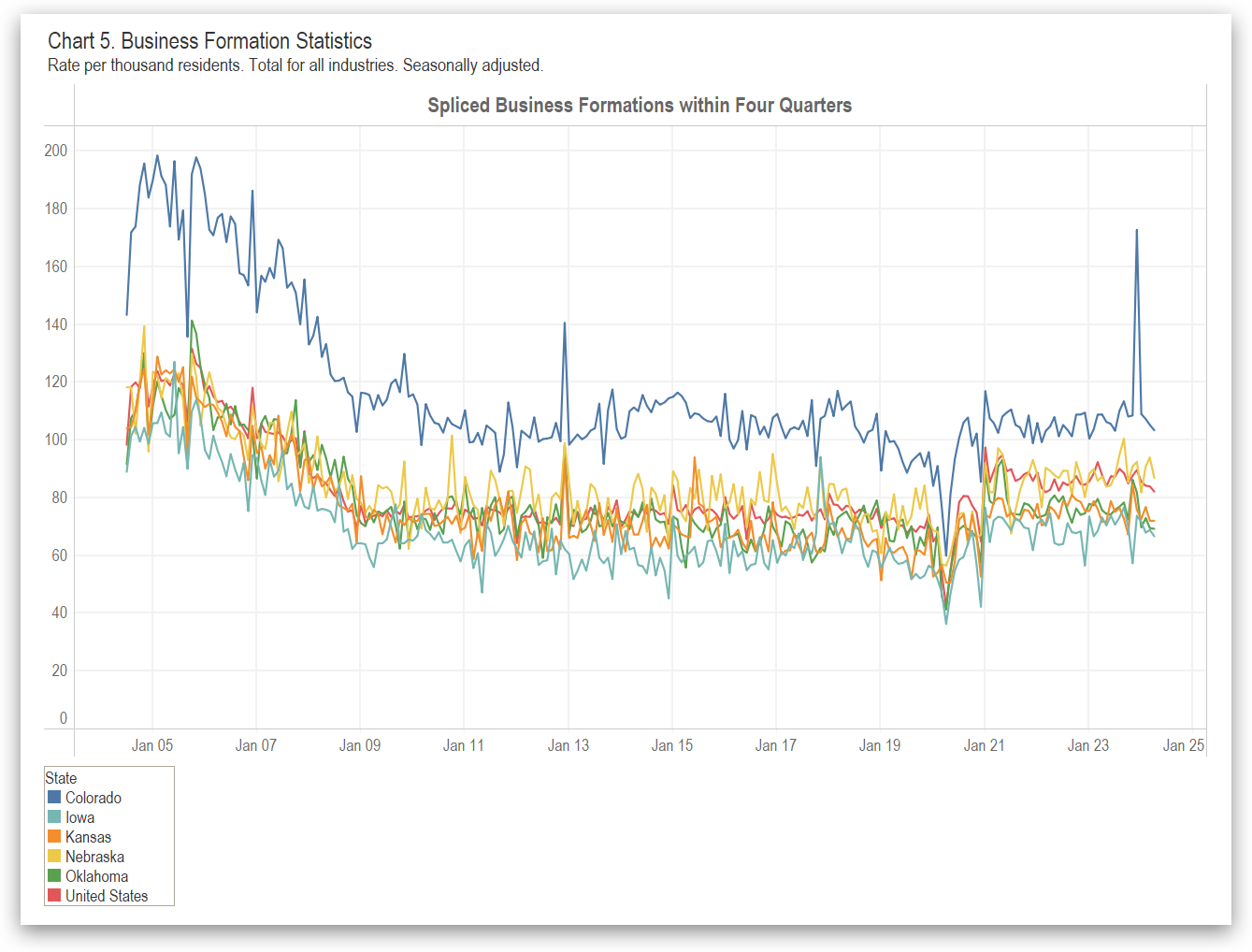
Entrepreneurship is important for a growing and dynamic economy. The performance of Kansas in entrepreneurial activity is not high, compared to other states.

The Ewing Marion Kauffman Foundation prepares the Kauffman Index of Entrepreneurial Activity. According to the Foundation, “The Kauffman Index of Entrepreneurial Activity improves over other possible measures of entrepreneurship because of its timeliness, dynamic nature, inclusion of all types of business activity, exclusion of ‘casual’ businesses, and information on owner demographics.”

The following interactive visualization presents KIEA data. You may use the visualization below, or click here to open it in a new window, which may work better, as this is a large visualization. Use Ctrl+Click to add or remove states for comparison. Data is from Kauffman Index of Entrepreneurial Activity. Visualization created by myself using Tableau Public.

{ 0 comments }

Kansas government spending, a visualization

by Bob Weeks on April 27, 2013

Here is an interactive visualization of Kansas state government spending. Data is presented for both the general fund and total spending, and also in actual dollars and constant dollars, adjusted for inflation. Data is also presented as total spending, and as per person spending.

You may use the visualization below, or click here to open it in a new window, which may work better for some people. Data is from Kansas Fiscal Facts adjusted with data from U.S. Bureau of Labor Statistics; visualization created by myself using Tableau Public.

{ 0 comments }

Personal income growth in the states

by Bob Weeks on March 31, 2013

As Kansas debates whether to move forward with a new vision, especially in tax policy, we should examine how we have fared under the policies of recent decades.

The visualization below starts in 1994, the year Bill Graves was elected governor. That started a 16 year period of governance by moderate Republicans and Democrats, a period now promoted as a golden area of common sense government that has led to prosperity in Kansas.

But in the visualization below, where does Kansas rank in relation to some of our surrounding states? The answer is: Not well.

To see how your state compares with others in personal income growth, use the interactive visualization below. Click the check boxes to add or remove states. Use the slider to adjust the range of years. Click on state names in the legend below the chart to highlight one or more states’ data (Ctrl+click highlights more than one state.)

You may use the visualization below, or click here to open it in a new window, which may work better for some people. Data is from U.S. Bureau of Economic Analysis (BEA); visualization created by myself using Tableau Public.

{ 0 comments }

Taxes flowing to the capitol

In the current policy debate in Kansas, we often compare our state with Texas. The prevailing themes sounded by Democrats and other spenders include that because Texas has no income tax, its other taxes (sales and property) are higher. We also hear that Texas is “atop a sea of oil” from which the state collects a gusher of tax revenue.

But what are the facts? Regarding taxation: In 2011 Kansas state government collected $2,378 in taxes for each person. Texas collected $1,682. We see that Texas collects far less tax per person than does Kansas. Texas may have higher sales or property taxes than Kansas, but the total tax burden in Texas is lower.

Spending follows the same pattern. In 2011 Kansas state government spent $5,115 per person in total, with $1,974 in general fund spending and $130 in bond spending. For Texas the total was $3,718 spent per person in total, with $1,654 in general fund spending and $50 in bond spending.

The lower level of spending means Texas has a less burdensome state government, which allows more money to remain in the productive private sector. In Kansas, we spend more on government.

The “sea of oil” and bountiful severance tax revenue: In 2011 Kansas, which has a severance tax of its own, collected $42.54 in this form of tax for each person. How much did Texas collect from its severance tax? $104.29 per person. The difference between the two — $61.75 per person per year — is only a small portion of the difference between Kansas and Texas taxation.

To see how your state compares with others in spending, use the interactive visualization below. To use the visualization, click the check boxes to add or remove states and years from the chart. Use the visualization below, or click here to open it in a new window. Data is from National Association of State Budget Officers and U.S. Bureau of Economic Analysis (BEA); visualization created by myself using Tableau Public.


(alternate link to the above table)


(alternate link to the above table)

{ 4 comments }

Wichita economic growth, compared

by Bob Weeks on February 27, 2013

Greater Wichita Economic Development Coalition

How does economic growth in Wichita compare to the state and nation? Use the interactive visualization below, or click here to view in a window by itself.

This interactive visualization presents the GDP (gross domestic product) produced by the private sector and the government sector, for three different geographies. I use the Wichita metropolitan statistical area, as that data available is from the Bureau of Economic Statistics. I present the data indexed with 2001 values set to 100. This lets us see the relative growth for each data series. Some data is available through 2011, but some only through 2010.

Here are some things you can notice by using the checkboxes to turn on and off various data series, or by clicking on the color legends to highlight a series:

For the Wichita MSA, government has grown more rapidly than the private sector.

The Wichita MSA private sector has grown more slowly then both the Kansas and U.S. private sectors.

The Wichita MSA government sector has grown faster than both the Kansas and US government sectors.

Would you say that the economic development efforts of Wichita and Sedgwick County have been successful?

{ 0 comments }

Job growth in the states

by Bob Weeks on February 26, 2013

How does your state compare to others in job growth? Is your state growing private sector or government jobs fastest? The interactive visualization below can help you explore this data.

To use the visualization, click the check boxes to add or remove states from the charts. Click on a single job type to display, and select a range of years. Use the visualization below, or click here to open it in a new window. Data is from U.S. Bureau of Economic Analysis (BEA); visualization created by myself using Tableau Public.

{ 1 comment }

State and local government employees, a visualization

by Bob Weeks on February 23, 2013

How does your state compare to others in the number of state and local government employees, and the payroll costs of these employees?

The following interactive visualization lets you compare any states. Data is presented separately for state government employees and local government employees. The number of employees is presented as full-time equivalent employees per thousand population. Payroll costs are presented as annual payroll costs per capita population.

To use the visualization, click the check boxes to add or remove states from the charts. Click on axis labels to display a sorting menu. Use the visualization below, or click here to open it in a new window. Data is for 2011, obtained from U.S. Census Bureau; visualization created by myself using Tableau Public.

{ 0 comments }

State and local tax burden visualized

by Bob Weeks on January 28, 2013

For two decades the Tax Foundation has estimated the combined state and local tax burden for all the states. I’ve created an interactive visualization that lets you compare states and see trends in rank over time.

In its publication, the Tax Foundation explains:

For each state, we compute this measure of tax burden by totaling the amount of state and local taxes paid by state residents to both their own and other governments and then divide these totals by each state’s total income. We not only make this calculation for the most recent year, but also for earlier years due to the fact that income and tax revenue data are periodically revised by government agencies.

Our goal here is to move the focus from the tax collector to the taxpayer. We aim to find what percentage of state income residents are paying in state and local taxes and whether those taxes are paid to their own state or to others.

The most recent version of the report is located at Annual State-Local Tax Burden Ranking (2010) – New York Citizens Pay the Most, Alaska the Least.

To use the visualization, click on any state from the map. To add states, use Ctrl+click. Use the visualization below, or click here to open it in a new window. Data from Tax Foundation; visualization created using Tableau Public.

{ 0 comments }

Trends in government spending

by Bob Weeks on January 25, 2013

The interactive visualization below may help you appreciate the trend in federal and local government spending. Spending is presented as a percentage of Gross Domestic Product (GDP).

Data from U.S. Office of Management and Budget. Use the visualization below, or click here to open in a new window.

{ 0 comments }

Obama will need more economic growth

January 22, 2013

To pay for the Obama taxing and spending agenda, the country will need much more economic growth. Unfortunately, the rate of growth is slowing just when we need greater rates of growth.

Read the full article →

Growth in Gross Domestic Product by metropolitan area

January 8, 2013

An interactive visualization that illustrates the growth in Gross Domestic Product by metropolitan area.

Read the full article →

Growth in Gross Domestic Product by state

January 8, 2013

An interactive visualization that illustrates the growth in Real Gross Domestic Product by state and region.

Read the full article →

A spending problem, or a revenue problem?

January 7, 2013

Does the United States have a revenue problem or a spending problem? The interactive visualization below may help you decide.

Read the full article →

Size and growth of Kansas economy, by industry

January 5, 2013

An interactive visualization of the composition of the Kansas economy, by industry.

Read the full article →

Labor force participation rate

January 5, 2013

An interactive visualization of participation in the U.S. labor force.

Read the full article →

GDP growth by state and region

December 23, 2012

Here is a visualization that shows the rate of growth of gross domestic product (GDP) by state, regions, and the entire country.

Read the full article →

Wichita, Kansas, and national job growth

December 10, 2012

Wichita, Kansas, and national job growth.

Read the full article →

Wichita economic growth, in comparison

December 8, 2012

How does economic growth in Wichita compare to the state and nation?

Read the full article →