Taxation

Oil painting "Tragic Prelude" (1938-40) by John Steuart Curry (1897-1946)

As the Kansas Legislature prepares to end its 2013 session, budgetary and taxation issues remain to be resolved. It’s important that the legislature resolve these issues in a way that positions Kansas for economic growth, rather than retaining the policies that have led to stagnation compared to other states.

First, let’s stop talking about the need to “pay for tax cuts.” The only way in which tax cuts have a cost is if you believe that your income belongs first to government, and then to you. While that schema is preferred by Kansas Progressives, it’s contrary to freedom and destructive to jobs and prosperity. Kansas will be better off if Kansans are able to control more of their own spending, rather than having government spend it for them.

Second, we must remember that the projected “holes in the budget” or deficits have two moving parts: Income and spending. Any deficit or surplus is produced equally by both factors. A reduction in income to the government produces a deficit only if government chooses to keep spending.

Third, let’s stop talking about “irresponsible tax cuts” and how cutting taxes is an “experiment.” To proceed as Kansas has — that would be irresponsible, as we know that Kansas has been underperforming relative to other states. No experimentation is needed. We know that Kansas has not done well.

Fourth, we need to make sure that everyone is starting from the same set of facts. Here’s one example: While critics of the new Kansas tax policy focus on the elimination of state income taxes on certain forms of business organization, marginal tax rates were lowered for everyone. Additionally, the standard deduction was increased for everyone, meaning that zero tax is paid on a larger share of everyone’s income.

But one tax was raised. Kansas had a program that rebated sales tax paid on food. This was limited to those with modest incomes or over a certain age. It is generally recognized that the sales tax is a regressive tax, meaning that those with low incomes pay a larger share of their income in tax. Reducing this perceived inequity was the goal of the credit program.

In recognition of this, Kansas should eliminate the sales tax on food, especially if we keep the current high sales tax rate. This eliminates the clunky tax credit program and lets everyone save on food taxes every day, not just at tax filing time.

Critics also say that taxes were raised on some low income families. This argument is based on some tax credit programs that were eliminated, such as the tax credit for child and dependent care expenses, and another tax credit for child day care expenses. It’s important to remember that these programs were implemented as a tax credits, and they are properly categorized as welfare spending accomplished through the tax system. If we want to keep this welfare spending, let’s do it some other way. Spending through the tax system complicates the understanding of government finances.

What Kansas should do

Here’s what the Kansas Legislature needs to do: Keep the current sales tax rate, eliminate sales tax on food, and reduce individual income and corporate income tax rates. Reduce the income tax rates by an amount that would be revenue-neutral, so that state spending does not grow. This moves us towards more of a “Fair Tax” model, which many economists agree is better than taxing income. Elimination of the sales tax on food removes much of the regressivity of the sales tax.

To the extent that the legislature believes it needs other funds, take it from transportation funding. We’ve spent a lot on roads and highways in recent years. It’s enough for now.

Another important thing the legislature needs to do is get serious about reducing government spending. Kansas lost an important chance to save money — although a relatively small amount — when school choice programs failed to pass. These programs, across the country, save state and local governments money. Unfortunately, Kansas legislative leaders did not use this argument.

More ways to save: In 2011 the Kansas Legislature lost three opportunities to save money and improve the operations of state government. Three bills, each with this goal, were passed by the House of Representatives, but each failed to pass through the moderate-controlled Senate, or had its contents stripped and replaced with different legislation.

Each of these bills represented a lost opportunity for state government services to be streamlined, delivered more efficiently, or measured and managed. These goals, while always important, are now essential for the success of Kansas government and the state’s economy.

One bill was called the Kansas Streamlining Government Act, another would have created the Kansas Advisory Council on Privatization and Public-Private Partnerships, and another would have created performance measures for state agencies and report that information to the public. More information on these bills is at Kansas budget solution overlooked.

We have to wonder why these bills — or similar measures — were not introduced and advanced this year when the opposition in the Senate is weaker. These are the types of measures we need to take as a state.

{ 1 comment }

Sales tax increase isn’t necessary

by Guest Author on May 8, 2013

By Dave Trabert, Kansas Policy Institute.

Tax

What a difference a year makes. Last May, Governor Brownback signed historic tax reform legislation that would reduce state income taxes by roughly $800 million in its first full year. As the legislature returns this week, the debate is about how much of the last year’s tax reform will be wiped out. Instead of reducing the cost of government to implement tax reform this year, Governor Brownback and the Senate want to make the 6.3 percent sales tax permanent and eliminate the income tax deduction for home mortgage interest; they also propose 0.5 percent reduction in the income tax on the first $15,000 of taxable income in 2014 and a reduction in all marginal rates beginning in 2017 (after a billion dollar increase in sales taxes) with revenue growth above 4 percent being used to reduce rates thereafter and eventually eliminate income taxes.

The House plan isn’t perfect but it’s better. It allows the sales tax rate to drop to 5.7 percent as promised, proportionally reduces income tax deductions, has more spending reductions and a formula that gradually eliminates the income tax altogether, using annual revenue growth above 2 percent to buy down rates.

The goal of tax reform is to reduce the overall tax burden, not shift it. Consumption taxes are better than income taxes, but taxes will still be too high (and economic growth impaired) until we deal with the real problem of excess spending. But even some self-identified fiscal conservatives don’t want to reduce spending.

Part of their resistance is that many people equate spending less with service cuts, but that doesn’t have to be the case. Per-resident spending varies greatly across all fifty states. Yet, every state has schools, highways, social programs, etc.; some simply do so more efficiently. States with an income tax spend 44 percent more per-resident than those without an income tax. States that spend less, tax less (and grow more). Done well, states can spend less and actually deliver the same or better services.

In fact, Kansas would have spent $2.9 billion less last year if spending were at the same level as the average state without an income tax.

Our “Legislator’s Guide to Delivering Better Service at a Better Price” shows legislators how to use existing cash reserves to ‘buy time’ and implement thoughtful efficiency measures to reduce costs over time. It can be done and it can be done now.

The problem with implementing income tax reductions is one of politics, not economics. As Thomas Sowell says, “The first lesson of economics is scarcity: There is never enough of anything to satisfy all those who want it. The first lesson of politics is to disregard the first lesson of economics.”

Here’s hoping legislators make taxpayer-focused decisions based on sound economics when they return to Topeka this week.

A version of this appeared in the Wichita Eagle.

photo credit: 401(K) 2013 via photopin cc

{ 1 comment }

The first action under a new Wichita economic development policy doesn’t produce economic growth, and in fact, harms the Wichita economy.

Government takes and gives

A feature of Wichita’s recently-revised economic development policy grants property tax and sales tax forgiveness for speculative industrial buildings. These are buildings built without having a tenant in place. The proposed plan had a formula that grants a higher percentage of tax forgiveness as building size increases, but the council eliminated that and voted a 100 percent tax abatement for all buildings larger than 50,000 square feet.

Given tax costs and industrial building rents, this policy gives these incentivized buildings a cost advantage of about 20 percent over competitors. That’s very high, and makes it difficult for existing buildings to compete. Probably no one will build these buildings unless they qualify for and receive this incentive.

The city hopes that these incentivized buildings will generate new jobs in Wichita. But there appears to be nothing in the policy that prevents existing Wichita companies from moving to these buildings. If this happens, it doesn’t create any new jobs. The company that moves will save a lot in property taxes. Some other landlord in Wichita will have empty space, not through his own fault, but because of Wichita city policy.

This is what has happened. The first tenant for the first building built under this incentive policy is a company already in Wichita. It’s simply moving its existing operations within the city. The Wichita Business Journal reports that an existing Wichita company will vacate its current space to move in to the new building. It will use about one-third of the available space. (Big industrial spec building signs first tenant)

(Paying less in property taxes is good, as money remains in the private sector instead of being transferred to government. But city hall doesn’t believe this. Politicians and bureaucrats want to increase the tax base, but here is an example of giving it away.)

Will the owners of speculative buildings rent only to companies newly moving to Wichita, or will they rent to whoever is willing to pay? Will Wichita companies want to move to a new building with cheaper rent? We now have answers to these questions. So far, the city’s new policy has simply moved jobs from one location to another, creating no new jobs. It has harmed landlords with existing buildings.

Existing industrial landlords in Wichita — especially those with available space to rent — must be wondering why they attempt to stay in business when city hall sets up subsidized competitors with new buildings and a large cost advantage.

Citizens must wonder about equality. A principle of taxation is that everyone pays equally, and that policy should be applied uniformly. But this program creates a special class of landlords and tenants who do not have to bear their full share of the cost of city, county, school district, and state government.

Do incentives work?

We must ask ourselves what do we really get for the cost of incentives. Alan Peters and Peter Fisher wrote an academic paper titled The Failures of Economic Development Incentives, published in Journal of the American Planning Association. A few quotes from the study, with emphasis added:

Given the weak effects of incentives on the location choices of businesses at the interstate level, state governments and their local governments in the aggregate probably lose far more revenue, by cutting taxes to firms that would have located in that state anyway than they gain from the few firms induced to change location.

On the three major questions — Do economic development incentives create new jobs? Are those jobs taken by targeted populations in targeted places? Are incentives, at worst, only moderately revenue negative? — traditional economic development incentives do not fare well. It is possible that incentives do induce significant new growth, that the beneficiaries of that growth are mainly those who have greatest difficulty in the labor market, and that both states and local governments benefit fiscally from that growth. But after decades of policy experimentation and literally hundreds of scholarly studies, none of these claims is clearly substantiated. Indeed, as we have argued in this article, there is a good chance that all of these claims are false.

The most fundamental problem is that many public officials appear to believe that they can influence the course of their state or local economies through incentives and subsidies to a degree far beyond anything supported by even the most optimistic evidence. We need to begin by lowering their expectations about their ability to micromanage economic growth and making the case for a more sensible view of the role of government — providing the foundations for growth through sound fiscal practices, quality public infrastructure, and good education systems — and then letting the economy take care of itself.

In 2008 Kansas Legislative Division of Post Audit investigated spending on economic development. It found about the same as did Peters and Fisher.

There is one incentive that can be offered to all firms: Reduce tax costs for all. The Tax Foundation report from last year should be a shrill wake up call to the city and state that we must change our ways.

There is a lesson to be learned: Economic development incentives have a cost. Other businesses (and people) have to pay these costs. That only increases the motivation to seek incentives from the city and state. In fact, it may make it necessary to receive subsidies in order to be competitive with those companies who have incentives.

All this raises the cost of government. It’s a spiral that leads to ever-increasing control of economic activity by city hall. If all this produced results, that would be one thing. But Wichita has been lagging in economic growth for many years. The results of the first project undertaken under a new Wichita economic development policy holds clues as to why Wichita lags behind.

Wichita needs to build a dynamic economy that is based on free enterprise and entrepreneurship rather than government planning and handouts. This is the way we can have organic and sustainable economic development that will increase jobs and prosperity for everyone.

{ 1 comment }

A press release from Americans for Prosperity Foundation — Kansas. This will be an informative event. I’ll be there.

For Immediate Release — May 6, 2013
Contact: Jen Rezac, 785-354-4237

AFPF-Kansas to host policy luncheon on government overreach, high taxation, over spending

Topeka, Kan. — The Kansas chapter of Americans for Prosperity Foundation is pleased to announce that bestselling author and columnist Jonah Goldberg will speak in Topeka this week.

Goldberg, an American Enterprise Institute fellow, will address issues of government overreach, and heavy reliance on government, as well as high taxation and over spending.

“Americans are waking up to the fact that our federal government is encroaching further and further into our daily lives,” said AFPF-Kansas State Director Jeff Glendening. “We’re excited to bring Jonah to Kansas to speak to our AFPF citizen leaders, as well as legislators, about this issue and the effects of high taxation and government over spending on everyday citizens.”

Those attending the AFPF-Kansas luncheon will also have the opportunity to hear from AFP Foundation State Policy Manager Nicole Kaeding on Medicaid expansion, and Wichita’s leading conservative talker, radio host Joseph Ashby.

Friday’s luncheon is open to the public, but registration is required. To attend, please register online at afpfks-jonahgoldberg.eventbrite.com.

For those in Wichita, there is a bus trip available. The bus will leave Wichita at 8:30 am and return at 4:00 pm. More information is available when you register.

{ 0 comments }

In order to increase jobs and prosperity in Kansas, we should seek to reduce state spending as much as possible, thereby leaving more resources in the productive private sector.

Kansas Capitol

In the debate over reducing and eventually eliminating the income tax in Kansas, those who oppose income tax reduction say it will simply shift the burden of taxation to others, in the form of sales and property taxes. This is true only if we decide to keep spending at the same level. We could cut spending in response to reduced revenue, but it is argued that state spending is a good thing, a source of wealth that Kansas should continue to rely on.

The idea that government spending is a generator of wealth and prosperity is true only beyond a certain minimal level of spending. We benefit from government provision of things like national defense, public safety, and a court system. (There are those who believe that even these could be provided by the private sector rather than markets.) But once government grows beyond these minimal core functions, it is virtually certain that markets — that is, free people trading in the private sector — can produce a wider variety of better goods and services at lower cost.

We also have to realize that government spending has a cost that must be paid. Advocates of government spending point to the salary paid to a government worker and how that money gets spent in the economy, producing jobs. These advocates, however, do not recognize the source of the worker’s salary, which is money taken from someone through taxation (or through borrowing and inflation at the federal government level). The loss of that money to government has a cost in the form of the reduced economic activity of those who paid the taxes.

If this loss was economically equivalent to the gain, we might be unconcerned. But there is a huge cost in taxation and government inefficiency that makes government spending a negative-sum proposition.

Another fundamental problem with government taxation and spending is that it is not voluntary. In markets, people voluntarily trade with each other because they feel it will make them better off. That’s not the case with government. I do not pay my taxes because I feel doing so makes me better off, other than for that small part that goes to the basic core functions. Instead, I pay my taxes so that I can stay out of jail. This fundamentally coercive nature of government spending gets it off to a bad start.

Then, ask how that money is spent: Who decides, and how? Jeffrey A. Miron explains: “The political process, alas, does not lend itself to objective balancing of costs and benefits. Most programs benefit well-defined interest groups (the elderly, teachers unions, environmentalists, defense contractors) while imposing relatively small costs per person on everyone else. Thus the winners from excess spending fight harder than the losers, and spending far exceeds the level suggested by cost-benefit considerations.” (Slash Expenditure to Balance the Budget)

An example in Kansas is the special interest group that benefits from highway construction. They formed a group called Economic Lifelines. The group says it was formed to “provide the grassroots support for Comprehensive Transportation Programs in Kansas.” Its motto is “Stimulating economic vitality through leadership in infrastructure development.”

A look at the membership role, however, lets us know whose economic roots are being stimulated. Membership is stocked with names like AFL-CIO, Foley Equipment Company, Heavy Constructors Association of Greater Kansas City, Kansas Aggregate & Concrete Associations, Kansas Asphalt Pavement Association, Kansas Contractors Association, Kansas Society of Professional Engineers, and PCA South Central Cement Promotion Association. Groups and companies like these have an economic interest in building more roads and highways, whether or not the state actually needs them. They would happily build a highway to nowhere.

As Miron explained, groups like this will spend almost unlimited money in order to receive appropriations from the government. It’s easier than competing in markets, and that’s a big problem with government spending — decision are made by the centralized few, not the many dispersed actors in markets.

Some argue that without government spending, certain types of goods and services will not be provided. A commonly cited example is education, which accounts for about half of Kansas general fund spending. Would there be schools if not for government? Of course there would be. There are many non-government schools now, even though those who patronize them must first pay for the government schools before paying for their own schools. And there were many schools and educated, literate Americans before government decided it need to monopolize education.

Still, it is argued that government spending on education is needed because everyone benefits from an educated citizenry. Tom G. Palmer explains: “Thus, widespread education generates public benefits beyond the benefits to the persons who are educated, allegedly justifying state provision and financing through general tax revenues. But despite the benefits to others, which may be great or small, the benefits to the persons educated are so great for them that they induce sufficient investment in education. Public benefits don’t always generate the defection of free-riders.”

Those who still argue that government spending in education is for the good of everyone will also need to defend the sagging and declining performance of public schools, persuading us that government schools are producing an educated citizenry. They also need to defend the capture of Kansas spending on schools by special interest groups that benefit from this spending.

Back to the basics: Government spending as economic booster is the theory of the Keynesians, including the administration of Barack Obama. Miron, from the same article cited above, explains the problems with this:

That brings us to the second argument for higher spending: the Keynesian claim that spending stimulates the economy. If this is accurate, it might seem the U.S. should continue its high-spending ways until the recession is over.

But the Keynesian argument for spending is also problematic. To begin with, the Keynesian view implies that any spending — whether for vital infrastructure or bridges to nowhere — is equally good at stimulating the economy. This might be true in the short term (emphasis on might), but it cannot be true over the long haul, and many “temporary” programs last for decades. So stimulus spending should be for good projects, not “digging ditches,” yet the number of good projects is small given how much is already being spent.

More broadly, the Keynesian model of the economy relies on strong assumptions, so we should not embrace it without empirical confirmation. In fact, economists find weak or contradictory evidence that higher government spending spurs the economy.

Substantial research, however, does find that tax cuts stimulate the economy and that fiscal adjustments — attempts to reduce deficits by raising taxes or lowering expenditure — work better when they focus on tax cuts. This does not fit the Keynesian view, but it makes perfect sense given that high taxes and ill-justified spending make the economy less productive.

The implication is that the U.S. may not face a tradeoff between shrinking the deficit and fighting the recession: it can do both by cutting wasteful spending (Medicare, Social Security, and the wars in Iraq and Afghanistan, for starters) and by cutting taxes.

The reduced spending will make the economy more productive by scaling government back to appropriate levels. Lower tax rates will stimulate in the short run by improving consumer and firm liquidity, and they will enhance economic growth in the long run by improving the incentives to work, save, and invest.

Deficits will therefore shrink and the economy will boom. The rest of the world will gladly hold our debt. The U.S. will re-emerge as a beacon of small government and robust capitalism, so foreign investment (and talented people, if immigration policy allows) will come flooding in.

In Kansas, we need to scale back government to appropriate levels, as Miron recommends. That means cutting spending, as that is the measure of the size of government. That will allow us to cut tax rates, starting with the income tax. Then we in Kansas can start to correct the long record of sub-par economic performance compared to other states and bring prosperity and jobs here.

{ 0 comments }

Progress in Kansas

by Bob Weeks on March 28, 2013

Progressives throughout Kansas are up in arms over the prospect that our state might someday have no income tax. They point to moderate, common sense Kansas governance that they claim has built Kansas into a great state.

Here’s one writer:

Who will stand up to this Governor and say that there is a self inflicted and avoidable form of cancer being foisted upon the body politic of Kansas. … This cancer is self defeating, self sustaining, and metastasizing rapidly. Who will try to stop it? Who will find the cure? Who among us will find the courage to stand up to the bully and stop feeding the beast?

Funny. I thought government was the beast that we taxpayers have been feeding. When taxing and spending is reduced, and when people are allowed to keep more of what is rightfully theirs — that’s a reduction reduction in bullying, and puts government on a diet.

In the Winfield Daily Courier, Dave Seaton wrote “Neither the Senate nor the courts are any longer a bulwark against extremism in Topeka. The Senate has become a palace guard for the governor, and the courts are fighting for their independence. We, the people in the middle — moderate Republicans, moderate Democrats and unaffiliated voters — are the only force that remains to turn our state back to a common sense direction.”

We might ask Mr. Seaton what is the record of moderate and common sense Kansas government? Perhaps the most important issue for most Kansans is jobs. In this regard, Kansas — under leadership of moderates and “common sense” governors — has performed poorly. A chart of the number of private sector jobs in Kansas as compared to a few surrounding states over the past eleven years shows Kansas at or near the bottom. (Kansas is the thick black line. Data is indexed so that all states start at the same relative position.)

Kansas private sector job growth compared to other statesKansas private sector job growth compared to other states. Data is indexed, with January 2001 equal to 1. Source: Bureau of Labor Statistics

Incredibly, not long ago Kansas was reported to be the only state to have a loss in private sector jobs over a year-long period. (Revisions since then have shown a small gain in jobs.) This is the culmination of governance by the coalition of moderate, traditional Kansas Republicans and Democrats.

Here’s a link to an interactive visualization of job growth in the states. You can compare Kansas to any other state or combination of states. Can we be satisfied with the performance of Kansas?

Further evidence of the harm of moderate Republican/Democratic “common sense” governance was revealed last year when the Tax Foundation released a report examining tax costs on business in the states and in selected cities in each state. The news for Kansas is worse than merely bad, as our state couldn’t have performed much worse: Kansas ranks 47th among the states for tax costs for mature business firms, and 48th for new firms. See Kansas reasonable: We’re number 47 (and 48).

Then, there’s our schools. Here’s what House Democratic Leader Paul Davis wrote on his Facebook page: “The state should not be investing $10 million taxpayer dollars into private schools (which basically means public money with no strings attached) while leaving our local public schools severely underfunded.”

I’d like to ask Rep. Davis if he’s really proud of the results of Kansas schools — or if he is aware of the statistics. Many in Kansas say that our schools are much better than Texas schools, and that we don’t want our schools to fall to the level of Texas schools. If we look at National Assessment of Educational Progress (NAEP) test scores, we see that when reporting scores for all students, Kansas has higher scores than Texas, except for one tie.

But when we look at subgroups, all the sudden the picture is different: Texas has the best scores in all cases, except for two ties. Similar patterns exist for previous years. See Kansas school test scores, in perspective for tables.

kansas-texas-naep-test-scores-2011

Kansas students, in the aggregate, score better than Texas students, that is true. It is also true that Texas white students score better than Kansas white students, Texas black students score better than Kansas black students, and Texas Hispanic students score better than or tie Kansas Hispanic students. The same pattern holds true for other ethnic subgroups.

Comparing Kansas to the nation: Kansas does better than the national average in all cases. But if we look at the data separated by racial/ethnic subgroups, something different becomes apparent: Kansas lags behind the national average in some of these areas. See Kansas school supporters should look more closely for tables.

By the way, Texas spends less on schools than does Kansas. In 2009, Kansas spent $11,427 per student. Texas spent $11,085, according to the National Center for Education Statistics. Considering only spending categorized by NCES to be for instruction purposes, it was Kansas at $6,162 per student and Texas at $5,138.

Texas also has larger class sizes, or more precisely, a higher pupil/teacher ratio. Texas has 14.56 students for each teacher. In Kansas, it’s 13.67. (2009 figures, according to NCES.)

Do these facts matter to Kansas progressives who want to maintain high levels of taxation and government spending? We first must ask if they are even aware of the facts. Sadly, I suspect they don’t want to know.

{ 1 comment }

Tax policies are not tomfoolery

by Guest Author on March 10, 2013

By Kansas Representative Richard Carlson, Jonathan Williams, and Ben Wilterdink, both of American Legislative Exchange Council. A version of this appeared in the Wichita Eagle.

Across the country, states like Kansas are looking for ways to become more economically competitive and grow their economy. Fortunately, Kansas appears to be on the right track. Contrary to a recent column by H. Edward Flentje (H. Edward Flentje: State budget high jinks, February 24 2013 Wichita Eagle), the evidence presented in the American Legislative Exchange Council’s economic competiveness guide Rich States, Poor States is well-researched and empirically supported. In fact, the criticisms of the report that Flentje mentioned are severely lacking in research and substance and have been debunked by several economists quite a few times, including the former research vice-president for the San Francisco Federal Reserve Bank. By choosing to rely less on income taxes and more on consumption based taxes (such as the sales tax), Kansas is on firm footing for real economic growth.

Mainstream economists agree that taxes represent a net drag on an economy. Furthermore, not all taxes are equally as bad for an economy. A study done by the Organization for Economic Cooperation and Development ranked taxes in terms of most distortionary and damaging to an economy. The study found that taxes on capital and income were the most damaging, while taxes on consumption and property were the least damaging.

In just the last decade, the nine states that avoid a personal income tax greatly outperformed the nine states with the highest personal income tax rates. The population in states with no income tax has grown 149 percent faster than their high tax counterparts. While states with high income tax rates have lost jobs over the past decade, no income tax states have seen a healthy 5.4 percent growth in jobs. Even state revenue has grown 82 percent faster in no income tax states versus their high tax counterparts.

Lowering income taxes and broadening the sales tax base while keeping rates low is a key pillar of pro-growth tax reform. These points are well-documented in Rich States, Poor States while the conclusions from the referenced “Snake Oil” critique are based on measuring a state’s growth in per-capita income from 2007-2011 alone (the worst economic downturn in recent history). This is a deceiving metric because it penalizes states that have a high rate of population growth and rewards states for losing citizens (and their incomes). Low tax states are booming with people and businesses flocking into them, mainly coming as refugees from their high tax counterparts.

For example, California gained no congressional seats in 2010 for the first time in its history; Texas, by contrast, picked up four more seats this census. As people flee high tax states for opportunity and jobs, the population decreases, which can substantially spike the per-capita income of the state. This point is especially relevant when unemployed people leave a state with high taxes to find a job in another (commonly low tax) state. Their $0 of income is no longer calculated into the per-capita measures and neither is their unemployment status. The state they left now has higher per-capita income growth and even a lower unemployment rate, but the state has lost a citizen, a worker, and potential future revenue they would have received, shrinking the overall economy. This is exactly the trend that we are seeing when it comes to migration data and IRS tax return statistics.

Put simply, efforts to lower taxes on personal income and reform the tax code to keep tax rates low while broadening the base are anything but tomfoolery. The evidence is clear that these tax reform efforts help to grow the economic pie for everyone and will help Kansas achieve greater economic prosperity.

For an example of how per-capita statistics can mask underlying trends, see In Kansas, more debunking of the benefit of high taxes. Also, see States that Spend Less, Tax Less — and Grow More.

{ 1 comment }

Taxes flowing to the capitol

In the current policy debate in Kansas, we often compare our state with Texas. The prevailing themes sounded by Democrats and other spenders include that because Texas has no income tax, its other taxes (sales and property) are higher. We also hear that Texas is “atop a sea of oil” from which the state collects a gusher of tax revenue.

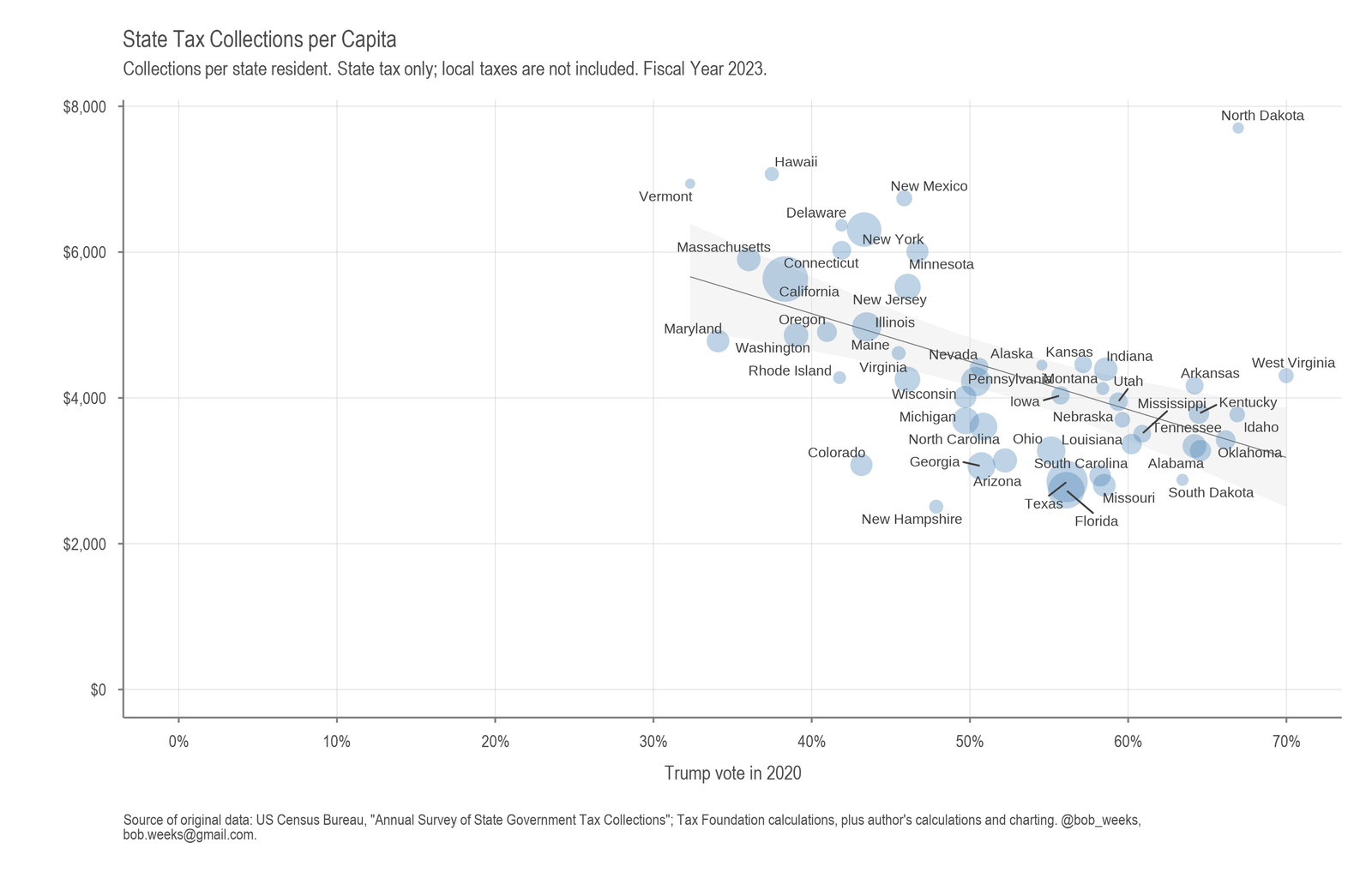
But what are the facts? Regarding taxation: In 2011 Kansas state government collected $2,378 in taxes for each person. Texas collected $1,682. We see that Texas collects far less tax per person than does Kansas. Texas may have higher sales or property taxes than Kansas, but the total tax burden in Texas is lower.

Spending follows the same pattern. In 2011 Kansas state government spent $5,115 per person in total, with $1,974 in general fund spending and $130 in bond spending. For Texas the total was $3,718 spent per person in total, with $1,654 in general fund spending and $50 in bond spending.

The lower level of spending means Texas has a less burdensome state government, which allows more money to remain in the productive private sector. In Kansas, we spend more on government.

The “sea of oil” and bountiful severance tax revenue: In 2011 Kansas, which has a severance tax of its own, collected $42.54 in this form of tax for each person. How much did Texas collect from its severance tax? $104.29 per person. The difference between the two — $61.75 per person per year — is only a small portion of the difference between Kansas and Texas taxation.

To see how your state compares with others in spending, use the interactive visualization below. To use the visualization, click the check boxes to add or remove states and years from the chart. Use the visualization below, or click here to open it in a new window. Data is from National Association of State Budget Officers and U.S. Bureau of Economic Analysis (BEA); visualization created by myself using Tableau Public.


(alternate link to the above table)


(alternate link to the above table)

{ 4 comments }

Wichita downtown tax base: Rising?

by Bob Weeks on February 21, 2013

Wichita city leaders have promoted public investment in downtown Wichita as wise because it will increase the tax base.

In his State of the City Address for 2013, Wichita Mayor Carl Brewer told the audience (based on his prepared remarks):

As you know, revitalizing downtown has been a key part of growing our community in recent years, recognizing that a healthy and thriving downtown improves our ability to attract new business, keep our young people here, and expand our tax base. With $100 million in completed downtown projects in 2012 and another $115 million starting this year, we’ve made extraordinary progress toward having the downtown that Wichitans have dreamed of. … As development continues downtown, we are closer to reaching our goals of increased pride, an increased tax base, and bringing more businesses and jobs to Wichita.

The Wichita Downtown Development Corporation sold the planning process to Wichitans by making the argument that “it will grow existing tax base revenues.”

Wichita downtown self-supporting municipal improvement district (SSMID) boundary map

To evaluate the success of the city’s efforts, we might look at the change in assessed property valuation in downtown Wichita over past years. A way to do that is to look at the valuations for property in the Wichita downtown self-supporting municipal improvement district (SSMID). This is a region of the city that pays an additional property tax to fund the activities of the Wichita Downtown Development Corporation. Its boundaries are roughly the Arkansas River east to Washington, and Kellogg north to Central.

Assessed valuation is the basis for levying property tax. The process starts with an appraised value, which is targeted to be fair market value for the property. Then, that is multiplied by 25 percent for commercial property, or by 11.5 percent for residential property. This produces the assessed value. Multiply that by the sum of the several mill levy rates that apply to the property, and you have the total property tax for that property.

With all the new projects coming online in downtown Wichita, we should expect that the assessed valuation is rising. As someone converts an old, dilapidated property into something more valuable, appraised and assessed values should rise. As new buildings are built, new appraised and assessed value is created where before there was none (or very little). This process is the success story that Mayor Brewer and boosters of public investment in downtown trumpet, as the mayor did twice in one paragraph in his State of the City Address.

So what has happened to the assessed valuation of property in downtown Wichita, using the SSMID as a surrogate?

The answer is that after a period of increasing values, the assessed value of property in downtown has has been declining. The peak was in 2008. The nearby table holds the figures.

This is the opposite of what we’ve been promised. We’ve been told that public investment in downtown Wichita builds up the tax base.

Some might excuse this performance by noting there’s been a recession. That’s true. But according to presentations, there has been much activity in downtown Wichita. Hundreds of millions of dollars in worth, we are told.

So why isn’t the assessed valuation rising? Why is it falling during the time of huge successes?

More research is needed.

Wichita downtown self-supporting municipal improvement district (SSMID) assessed property valuation

Data can be viewed here.

{ 4 comments }

Taxpayer-funded lobbying discussed

February 20, 2013

The Sedgwick County Commission passed a resolution expressing the commission’s opposition to a bill under consideration in the Kansas Legislature on taxpayer-funded lobbying.

Read the full article →

Lavonta Williams: ‘You don’t have to go there’

February 6, 2013

Wichita city council member Lavonta Williams advised taxpayers on what to do if they disagree with action taken by the council: Just don’t go there.

Read the full article →

Tax burden in the states

February 4, 2013

As Kansas debates tax reform, and as our state is frequently compared to Texas, we should take a look at the two states and their taxes.

Read the full article →

The real war on Kansas workers

February 3, 2013

A union petition states “What workers decide to do with their paychecks is none of the Government’s business.” I couldn’t agree more.

Read the full article →

State and local tax burden visualized

January 28, 2013

For two decades the Tax Foundation has estimated the combined state and local tax burden for all the states. I’ve created an interactive visualization that lets you compare states and see trends in rank over time.

Read the full article →

Obama will need more economic growth

January 22, 2013

To pay for the Obama taxing and spending agenda, the country will need much more economic growth. Unfortunately, the rate of growth is slowing just when we need greater rates of growth.

Read the full article →

Reaction to Kansas school lawsuit decision

January 14, 2013

Following are several reactions to the decision in Gannon vs. Kansas, the school funding lawsuit. The court ruled the state must spend more on schools.

Read the full article →

Wichita STAR bonds project not good for capitalism

January 14, 2013

A proposed STAR bonds project in Wichita is the latest example of Wichita and Kansas relying on cronyism and business welfare instead of capitalism.

Read the full article →

A spending problem, or a revenue problem?

January 7, 2013

Does the United States have a revenue problem or a spending problem? The interactive visualization below may help you decide.

Read the full article →

Wichita’s Lux applies for more business welfare

January 7, 2013

The Wichita City Council considers yet another layer of business welfare for The Lux, a luxury real estate development in downtown Wichita. This project, despite having already received millions in assistance from taxpayers, is not economically viable, according to city documents.

Read the full article →

States that Spend Less, Tax Less — and Grow More

December 18, 2012

States with an income tax spent 42% more per resident in 2011 than the nine states without an income tax, write Dave Trabert and Todd Davidson of Kansas Policy Institute.

Read the full article →

Eliminate mortgage interest deduction

November 30, 2012

The home mortgage interest deduction doesn’t accomplish much, and it should be eliminated.

Read the full article →

Nation can no longer afford wind tax credit

November 15, 2012

The nation should end expensive tax credit spending programs that distort markets.

Read the full article →

The Obama tax hike, compared to deficits

November 14, 2012

President Obama’s request for higher taxes, as large as it is, will do little to rein in our budgetary problem.

Read the full article →

The rich don’t have enough money

November 13, 2012

Even if President Barack Obama gets his way in upcoming tax negotiations, we’ll still be a long way from tackling the deficit.

Read the full article →

Sedgwick County Commission: Let’s not vote today

November 8, 2012

At the October 31 meeting of the Sedgwick County Commission, Karl Peterjohn introduced a measure that would let the Kansas Legislature know that the commission supports improving the tax climate in Kansas, and specifically would limit property tax growth. But electoral politics forced a delay in a vote.

Read the full article →

Kansas property tax honesty is needed

November 1, 2012

Kansas property tax reform means reducing the rate of growth of property taxes, not merely repurposing other tax revenue.

Read the full article →

Wichita’s $60 million gift to Spirit Aerosystems — not

October 22, 2012

Industrial Revenue Bonds is a confusing economic development program misunderstood by citizens, journalists, and even city council members.

Read the full article →

The Obama tax cuts

October 8, 2012

Are the tax cuts President Obama takes credit for the type of tax cuts that promote economic growth?

Read the full article →

The Lux in Wichita: Taxpayer funding of lifestyle choices

October 7, 2012

The Wichita City Council decides that taxpayers should pay for the lifestyle choices of a relative few.

Read the full article →

What’s wrong with Charles and David Koch?

September 28, 2012

Fran Tarkenton wonders: “So why do we vilify people who represent the greatness of America? Is it just because they have different political beliefs? It’s time to stop demonizing people who do things the right way and generate tremendous wealth — and value to all Americans.”

Read the full article →

Governor Romney is right: End the wind production tax credit

August 29, 2012

U.S. Representative Mike Pompeo explains the harm of government involvement in energy markets, wind power specifically.

Read the full article →

Renewable Portfolio Standard costly for Kansas

August 28, 2012

A policy promoted by Kansas Governor Sam Brownback will result in higher electricity costs, fewer jobs, and less investment in Kansas.

Read the full article →

Wichita speculative industrial buildings

August 27, 2012

A tax forgiveness policy for speculative industrial buildings in Wichita may not produce the intended results.

Read the full article →

Energy subsidies exposed

August 20, 2012

On the campaign trail, President Barack Obama calls for an end to energy subsidies for the fossil fuel industry. It turns out, however, that this industry receives relatively little subsidy, while the president’s favored forms of energy investment — wind and solar — receive much more. Additionally, coal, oil, and gas industries paid billions in taxes to the federal government, while electricity produced by solar and wind are a cost to taxpayers.

Read the full article →

In Kansas, more debunking of the benefit of high taxes

August 16, 2012

The argument that high state tax rates promote growth has a serious flaw, finds the Kansas Policy Institute.

Read the full article →

Debunking the debunkers on taxes and growth

August 16, 2012

While Congress and the President currently debate the best path to hold off the upcoming fiscal cliff, many states across the country have already tackled similar challenges this year

Read the full article →

Wichita property tax mill levy has increased and shifted in use

August 7, 2012

The City of Wichita says that the property tax mill levy has not increased in many years. But it has. In addition, property tax revenue has been shifted from debt repayment to current consumption.

Read the full article →

Pompeo: Impending tax increases threaten economic growth and jobs

July 29, 2012

An impending increase in federal income tax rates will harm economic growth and job creation, writes U.S. Representative Mike Pompeo.

Read the full article →

Why Kansas had to cut taxes

July 27, 2012

Kansas Governor Sam Brownback explains why Kansas needed to reduce taxes.

Read the full article →