STAR bonds

Carl Brewer: The state of Wichita, 2013

by Bob Weeks on January 30, 2013

Wichita Mayor Carl Brewer, State of the City Address, January 29, 2013

Much like President Barack Obama in his recent inaugural address, Wichita Mayor Carl Brewer displayed his collectivist instincts in his “State of the City” address for 2013. His speech, as prepared, may be read here.

Opening, the mayor said “Wichita has overcome great challenges in the past and will overcome these as well, but we’ll need to work together.”

Near the close, the mayor said “THE TIME FOR ACTION IS NOW! We have reached a point where we MUST come together as a community, and create a plan that defines our priorities and the City we are to become.” And then: “For all of our differences, I have never doubted this community’s ability to come together and protect what matters most.” (The capitalization is in the mayor’s prepared text.)

But what’s really important to Wichita is economic development. Regarding that, Brewer said this:

As we struggle to compete for new businesses and new jobs, especially in light of job losses in aviation, we must face the reality that we are competing with other cities that offer economic incentives for business development and expansion. If we want to be IN the game, we need to PLAY the game, but we have no dedicated funding source for economic development. If we’re serious about finding new jobs for our people — and I am — we must change this scenario as soon as possible. Where will those incentive dollars come from? (Capitalization, again, is from the original.)

The idea of a dedicated funding source for economic development is something that many in Wichita would support. Many would oppose it, too. But instead of just lobbing rhetorical questions (Where will those incentive dollars come from?), the mayor should give us some answers. Or, at least make a specific proposal. Does the mayor recommend a sales tax increase? Or allocating specific levels of property tax to economic development? (The city is doing this on a temporary basis.) Or asking the state legislature to fund Wichita’s economic development, as we insist the legislature fund our airline subsidy program?

Whatever it is, Mayor Brewer, give us some specific ideas as to how you want to raise this money, and how you would spend it.

It’s that spending, I think, that people in Wichita have concern over. The cumulative record of Brewer, the city council, and city bureaucratic staff hasn’t inspired trust and confidence. Giving the city additional dollars to spend on economic development is not a wise investment.

For example, the mayor says that subsidizing downtown development is good economic development strategy. But we see the mayor and nearly all council members voting to give an overpriced no-bid contract to their significant campaign contributors. This happened despite the company’s large cost overruns on previous no-bid contracts awarded by the city. Is that good economic development practice?

We see the city council sitting in a quasi-judicial role, adjudicating the award of an airport construction contract when one of the parties is a significant campaign contributor. In fact, Key Construction — the company that prevailed in that decision — through its principals and executives, was the sole source of campaign funds raised by Lavonta Williams (district 1, northeast Wichita) in 2012 as she prepared to run for reelection this spring.

Key’s executives also contributed heavily to James Clendenin (district 3, southeast and south Wichita) last year. He’s running this spring, too.

At the time this airport contract was being handled, Council Member Jeff Longwell (district 5, west and northwest Wichita) was campaigning for the Sedgwick County Commission. Campaign finance reports revealed contributions from parties associated with Walbridge, a Michigan construction company. Why would those in Michigan have an interest in helping a Wichita City Council member fund his campaign for a county office? Would the fact that Walbridge is a partner with Key Construction on the new airport terminal, and that Longwell would be voting on that contract, provide a clue?

Or: A movie theater owner and business partners contribute to the mayor’s (and other) campaigns. Mayor and council vote to give a no-interest and low-interest loan and tax breaks to theater owner and his partners. Mayor goes into barbeque sauce business. Mayor’s barbeque sauce is now sold at movie theater.

Doesn’t Carl Brewer see anything wrong with this? Don’t his advisors tell him that this creates the appearance of impropriety? Does the mayor consider whether these actions make a positive impression on those who might want to invest in Wichita?

We see the city awarding economic development incentives that were not necessary for the project to proceed. It took a special election to teach the mayor and council that lesson. By the way, that unneeded and rejected incentive was awarded to the significant campaign contributors of Mayor Brewer and most council members.

We see the city taking credit for building up the tax base, yet giving away tax revenue in the form of property tax abatements, IRBs, tax increment financing, and STAR bonds.

The bureaucratic missteps: The Southfork TIF district is just the latest example.

The lack of respect for citizens’ right to know how taxpayer funds are spent is another troubling aspect of Brewer’s tenure as mayor. None of the words “accountability,” “transparency,” or “open government” were mentioned in the mayor’s address this year, as they have been in the past. No sense in calling attention to an area where the city has failed, I suppose.

All this is done in the name of economic development and jobs. But Wichita is underperforming Kansas and the nation in these areas. Under Brewer’s leadership, however, we are overachieving in the advancement of cronyism and its ills.

The record indicates that our officeholders, and those who advise them, are not worthy of our trust, and certainly not more taxes for economic development.

After last year’s State of the City speech, I noted “Wichita’s mayor is openly dismissive of economic freedom, free markets, and limited government, calling these principles of freedom and liberty ‘simplistic.’ Instead, his government prefers crony capitalism and corporate welfare.”

I also wrote: “Relying on economic freedom, free markets, and limited government for jobs and prosperity means trusting in free people, the energy of decentralized innovation, and spontaneous order. A government plan for economic development is the opposite of these principles.”

This year, the outlook for economic freedom and limited government in Wichita is gloomier than ever before. The door for those who wish to profit through cronyism is wide open. We’ll have to hope that, somehow, Wichita can learn to thrive under this regime.

{ 1 comment }

Wichita STAR bonds project not good for capitalism

by Bob Weeks on January 14, 2013

Tomorrow the Wichita City Council considers approval of the project plan for a STAR bonds project in Wichita.

The formation of the district has already been approved. This action by the council will consider the development plan and the actual authorization to spend money.

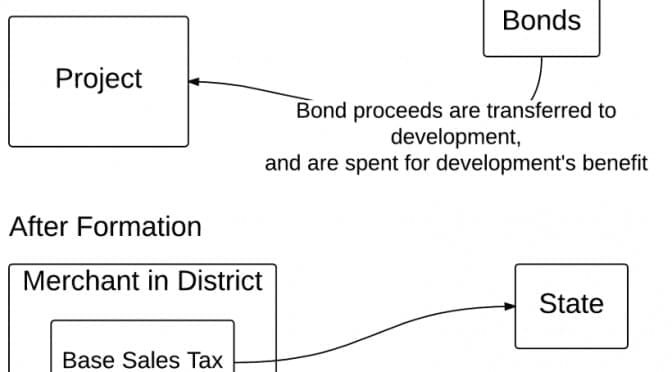
If approved, the city will proceed under the State of Kansas STAR bonds program. The city will sell bonds and turn over the proceeds to the developer. As bond payments become due, sales tax revenue will make the payments.

It’s only the increment in sales tax that is eligible to be diverted to bond payments. This increment is calculated by first determining a base level of sales for the district. Then, as new development comes online — or as sales rise at existing merchants — the increased sales tax over the base is diverted to pay the STAR bonds. Estimates are that annual revenue available for the bonds will be over $5,000,000.

For this district, the time period used to determine the base level of sales tax is February 2011 through January 2012. A new Cabela’s store opened in March 2012, and it’s located in the STAR bonds district. Since Cabela’s sales during the period used to calculate the base period was $0, the store’s entire sales tax collections will be used to benefit the STAR bonds developer.

(There are a few minor exceptions, such as the special CID tax Cabela’s collects for its own benefit.)

Which begs the question: Why is the Cabela’s store included in the boundaries of the STAR bonds district?

With sales estimated at $35 million per year, the state has been receiving around $2 million per year in sales tax from this store. But after the STAR bonds are sold, that money won’t be flowing to the state. Instead, it will be used to pay off bonds that benefit the project’s developer.

Some questions

Curiously, the city doesn’t provide a cost-benefit study for this project. This is the usual mechanism the city relies on as justification for investments in economic development projects.

Often developers ask government for incentives because they claim the project is not economically feasible without assistance. Is that the case with this development? If not, why the need for subsidies?

And if taxpayer subsidy is required for this development, we need to ask what it is about Kansas that discourages this type of business investment.

STAR bonds should be opposed as they turn over tax policy to the private sector. We should look at taxation as a way for government to raise funds to pay for services that all people benefit from. An example is police and fire protection. Even people who are opposed to taxation rationalize paying taxes that way.

But STAR bonds turn tax policy over to the private sector for personal benefit. The money is collected under the pretense of government authority, but it is collected for the exclusive benefit of the owners of property in the STAR bonds district.

Citizens should be asking this: Why do we need taxation, if we can simply excuse some from participating in the system?

Another question: In the words of the Kansas Department of Commerce, the STAR bonds program offers “municipalities the opportunity to issue bonds to finance the development of major commercial, entertainment and tourism areas and use the sales tax revenue generated by the development to pay off the bonds.” This description, while generally true, is not accurate. This STAR bonds district includes much area beyond the borders of the proposed development, including a Super Target store, a new Cabela’s store, and much vacant ground that will probably be developed as retail. The increment in sales taxes from these stores — present and future — goes to the STAR bond developer. As we’ve seen, since the Cabela’s store did not exist during the time the base level of sales was determined, all of its sales count towards the increment.

STAR bonds, or capitalism?

In economic impact and effect, the STAR bonds program is a government spending program. Except: Like many spending programs implemented through the tax system, legislative appropriations are not required. No one has to vote to spend on a specific project. Can you imagine the legislature voting to grant $5 million per year to a proposed development in northeast Wichita? That doesn’t seem likely. Few members would want to withstand the scrutiny of having voted in favor of such blatant cronyism.

But under tax expenditure programs like STAR bonds, that’s exactly what happens — except for the legislative voting part, and the accountability that sometimes follow.

Government spending programs like STAR bonds are sold to legislators as jobs programs. Development, it is said, will not happen unless project developers receive incentives through these spending programs. Since no legislator wants to be seen voting against jobs, many are susceptible to the seductive promise of jobs.

But often these same legislators are in favor of tax cuts to create jobs. This is the case in the Kansas House, where many Republican members are in favor of reducing the state’s income tax as a way of creating economic growth and jobs. On this issue, these members are correct.

But many of the same members voted in favor of tax expenditure programs like the STAR bonds program. These two positions cannot be reconciled. If government taxing and spending is bad, it is especially bad when part of tax expenditure programs like STAR bonds. And there’s plenty of evidence that government spending and taxation is a drag on the economy.

It’s not just legislators that are holding these incongruous views. Secretary of Commerce Pat George promoted the STAR bonds program to legislators. Governor Sam Brownback supported the program.

When Brownback and a new, purportedly more conservative Kansas House took office, I wondered whether Kansas would pursue a business-friendly or capitalism-friendly path: “Plans for the Kansas Republican Party to make Kansas government more friendly to business run the risk of creating false, or crony capitalism instead of an environment of genuine growth opportunity for all business.” I quoted John Stossel:

The word “capitalism” is used in two contradictory ways. Sometimes it’s used to mean the free market, or laissez faire. Other times it’s used to mean today’s government-guided economy. Logically, “capitalism” can’t be both things. Either markets are free or government controls them. We can’t have it both ways.

The truth is that we don’t have a free market — government regulation and management are pervasive — so it’s misleading to say that “capitalism” caused today’s problems. The free market is innocent.

But it’s fair to say that crony capitalism created the economic mess.

But wait, you may say: Isn’t business and free-market capitalism the same thing? Not at all. Here’s what Milton Friedman had to say: “There’s a widespread belief and common conception that somehow or other business and economics are the same, that those people who are in favor of a free market are also in favor of everything that big business does. And those of us who have defended a free market have, over a long period of time, become accustomed to being called apologists for big business. But nothing could be farther from the truth. There’s a real distinction between being in favor of free markets and being in favor of whatever business does.” (emphasis added.)

Friedman also knew very well of the discipline of free markets and how business will try to avoid it: “The great virtue of free enterprise is that it forces existing businesses to meet the test of the market continuously, to produce products that meet consumer demands at lowest cost, or else be driven from the market. It is a profit-and-loss system. Naturally, existing businesses generally prefer to keep out competitors in other ways. That is why the business community, despite its rhetoric, has so often been a major enemy of truly free enterprise.”

The danger of Kansas government having a friendly relationship with Kansas business is that the state will circumvent free markets and promote crony, or false, capitalism in Kansas. It’s something that we need to be on the watch for. The existence of the STAR bonds program lets us know that a majority of Kansas legislators — including many purported fiscal conservatives — prefer crony capitalism over free enterprise and genuine capitalism.

The problem

Government bureaucrats and politicians promote programs like STAR bonds as targeted investment in our economic future. They believe that they have the ability to select which companies are worthy of public investment, and which are not. It’s a form of centralized planning by the state that shapes the future direction of the Kansas economy.

Arnold King has written about the ability of government experts to decide what investments should be made with public funds. There’s a problem with knowledge and power:

As Hayek pointed out, knowledge that is important in the economy is dispersed. Consumers understand their own wants and business managers understand their technological opportunities and constraints to a greater degree than they can articulate and to a far greater degree than experts can understand and absorb.

When knowledge is dispersed but power is concentrated, I call this the knowledge-power discrepancy. Such discrepancies can arise in large firms, where CEOs can fail to appreciate the significance of what is known by some of their subordinates. … With government experts, the knowledge-power discrepancy is particularly acute.

Despite this knowledge problem, Kansas legislators are willing to give power to bureaucrats in the Department of Commerce who feel they have the necessary knowledge to direct the investment of public funds. One thing is for sure: the state and its bureaucrats have the power to make these investments. They just don’t have — they can’t have — the knowledge as to whether these are wise.

What to do

The STAR bonds program is an “active investor” approach to economic development. Its government spending on business leads to taxes that others have to pay. That has a harmful effect on other business, both existing and those that wish to form.

Professor Art Hall of the Center for Applied Economics at the Kansas University School of Business is critical of this approach to economic development. In his paper Embracing Dynamism: The Next Phase in Kansas Economic Development Policy, Hall quotes Alan Peters and Peter Fisher: “The most fundamental problem is that many public officials appear to believe that they can influence the course of their state and local economies through incentives and subsidies to a degree far beyond anything supported by even the most optimistic evidence. We need to begin by lowering expectations about their ability to micro-manage economic growth and making the case for a more sensible view of the role of government — providing foundations for growth through sound fiscal practices, quality public infrastructure, and good education systems — and then letting the economy take care of itself.”

In the same paper, Hall writes this regarding “benchmarking” — the bidding wars for large employers that Kansas and many of its cities employ: “Kansas can break out of the benchmarking race by developing a strategy built on embracing dynamism. Such a strategy, far from losing opportunity, can distinguish itself by building unique capabilities that create a different mix of value that can enhance the probability of long-term economic success through enhanced opportunity. Embracing dynamism can change how Kansas plays the game.”

In making his argument, Hall cites research on the futility of chasing large employers as an economic development strategy: “Large-employer businesses have no measurable net economic effect on local economies when properly measured. To quote from the most comprehensive study: ‘The primary finding is that the location of a large firm has no measurable net economic effect on local economies when the entire dynamic of location effects is taken into account. Thus, the siting of large firms that are the target of aggressive recruitment efforts fails to create positive private sector gains and likely does not generate significant public revenue gains either.’”

There is also substantial research that is it young firms — distinguished from small business in general — that are the engine of economic growth for the future. We can’t detect which of the young firms will blossom into major success — or even small-scale successes. The only way to nurture them is through economic policies that all companies can benefit from. Reducing tax rates is an example of such a policy. Government spending on specific companies through programs like STAR bonds is an example of precisely the wrong policy.

We need to move away from economic development based on this active investor approach. We need to advocate for policies at all levels of government that lead to sustainable economic development. We need political leaders who have the wisdom to realize this, and the courage to act appropriately. Which is to say, to not act in most circumstances.

Public Hearing Considering the Adoption of a STAR Bond Project Plan for the K-96 Greenwich Star Bond Projec… by

{ 0 comments }

An upcoming vote in the Kansas Legislature, possibly today, will let Kansans know who is truly in favor of economic freedom, limited government, and free market capitalism — and who favors crony capitalism instead.

The bill is Senate Substitute for HB2382: AN ACT concerning economic development; concerning the STAR bonds financing act; relating to the provisions regarding STAR bond projects; extending the sunset date. Under current law, the Kansas STAR bonds program will expire on July 1, 2012. This bill extends the program’s life for five years.

The STAR bonds program allows increases in sales tax revenue to be directed to private interests rather than feeding the state treasury. The mechanism is that local governments like cities can sell bonds and give the proceeds to developers. Then, increments in sales tax revenues are used to make bond payments.

In economic impact and effect, the STAR bonds program is a government spending program. Except: Like many spending programs implemented through the tax system, legislative appropriations are not required. No one has to vote to spend on a specific project. Can you imagine the legislature voting to grant $50 million over a period of years to a proposed development in northeast Wichita? That doesn’t seem likely. Few members would want to withstand the scrutiny of having voted in favor of such blatant cronyism.

But under stealth-like tax expenditure programs like STAR bonds, that’s exactly what happens — except for the legislative voting part.

Government spending programs like STAR bonds are sold to legislators as jobs programs. Development, it is said, will not happen unless project developers receive incentives through these spending programs. Since no legislator wants to be seen voting against jobs, many are susceptible to the seductive promise of jobs.

But often these same legislators are in favor of tax cuts to create jobs. This is the case in the Kansas House, where many Republican members are in favor of reducing the state’s income tax as a way of creating economic growth and jobs. On this issue, these members are correct.

But many of the same members voted earlier this year for a previous version of the STAR bonds extension bill. (See In Kansas, STAR bonds vote uplifted cronyism over capitalism.) These members voted in favor of a tax expenditure program. These two positions — voting for tax cuts, but voting for targeted spending through the tax system — cannot be reconciled. If government taxing and spending is bad, it is especially bad when part of tax expenditure programs like STAR bonds. And there’s plenty of evidence that government spending and taxation is a drag on the economy.

It’s not just legislators that are holding these incongruous views. Secretary of Commerce Pat George promoted the STAR bonds program to legislators. This seems to be contrary to the spirit of tax reform plans Kansas Governor Sam Brownback promoted earlier in the session. At that time, he proposed ending spending programs implemented through the tax system. Historic preservation tax credits was a particular program that he wanted to end.

The danger of false, or “crony” capitalism

Last year at the time Brownback and a new, purportedly more conservative Kansas House took office, I wondered whether Kansas would pursue a business-friendly or capitalism-friendly path: “Plans for the Kansas Republican Party to make Kansas government more friendly to business run the risk of creating false, or crony capitalism instead of an environment of genuine growth opportunity for all business.” I quoted John Stossel:

The word “capitalism” is used in two contradictory ways. Sometimes it’s used to mean the free market, or laissez faire. Other times it’s used to mean today’s government-guided economy. Logically, “capitalism” can’t be both things. Either markets are free or government controls them. We can’t have it both ways.

The truth is that we don’t have a free market — government regulation and management are pervasive — so it’s misleading to say that “capitalism” caused today’s problems. The free market is innocent.

But it’s fair to say that crony capitalism created the economic mess.

But wait, you may say: Isn’t business and free-market capitalism the same thing? Not at all. Here’s what Milton Friedman had to say: “There’s a widespread belief and common conception that somehow or other business and economics are the same, that those people who are in favor of a free market are also in favor of everything that big business does. And those of us who have defended a free market have, over a long period of time, become accustomed to being called apologists for big business. But nothing could be farther from the truth. There’s a real distinction between being in favor of free markets and being in favor of whatever business does.” (emphasis added.)

Friedman also knew very well of the discipline of free markets and how business will try to avoid it: “The great virtue of free enterprise is that it forces existing businesses to meet the test of the market continuously, to produce products that meet consumer demands at lowest cost, or else be driven from the market. It is a profit-and-loss system. Naturally, existing businesses generally prefer to keep out competitors in other ways. That is why the business community, despite its rhetoric, has so often been a major enemy of truly free enterprise.”

The danger of Kansas government having a friendly relationship with Kansas business is that the state will circumvent free markets and promote crony, or false, capitalism in Kansas. It’s something that we need to be on the watch for. The vote on the STAR bonds project will let us know how our state is proceeding. If the upcoming vote goes as did the earlier votes on this matter, the verdict is clear: Kansas legislators — including many purported fiscal conservatives — prefer crony capitalism over free enterprise and genuine capitalism.

The problem

Government bureaucrats and politicians promote programs like STAR bonds as targeted investment in our economic future. They believe that they have the ability to select which companies are worthy of public investment, and which are not. It’s a form of centralized planning by the state that shapes the future direction of the Kansas economy.

Arnold Kling has written about the ability of government experts to decide what investments should be made with public funds. There’s a problem with knowledge and power:

As Hayek pointed out, knowledge that is important in the economy is dispersed. Consumers understand their own wants and business managers understand their technological opportunities and constraints to a greater degree than they can articulate and to a far greater degree than experts can understand and absorb.

When knowledge is dispersed but power is concentrated, I call this the knowledge-power discrepancy. Such discrepancies can arise in large firms, where CEOs can fail to appreciate the significance of what is known by some of their subordinates. … With government experts, the knowledge-power discrepancy is particularly acute.

Despite this knowledge problem, Kansas legislators are willing to give power to bureaucrats in the Department of Commerce (along with local government officials and bureaucrats) who feel they have the necessary knowledge to direct the investment of public funds. One thing is for sure: the state and its bureaucrats have the power to make these investments. They just don’t have — they can’t have — the knowledge as to whether these are wise.

What to do

The STAR bonds program is an “active investor” approach to economic development. Its government spending on business leads to taxes that others have to pay. That has a harmful effect on other business, both existing and those that wish to form.

Professor Art Hall of the Center for Applied Economics at the Kansas University School of Business is critical of this approach to economic development. In his paper Embracing Dynamism: The Next Phase in Kansas Economic Development Policy, Hall quotes Alan Peters and Peter Fisher: “The most fundamental problem is that many public officials appear to believe that they can influence the course of their state and local economies through incentives and subsidies to a degree far beyond anything supported by even the most optimistic evidence. We need to begin by lowering expectations about their ability to micro-manage economic growth and making the case for a more sensible view of the role of government — providing foundations for growth through sound fiscal practices, quality public infrastructure, and good education systems — and then letting the economy take care of itself.”

In the same paper, Hall writes this regarding “benchmarking” — the bidding wars for large employers that Kansas and many of its cities employ: “Kansas can break out of the benchmarking race by developing a strategy built on embracing dynamism. Such a strategy, far from losing opportunity, can distinguish itself by building unique capabilities that create a different mix of value that can enhance the probability of long-term economic success through enhanced opportunity. Embracing dynamism can change how Kansas plays the game.”

In making his argument, Hall cites research on the futility of chasing large employers as an economic development strategy: “Large-employer businesses have no measurable net economic effect on local economies when properly measured. To quote from the most comprehensive study: ‘The primary finding is that the location of a large firm has no measurable net economic effect on local economies when the entire dynamic of location effects is taken into account. Thus, the siting of large firms that are the target of aggressive recruitment efforts fails to create positive private sector gains and likely does not generate significant public revenue gains either.’”

There is also substantial research that is it young firms — distinguished from small business in general — that are the engine of economic growth for the future. We can’t detect which of the young firms will blossom into major success — or even small-scale successes. The only way to nurture them is through economic policies that all companies can benefit from. Reducing tax rates is an example of such a policy. Government spending on specific companies through programs like STAR bonds is an example of precisely the wrong policy.

We need to move away from economic development based on this active investor approach. We need to advocate for policies at all levels of government that lead to sustainable economic development. We need political leaders who have the wisdom to realize this, and the courage to act appropriately. Which is to not act in most circumstances. But politicians have an irresistible urge to be seen doing something, even though most of what is done is harmful.

{ 0 comments }

Political cronyism has become the way

by Bob Weeks on May 7, 2012

“A society whose businesses engage in cronyism instead of serving people will not be prosperous, and in America it is clear that cronyism is becoming a more common choice,” writes Sam Patterson at EconomicFreedom.org.

Cronyism is the practice of seeking business success through government rather than through markets. The difference is that business succeeds in the market by providing goods and services that people are willing to buy. Political cronyism, on the other hand, results in people being forced to buy from, or to otherwise involuntarily subsidize, certain business firms that have succeeded in the political arena.

In Kansas, despite the fiscal conservatism of Kansas Governor Sam Brownback and many members of the legislature, political cronyism thrives. An example is the increased powers given to the Kansas PEAK program (Promoting Employment Across Kansas). A more recent example is the vote to extend the STAR bonds program. Both programs provide business firms a way to obtain money isolated from market forces. Instead, applicants must meet the guidelines of a government program.

In Wichita and Sedgwick County, cronyism is firmly established as economic development policy. It’s little wonder that our policies are failing and we are losing people and income to other states.

Cronyism Undermines the Beneficial Role of Business in Society

By Sam Patterson

The role that business plays in society is straightforward — businesses produce goods and services that people consider beneficial. If a business can do that while wisely using resources, it makes a profit. Successful businesses benefit society by producing goods or services which improve people’s lives, and are then rewarded with profit. Those profits enable businesses to innovate or offer more goods and services, further improving people’s lives. Businesses must cater to the needs of society or they will find that they are not rewarded with profit and may well no longer exist.

At least, that’s how it works in a free market. There is another path for businesses to make profit other than providing valuable products. It’s called cronyism. Cronyism occurs when a business colludes with government officials to create unfair legislation and/or regulations which give them benefits they could not have otherwise obtained voluntarily.

Continue reading at Cronyism Undermines the Beneficial Role of Business in Society.

{ 0 comments }

Wichita to hold public hearing, again

by Bob Weeks on April 30, 2012

On Tuesday the Wichita City Council will consider whether to set June 5th as the date to re-hold the public hearing on the K-96 Greenwich STAR Bond District Plan. The council held a public hearing on this matter in February, but there was a mistake in the ordinance accompanying the original public hearing. Therefore, the need for the second public hearing.

I find myself torn, not wanting to root for the competent administration of bad policies. But Wichita seems to have administrative difficulties implementing the bad programs it has passed.

A history of blunders, and worse

This is not the only recent example of the city making such a mistake. Last October the city had to re-hold a public hearing regarding a tax abatement. The reason was a mistake in the dates published regarding the holding of the hearing. City documents describe the problem: “The notice incorrectly stated that a public hearing would be held on August 3, 2010. The item was heard by the Council on September 21, 2010 and was approved. Since the August date was prior to the publication, there was no proper notification. Therefore, a new public hearing is required.”

In March, there was the mistake notifying the Kansas Department of Revenue regarding the Community Improvement District (CID) tax on the Cabela’s store, and so the store was not authorized to collect the extra tax, even through it did for about two weeks before the mistake was realized. See Wichita Eagle, City error will delay funds from Cabela’s special sales tax.

The details of other mistakes are not available to the public. Last week the council approved a settlement of $80,000 to a person injured by the allegedly negligent action of a Wichita street maintenance employee. In response to my inquiry, the city responded that the employee was disciplined, but would not provide additional details. Accidents will happen, but when they cost this much, citizens have the right to know how the city responds. In this case, we don’t know this.

So who is responsible for these mistakes? We don’t know for sure, but when the city council originally considered this item that it must now re-consider, the resolution and accompanying exhibits were approved as to form by Wichita city attorney Gary E. Rebenstorf. These documents may be viewed at Resolution Considering the Establishment of the K-96 Greenwich STAR Bond District.

Under Rebenstorf, the city periodically violates the Kansas Open Meetings Act. In 2009, the Wichita Eagle reported: “City Attorney Gary Rebenstorf apologized for the violation and said he takes the blame for it. ‘I will make every effort to further a culture of openness and ensure that like mistakes are avoided in the future,’ he said.”

Since then, Rebenstorf has had several chances to help citizens seek access to government records by upholding the clear meaning of the Kansas Open Records Act, but has sided with government seeking to keep secrets. See For Wichita city government, open records are not valued for more.

The mistakes flowing from his office, coupled with his hostility towards the citizens of Wichita, suggest that it is time for Wichita city attorney Rebenstorf to retire.

{ 0 comments }

Recently both chambers of the Kansas Legislature passed similar bills authorizing a five year extension of the Kansas STAR bonds program. In the House the bill passed 92 to 31. In the Senate the vote was 27 to 13.

The STAR bonds program provides a way to redirect sales taxes to project developers instead of the state treasury, which is where most people think taxes go — or should go.

Not so with STAR bonds. In the words of the Kansas Department of Commerce, the program offers “municipalities the opportunity to issue bonds to finance the development of major commercial, entertainment and tourism areas and use the sales tax revenue generated by the development to pay off the bonds.” This description, while generally true, is not accurate. A proposed STAR bond district in Wichita includes much area beyond the borders of the proposed development, including a Super Target store, a new Cabela’s store, and much vacant ground that will probably be developed as retail. The increment in sales taxes from these stores — present and future — goes to the STAR bond developer.

I asked a number of members of the Kansas House and Senate to explain their votes in favor of extending the STAR bonds program. It was difficult to extract answers, but I finally a received a few.

One member explained to me that some votes are “ugly.” Yes, indeed I would say, including this member’s. But that’s no reason not to vote correctly in favor of limited government, capitalism, and free markets. Sometimes members have to vote according to their campaign promises.

One member explained to me that the bonds that will be sold are bought by private investors, and there’s nothing wrong with that. That’s true, but stopping the thought process there is naive. How are payments on these bonds to be made, we have to ask. The answer is payments are made, at least partially, from the captured sales tax revenue. That’s revenue not earned by the developers. Instead, it is revenue collected by government in the form of taxes that consumers have no choice but to pay. From the developers’ viewpoint (and pocketbook) it is a gift from government that others in similar situations are not able to receive. These gifts of money from government to business are known as cronyism. It is Kansas being business-friendly, which is not the same as capitalism-friendly, and it makes our state poorer and less able to compete.

Some made the argument that STAR bond proceeds can be used only for certain allowable expenses such as “horizontal” expenses. Arguments such as these are commonly made to support government subsidy programs. Supporters argue that since the use of the funds is restricted, this somehow makes it allowable, even benign. But this is nonsense. If I gave you $100 with the stipulation that you could spend it only on Mondays, would anyone deny that you are wealthier by $100? That is, of course, if you were planning to spend money on Mondays. And if you weren’t, couldn’t you shift some of your spending to Mondays?

This is the nonsensical nature of these arguments. Still, many purportedly fiscal conservatives are persuaded.

Simply put, the STAR bonds program turns over taxation to private parties for their own benefit. When we are willing to turn over taxation to the benefit of private interests, we have to wonder a few things:

First, why do we need taxation at all, if we can simply excuse some from participating in the system?

Second: Can something be moral if it is not applied equally to everyone?

Third: Sometimes it is claimed that without the government subsidy, a project is not economically feasible. Developers have lots of ways to make a project appears that it needs government help, and they have multimillion dollar motives to do so. But when something is truly not economically feasible, that means that the judgment of the marketplace is that the product or service is not desired — at least not at a price necessary to make the project profitable. But not to worry — our fearless government leaders will override the judgment of free people trading freely in markets. They will enact a forced transfer of wealth from taxpayers to the developers whose ideas can’t make it in the market. These leaders include Kansas Governor Sam Brownback, Secretary of Commerce Pat George, the Speaker of the House and President of the Senate, and chairs of key committees, except (surprisingly) Les Donovan, chair of the senate tax committee.

For more on the harm to capitalism of the STAR bonds program, see Kansas STAR bonds vote a test for capitalism.

In the House of Representatives, there were two explanations as to why some members voted no. The first one reads: “I vote NO on HB 2561. Star Bonds are a form of failed economic policy that Kansas should distance itself from. It is time for government to stop picking winners and losers and instead promote economic policies and a lower tax structure that all Kansans can benefit from. Star bonds are a form of centralized planning that favors a few at the expense of other taxpayers and businesses. These bonds divert needed money from police, fire, roads, and other core functions of government for 10, 20, and even 30 years. Mr. Speaker, I vote NO, choosing to support the taxpayers who voted me in office.” This was in the names of Pete DeGraaf, Virgil Peck, Jr, Randy Garber, Charlotte O’Hara, Owen Donohoe, and Connie O’Brien.

A second statement read: “HB 2561 goes against my principles of free enterprise and limited government. By redirecting tax revenue to a particular business, STAR bonds create an unequal playing field. STAR bonds favor a few at the expense of other taxpayers and businesses. These bonds divert money needed for core functions of government for decades into the future. It is time for government to stop picking winners and losers and instead promote economic policies and a lower tax structure from which all Kansans can benefit. Mr. Speaker, I stand with the voters that elected me. I vote NO on HB2561.” This was in the names of Jim Howell, Dennis Hedke, TerriLois Gregory, Brett Hildabrand, Greg Smith, Kelly Meigs, Amanda Grosserode, Jana Goodman, Lance Y. Kinzer, Mitch Holmes, Marc Rhoades, Kasha Kelley, Dan Collins, and Tom Arpke.

In the House, there were a number of members who voted in favor of the STAR bonds program in spite of proclamations of fiscal conservatism. Many of these members are looking for ways to reduce the growth of Kansas government and taxes. Some are in high leadership positions. Yet, somehow they didn’t see the harm in voting for the STAR bonds program. This list includes Steve Brunk of Wichita; Richard Carlson of St. Marys and Chair of the House Taxation Committee; Mario Goico of Wichita; Phil Hermanson of Wichita; Kyle Hoffman of Coldwater; Steve Huebert of Valley Center; Dan Kerschen of Garden Plain; Mike Kiegerl of Olathe; Marvin Kleeb of Overland Park and vice-chair of House Taxation Committee; Brenda Landwehr of Wichita; Peggy Mast of Emporia, who is Assistant Majority Leader; Mike O’Neal of Hutchinson, who is Speaker of the House; Les Osterman of Wichita; Joe Patton of Topeka; Scott Schwab of Olathe; Arlen Siegfreid of Olathe, who is Majority Leader; Gene Suellentrop of Wichita; and Brian Weber of Dodge City.

In the Senate, these votes came from Terry Bruce of Hutchinson; Dick Kelsey of Goddard, Jeff King of Independence; Garrett Love of Montezuma; and Susan Wagle of Wichita.

{ 0 comments }

Kansas STAR bonds vote a test for capitalism

by Bob Weeks on March 26, 2012

Update: The bill passed in the House of Representatives 92 to 31. A similar bill passed in the Senate 27 to 13.

An upcoming vote in the Kansas House of Representatives will let Kansans know who is truly in favor of economic freedom, limited government, and free market capitalism — and who favors crony capitalism instead.

The bill is HR 2561: Extension of the STAR bonds financing act sunset provision regarding STAR bond projects. Under current law, the Kansas STAR bonds program will expire on July 1, 2012. This bill extends the program’s life for five years.

The STAR bonds program allows increases in sales tax revenue to be directed to private interests rather than feeding the state treasury. The mechanism is that local governments like cities can sell bonds and give the proceeds to developers. Then, increments in sales tax revenues are used to make bond payments.

In economic impact and effect, the STAR bonds program is a government spending program. Except: Like many spending programs implemented through the tax system, legislative appropriations are not required. No one has to vote to spend on a specific project. Can you imagine the legislature voting to grant $50 million over a period of years to a proposed development in northeast Wichita? That doesn’t seem likely. Few members would want to withstand the scrutiny of having voted in favor of such blatant cronyism.

But under tax expenditure programs like STAR bonds, that’s exactly what happens — except for the legislative voting part.

Government spending programs like STAR bonds are sold to legislators as jobs programs. Development, it is said, will not happen unless project developers receive incentives through these spending programs. Since no legislator wants to be seen voting against jobs, many are susceptible to the seductive promise of jobs.

But often these same legislators are in favor of tax cuts to create jobs. This is the case in the Kansas House, where many Republican members are in favor of reducing the state’s income tax as a way of creating economic growth and jobs. On this issue, these members are correct.

But many of the same members are, I am told, in favor of tax expenditure programs like the STAR bonds program. These two positions cannot be reconciled. If government taxing and spending is bad, it is especially bad when part of tax expenditure programs like STAR bonds. And there’s plenty of evidence that government spending and taxation is a drag on the economy.

It’s not just legislators that are holding these incongruous views. Secretary of Commerce Pat George is promoting the STAR bonds program to legislators. He wouldn’t do that unless Governor Sam Brownback supported the program.

Last year at the time Brownback and a new, purportedly more conservative Kansas House took office, I wondered whether Kansas would pursue a business-friendly or capitalism-friendly path: “Plans for the Kansas Republican Party to make Kansas government more friendly to business run the risk of creating false, or crony capitalism instead of an environment of genuine growth opportunity for all business.” I quoted John Stossel:

The word “capitalism” is used in two contradictory ways. Sometimes it’s used to mean the free market, or laissez faire. Other times it’s used to mean today’s government-guided economy. Logically, “capitalism” can’t be both things. Either markets are free or government controls them. We can’t have it both ways.

The truth is that we don’t have a free market — government regulation and management are pervasive — so it’s misleading to say that “capitalism” caused today’s problems. The free market is innocent.

But it’s fair to say that crony capitalism created the economic mess.

But wait, you may say: Isn’t business and free-market capitalism the same thing? Not at all. Here’s what Milton Friedman had to say: “There’s a widespread belief and common conception that somehow or other business and economics are the same, that those people who are in favor of a free market are also in favor of everything that big business does. And those of us who have defended a free market have, over a long period of time, become accustomed to being called apologists for big business. But nothing could be farther from the truth. There’s a real distinction between being in favor of free markets and being in favor of whatever business does.” (emphasis added.)

Friedman also knew very well of the discipline of free markets and how business will try to avoid it: “The great virtue of free enterprise is that it forces existing businesses to meet the test of the market continuously, to produce products that meet consumer demands at lowest cost, or else be driven from the market. It is a profit-and-loss system. Naturally, existing businesses generally prefer to keep out competitors in other ways. That is why the business community, despite its rhetoric, has so often been a major enemy of truly free enterprise.”

The danger of Kansas government having a friendly relationship with Kansas business is that the state will circumvent free markets and promote crony, or false, capitalism in Kansas. It’s something that we need to be on the watch for. The vote on the STAR bonds project will let us know how our state is proceeding. If the vote goes as sources tell me, the verdict is clear: Kansas legislators — including many purported fiscal conservatives — prefer crony capitalism over free enterprise and genuine capitalism.

The problem

Government bureaucrats and politicians promote programs like STAR bonds as targeted investment in our economic future. They believe that they have the ability to select which companies are worthy of public investment, and which are not. It’s a form of centralized planning by the state that shapes the future direction of the Kansas economy.

Arnold King has written about the ability of government experts to decide what investments should be made with public funds. There’s a problem with knowledge and power:

As Hayek pointed out, knowledge that is important in the economy is dispersed. Consumers understand their own wants and business managers understand their technological opportunities and constraints to a greater degree than they can articulate and to a far greater degree than experts can understand and absorb.

When knowledge is dispersed but power is concentrated, I call this the knowledge-power discrepancy. Such discrepancies can arise in large firms, where CEOs can fail to appreciate the significance of what is known by some of their subordinates. … With government experts, the knowledge-power discrepancy is particularly acute.

Despite this knowledge problem, Kansas legislators are willing to give power to bureaucrats in the Department of Commerce who feel they have the necessary knowledge to direct the investment of public funds. One thing is for sure: the state and its bureaucrats have the power to make these investments. They just don’t have — they can’t have — the knowledge as to whether these are wise.

What to do

The STAR bonds program is an “active investor” approach to economic development. Its government spending on business leads to taxes that others have to pay. That has a harmful effect on other business, both existing and those that wish to form.

Professor Art Hall of the Center for Applied Economics at the Kansas University School of Business is critical of this approach to economic development. In his paper Embracing Dynamism: The Next Phase in Kansas Economic Development Policy, Hall quotes Alan Peters and Peter Fisher: “The most fundamental problem is that many public officials appear to believe that they can influence the course of their state and local economies through incentives and subsidies to a degree far beyond anything supported by even the most optimistic evidence. We need to begin by lowering expectations about their ability to micro-manage economic growth and making the case for a more sensible view of the role of government — providing foundations for growth through sound fiscal practices, quality public infrastructure, and good education systems — and then letting the economy take care of itself.”

In the same paper, Hall writes this regarding “benchmarking” — the bidding wars for large employers that Kansas and many of its cities employ: “Kansas can break out of the benchmarking race by developing a strategy built on embracing dynamism. Such a strategy, far from losing opportunity, can distinguish itself by building unique capabilities that create a different mix of value that can enhance the probability of long-term economic success through enhanced opportunity. Embracing dynamism can change how Kansas plays the game.”

In making his argument, Hall cites research on the futility of chasing large employers as an economic development strategy: “Large-employer businesses have no measurable net economic effect on local economies when properly measured. To quote from the most comprehensive study: ‘The primary finding is that the location of a large firm has no measurable net economic effect on local economies when the entire dynamic of location effects is taken into account. Thus, the siting of large firms that are the target of aggressive recruitment efforts fails to create positive private sector gains and likely does not generate significant public revenue gains either.’”

There is also substantial research that is it young firms — distinguished from small business in general — that are the engine of economic growth for the future. We can’t detect which of the young firms will blossom into major success — or even small-scale successes. The only way to nurture them is through economic policies that all companies can benefit from. Reducing tax rates is an example of such a policy. Government spending on specific companies through programs like STAR bonds is an example of precisely the wrong policy.

We need to move away from economic development based on this active investor approach. We need to advocate for policies at all levels of government that lead to sustainable economic development. We need political leaders who have the wisdom to realize this, and the courage to act appropriately. Which is to say, to not act in most circumstances.

{ 0 comments }

Kansas needs a dynamic economic growth policy

by Bob Weeks on May 25, 2011

Note: Since Dr. Hall’s address to the Wichita Pachyderm Club covered below, the business expensing that he proposed has been signed into law by Governor Brownback. The governor also issued an economic development plan that incorporates large portions of Hall’s advice, but legislation expanding some of the present-day “active investor” economic development practices has also been signed into law. The Promoting Employment Across Kansas (PEAK) program, which allows companies to retain their employees’ payroll withholding taxes, has been expanded, but not so that it covers all new business firms, as Hall recommended.

A dynamic market where many new business startups attempt to succeed and thrive while letting old, unproductive firms die is what contributes to productivity and economic growth. But most economic development policies, including those of Kansas and Wichita, do not encourage this dynamism, and in fact, work against it.

That’s the message of Dr. Art Hall, who spoke to the Wichita Pachyderm Club on the topic “Business Dynamics and Economic Development in Kansas.” Hall is Director of the Center for Applied Economics at the Kansas University School of Business.

At the start of his talk, Hall said that economic development has become an industry of its own, a public industry sometimes implemented as public-private partnerships. But its agenda is often not genuine economic development, he said.

In a short history lesson, Hall described how Walter Beech came to Wichita from North Carolina simply because Clyde Cessna was in Wichita. Sprint began in Abilene in 1899. Fred Koch, who founded the company that became Koch Industries, came to Wichita because Lewis Winkler was here. “Serendipity — that’s the theme.”

Hall displayed a map of taxpayer migration. There is a huge and wide swath of deep blue — representing the highest rate of out-migration — stretching north to south through the Great Plains, including much of Kansas. The Plains are urbanizing, Hall said. Pockets are doing well, but generally the rural areas are losing population. Economic development strategies must realize this long-term trend, he said.

A chart showed the geographic distribution of income earned in Kansas. In 1970, 55 percent of income was earned outside the state’s two major urban areas: Wichita and the Kansas City and Lawrence areas. In 2008, that number had declined to 38 percent. The cause of this is people moving to cities from small towns and rural areas.

On a map of Kansas counties, Hall showed how jobs are moving — concentrating — to a few areas of the state. “I think this is a positive development, because density tends to be a precursor to productivity, and productivity — meaning the value of output per worker — is one of the core fundamental definitions of economic growth.” It’s the reason, generally speaking, as to why cities are prosperous.

Hall said that we should care about our rural communities, but if we slow down the process of densification, we may be losing out on productivity growth and its benefit to economic development.

Continuing on this important theme, Hall said that the key to real and sustainable economic development is productivity growth: “Productivity growth happens on the front lines of individual businesses. You cannot will productivity growth. You cannot legislate productivity growth. You must create the conditions under which individual businesspeople, slogging it out on the front lines every day, create prosperity and productivity by trying new things and working hard. That requires a climate in which they feel optimistic enough to try new things, are rewarded for their efforts, and are willing to test new ideas.”

Dynamism is one of the most underappreciated aspects of the U.S. economy among those working in economic development, Hall told the audience. There is a high correlation between the average size of a business and economic growth, and particularly employment growth. In other words, small companies tend to grow faster than large companies. In the chart Hall displayed, there is a clear demarcation at companies with about 20 employees.

But most of our economic development policies have a bias towards big business. Hall said this is understandable. Further, he said that Wichita is a big business town, meaning that statistically, it is not poised to be a fast-growing area. Hall said we should create an atmosphere where we have lots of small businesses, where there is lots of experimentation. “If our economic development policies are biased against that, that is not helpful.”

A chart showed that each year many business firms die or contract, and many others are born or expand. These numbers are large, relatively speaking: in most years, around 150,000 jobs are created through new firms or expansion of existing firms, and about the same number are lost. Given that Kansas has about one million jobs, each year about 30 percent of Kansas jobs are in in play, just as a result of business dynamics.

Hall said that when the Kansas Department of Commerce announces the creation of 80 new jobs in Kansas, we need to remember that the marketplace swamps anything that individual economic development agencies can do. Hall called for policies that can handle a large volume of businesses — 15,000 to 25,000 — in growth mode each year. Our state’s economic development policies can not handle this level of volume, he said.

Another chart of the states illustrated the relationship between job reallocation rate — the “churn” of jobs — and the economic growth rate in a state. States with high growth rates have high turnover rates in jobs. Kansas ranks relatively low in economic growth.

Economic development policy should encourage new business startups, Hall said, although there is a high correlation between newness and death of businesses. “What you’re trying to do is have enough experimentation that enough good experiments take hold, and they grow.” This concept of experimentation is related to serendipity, or “making desirable discoveries by accident” that Hall mentioned earlier.

But much economic development policy focuses on retaining jobs. Hall said that if what we mean by job retention is saving jobs in companies that ought to die, the policy is not productive. Instead, job retainment policies should create a climate where people can find new jobs quickly here in Kansas. Job retention should not mean bailouts, he added.

Hall emphasized that while there is a high correlation between new businesses and being small, he said it is new businesses that are most important to driving economic growth.

Newness of business firms is vitally important, Hall said. Summarizing a chart of Kansas job creating by age of the firm, he told the audience: “Without year-zero businesses [meaning the newest firms], the entire state of Kansas is almost always losing jobs. It’s the same for the United States. It’s the newness that matters. We want new businesses, but new businesses create churn, as there’s a high correlation between birth and death.”

Hall said this is a complicated process, and that most discussions of economic development do not recognize this complexity.

Hall explained that the state, in conducting economic development activity, often acts as an investor in a company. Specifically, he said that the state acts as an “active manager” similar to an actively managed stock mutual fund. The other type of investor or mutual fund is the passively-managed index fund, where the fund invests in all stocks, usually weighted by the size of the firms. Which approach works best: active management, or investing in all companies. This historical record shows that very few actively-managed funds beat index funds, only 2.4 percent from 1994 to 2004.

Hall said the data shows it is very difficult to predict which are the right firms to pick to come to Kansas. Therefore, we need policies that benefit all companies in order to have a dynamic market in new business firms. “Everyone gets the same deal,” he said.

Hall recommended three specific policies: First, universal expensing of all new capital investment made in Kansas, which means that companies can deduct new investment immediately. Second, eliminate the tax on capital gains. Third, automatic property tax abatements for new or improved business investment for a period of five years.

Hall’s talk was based on his paper from earlier this year titled Embracing Dynamism: The Next Phase in Kansas Economic Development Policy. That paper contains the charts referred to, and also more detail, additional information, and policy recommendations.

{ 2 comments }

Kansas economic growth policy should embrace dynamism

by Bob Weeks on December 21, 2010

A dynamic market where many new business startups attempt to succeed and thrive while letting old, unproductive firms die is what contributes to productivity and economic growth. But most economic development policies, including those of Kansas and Wichita, do not encourage this dynamism, and in fact, work against it.

That’s the message of Dr. Art Hall, who spoke to the Wichita Pachyderm Club on the topic “Business Dynamics and Economic Development in Kansas.” Hall is Director of the Center for Applied Economics at the Kansas University School of Business.

At the start of his talk, Hall said that economic development has become an industry of its own, a public industry sometimes implemented as public-private partnerships. But its agenda is often not genuine economic development, he said.

In a short history lesson, Hall described how Walter Beech came to Wichita from North Carolina simply because Clyde Cessna was in Wichita. Sprint began in Abilene in 1899. Fred Koch, who founded the company that became Koch Industries, came to Wichita because Lewis Winkler was here. “Serendipity — that’s the theme.”

Hall displayed a map of taxpayer migration. There is a huge and wide swath of deep blue — representing the highest rate of out-migration — stretching north to south through the Great Plains, including much of Kansas. The Plains are urbanizing, Hall said. Pockets are doing well, but generally the rural areas are losing population. Economic development strategies must realize this long-term trend, he said.

A chart showed the geographic distribution of income earned in Kansas. In 1970, 55 percent of income was earned outside the state’s two major urban areas: Wichita and the Kansas City and Lawrence areas. In 2008, that number had declined to 38 percent. The cause of this is people moving to cities from small towns and rural areas.

On a map of Kansas counties, Hall showed how jobs are moving — concentrating — to a few areas of the state. “I think this is a positive development, because density tends to be a precursor to productivity, and productivity — meaning the value of output per worker — is one of the core fundamental definitions of economic growth.” It’s the reason, generally speaking, as to why cities are prosperous.

Hall said that we should care about our rural communities, but if we slow down the process of densification, we may be losing out on productivity growth and its benefit to economic development.

Continuing on this important theme, Hall said that the key to real and sustainable economic development is productivity growth: “Productivity growth happens on the front lines of individual businesses. You cannot will productivity growth. You cannot legislate productivity growth. You must create the conditions under which individual businesspeople, slogging it out on the front lines every day, create prosperity and productivity by trying new things and working hard. That requires a climate in which they feel optimistic enough to try new things, are rewarded for their efforts, and are willing to test new ideas.”

Dynamism is one of the most underappreciated aspects of the U.S. economy among those working in economic development, Hall told the audience. There is a high correlation between the average size of a business and economic growth, and particularly employment growth. In other words, small companies tend to grow faster than large companies. In the chart Hall displayed, there is a clear demarcation at companies with about 20 employees.

But most of our economic development policies have a bias towards big business. Hall said this is understandable. Further, he said that Wichita is a big business town, meaning that statistically, it is not poised to be a fast-growing area. Hall said we should create an atmosphere where we have lots of small businesses, where there is lots of experimentation. “If our economic development policies are biased against that, that is not helpful.”

A chart showed that each year many business firms die or contract, and many others are born or expand. These numbers are large, relatively speaking: in most years, around 150,000 jobs are created through new firms or expansion of existing firms, and about the same number are lost. Given that Kansas has about one million jobs, each year about 30 percent of Kansas jobs are in in play, just as a result of business dynamics.

Hall said that when the Kansas Department of Commerce announces the creation of 80 new jobs in Kansas, we need to remember that the marketplace swamps anything that individual economic development agencies can do. Hall called for policies that can handle a large volume of businesses — 15,000 to 25,000 — in growth mode each year. Our state’s economic development policies can not handle this level of volume, he said.

Another chart of the states illustrated the relationship between job reallocation rate — the “churn” of jobs — and the economic growth rate in a state. States with high growth rates have high turnover rates in jobs. Kansas ranks relatively low in economic growth.

Economic development policy should encourage new business startups, Hall said, although there is a high correlation between newness and death of businesses. “What you’re trying to do is have enough experimentation that enough good experiments take hold, and they grow.” This concept of experimentation is related to serendipity, or “making desirable discoveries by accident” that Hall mentioned earlier.

But much economic development policy focuses on retaining jobs. Hall said that if what we mean by job retention is saving jobs in companies that ought to die, the policy is not productive. Instead, job retainment policies should create a climate where people can find new jobs quickly here in Kansas. Job retention should not mean bailouts, he added.

Hall emphasized that while there is a high correlation between new businesses and being small, he said it is new businesses that are most important to driving economic growth.

Newness of business firms is vitally important, Hall said. Summarizing a chart of Kansas job creating by age of the firm, he told the audience: “Without year-zero businesses [meaning the newest firms], the entire state of Kansas is almost always losing jobs. It’s the same for the United States. It’s the newness that matters. We want new businesses, but new businesses create churn, as there’s a high correlation between birth and death.”

Hall said this is a complicated process, and that most discussions of economic development do not recognize this complexity.

Hall explained that the state, in conducting economic development activity, often acts as an investor in a company. Specifically, he said that the state acts as an “active manager” similar to an actively managed stock mutual fund. The other type of investor or mutual fund is the passively-managed index fund, where the fund invests in all stocks, usually weighted by the size of the firms. Which approach works best: active management, or investing in all companies. This historical record shows that very few actively-managed funds beat index funds, only 2.4 percent from 1994 to 2004.

Hall said the data shows it is very difficult to predict which are the right firms to pick to come to Kansas. Therefore, we need policies that benefit all companies in order to have a dynamic market in new business firms. “Everyone gets the same deal,” he said.

Hall recommended three specific policies: First, universal expensing of all new capital investment made in Kansas, which means that companies can deduct new investment immediately. Second, eliminate the tax on capital gains. Third, automatic property tax abatements for new or improved business investment for a period of five years.

Hall’s talk was based on his paper from earlier this year titled Embracing Dynamism: The Next Phase in Kansas Economic Development Policy. That paper contains the charts referred to, and also more detail, additional information, and policy recommendations.

{ 2 comments }

Wichita’s alphabet soup of ‘tax tricks’

October 13, 2010

I want to commend the courage shown by the October 10 Sunday editorial “Get control of incentives.” It takes some intestinal fortitude to speak out against the “tax tricks” (wonderful description) that have been foisted on the city and county taxpayers already burdened by federal, state, and property taxes.

Read the full article →

Economic development planning in Wichita on tap

September 11, 2010

Tuesday’s meeting of the Wichita City Council features four public hearings concerning Community Improvement District. One CID also will have a public hearing on its application for tax increment financing (TIF).

Read the full article →

Wichita Bowllagio hearing produces only delay

June 9, 2010

Yesterday’s meeting of the Wichita City Council featured a lengthy public hearing for a proposed west-side entertainment development known as Bowllagio. Bowllagio is planned to have a bowling and entertainment center, a boutique hotel, and a restaurant owned by a celebrity television chef.

Read the full article →

Wichita economic development to be topic of meeting

May 16, 2010

This Monday (May 17), economic development tools and incentives in Wichita will be discussed at a meeting sponsored by the Kansas chapter of Americans for Prosperity.

Read the full article →