Open records

Kansas Open Records Act needs improvement

by Bob Weeks on March 12, 2013

File folder and documents

Testimony to Senate Standing Committee on Federal and State Affairs as proponent of SB 10: Open meetings; minutes required; open records; charges limited, by Bob Weeks, March 13, 2013.

Chairman Ostmeyer and members of the Committee:

Thank you for this opportunity to present testimony on problems with the Kansas Open Records Act regarding high fees for the production of records. In 2008 I personally encountered this problem, as reported in the Wichita Eagle:

Open Records Requests Can Spell High Fees (Wichita Eagle, March 9, 2008)

Want information from the governor’s office? Get ready to pay up. That’s what Wichita blogger Bob Weeks says he discovered when he requested four days’ worth of e-mails sent and received by Gov. Kathleen Sebelius and her staff.

To get the records, he was told he’d have to pay a lawyer in the governor’s office $27 an hour, for 50 hours, to read the e-mails to make sure they aren’t exempt from disclosure. That and 25 cents a page for copies or an unspecified extra charge to get the e-mails in electronic form. “Please make your check for the amount of $1,350 payable to the state of Kansas and reference your open records request,” said a letter Weeks received from JaLynn Copp, assistant general counsel to the governor.

State Sen. Timothy Huelskamp, R-Fowler, said he was aware of Weeks’ case. He said he thinks the fees are excessive. “It doesn’t mean much for it to be an open record if you can’t afford it,” he said. In addition, he said a sluggish response to the request from the governor’s office appears to have violated the state Open Records Act. Huelskamp said the law requires state agencies to fulfill records requests within three business days or provide a detailed reason why that can’t be done. Weeks mailed his request on Feb. 7 and got an initial response Feb. 13. His cost estimate didn’t come until Feb. 26, and neither letter explained the delay, Huelskamp said. “It’s really in violation of the letter and the spirit of the law and I’ve seen that happen more than once,” he said. (Full article available online at bit.ly/openrecordsks001)

Based on this and other experience, it is difficult to obtain email records at reasonable cost. If one makes a very narrowly-defined request that is affordable, there is a chance that the request will not produce the desired documents. If the request is broad enough to catch the records one needs, it is likely to be very expensive.

Kansas could use as a model the federal Freedom of Information Act (5 USC § 552), which provides for a limit on fees in certain cases: “Fees shall be limited to reasonable standard charges for document duplication when records are not sought for commercial use and the request is made by an educational or noncommercial scientific institution, whose purpose is scholarly or scientific research; or a representative of the news media.” (emphasis added)

There are other problems with the Kansas Open Records Act. Enforcement is weak. In my case, the Sedgwick County District Attorney took 14 months to produce a ruling that I believe is contrary to the intent of this Legislature. As the Kansas attorney General refers all cases to the local District Attorney, I have no other avenue for enforcement except for a private lawsuit at my expense.

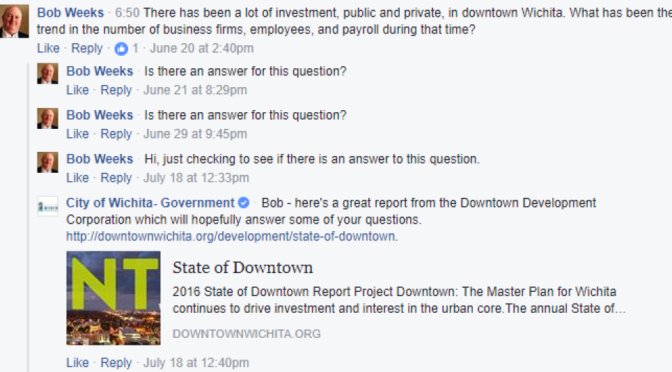
Cities and other local governmental bodies have set up non-profit organizations to conduct business such as economic development. These agencies, as in the case of the Wichita Downtown Development Corporation, may receive up to 98 percent of their revenue from taxation, have only government as clients, and perform functions that are governmental in nature, yet they are judged not to be a public agency for purposes of the Kansas Open Records Act. This flies in the face of the Legislature’s declared intent in the preamble of the Act: “It is declared to be the public policy of the state that public records shall be open for inspection by any person unless otherwise provided by this act, and this act shall be liberally construed and applied to promote such policy.”

While the Kansas Open Records Act requires agencies to respond to the request within three business days, a response might be “This will take more time.” At that point, as far as I know, there is nothing to prevent an agency from stalling indefinitely in fulfilling the records request.

In some jurisdictions, if three or more records requests are received on the same topic, the agency must post the records. Kansas should go a step farther and require that governmental agencies post online all documents and records produced in response to records requests. In this way, the work done to fulfill requests could be leveraged and appreciated by a broader audience. An example of an agency doing this is Community Unit School District 300 in Illinois, at www.d300.org.

Elected officials and bureaucrats often are either misinformed regarding the Open Records Act, or have a poor attitude towards open government. This Wichita school district, for example, has told me that my records requests are a “burden” that interferes with the education of children. A Wichita city council member argued that if the city manager was satisfied with the level of service that an agency provided, there was no need for the agency to produce records.

The council member then extended that argument, wondering if any company the city contracts with that is providing satisfactory products or service would be subject to “government intrusion” through records requests. He must not have been aware that the Kansas Open Records Act contains a large exception, which excepts: “Any entity solely by reason of payment from public funds for property, goods or services of such entity.” So companies that sell to government in the ordinary course of business are not subject to the open records law.

In 2007 the Better Government Association and National Freedom of Information Coalition gave Kansas a letter grade of “F” for its open records law. In 2011 State Integrity Investigation looked at the states, and Kansas did not rank well there, either.

There is much that Kansas can, and should do, to strengthen its Open Records Law to give citizens and journalists better access to records and documents. Reigning in the ability of agencies to erect a protective wall of high fees is a first step.

I have additional information about the Kansas Open Records Act and its problems at wichitaliberty.org/open-records.

Respectfully submitted,
Bob Weeks

{ 0 comments }

Open records in Kansas

by Bob Weeks on February 11, 2013

Open Government

Kansas has a weak open records law. Wichita doesn’t want to follow the law, as weak as it is. Legislation has been introduced to correct some of the problems with the Kansas Open Records Act.

Here’s a portal of information on the problems I and others have had with the Kansas Open Records Act: Open records in Kansas.

{ 0 comments }

Open Records in Kansas

by Bob Weeks on February 11, 2013

Kansas has a weak open records law. Wichita doesn’t want to follow the law, as weak as it is.

As citizen watchdogs, I and others need access to information and data. The City of Wichita, however, has created several not-for-profit organizations that are largely funded by tax money. The three I am concerned with are the Wichita Downtown Development Corporation, Go Wichita Convention and Visitors Bureau, and Greater Wichita Economic Development Coalition.

I have asked each organization for checkbook-level spending data. Each has refused to comply, using the reasoning that they are not “public agencies” as defined in the Kansas Open Records Act. But consider the WDDC: In every year but one, its percent of revenue derived from taxes is well over 90 percent. In many years the only income WDDC received was from taxes and a small amount of interest earned. Click here to see how much of WDDC’s revenue comes from taxes.

The Wichita city attorney backs these organizations and their interpretation of the law. So do almost all city council members. After 14 months investigating this matter, the Sedgwick County District Attorney agreed with the city’s position. (Click here to read the determination.) The only course of action open to me is to raise thousands of dollars to fund a lawsuit.

Citizen watchdogs and others need the ability to examine the spending of tax money. When government creates quasi-governmental bodies that are almost totally funded through taxes, and then refuses to disclose how that money is spent, we have to wonder why the city doesn’t want citizens to know how this money is spent.

An example of why this is important is the case of Mike Howerter, a trustee of Labette Community College in Parsons. He noticed that a check number was missing from a register. Upon his inquiry, it was revealed that the missing check was used to reimburse the college president for a political campaign contribution. While the college president committed no violation by making this political contribution using college funds, this is an example of the type of information that citizens may want regarding the way public funds are spent.

In Wichita, because of a loophole in the Kansas Open Records Act, a large amount of tax money is spent without this type of scrutiny. This year the Kansas Legislature is considering HB 2188, which will start to bring accountability for how all tax money is spent. Testimony from Kansas Policy Institute on this bill is here.

The Attorney General’s page on the Kansas Open Records Act is here. The Kansas Legislator Briefing Book chapter for the Kansas Open Records Act is here.

Wichita doesn’t value open records and open government

On the KAKE Television public affairs program “This Week in Kansas” the failure of the Wichita City Council, especially council member Wichita City Council Member Pete Meitzner (district 2, east Wichita), to recognize the value of open records and open government is discussed.

For more background, see Wichita, again, fails at open government.

Wichita, again, fails at open government

The Wichita City Council, when presented with an opportunity to increase the ability of citizens to observe the workings of the government they pay for, decided against the cause of open government, preferring to keep the spending of taxpayer money a secret. Continue reading here.

Wichita could do better regarding open government, if it wants

Tomorrow the Wichita City Council will consider renewing its contract with Go Wichita Convention and Visitors Bureau. The renewal will provide another opportunity for the council to decide whether it is truly in favor of open government and citizen access to records. Continue reading here.

Wichita government’s attitude towards citizens’ right to know is an issue

At a meeting of the Wichita City Council, Kansas Policy Institute president Dave Trabert explained the problems in obtaining compliance with the Kansas Open Records Act. Continue reading here.

Open records again an issue in Kansas

Responses to records requests made by Kansas Policy Institute are bringing attention to shortcomings in the Kansas Open Records Act. Continue reading here.

In Wichita, disdain for open records and government transparency

Despite receiving nearly all its funding from taxpayers, Go Wichita Convention and Visitors Bureau refuses to admit it is a “public agency” as defined in the Kansas Open Records Act. The city backs this agency and its interpretation of this law, which is in favor of government secrecy and in opposition to the letter and spirit of the Open Records Act. Continue reading here.

Additional information on open records is at:

Downtown Wichita issues not appreciated

by Bob Weeks on February 5, 2013

Once again, the Wichita Eagle editorial board misses the point regarding downtown Wichita development.

There may be some that are opposed to downtown simply because it’s downtown, or for other silly reasons. That seems to be the focus of Rhonda Holman’s editorial today.

But speaking from a perspective of economic freedom and individual liberty, it’s government interventionism in downtown that I object to. This is what harms Wichita, not the fact that people are living and working downtown or anywhere else, for that matter.

The political cronyism involved in many projects in downtown Wichita is what harms our city. When government takes from one and gives to another, everyone is worse off — other than the recipients. I understand that it’s easy to look at a subsidized project — be it downtown or elsewhere — and see people working at jobs. It’s much more difficult, however, to see the harm that the government intervention causes: Prosperity and jobs are lost due to inefficient government allocation of capital through political, not market, mechanisms. In the whole, we are worse off, not better.

If you don’t believe this — if you insist that the city government can create jobs and prosperity through its interventions, and that these have no net cost — then you have to ask why the city is not involved in more development.

It is the principled objection to government involvement that many do not understand, including, I think, the Wichita Eagle editorial board. An example: In September 2011, after I and others started a campaign to overturn a city council decision to award a tax subsidy to the Ambassador Hotel, the hotel’s lead developer asked to meet with me. In the meeting I explained that I would oppose the city’s action if applied to any hotel, located anywhere in Wichita, owned by anyone. He said that he sensed my opposition was based on principle, and I agreed.

The curious thing is that this seemed to puzzle him — that people would actually apply principles to politics.

The political allocation of investment capital in Wichita leads to problems of the appearance of impropriety, if not actual impropriety. There is a small group of people that repeatedly receive large amounts of taxpayer subsidy. These people and others associated with their companies regularly contribute to the campaign funds of city council members and candidates. These council members then vote to grant these people taxpayer-funded subsidy, year after year.

City council members also vote to award them with no-bid contracts. That’s terrible government policy. Especially when one recent contract was later put to competitive bid, and turned out to cost much less than the no-bid price. City council members, all except one, were willing to award their significant campaign contributors with an overpriced no-bid contract at taxpayer expense.

The company that won the no-bid contract was Key Construction. Its owners and executives were the sole contributors to the campaign fund of Lavonta Williams (district 1, northeast Wichita) in 2012 as she prepared to run for reelection this spring.

James Clendenin (district 3, southeast and south Wichita), also running for reelection this spring, and also having voted for the no-bid contract for Key, also received many contributions from Key and its executives in 2012. That company, along with person associated with one other company, were the sole source of Clendenin’s campaign funding that year.

Doesn’t the Wichita Eagle editorial board see a problem here? Doesn’t the newsroom?

There was a time when newspaper opinion editors crusaded against this type of behavior.

Newspaper editorial writers ought also to be concerned about how taxpayer funds are spent. The City of Wichita, however, has established non-profit organizations to spend taxpayer funds. The Wichita Downtown Development Corporation, for example, is funded almost exclusively through taxes. Yet, it claims that it is not a public agency as defined in the Kansas Open Records Act, and therefore need not fulfill records requests seeking to bring transparency as to how the agency spends its taxpayer funds. The city, inexplicably, backs WDDC in this interpretation of law that is contrary to the interests of citizens.

Secrecy of this type regarding taxpayer funds is not good public policy. There was a time when newspaper editors railed against government secrecy like this.

We need a newspaper editorial board that understands principle vs. political expediency. As a first step, let’s ask for an editorial board that recognizes these abuses of citizens and is willing to talk about them.

{ 3 comments }

Who is Richard Windsor?

by Bob Weeks on January 17, 2013

Kyle Smith in the New York Post:

Richard Windsor was the nom de plume of EPA chief Lisa Jackson, who announced her resignation last month. Why, you may ask, would a federal bureaucrat need an alias? Did she need cover in order to work on her own version of “50 Shades of Grey”? Does a secret identity liberate her to fight General Zod and Lex Luthor?

Or is she, like most users of aliases, trying to hide from the law?

The latter seems closest to the truth. Jackson has not been charged with any wrongdoing, but she has apparently been using unofficial e-mail accounts to discuss government affairs. As a side benefit, such exchanges might have been expected to escape discovery via the Freedom of Information Act. It is against federal law to use private e-mail addresses to discuss the people’s business.

Using secret anonymous email accounts to conduct government business is a serious matter. As Kansas seeks to beef up its open records law, we ought to include language to cover this type of abuse.

The Competitive Enterprise Institute is at the forefront of this breaking issue. Their hub of information is at The EPA’s “Richard Windsor” Email Scandal.

{ 0 comments }

On the KAKE Television public affairs program “This Week in Kansas” the failure of the Wichita City Council, especially council member Wichita City Council Member Pete Meitzner (district 2, east Wichita), to recognize the value of open records and open government is discussed.

For more background, see Wichita, again, fails at open government.

{ 0 comments }

Wichita, again, fails at open government

by Bob Weeks on December 19, 2012

The Wichita City Council, when presented with an opportunity to increase the ability of citizens to observe the workings of the government they pay for, decided against the cause of open government, preferring to keep the spending of taxpayer money a secret.

The occasion was consideration of renewing its contract with Go Wichita Convention and Visitors Bureau. I asked, as I have in the past for this agency and also for Wichita Downtown Development Corporation and Greater Wichita Economic Development Coalition, that they consider themselves to be what they are: public agencies as defined in the Kansas Open Records Act.

In the past I’ve argued that Go Wichita is a public agency as defined in the Kansas Open Records Act. But the city disagreed. And astonishingly, the Sedgwick County District Attorney agrees with the city’s interpretation of the law.

So I asked that we put aside the law for now, and instead talk about good public policy. Let’s recognize that even if the law does not require Go Wichita, WDDC, and GWEDC to disclose records, the law does not prohibit them from fulfilling records requests.

Once we understand this, we’re left with these questions:

Why does Go Wichita, an agency funded almost totally by tax revenue, want to keep secret how it spends that money, over $2 million per year?

Why is this city council satisfied with this lack of disclosure of how taxpayer funds are spent?

Why isn’t Go Wichita’s check register readily available online, as it is for Sedgwick County?

For that matter, why isn’t Wichita’s check register online?

It would be a simple matter for the council to declare that the city and its taxpayer-funded partner agencies believe in open government. All the city has to have is the will to do this. It takes nothing more.

Only Wichita City Council Member Michael O’Donnell (district 4, south and southwest Wichita) gets it, and yesterday was his last meeting as a member of the council. No other council members would speak up in favor of citizens’ right to open government.

But it’s much worse than a simple failure to recognize the importance of open government. Now we have additional confirmation of what we already suspected: Many members of the Wichita City Council are openly hostile towards citizens’ right to know.

In his remarks, Wichita City Council Member Pete Meitzner (district 2, east Wichita) apologized to the Go Wichita President that she had become “a pawn in the policy game.” He said it was “incredibly unfair that you get drawn into something like this.”

He added that this is a matter for the Attorney General and the District Attorney, and that not being a lawyer, she shouldn’t be expected to understand these issues. He repeated the pawn theme, saying “Unfortunately there are occasions where some people want to use great people like yourself and [Wichita Downtown Development Corporation President] Jeff Fluhr as pawns in a very tumultuous environment. Please don’t be deterred by that.”

Mayor Brewer added “I would have to say Pete pretty much said it all.”

We’ve learned that city council members rely on — as Randy Brown told the council last year — facile legal reasoning to avoid oversight: “It may not be the obligation of the City of Wichita to enforce the Kansas Open Records Act legally, but certainly morally you guys have that obligation. To keep something cloudy when it should be transparent I think is foolishness on the part of any public body, and a slap in the face of the citizens of Kansas. By every definition that we’ve discovered, organizations such as Go Wichita are subject to the Kansas Open Records Act.”

But by framing open government as a legal issue — one that only lawyers can understand and decide — Wichita city government attempts to avoid criticism for their attitude towards citizens.

It’s especially absurd for this reason: Even if we accept the city’s legal position that the city and its quasi-governmental taxpayer-funded are not required to fulfill records request, there’s nothing preventing from doing that — if they wanted to.

In some ways, I understand the mayor, council members, and bureaucrats. Who wants to operate under increased oversight?

What I don’t understand is the Wichita news media’s lack of interest in this matter. Representatives of all major outlets were present at the meeting.

I also don’t understand what Council Member Lavonta Williams (district 1, northeast Wichita) suggested I do: “schmooze” with staff before asking for records. (That’s not my word, but a characterization of Williams’ suggestion made by another observer.)

I and others who have made records requests of these quasi-governmental taxpayer-funded organizations have alleged no wrongdoing by them. But at some point, citizens will be justified in wondering whether there is something that needs to be kept secret.

The actions of this city have been noticed by the Kansas Legislature. The city’s refusal to ask its tax-funded partners to recognize they are public agencies as defined in the Kansas Open Records Act is the impetus for corrective legislation that may be considered this year.

Don’t let this new law be known as the “Wichita law.” Let’s not make Wichita an example for government secrecy over citizens’ right to know.

Unfortunately, that bad example has already been set, led by the city’s mayor and city council.

{ 5 comments }

Tomorrow the Wichita City Council will consider renewing its contract with Go Wichita Convention and Visitors Bureau. The renewal will provide another opportunity for the council to decide whether it is truly in favor of open government and citizen access to records.

Go Wichita, along with the Wichita Downtown Development Corporation and Greater Wichita Economic Development Coalition, contends that it is not a “public agency” as defined in Kansas law, and therefore does not have to fulfill records requests. Mayor Carl Brewer and all council members except Wichita City Council Member Michael O’Donnell (district 4, south and southwest Wichita) are comfortable with this tortured interpretation of the law. Inexplicably, the Sedgwick County District Attorney agreed with the city.

I, along with many others, believe the city’s interpretation of the law is incorrect. So do many in the Kansas Legislature, and action may be taken there soon to eliminate the ability of Wichita to keep public records from the public. We can call it Gary’s Law, after Wichita City Attorney Gary Rebenstorf, who provides the legal advice the city relies upon.

The legal stance of the City of Wichita certainly isn’t good public policy. Citizens should be able to learn how taxpayer money is spent. Agencies like Go Wichita, WDDC, and GWEDC need to open their check registers as has Sedgwick County, for example.

In the meantime, there is nothing to prevent the city from asking Go Wichita to act as though it was a public agency as defined in the Kansas Open Records Act and to fulfill records requests. This would let Wichitans know that the city is truly interested in open and transparent government.

It’s easy to bluster about open government. In his “State of the City” address last year, Mayor Brewer promoted the city’s efforts in accountability and transparency, telling the audience: “We must continue to be responsive to you. Building on our belief that government at all levels belongs to the people. We must continue our efforts that expand citizen engagement. … And we must provide transparency in all that we do.” Many other city documents mention transparency as a goal for the city.

Until the city asks that these quasi-governmental organizations subject themselves to the Kansas Open Records Act, the message from the City of Wichita is clear: Accountability and transparency is provided on the city’s terms, not on citizens’ terms and the law.

Why open records are important

Here’s an example as to why this issue is important: In 2009 Mike Howerter, a trustee for Labette Community College, noticed that a check number was missing from a register. Based on his inquiry, it was revealed that the missing check was used to reimburse the college president for a political contribution. While it was determined that the college president committed no crime by making this political contribution using college funds, this is an example of the type of information that citizens may want regarding the way public funds are spent.

This is the type of information that I have requested. It is what is needed to perform effective oversight. It is what the City of Wichita has decided to avoid.

This item, last year

Last year I asked that the city council approve the contract with Go Wichita only after adding a provision that Go Wichita consider itself a public agency under the Kansas Open Records Act. Following are a few notes from the meeting (video may be viewed here or at the end of this article):

Discussion of this matter at the meeting reveals that city staff believes that the annual reports filed by Go Wichita along with periodic checks by city staff are sufficient oversight.

City Attorney Gary Rebenstorf cited the law regarding enforcement of the Kansas Open Records Act, stating that the Kansas Attorney General or the courts is the next step to seek enforcement of KORA. While Rebenstorf is correct on the law, the policy of the Kansas Attorney General is to refer all cases to the local district attorney. The Kansas AG will not intervene in this matter.

Randy Brown, who is chair of the Kansas Sunshine Coalition for Open Government and former opinion page editor of the Wichita Eagle was at the meeting and spoke on this matter. In his remarks, Brown said “It may not be the obligation of the City of Wichita to enforce the Kansas Open Records Act legally, but certainly morally you guys have that obligation. To keep something cloudy when it should be transparent I think is foolishness on the part of any public body, and a slap in the face of the citizens of Kansas. By every definition that we’ve discovered, organizations such as Go Wichita are subject to the Kansas Open Records Act.”

Brown said that he’s amazed when public officials don’t realize that transparency helps build trust in government, thereby helping public officials themselves. He added “Open government is essential to a democracy. It’s the only way citizens know what’s going on. … But the Kansas Open Records Act is clear: Public records are to be made public, and that law is to be construed liberally, not by some facile legal arguments that keep these records secret.”

He recommended to the council, as I did, that the contract be contingent on Go Wichita following the Kansas Open Records Act.

John Rolfe, president of Go Wichita, told the council that he has offered to provide me “any information that is relevant” regarding Go Wichita. He mentioned the various financial reports his organization provides. He said he is unclear on the transparency question, and what isn’t transparent.

Wichita City Council Member Michael O’Donnell (district 4, south and southwest Wichita) asked Rolfe if he had ever denied a KORA request. Rolfe replied no, perhaps not remembering that Go Wichita denied my request.

Misunderstanding the scope of KORA

In remarks from the bench Wichita City Council Member James Clendenin (district 3, southeast and south Wichita) asked the city manager a series of questions aimed at determining whether the city was satisfied with the level of service that Go Wichita has provided. He then extended that argument, wondering if any company the city contracts with that is providing satisfactory products or service would be subject to “government intrusion” through records requests. Would this discourage companies from wanting to be contractors?

First, the Kansas Open Records Act does not say anything about whether a company is providing satisfactory service to government. That simply isn’t a factor, and is not a basis for my records request to Go Wichita. Additionally, the Kansas Open Records Act contains a large exception, which excepts: “Any entity solely by reason of payment from public funds for property, goods or services of such entity.” So companies that sell to government in the ordinary course of business are not subject to the open records law. Go Wichita is distinguished, since it is almost entirely funded by taxes and has, I believe, just a single client: the City of Wichita.

Finally, we should note that the open records law does not represent government intrusion, as Clendenin claimed. Open records laws offer citizens the ability to get an inside look at the working of government. That’s oversight, not intrusion.

Is the city overwhelmed with records requests?

Wichita City Council Member Pete Meitzner (district 2, east Wichita) asked that there might be a workshop to develop a policy on records requests. He expressed concern that departments might be overwhelmed with requests from me that they have to respond to in a timely fashion, accusing me of “attempt to bury any of our departments in freedom of information acts [sic].”

In making this argument, Mr. Meitzner might have taken the time to learn how many records requests I’ve made to the city. The answer, to the best of my recollection, is that I have made no requests this year to the city citing the open records act. I have made perhaps a half-dozen informal requests, most of which I believe were fulfilled consuming just a few moments of someone’s time.

As to his concern over the costs of fulfilling records requests: The law allows for government and agencies to charge fees to fulfill requests. They often do this, and I have paid these fees. But more important than this, the attitude of council member Meitzner is troubling. Government should be responsive to citizens. As Randy Brown told the council, government should welcome opportunities to share information and be open and transparent.

As for a workshop for city council on the topic of open records: This would probably be presented by Rebenstorf, and his attitude towards the open records law is known, and is not on the side of citizens.

O’Donnell made a motion that the contract be approved, but amended that Go Wichita will comply with the Kansas Open Records Act. That motion didn’t receive a second.

Wichita’s attitude towards citizens

Randy Brown’s remarks are an excellent summation of the morality and politics of the city’s action and attitude regarding this matter.

The council ought to be wary of taking legal advice from city attorney Gary Rebenstorf. He has been wrong several times before when issuing guidance to this council regarding the Kansas Open Meetings Act, which is similar to the Open Records Act. He’s taken the blame and apologized for these violations. He was quoted in the Wichita Eagle as saying “I will make every effort to further a culture of openness and ensure that like mistakes are avoided in the future.”

But Rebenstorf’s attitude, as gauged accurately by Randy Brown, is to rely on facile legal arguments to avoid complying with the clear meaning and intent of the law.

Why city council members — except for Michael O’Donnell — would be opposed to what I have asked is unknown. Perhaps they know that among the public, issues relating to open records generally aren’t that important. Citizens ought to note the actions of Mayor Brewer. The mayor could easily put this matter to an end. He speaks of wanting to have open and transparent government, but when it comes time to make a tough call, his leadership is missing.

It’s becoming evident that Kansans need a better way to enforce compliance with the Kansas Open Records Act. It seems quite strange that local district attorneys are placed in a quasi-judicial role of deciding whether citizen complains are justified. If citizens disagree — and nearly everyone I’ve talked to thinks that the opinion issued by the Sedgwick County District Attorney is this matter is nonsensical and contrary to the letter and spirit of the law — they find themselves in the position of suing their government. That is costly, and citizens soon realize their own taxpayer dollars are used against them.

{ 2 comments }

At a meeting of the Wichita City Council, Kansas Policy Institute president Dave Trabert explained the problems in obtaining compliance with the Kansas Open Records Act.

The target of Trabert’s record request was Wichita Downtown Development Corporation. This agency — contrary to any reasonable interpretation of the law — believes it is not subject to KORA, even though it receives nearly all its funding from taxes.

It’s important to remember that while the Kansas Open Records Act contains many exclusions that agencies use to avoid releasing records, agencies may release the records if they want.

The city hides behind a narrow and tortured legal interpretation of the Kansas Open Records Act. Today, not one city council member spoke in support of government transparency. It would be a simple matter for the council to ask that WDDC satisfy records requests. There are many exclusions that cover records WDDC may not want to release.

Last year I made a similar argument to the council regarding a different quasi-public agency. Randy Brown, who is chair of the Kansas Sunshine Coalition for Open Government and former opinion page editor of the Wichita Eagle was at the meeting and spoke on this matter. In his remarks, Brown said “It may not be the obligation of the City of Wichita to enforce the Kansas Open Records Act legally, but certainly morally you guys have that obligation. To keep something cloudy when it should be transparent I think is foolishness on the part of any public body, and a slap in the face of the citizens of Kansas. By every definition that we’ve discovered, organizations such as Go Wichita are subject to the Kansas Open Records Act.” WDDC fits in this category, too.

Brown said that he’s amazed when public officials don’t realize that transparency helps build trust in government, thereby helping public officials themselves. He added “Open government is essential to a democracy. It’s the only way citizens know what’s going on. … But the Kansas Open Records Act is clear: Public records are to be made public, and that law is to be construed liberally, not by some facile legal arguments that keep these records secret.”

For more on this issue in Kansas, see Open records again an issue in Kansas.

{ 0 comments }

In Wichita, disdain for open records and government transparency

December 27, 2011

On an episode of KAKE Television’s “This Week in Kansas,” the disdain of Go Wichita Convention and Visitors Bureau and the City of Wichita towards open records and government transparency is discussed.

Read the full article →

Kansas and Wichita quick takes: Monday December 19, 2011

December 19, 2011

Today: Boeing tanker and Wichita; Wichita school dress code; Kansas legislator briefing book; Velvet Revolution voice has died; Open records in Wichita; Cellulosic ethanol; Overcriminilization; Stevens, Pachyderm President, honored; Occupiers and crony capitalism.

Read the full article →

Kansas and Wichita quick takes: Friday December 16, 2011

December 16, 2011

Today: Kansas school finance; No school choice for Kansas; Federal budget transparency; Open records in Wichita; Cell phone ban while driving; Myths of the Great Depression.

Read the full article →

Kansas and Wichita quick takes: Wednesday December 14, 2011

December 14, 2011

Today: Property rights in Wichita; Importance of open records; Wichita city news; Cronyism in America.

Read the full article →

Wichita open records issue buried

December 12, 2011

The City of Wichita is burying an issue related to its refusal to act in a genuinely open and transparent manner.

Read the full article →

Kansas and Wichita quick takes: Friday March 25, 2011

March 25, 2011

Today: Elections coming up; campaign signs; Kansas income is growing; March to Economic Growth stalled; in Kansas, cutting unnecessary spending can avoid service cuts; open records under attack; ignorant or just ill-informed?; government spending overrides privates spending.

Read the full article →

Kansas and Wichita quick takes: Wednesday March 23, 2011

March 23, 2011

Today: Health information campaign; Eisenhower book author to speak in Wichita; Kansas agencies mum on travel spending; Kansas wind energy jobs; the role of profits and losses.

Read the full article →

Kansas and Wichita quick takes: Wednesday March 9, 2011

March 9, 2011

Today: Kansas legislature website; Kansas smoking ban; fighting government secrecy; Kansas judicial selection; Kansas Education Liberty Act; what … it’s not about the whales?; Wichita council candidates; Common Sense — Revisited author in Wichita.

Read the full article →

Wichita Mayor Carl Brewer: State of the City 2011

January 27, 2011

Wichita Mayor Carl Brewer delivers his 2001 State of the City address.

Read the full article →

Wichita school district makes transparency effort

January 11, 2011

A recent transparency effort by USD 259, the Wichita public school district, is welcome, but we need to wait to see if the district’s past poor attitude towards open records can be reversed.

Read the full article →

For Wichita city government, open records are not valued

December 8, 2010

The City of Wichita decides again to be open and transparent on its own terms, and to not follow the Kansas Open Records Act.

Read the full article →

Wichita open records intent not what it seems

June 12, 2010

At Tuesday’s meeting Wichita City Council, the city may take action that appears to advance the goal of making more information about government available to citizens. The proposed action, however, simply acknowledges intent to comply with one provision of the Kansas Open Records Act (KORA). The city still avoids full compliance with this law.

Read the full article →

Wichita won’t release Southwest Airlines report

May 28, 2010

Research produced for the City of Wichita by a taxpayer-supported university won’t be made available to the public until a later date.

The report, produced by the Center for Economic Development and Business Research at Wichita State University, may provide analysis of the feasibility and economic impact of Southwest Airlines entering the Wichita market.

Read the full article →

Wichita’s Intrust Bank Arena shrouded in mystery

April 30, 2010

Okay, maybe that’s a little over-hyped, but when arena cheerleader Rhonda Holman of the Wichita Eagle starts to question the operations of Intrust Bank Arena in downtown Wichita, there must be something going on.

Read the full article →

Kansas senate debate centers on free speech, transparency

March 23, 2010

This afternoon the Kansas Senate debated for about 90 minutes on an amendment that would require more disclosure for “issue ads” or communications in favor of candidates by third parties.

Read the full article →

Kansas news digest

March 16, 2010

News from alternative media around Kansas for March 16, 2010.

Read the full article →

Open Records are an issue in Kansas

January 6, 2010

I’d like to see to Kansas Open Records Act (KORA) strengthened in some way.

Recently I asked three quasi-governmental organizations in Wichita for some records. They declined, stating that they are not subject to the records act. They believe that because their form of organization is non-profit — several different forms of 501c status — they do not have to follow the KORA.

Read the full article →

Sedgwick County misses opportunity to compel transparency

December 16, 2009

During today’s meeting of the Sedgwick County Commission, commissioners awarded funds to an organization without requiring accountability and transparency.

Read the full article →

Visioneering Wichita should not receive public funds

December 16, 2009

I’m here today to recommend that this body not give taxpayer funds to Visioneering Wichita.

My reason is simple: Many of the items that Visioneering is in favor of require government spending. Mr. Rolph told me that Visioneering doesn’t advocate for higher taxes. But any government spending — at least by governmental bodies other than the federal government — requires taxation or borrowing, which is simply deferred taxation.

Read the full article →

Wichita Convention and Visitors Bureau should follow Kansas Open Records Act

December 1, 2009

Mr. Mayor, members of the council,

I’m recommending that the city not renew its contract with the Go Wichita Convention and Visitors Bureau until that organization decides to follow the Kansas Open Records Act.

Read the full article →

Kansas news digest

November 16, 2009

News from alternative media around Kansas for November 16, 2009.

Read the full article →

City of Wichita and the Kansas Open Records Act

November 4, 2009

At a meeting of the Wichita City Council, it becomes clear that either the city doesn’t understand the meaning of the Kansas Open Records Act, or it has no intention of following it.

Read the full article →

Wichita’s open records policy is contrary to the interests of citizens

November 3, 2009

The Kansas Open Records Act states: “It is declared to be the public policy of the state that public records shall be open for inspection by any person unless otherwise provided by this act, and this act shall be liberally construed and applied to promote such policy.”

But in my recent experience, our city’s legal staff has decided to act contrary to this policy. It’s not only the spirit of this law that the city is violating, but also the letter of the law as well.

Read the full article →

Kansas News Digest

November 2, 2009

News from alternative media around Kansas for November 2, 2009.

Read the full article →

Wichita Downtown Development Corporation and City of Wichita refuse to follow Kansas Open Records Act

October 27, 2009

On October 15 I made a request under the Kansas Open Records Act, asking for agendas and minutes of the board meetings of the Wichita Downtown Development Corporation for 2009. The City of Wichita, and later the WDDC, denied this request.

In its denial, the city stated: “The WDDC is a non-profit organization. Such entities do not become subject to the KORA merely by the receipt of some of their funding from the City, which is used to pay for services from the WDDC.”

It’s true that the WDDC is organized as a 501 (c)(3) tax-exempt corporation. But this is not relevant to whether the WDDC is considered a public agency as defined by the KORA.

Read the full article →

Press availability: WDDC refuses to follow Kansas Open Records Law

October 26, 2009

Recently Bob Weeks submitted records requests to the Wichita Downtown Development Corporation. While organized as a non-profit corporation, the WDDC, because it receives its funding from property taxes, is subject to the Kansas Open Records Act.

But the WDDC and the City of Wichita have refused to recognize the fact that the WDDC is a public agency as defined in the Kansas Open Records Act, and therefore must follow that law.

Read the full article →

Wichita City Council, September 15, 2009

September 15, 2009

On today’s public agenda of the Wichita City Council, I have two things to discuss with the council. One is the city’ refusal to make public proposals submitted by planning firms wishing to be awarded a contract by the city. Background is here: Downtown Wichita proposals not available to citizens.

Then, there’s Janet Miller’s junket to France, with background here: Janet Miller’s junket should be canceled.

Read the full article →

Downtown Wichita proposals not available to citizens

September 10, 2009

As part of Wichita’s downtown revitalization effort, city leaders decided to hire a planning firm. Four firms have been selected as finalists, and a committee is in the process of evaluating their proposals.

Whether or not you think this planning process is wise — and I happen to think it is not — it seems to be the will of the city and the special interest groups that will benefit from this type of central planning. So, it seems, we might as well make the best of it. This would include selecting a planning firm that seems most likely to respect property rights, specifically: (a) rejecting the use of eminent domain to seize property, (b) respecting existing zoning and land use rights, and (c) rejecting the use of TIF districts and other forms of public subsidy. These are the things that I learned are important from my trip to Anaheim’s Platinum Triangle, if a city wants to plan in a freedom-friendly way.

Read the full article →

Kansas open records examined

August 5, 2009

Government transparency in Kansas is determined largely by open records and open meetings laws which state lofty goals but offer many loopholes and exemptions and few penalties for violations of the laws.

The Kansas Open Records Act (KORA) starts off well. “It is declared to be the public policy of the state that public records shall be open for inspection by any person unless otherwise provided by this act, and this act shall be liberally construed and applied to promote such policy.”

Read the full article →

Open records in Kansas not always so

June 29, 2009

Open records and meetings in Kansas are in the news.

Read the full article →