Kansas State Department of Education

Once again we see the Kansas public school establishment dodging the facts about Kansas school spending. An example from yesterday was provided by Kansas House of Representatives Minority Leader Paul Davis on his Facebook page. Here’s what he posted:

Paul Davis Facebook Posting

Rep. Davis, it’s not the governor that makes claims regarding the level of school spending in Kansas. The Kansas State Department of Education compiles and reports spending numbers. For those who can’t navigate the KSDE website to find spending numbers, I’ve provided them here, and also at the end of this article.

From this table we can see that after peaking in fiscal year 2009, state aid to schools fell in 2010. Since then it has risen each year, in both total dollars spent and dollars spent per pupil. (By the way, who was governor when state aid to schools fell?)

Rep. Davis may be referring to base state aid per pupil when making his argument. That number has fallen. But as you can see, total State of Kansas spending on schools has been rising after falling under a previous governor’s administration. Readers should also note that as Kansas state aid to schools fell, federal aid rose, almost making up the difference.

I would also remind the minority leader that tax cuts do not have a cost that needs to be paid for. It is government that has a cost. Reducing taxes lets people keep more of what is rightfully theirs, and that is always good.

Paul Davis Facebook Posting

Then: A reader left a comment wondering whether the school spending figures included mandatory KPERS payments. These are payments to the Kansas Public Employees Retirement System. These payments are part of the cost of having employees, as long as schools want to provide a retirement plan to their employees. Rep. Davis’ response is correct. The state sends funds to school districts, which the districts then send to KPERS. These funds, then, are included in total school spending figures.

Which is how it should be. How should the comment “it definitely doesn’t all go to classrooms” and Davis’ response be interpreted? The education spending establishment would like us to ignore that spending. But it’s money that’s spent. It’s part of the expense of having teachers. So does it go to the classroom? You be the judge.

{ 1 comment }

At a meeting of the South-Central Kansas Legislative Delegation today, it was apparent that facts are either not known — or not important — to public school spending advocates.

The audience for today’s meeting was, apparently, heavily stocked with teachers who were eager to voice approval or displeasure with statements made by either the public speakers or the legislators. At one time the teachers drew a reprimand from Representative Nile Dillmore.

Here’s what Kansas should learn from this meeting — something important that affects actual public policy: We can’t have an honest discussion of school finance unless we recognize and agree on some facts such as the current level of spending. The teachers in today’s audience either don’t know the facts, or don’t want to talk about them.

Teachers react to school spending.

In the nearby audio clip, Representative Gene Suellentrop told the audience the spending figures for USD 259, the Wichita public school district. According to figures available from the Kansas State Department of Education, he was correct to the dollar. The audience reacted with jeers.

So we’re left wondering this: Do Kansas schoolteachers know the correct level of school spending? Or do they know, but don’t believe it? Or do they know, but don’t want to talk about it?

This is particularly troubling for Kansas, as the public school bureaucracy insists on more school spending. But talking about actual school spending is somehow uncouth and deserves to be shouted down.

Newspaper editorial boards aren’t helping Kansans learn about school spending and student achievement. Surveys find that like the general public across the nation, Kansans are uninformed on school spending.

This is the uncomfortable condition of public discourse in Kansas. We are lacking in knowledge and facts. Even worse, we’ve taken something that ought to be noncontroversial (the education of children) and turned it into a shouting match. This is what we get by turning over important things to politics.

{ 3 comments }

Wichita school board candidates on spending

by Bob Weeks on February 11, 2013

At a forum for candidates for the board of USD 259, the Wichita public school district, several candidates showed they were not informed on the level of school spending.

A questioner asked specifically for per student spending from all funds.

Wichita school board candidate John Crane.

John Crane answered the question this way: “Last year I believe, and I’m not for sure on this, but it was $3,000 and something that we spent per child. … We’re back down to the 1970s when it comes to cost per children.”

Wichita school board candidate Mike Rodee.

Mike Rodee answered: “I believe the budget for 2012-2013 was $3,808 per student.” He added that “there’s some of the numbers we’re not 100 percent sure on. We’re just getting information now.”

Here are the actual numbers according to the Kansas State Department of Education: For the 2011 – 2012 school year, USD 259 spent $12,734 per student. Of that, $7,501 came from the State of Kansas, $1,531 from the federal government, and $3,702 from local taxes.

The figure Crane and Rodee referred to (the actual number is $3,838) is base state aid per pupil. It is the starting point for the Kansas school finance formula. It’s often cited for two reasons: It’s a lot less than the actual spending, and it has gone down in recent years. See Wichita school spending: The grain of truth.

But it doesn’t really mean much by itself. As you can see, Wichita schools received $7,501 from the state per student when base aid was $3,838. That’s an additional 95 percent over base aid.

Whether you think school spending is too high or too low, facts are facts. Spending is what it is. If we can’t agree on the level of school spending, we can’t have a reasoned discussion.

While surveys have shown that the average person has little knowledge of the level of school spending, we might ask that candidates for school board have the correct information. Sadly, even school board members and legislators are either uninformed or misinformed.

Wichita school spending, as reported by Kansas State Department of Education.

{ 1 comment }

Why don’t Kansas children have options?

by Bob Weeks on February 4, 2013

School

School choice programs in some states are targeted at children with special needs, as in Oklahoma with its Lindsey Nicole Henry Scholarships for Students with Disabilities Program.

Children in Kansas don’t have the same opportunity that Oklahoma schoolchildren have.

The following video illustrates the difference school choice can make to special needs students. Visit WhyNotKansas.com to learn more.

{ 0 comments }

National Council on Teacher Quality has released its new edition of its State Teacher Policy Yearbook. Kansas doesn’t do well.

Kansas earned a grade of D+, the same as the previous year. That’s also the average state grade.

Under the heading “Critical Attention” the report states “Kansas does not ensure that teacher preparation programs admit candidates with strong academic records.” Also in this category: “Kansas does not ensure that new elementary teachers are ready to teach to the Common Core Standards” and “Kansas does not hold its teacher preparation programs accountable for the effectiveness of the teachers they produce.”

There is some good news: “Kansas is on track to ensure that new middle school teachers will be prepared to teach appropriate grade-level content.”

The full report for Kansas is at Improving Teacher Preparation in Kansas.

{ 0 comments }

Kansas parents lack power

by Bob Weeks on January 20, 2013

Compared to other states, parents in Kansas have little power to exercise control over school decisions, according to the Center for Education Reform.

The center’s recent Parent Power Index ranks Kansas forth-seventh among the states. Its overall assessment of Kansas is “The Sunflower State has a less than sunny outlook for reform, making it more difficult for parents to find new and more effective options for their children. Like other rural states, Kansas offers some access to digital learning modalities, but other than that, parents have few choices and few assurances that teacher quality is acceptable.”

For the report for Kansas, click here.

{ 0 comments }

Kansas school test scores, in perspective

by Bob Weeks on January 10, 2013

We hear a lot about how Kansas shouldn’t strive to become more like Texas, especially regarding schools. Defenders of high school spending in Kansas portray Texas as a backwater state with poor schools.

Superficially, it looks like the Kansas school spending establishment has a valid point. Scores on the National Assessment of Education Progress, a test that is the same in all states, has Kansas scoring better than Texas (with one tie) in reading and math, in both fourth and eighth grade.

That makes sense to the school spending establishment, as Kansas, in 2009, spent $11,427 per student. Texas spent $11,085, according to the National Center for Education Statistics. Considering only spending deemed by NCES to be for instruction, it was Kansas at $6,162 per student and Texas at $5,138.

Texas also has larger class sizes, or more precisely, a higher pupil/teacher ratio. Texas has 14.56 students for each teacher. In Kansas, it’s 13.67. (2009 figures, according to NCES.)

So for those who believe that school spending is positively correlated with student success, Kansas and Texas NAEP scores are evidence that they’re correct in their belief.

But let us take another look at the Kansas and Texas NAEP scores. Here’s a table of 2011 scores.

kansas-texas-naep-test-scores-2011

Notice that when reporting scores for all students, Kansas has the highest scores, except for one tie. But when we look at subgroups, all the sudden the picture is different: Texas has the best scores in all cases, except for two ties. Similar patterns exist for previous years.

Kansas students score better than Texas students, that is true. It is also true that Texas white students score better than Kansas white students, Texas black students score better than Kansas black students, and Texas Hispanic students score better than or tie Kansas Hispanic students. The same pattern holds true for other ethnic subgroups.

How can this be? The answer is Simpson’s Paradox. A Wall Street Journal article explains: “Put simply, Simpson’s Paradox reveals that aggregated data can appear to reverse important trends in the numbers being combined.”

The Wikipedia article explains: “A paradox in which a trend that appears in different groups of data disappears when these groups are combined, and the reverse trend appears for the aggregate data.”

In this case, the confounding factor (“lurking” variable) is that the two states differ greatly in the proportion of white students. In Kansas, 69 percent of students are white. In Texas it’s 33 percent. This large difference in the composition of students is what makes it look like Kansas students perform better on the NAEP than Texas students.

But looking at the scores for ethnic subgroups, which state would you say has the most desirable set of NAEP scores?

Kansas progressives and those who support more spending on schools say we don’t want to be like Texas. I wonder if they are aware of Simpson’s Paradox.

{ 1 comment }

When asked about the level of spending on public schools in Kansas, citizens are generally uninformed or misinformed. They also incorrectly thought that spending has declined in recent years.

These are some of the findings of a survey commissioned by Kansas Policy Institute and conducted by SurveyUSA, a national opinion research firm.

In a press release, KPI president Dave Trabert said “As Kansans consider how to deal with the potential fallout from another school lawsuit, pressure to expand Medicaid, ballooning pension deficits and concerns about rising property taxes, we wanted to check again to see how perceptions of the facts influences opinions. Good information is essential to informed opinions and it is clear that when given the facts, Kansans offer much different responses than what is typically reported from overly-simplistic public surveys.”

Here’s the first question of the survey, asking about Kansas state spending on schools: “How much state funding do you think Kansas school districts currently receive per pupil each year from JUST the state of Kansas? Less than $4,000 per pupil? Between $4,000 and $5,000? Between $5,000 and $6,000? Or more than $6,000 per pupil?”

The correct answer is the last category, according to Kansas State Department of Education. State spending on Kansas schools, on a per-pupil basis, is $6,984 for the most recent school year. That’s total state-funded spending of $3,184,163,559 divided by 456,000.50 full time equivalent students. 13 percent of survey respondents chose the correct category. 44 percent thought the correct answer was less than $4,000.

To get a reading about respondents’ level of knowledge regarding total school spending, the survey asked “How much funding per pupil do you think Kansas school districts currently receive from ALL taxpayer sources per year, including State, Federal and Local taxpayers? Less than $6,000 per pupil? Between $6,000 and $9,000? Between $9,000 and $12,000? Or more than $12,000 per pupil?”

According to KSDE, the spending per pupil from all sources of funding is $12,656. On the survey, seven percent chose the correct category. 39 percent thought the answer was less than $6,000, which is less than half the actual spending.

What the trend in school spending? The survey asked: “Over the last 5 years, do you think per-pupil school district funding from the State, Federal Government and local property taxes has gone down by more than 10%? Has remained about the same? Has gone up by less than 5%? Or has gone up by about 10%?”

Here are the figures: For 2011-2012, spending per pupil was $12,656. Five years ago, the 2006-2007 school year, spending was $11,558. That’s 9.5 percent. Only 15 percent chose the correct answer, “up by about 10%.” Fully 61 percent thought spending had declined.

The level of knowledge revealed in this survey is not a surprise. In 2010 KPI commissioned a survey that asked similar questions, with similar results.

A national survey, Is the Price Right? Probing American’s knowledge of school spending, a 2007 project produced by EducationNext, a project of the Harvard Kennedy School of Government, produced similar results:

How well informed is the public about these financial commitments? Not very. Among those asked without the prompt listing possible expenses, the median response was $2,000, or less than 20 percent of the true amount being spent in their districts. Over 90 percent of the public offered an amount less than the amount actually spent in their district, and more than 40 percent of the sample claimed that annual spending was $1,000 per pupil or less. The average estimate of $4,231 reflects the influence of a small percentage of individuals who offered extremely high figures. Even so, the average respondent’s estimate was just 42 percent of actual spending levels in their district.

Why the low level of correct information?

Given that citizens have a consistent record of underestimating the amount spend on schools, we might ask why. There are several answers.

First, school officials lie to the public. That’s unfortunate, but there’s no other way to characterize comparisons between their statements and the facts.

In July, a Wichita Eagle news story quoted John Allison, superintendent of USD 259, the Wichita public school district thusly: “We’re still at 2001 funding levels. If only our costs were at 2001.”

In March, Wichita school board member Connie Dietz wrote in an Eagle op-ed: “But what neither I nor any of my fellow board members planned on was building a fiscal year 2012 budget based on 1999 funding levels.”

Looking at the facts, these claims are demonstrably false. Considering Allison’s claim specifically: From the 2001-2002 school year to the 2011-2012 year, spending per pupil from state sources increased from $4,812 to $7,501, an increase of 55.8 percent. Spending per pupil from all sources grew from $8,393 to $12,734, an increase of 51.7 percent.

During the same time, the Consumer Price Index, the primary measure of inflation, rose about 27 percent, about half the rate that Wichita school spending increased.

I don’t know why these school leaders makes these claims that are so divergent from the facts. I do know, however, that our opinion leaders aren’t doing any better. A Lawrence Journal-World editorial that was repeated in the Wichita Eagle made several claims about Kansas schools that don’t hold up under scrutiny. The editorial made this claim: “In the last four years, per-pupil state funding for public schools has declined by about 14 percent, from $4,400 per student to $3,780. Districts have cut the fat in their budgets and then some. It’s time to correct this dangerous trend.”

This statement about “base state aid per pupil” is true. But using only that figure to describe spending on schools in Kansas is disingenuous. It hides facts that are contrary.

School spending advocates present base state aid per pupil as the primary benchmark or indicator of school spending, despite the fact that it is only part of the Kansas school spending formula and disguises the overall level of spending.

Specifically, base state aid per pupil for the last school year was $3,780. But the state spent an average of $6,983 per pupil that year, which is an additional $3,203 or 84.7 percent more than base state aid. Overall spending from all sources was $12,656 per pupil. Both of the latter numbers are higher than the previous year.

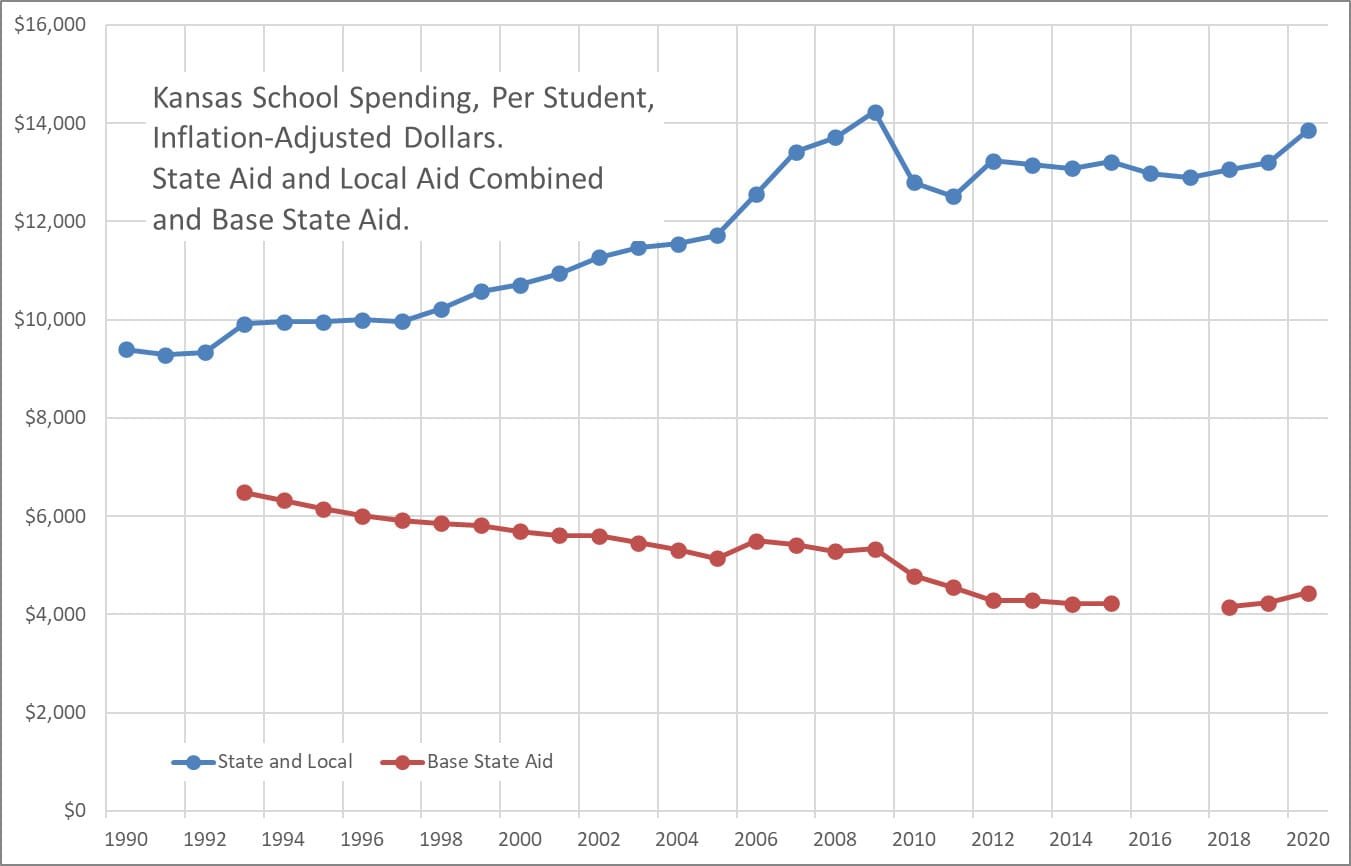
As can be seen in the chart, base state aid has declined, but total state spending has increased.

Why do school spending supporters focus only on base state aid? Its decline provides the grain of truth for their larger and false argument about school spending. As explained in Kansas school spending: the deception this grain of truth enables school spending advocates like Mark Desetti (Director of Legislative and Political Advocacy at Kansas National Education Association (KNEA), our state’s teachers union) to be accurate and deceptive, all at the same time.

Finally, people want schools and students to succeed. Our future depends on it. A good education is a valuable investment. So there’s a built-in bias in favor of schools, and school spending advocates use this to their advantage. Anyone who simply brings attention to the facts — not to mention criticism — is blasted as “anti-education” or “anti-child.”

People are shocked when they learn the level of spending by schools. When they — either through their own observations or measures of student achievement — compare that spending to the product produced by public schools, citizens become truly alarmed — and they should be.

Base state aid compared to Kansas state spending and total spending. State and total spending has risen even though base state aid is mostly flat.

{ 1 comment }

Kansas Democrats wrong on school spending

by Bob Weeks on October 28, 2012

While the Kansas Democratic Party apologized last week for misstating candidates’ voting record on two mail pieces, the party and its candidates continue a campaign of misinformation regarding spending on Kansas public schools.

Many of the allegations are made against Kansas Governor Sam Brownback for purportedly cutting school spending. An example is on the Kansas Democratic Party Facebook page, which can be seen nearby.

As part of the party’s website, on a page titled Restore Education Funding, Kansas Democrats make this claim:

An Education Fact

Between FY2008-2009 and FY2011-2012, general state aid to education was cut by nearly $400 million. In just thee [sic] years, that’s a reduction of $620 for every schoolchild in the state.

This claim is repeated on candidates’ web sites, such as this example from senatorial candidate Tim Snow, which reads: “In the last three years, conservatives in Topeka have slashed education spending by $620 per student.”

The problem is that these claims aren’t factual. Consider the numbers from the Kansas Democrat website. In 2008-2009 Kansas state spending on schools was $3,287,165,278, according to the Kansas State Department of Education. In 2011-2012, that figure was $3,184,163,559. That’s a difference of $103,001,719, which is a long way from $400 million, the number claimed by Democrats.

Looking at spending per pupil figures, the change was from $7,344 to $6,983. That’s $361, not $620 as Democrats claim.

The Democrats are also considering only Kansas state spending on schools, neglecting federal and local sources of funds. In the 2008-2009 and 2009-2010 schools years, federal aid soared as a result of the Obama stimulus program. These funds almost made up for the decline in state spending, meaning that total spending on Kansas schools declined only slightly.

(You’d think that Kansas Democrats would want to remind us of the supposedly wonderful things the Obama stimulus accomplished, but evidently not when the facts are inconvenient.)

Then, who was Kansas governor during the years that Kansas state spending on schools declined? Kathleen Sebelius and Mark Parkinson. They’re Democrats, I believe.

There are more examples of Democrats misleading Kansans. Here’s Senate Minority Leader Anthony Hensley: “But Gov. Brownback is acting on the assumption that schools aren’t stretching every dollar to the last cent, even after he made the largest cut to public education in Kansas history.” (Dems seek input from parents, educators on impact of school funding cuts.) (emphasis added)

Paul Davis, the Kansas House of Representatives Minority Leader, was quoted in the Lawrence Journal-World as saying “Instead of hosting an online forum to complain about public schools, why not discuss all the innovative ways our teachers and administrators have done more with less since Gov. Brownback implemented the largest cut to education funding in Kansas history?” (emphasis added)

Hensley and Davis are two of the top Democrats in Kansas, absolutely so in the Kansas Legislature.

It’s easy to understand why Democrats focus on school spending. It’s easy to persuade parents — and anyone, for that matter — that if we want the best for Kansas schoolchildren, we need to spend more.

More spending in schools means more spending in largely Democratic hands, and more public sector union members, a key Democratic constituency.

The school spending advocates have done a good job promoting their issue, too. On a survey, not only did Kansans underestimate school spending levels, they did so for the state portion of school funding, and again for the total of all funding sources — state, federal, and local. Kansans also thought spending had declined, when it had increased. See Kansans uninformed on school spending. Similar findings have been reported across the country.

Spending more on schools is seen as an easy way to solve a problem. But the problems facing Kansas schools will require different approaches, and the Kansas school establishment won’t consider them. For a list of reforms that are needed, but resisted, see Kansas school reform issues.

Kansas Democrats should consider themselves fortunate that our governor isn’t pressing for the reform that Democrats really hate: school choice.

{ 0 comments }

Kansas school test scores haven’t declined, despite early reports

October 1, 2012

Kansas state test scores didn’t fall in 2012, contrary to first reports. Let’s hope Kansas National Education association, our state’s teachers union, takes notice.

Read the full article →

Kansas school test scores should make us think

September 24, 2012

Kansas public school test scores have declined. This should cause us to ask two questions: why have the scores been rising, and does Kansas do as well as is claimed?

Read the full article →

At Kansas Board of Education, some questions aren’t allowed

September 20, 2012

At a meeting of the Kansas Board of Education, chair David Dennis uses his authority to bury topics the public school bureaucracy doesn’t want mentioned.

Read the full article →

Steve Rose defends Kansas school spending

August 15, 2012

Attitudes toward Kansas public schools, or facts about them: Which is most important? For boosters of the Kansas school spending establishment, attitude is all that matters.

Read the full article →

Kansas reasonable: The education candidates

July 26, 2012

In Kansas, who are the candidates and special interest groups that have a reasonable approach to education?

Read the full article →

Wichita school spending

July 25, 2012

A statement by Wichita school superintendent John Allison is part of an ongoing campaign of misinformation spread by school spending advocates in Wichita and across Kansas.

Read the full article →