Janet Miller

Wichita City Council sets hotel tax election date

by Bob Weeks on December 26, 2011

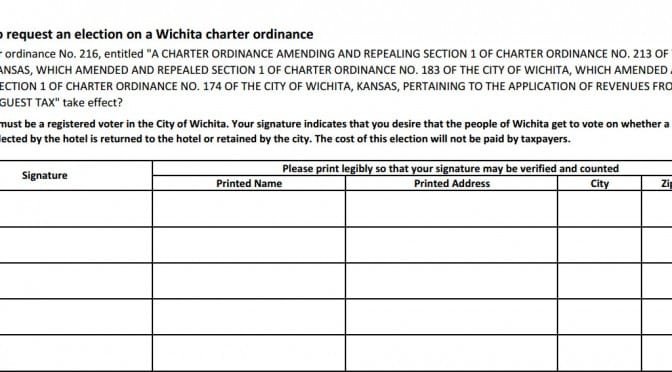
In response to a successful petition effort aimed at overturning a Wichita charter ordinance, the Wichita City Council last week considered an agenda item that gave the council two choices: Rescind the ordinance, or set a date for an election. The charter ordinance concerns rebating a portion of the Ambassador Hotel’s guest tax collections back to the hotel for its own use.

The most important issue to the council seemed to be holding the election on a date convenient to the hotel developers. The recommendation from Sedgwick County Election Commissioner Tabitha Lehman was that the election, if the council decides to hold it, should be on February 28, 2012.

During discussion, Council Member Pete Meitzner (district 2, east Wichita) wanted to move the election to an earlier date so as to “avoid community discourse and debate.”

Council Member Janet Miller (district 6, north central Wichita) asked a series of questions designed to produced a response that if the election were held earlier, and if that would make it more expensive, would the developer have to pay these extra costs? (The agreement with the city states hotel developers are responsible for the cost of the election, which has been estimated at $50,000.)

She also expressed concern over “dragging this out,” and said she wants to “get it over with as soon as we can so that we can move on.” She assumed that the developer would like to have the issue resolved as soon as possible.

Vice Mayor Lavonta Williams (district 1, northeast Wichita) asked the hotel developers if they would agree to pay extra to hold the election sooner. David Burk appeared on behalf of the hotel development team, and said he would like to see the election held as soon as possible, and would pay additional for that. He said it is “hard on our community,” and that “each day that goes by we’re casting a bad sign on future development in downtown, and in Wichita in general.”

Council Member Jeff Longwell (district 5, west and northwest Wichita) framed the issue as the election commissioner needing more time “beyond what is required by law.” He suggested that the item be delayed until later in the meeting and that the election commissioner be summoned to appear before the council. A motion was made to that effect, and it passed.

When the election item was continued later in the meeting, Longwell engaged Commissioner Lehman in a series of questions attempting to manage the election calender for her. Lehman explained the various reasons as to why February 28 is a reasonable date for the election. The Kansas Secretary of State’s office has agreed with this assessment, she added.

In his remarks, Mayor Carl Brewer said: “This is an issue that really — there’s a lot of things that are going on in the dynamics of this entire thing. And when we have a special election, I believe that this council and the community deserve the right to be able to have it — have an election as quickly as possible. By doing that, it eliminates a lot of turmoil inside the community, unrest. But trying to be fair and giving individuals a fair — coming and going — with a fair process, so that every citizen can be heard. And so the sooner you can actually do it, the better off that we are.”

The mayor made a motion to set the election date as February 28, and it passed with all members except Williams voting in favor.

Discussion

This episode provided another example reinforcing the realization that Wichita has a city council — with the exception of one member, Michael O’Donnell (district 4, south and southwest Wichita) — that is entirely captured by special interests. In this case the special interests are a hotel development team consisting of partners who have made significant campaign contributions to many members of the Wichita city council.

An example: While city attorney Gary Rebenstorf explained to the council that one option was to rescind the ordinance, there was no discussion of that among council members.

Another example was the measures the council went through to try and get an early election date, something that many observers feel favors the hotel developers. In particular, it was disconcerting to see Longwell attempt to micromanage the Sedgwick County Election Commissioner. He has no business doing that, especially when his motive is so transparent.

And why would the council be so eager to please the hotel developers and their desired election date? Don’t the desires and concerns of the other side have any relevance? To this council, the answer is no.

Perhaps the worst impression to come out of this meeting is that many Wichita city council members simply don’t care much for what citizens think. It’s hard to pick the most telling example, but Meitzner’s concern that we need to “avoid community discourse and debate” ranks right at the top. To Meitzner, it seems that things like discussing and debating issues are harmful, if they would get in the way of satisfying his campaign contributors, or his vision for molding the future of Wichita from the top down.

The rest of the council members, with the exception of O’Donnell, deserve scorn as well.

Then there are the mayor’s remarks. He spoke of giving individuals a “fair process” so that they may be heard, but also that the election needs to be held quickly. These two goals contradict each other.

Mayor Brewer also repeated his practice of making vague criticisms of his opponents without being specific, this time referring to “lot of things that are going on in the dynamics of this entire thing.” Brewer — perhaps in an effort to maintain a sense of decorum or apparent integrity — usually does not mention the names of those he criticizes or specifics of the issues involved. This allows him to appear noble, but without being accountable to actual people — and on the specifics of actual issues — for the things he says.

{ 7 comments }

Wichita’s political class

by Bob Weeks on December 9, 2011

From June.

The discussion at yesterday’s Wichita City Council meeting provided an opportunity for citizens to discover the difference in the thinking of the political class and those who value limited government and capitalism.

At issue was Mid-Continent Instruments, Inc., which asked the city for a forgivable loan of $10,000. It received the same last week from Sedgwick County. According to city documents, the State of Kansas through its Department of Commerce is also contributing $503,055 in forgivable loans, sales tax exemptions, training grants, and tax credits.

At the city council meeting Clinton Coen, a young man who ran for city council earlier this year, spoke against this measure, which he called corporate welfare.

In response to Coen, Council Member James Clendenin (district 3, south and southeast Wichita) asked if we should ignore companies that want to do business here, or should we allow them to leave? Implicit in the question is that the threat dangled by Mid-Continent is real: that unless the city gives them $10,000, they will expand somewhere else. How citizens and council members feel about this issue largely depends on their perceived genuineness of this threat.

When Coen recommended that the city cut spending, Clendenin said “I can guarantee you, from what I have seen, this city government has cut a tremendous amount of spending.” When pressed by Coen for examples of cuts, he demurred. Clendenin also said that the $10,000 is needed to show the city’s commitment to the company.

Perhaps coming to the rescue of her younger and less experienced colleague, Council Member Janet Miller asked City Manager Bob Layton how much has been cut from the budget, and he replied “we’ve cut over $20 million in the general fund over three years.”

In saying that, Layton is using the language and mind-set of bureaucrats and politicians. In this world, it’s a cut if spending does not rise as fast as planned or hoped for. As you can see from the accompanying chart, Wichita general fund spending has not been cut in recent years. It has risen in each of the last three years, and plans are for it to keep rising.

Wichita general fund spending

This illustrates a divide between the thinking of the political class and regular people. Blurring the distinction between plans and reality lets politicians and bureaucrats present a fiscally responsible image — they cut the budget, after all — and increase spending at the same time. It’s a message that misinforms citizens about the important facts.

Miller also praised the return on investment the city receives for its spending on economic development, citing Wichita State University Center for Economic Development and Business Research and the cost-benefit calculations it performs. These calculations take the cost of providing the incentives and compare it to the returns the city and other governmental entities receive.

What is rarely mentioned, and what I think most people would be surprised to learn, is that the “returns” used in these calculations is manifested in the form of increased tax revenue. It’s not like in the private sector, where business firms attempt to increase their sales and profits by providing a product or service that people willingly buy. No, the city increases its revenue (we can’t call it profit) by collecting more taxes.

It’s another difference between the political class and everyone else: The political class craves tax revenue.

Aside from this, the cost-benefit calculations for the city don’t include the entire cost. The cost doesn’t include the county’s contribution, the majority of which comes from residents of its largest city, which is Wichita. Then, there’s the half-million in subsidy from the state, with a large portion of that paid for by the people of Wichita.

But even if you believe these calculations, there’s the problem of right-sizing the investment. If an investment of $10,000 has such glowing returns — last week Sedgwick County Commissioner Jim Skelton called the decision a “no-brainer” — why can’t we invest more? If we really believe this investment is good, we should wonder why the city council and county commission are so timid.

Since the applicant company is located in his district, Council Member Pete Meitzner (district 2, east Wichita), praised the company and the state’s incentives, and made a motion to approve the forgivable loan. All council members except Michael O’Donnell (district 4, south and southwest Wichita) voted yes.

Going forward

While the political class praises these subsidies and the companies that apply for them, not many are willing to confront the reality of the system we’re creating. Some, like O’Donnell and Sedgwick County Commissioner Richard Ranzau, have recognized that when government is seen as eager to grant these subsidies, it prompts other companies to apply. The lure of a subsidy may cause them to arrange their business affairs so as to conform — or appear to conform — to the guidelines government has for its various subsidy programs. Companies may do this without regard to underlying economic wisdom.

We also need to recognize that besides simple greed for public money, businesses have another reason to apply for these subsidies: If a publicly-traded company doesn’t seek them, its shareholders would wonder why the company didn’t exercise its fiduciary duty to do so. But this just perpetuates the system, and so increasing amounts of economic development fall under the direction of government programs.

While most people see this rise in corporate welfare as harmful — I call it a moral hazard — the political class is pleased with this arrangement. As Meitzner said in making his motion, he was proud that Wichita “won out” over the other city Mid-Continent Instruments considered moving to.

Another harmful effect of these actions is to create a reputation for having an uncompetitive business environment. Not only must businesses of all types pay for the cost of these subsidies, some face direct competition by a government-subsidized competitor. This is the situation Wichita-area hotels face as a result of the city granting millions in subsidy to a hotel developer to build a Fairfield Inn downtown.

Even those not in direct competition face increased costs as they attempt to hire labor, buy supplies, and seek access to capital in competition with government-subsidized firms. Could this uneven competitive landscape be a factor that business firms consider in deciding where to locate and invest?

We can expect to see more government intervention in economic development and more corporate welfare. Former council member Sue Schlapp in April took a job with the Kansas Department of Commerce. Her job title is “senior constituent liaison,” which I think can be better described as “customer service agent for the corporate welfare state.” Her office is in Wichita city hall.

Increasingly we see politicians and bureaucrats making decisions based on incorrect and misleading information, such as claiming that the city’s general fund budget has been cut when spending has increased. Sometimes they are fed incorrect information, as in the case of a presentation at Sedgwick County Commission that bordered on fraudulent.

Sometimes, I think, officeholders just don’t care. It’s easiest to go along with the flow and not raise ripples. They participate in groundbreakings and get their photograph in the newspaper and on television that way. Which brings up an important question: why do none of our city’s mainstream media outlets report on these matters?

{ 2 comments }

AFP meeting features former Congressman Tiahrt. Tonight’s (October 10th) meeting of Americans for Prosperity, Kansas features former United States Representative Todd Tiahrt speaking on “How regulations affect our economy.” There will be a presentation followed by a group discussion. Tiahrt represented the fourth district of Kansas from 1995 to 2011. He is presently our states Republican National Committeeman. … This free meeting is from 7:00 pm to 8:30 pm at the Lionel D. Alford Library located at 3447 S. Meridian in Wichita. The library is just north of the I-235 exit on Meridian. The event’s sponsor is Americans for Prosperity, Kansas. For more information on this event contact John Todd at john@johntodd.net or 316-312-7335, or Susan Estes, AFP Field Director at sestes@afphq.org or 316-681-4415.

Government planning. In an address from 1995, Gerald P. O’Driscoll Jr. spoke on Friedrich Hayek and his ideas on government interventionism. His conclusion should be a caution to those — such as Wichita City Council members and city hall bureaucrats — who believe they can guide the economic future of Wichita through interventions such as TIF districts, grants, forgivable loans, tax credits, tax abatements, sweetheart lease deals, eminent domain, zoning, and other measures: “In all his work, Hayek focused on the self-ordering forces in society. Hayek’s fellow Nobel laureate Kenneth Arrow has suggested that ‘the notion that through the workings of an entire system effects may be very different from, and even opposed to, intentions is surely the most important intellectual contribution that economic thought has made to the general understanding of social processes.’ The Arrovian formulation echoes Adam Smith’s observation that, as a consequence of the interaction of conflicting interests, man is ‘led by an invisible hand to promote an end which was no part of his intention.’ The classic Hayekian statement visualizes economics as analyzing ‘the results of human action but not of human design.’ The economic conception of society is an affront to the conceit of those who would impose order from above. Economic forces defy the will of authoritarians seeking to mold social outcomes. Human beings respond to each government intervention by rearranging their lives so as to minimize its disruptive effects. The resulting outcome may thus be different from and even opposed to the intention of the intervention.” The full lecture is at The Meaning of Hayek.

Longwell joins Democrats to defeat Republicans. While Wichita city council members are officially non-partisan — meaning they don’t run for election as members of political parties — most members are closely identified with a party. Some, like Jeff Longwell (district 5, west and northwest Wichita), see themselves as leaders in their parties, the Republican Party in this case. Last week, however, Longwell joined with the three Democrats on the Wichita City Council to oppose the votes of three Republicans. (There was a nuance to that vote, but nonetheless Longwell voted with the Democrats.) On Sunday he teamed with left-wing Council Member Janet Miller (district 6, north central Wichita) to write an op-ed that appeared in The Wichita Eagle (Grant helps region). The piece approved increased federal government spending, increased federal government control, and increased centralized planning.

Optimal size of government. Is government too large? Yes, and trying to determine an optimum size for government is impossible. So says a new policy briefing paper from the Center for Global Liberty and Prosperity, a project of the Cato Institute.

Can We Determine the Optimal Size of Government? by James A. Kahn. In the executive summary, we can read this: “The massive spending programs and new regulations adopted by many countries around the world in response to the economic crisis of 2008 have drawn renewed attention to the role of government in the economy. Studies of the relationship between government size and economic growth have come up with a wide range of estimates of the ‘optimal’ or growth-maximizing size of government, ranging anywhere between 15 and 30 percent of gross domestic product (GDP).

This paper argues that such an exercise is ill conceived. Modern growth economics suggests, first, that government policies leave their long-term impact primarily on the level of economic activity, not the growth rate; and, second, that the sources of this impact are multi-dimensional and not necessarily well measured by conventional measures of ‘size,’ such as the share of government spending in GDP.

In fact, measures of economic freedom more closely relate to per capita GDP than do simple measures of government spending. The evidence shows that governments are generally larger than optimal, but because the available data include primarily countries whose governments are too large, it cannot plausibly say what the ideal size of government is. The data can realistically only say that smaller governments are better, and suggest that the optimal size of government is smaller than what we observe today.”

Steve Jobs. What is his legacy? From Richard A. Viguerie: “Steve Jobs, Apple Computer’s late founder and CEO, gave the vast majority of his hundreds of thousands of dollars in political contributions to liberal Democrats, such as Nancy Pelosi, Ted Kennedy and California Governor Jerry Brown. Yet it is hard to think of a 21st Century entrepreneur who has done more to empower individuals and free them from the demands of the liberal collective than Steve Jobs did through the invention of the iPod, and iPad and the popularization of personal computing. Through the innovative products Apple brought to market, Jobs proved the collectivist premise of John Kenneth Galbraith’s The Affluent Society to be both absolutely true and utterly wrong.” … More at Steve Jobs’ Conservative Legacy.

Lieutenant Governor in Wichita. This week’s meeting (October 14th) of the Wichita Pachyderm Club features Lieutenant Governor Jeff Colyer, M.D. speaking on “An update on the Brownback Administration’s ‘Roadmap for Kansas’ — Medicaid Reform” … Upcoming speakers: On October 21st: N. Trip Shawver, Attorney/Mediator, on “The magic of mediation, its uses and benefits.” … On October 28th: U.S. Representative Tim Huelskamp, who is in his first term representing the Kansas first district, speaking on “Spending battles in Washington, D.C.” … On November 4th: Chris Spencer, Vice President, Regional Sales Manager Oppenheimer Funds, speaking on “Goliath vs Goliath — The global battle of economic superpowers.” … On November 11th: Sedgwick County Commission Members Richard Ranzau and James Skelton, speaking on “What its like to be a new member of the Sedgwick County Board of County commissioners?” … On November 18th: Delores Craig-Moreland, Ph.D., Wichita State University, speaking on “Systemic reasons why our country has one of the highest jail and prison incarceration rates in the world? Are all criminals created equal?”

When governments cut spending. Advocates of government spending argue that if it is cut, the economy will suffer. Is this true? Is government spending necessary to keep the economy functioning? “There is no historical credence to this very popular idea that cutting spending now will actually slow down the economy and actually lead to a double dip recession or an increase in economic stagnation.” This is the conclusion of Dr. Stephen Davies in a short video. As one example — he cites others — Davies explains that there was fear in the United States that the end to massive government spending during World War II would lead to a return of the Great Depression. “In fact, as we know, exactly the opposite happened. As the defense spending of the war years was wound down, and as government was pulled back in other ways as well under the Truman and Eisenhower administrations, the result was an enormous period of sustained growth in the United States and other countries that went through a similar process.” Davies says that economic growth accelerates when government reduces its spending. Reasons include the greater productivity of private sector spending as compared to government spending, and increased confidence of private sector investors. … The video is from LearnLiberty.org, a project of Institute for Humane Studies.

{ 1 comment }

At Wichita City Council, facts are in dispute

by Bob Weeks on September 20, 2011

Some Wichita City Council members, including Mayor Carl Brewer criticize people who speak at council meetings for using inaccurate information. Although most citizens who speak are willing to take questions at the time they present their testimony, most council members will not engage in dialog with them, instead choosing to level their criticism at a time when the speakers are not able to defend themselves.

So let’s take a look at some of the statements made by city council members at the September 13th meeting, where the council approved by a six to one vote a package of incentives for the Douglas Place project, a downtown hotel.

James Clendenin

At the September 13th meeting, James Clendenin (district 3, south and southeast Wichita) said “I heard a lot of misinformation, and I heard a lot of good information.” He seemed to be most interested in the jobs that the hotel will create. Referring to the contention that the hotel will create 100 jobs, he said: “That’s all people ask me about — how many jobs. Just tell me jobs. I want to know jobs — jobs, jobs, jobs — people want to know jobs. I know that when Old Town was started 20 years ago, no jobs where in that part of the city. 20 years later we have jobs. … But I see people employed 20 years later that would never would have been employed unless a developer stepped up.”

I can understand the concern for jobs and how council members want to be seen doing things that they believe will create jobs. But it’s difficult to see how this hotel will create new jobs, except perhaps on the several times each year that the hotel might be used to support the larger conventions the city hopes to draw.

Instead, it’s much more likely that the hotel will simply draw most of its customers from the pool of people already planning to come to Wichita. And this hotel will have a big advantage in competing for these existing customers, especially those looking for a high-end hotel. As reported in the Wichita Eagle, the hotel developers said that without the city subsidy, the rooms would cost $250 per night. Their plans, however, are to offer the rooms for $150.

So with the help of taxpayers, the developers get to offer a $250 product for $150. That’s quite a competitive boost. My research shows that currently there are four downtown Wichita hotels offering rooms at that rate or higher. I wonder how they will feel when undercut by a taxpayer-subsidized competitor? (First, the owners of these hotels will have to realize that they, too, have received substantial subsidy.)

As to the impact of subsidies like Tax increment financing, or TIF: The important paper Tax Increment Financing: A Tool for Local Economic Development by Richard F. Dye and David F. Merriman comes to these conclusions:

If the use of tax increment financing stimulates economic development, there should be a positive relationship between TIF adoption and overall growth in municipalities. This did not occur. If, on the other hand, TIF merely moves capital around within a municipality, there should be no relationship between TIF adoption and growth. What we find, however, is a negative relationship. Municipalities that use TIF do worse.

We find evidence that the non-TIF areas of municipalities that use TIF grow no more rapidly, and perhaps more slowly, than similar municipalities that do not use TIF. (emphasis added)

Later, the paper concluded: “TIF subsidies might be helping growth within the TIF district, but they are hurting growth outside the district by a larger amount.”

This paper addresses economic growth, which is not, strictly speaking, equivalent to jobs, although the two are closely related. A paper that does address the impact of TIF on jobs is from Paul F. Byrne of Washburn University. The title of the report is Does Tax Increment Financing Deliver on Its Promise of Jobs? The Impact of Tax Increment Financing on Municipal Employment Growth, and in the abstract we find this conclusion regarding the impact of TIF on jobs:

Increasingly, municipal leaders justify their use of tax increment financing (TIF) by touting its role in improving municipal employment. However, empirical studies on TIF have primarily examined TIF’s impact on property values, ignoring the claim that serves as the primary justification for its use. This article addresses the claim by examining the impact of TIF adoption on municipal employment growth in Illinois, looking for both general impact and impact specific to the type of development supported. Results find no general impact of TIF use on employment. However, findings suggest that TIF districts supporting industrial development may have a positive effect on municipal employment, whereas TIF districts supporting retail development have a negative effect on municipal employment. These results are consistent with industrial TIF districts capturing employment that would have otherwise occurred outside of the adopting municipality and retail TIF districts shifting employment within the municipality to more labor-efficient retailers within the TIF district. (emphasis added)

I would ask that council member Clendenin and the others read research like this before they come to their conclusions.

Furthermore, we might ask the hotel developers if they are going to run their hotel as a jobs program, or are they going to seek to minimize the use of labor, employing only as much as is required to run the hotel the way they want? In a competitive marketplace, this is what businesses are forced to do, if they want to stay in business.

Finally, the contention of Clendenin that there are people who are employed only because of Old Town is laughable.

Pete Meitzner

Newly-elected council member Pete Meitzner (district 2, east Wichita) seemed impressed and secure in that the hotel developers have agreed to personally guarantee any shortfall in property tax revenue below what is necessary to cover the payments on the bonds the city is issuing under tax increment financing.

This guarantee is quite unlikely to ever be tapped, and is an example of offering something at little risk and no cost to the developers. Then, gullible city council members lap it up.

Here’s how the arithmetic works: According to city documents, the projected debt service required to pay the TIF bonds in 2016 is $340,000. For the same year, the projected revenue from the hotel’s property tax that is applicable to the TIF bond repayments is $262,000. (Remember these property taxes are taxes the hotel must pay, no matter what they’re used for.)

For the hotel owners to become in a position where they would have to pay to cover a shortfall, the value of the hotel would have to drop by 23 percent. That’s not likely to happen, and if something like that did, it would be a signal of severe problems across the entire city, or country, for that matter.

Jeff Longwell

Speaking from the bench when he could not be rebutted by citizens, Council Member Jeff Longwell criticized citizens who testified, saying they are using “wrong numbers.” Longwell’s criticisms deserve scrutiny.

During the council meeting, there were several ratios presented as a way to evaluate the hotel, and Longwell confused them. He said: “You can argue if it’s 6 to 1, or 5 to 1, but I’ll tell you, even if it’s as low as 2.6 to 1 return, folks, that’s a great investment.”

The 6 to 1 ratio is the ratio of private investment to public investment, as calculated by the city.

The 2.6 to 1 return is a payback to the city, based on expected increased tax revenues compared to the city’s cost. This is calculated by the Wichita State University Center for Economic Development and Business Research.

The 6 to 1 ratio is based on balance sheet concepts. It refers to assets.

The 2.6 to 1 ratio is a calculation from an income statement. It refers to income relative to expenses.

The only conclusion to draw is that Longwell is sorely confused. Perhaps worse, Allen Bell, Wichita’s Director of Urban Development had just explained these numbers in response to a question by Meitzner. But Bell didn’t correct Longwell. Neither did the city manager, who undoubtedly knows the difference between the two sets of numbers.

Besides this, the 6 to 1 ratio is calculated using an extremely narrow view of the city’s investment in the project, and an overly expansive assessment of the developer’s investment. It ignores many subsidies being provided to the developers, some at city expense, and also at the expense of state and federal taxpayers.

Further, for that ratio to make any sense, you have to assume city ownership of the hotel. “We” — meaning the city of Wichita — don’t own the “6″ part of the ratio. The hotel developers do. It’s not a public asset.

Janet Miller

Like Clendenin and Longwell, Council Member Janet Miller (district 6, north central Wichita) criticized the inaccurate information presented by citizens: “A lot of the information that was shared this morning was not accurate. … I’m not going to be able to address everything.”

Here’s an example of the reasoning of Miller. Referring to the issue of tax money being diverted to the Douglas Place project, she said: “Other taxes, such as the historic and federal tax credits are not property taxes, they’re not sales taxes, those are credits toward income taxes. So unless you’re paying the income taxes those are not your taxes.”

Here Miller is ignoring the effect of tax credits on the budgets of states and the federal government. Tax credits reduce the revenue of the issuing body by the amount of the credit. So when the state of Kansas issues $3,800,000 in tax credits to the Douglas Place project, it reduces revenue to the state by that same amount.

Now if the state were to reduce its spending by that same amount, specifically based on the issuance of this tax credit, we’d be left with no impact on the state’s budget.

But the state isn’t going to to that — it never has. So taxpayers across the state must make up the difference — directly contradicting Miller’s contention that “those are not your taxes.”

The same reasoning applies to the federal tax credits of $3,500,000 that this project is seeking.

Miller also contended that the guest taxes paid by this hotel are “not your taxes.” According to the city’s budget, the purpose of the Tourism and Convention Fund, which is funded by the guest tax, is to “support tourism and convention, infrastructure, and promotion of the City.” Its outlined priorities are to be “debt service for tourism and convention facilities, operational deficit subsidies, and care and maintenance of Century II.”

So, yes, I would say that the guest tax is “our” tax. There are those who are asking for millions to renovate Century II. Since this hotel’s guest tax — most of it — will not be going to that goal, someone else has to pay.

Further, to the extent that the new hotel draws guests from other hotels, that guest tax is being diverted away from the Tourism and Convention Fund. (Of course, we have to remember that many other hotels have a similar deal to benefit from their guest taxes. Last year the city gifted the Fairfield Inn & Suites Wichita Downtown, part of the heavily subsidized WaterWalk project, $2,500,000, to be paid back by the hotel’s guest tax receipts.)

Miller also took issue with those who contend that the original plan called for Key Construction to build the parking garage: “While there was a general contractor, and that part of the project would not have been bid out, the rest of it would have been bid thorough the city’s process. So the vast majority, except for about 6 percent of the project, would have been bid out through the city’s bid project.”

Miller is specifically contradicted by the letter of intent that she voted for at the August 9th meeting of the council. The letter states: “Douglas Place LLC, will acquire and rehabilitate the Douglas Building and will construct the parking garage and urban park.”

Does she think that the principals of Key Construction — who are part of the development team of the Douglas Place project, and who have made heavy campaign contributions to Miller and others — would let someone else build the garage?

Furthermore, at the same meeting City Attorney Gary Rebenstorf said it was the developer’s preference that the garage be built without competitive bidding — again contradicting Miller’s contention that the garage would be bid on.

And if we take Miller’s statement at face value — “the vast majority, except for about 6 percent of the project, would have been bid out” — does this imply that 94 percent of the project will be bid out? This would imply that the hotel itself would be placed for public bid, and I don’t think there’s been any consideration of that.

Miller also addressed the issue of special assessment financing. That is part of the Douglas Place project, with $1,500,000 to be used for facade improvement and lead paint and asbestos removal. Miller said: “Just as a reminder: The facade improvement and asbestos removal expenses, all of that — those dollars are being repaid through special assessments. For those of you who are critical of special assessment financing, I would encourage you to look at your annual tax bill and see if it says special assessment on there. If it does, we have loaned your developer money to put in public improvements around your property. There’s a very large share of Wichita’s outstanding debt that is developers’ specials. So if we want to be critical of developers specials, that’s gonna be a really big conversation that will include all the housing developers in this city and how those dollars are lent and repaid over years.”

There’s a big distinction between the way special assessment financing is used for new development as compared to this project. On new developments, special assessment financing is used to pay for public improvements like streets, sewers, water mains, and storm water drainage. After they are built, these assets are then owned by the city. They become city assets, but were paid for by the developer.

That’s not going to happen with this hotel. Its owners will not deed over the building’s facade to the city. It will remain a private asset.

Furthermore, in new development, the assets that special assessment financing is used to pay for support development that generally ends up on the tax roles, providing the tax revenue stream that city council members promote as good. But not so with this hotel. Being in a TIF district, its property taxes — except for 30 percent — do not benefit the city, as they are used to benefit the developers.

{ 5 comments }

In Wichita, private tax policy on the rise

by Bob Weeks on September 12, 2011

In a free society with a limited government, taxation should be restricted to being a way for government to raise funds to pay for services that all people benefit from. An example is police and fire protection. Even people who are opposed to taxation rationalize paying taxes that way. But in the city of Wichita, private tax policy is overtaking our city.

The Douglas Place project, a downtown hotel to be considered tomorrow by the Wichita City Council, makes use of several of these private tax policy strategies.

By private tax policy, I mean that the proceeds of a tax are used for the exclusive benefit of one person (or business firm), instead of used for the benefit of all. And in at least one case, private parties are being allowed to determine the city’s tax policy at their discretion.

The taxes collected by this private tax policy is still collected under the pretense of government authority. But instead of going to pay for government — things like police, fire, and schools — the tax is collected for the exclusive benefit of one party, not the public.

In Wichita and across Kansas, one example of taxation being used for the benefit of one person or business is the Community Improvement District (CID). Under this program, the business collects an extra tax that looks just like sales tax. Except — the proceeds of the extra CID tax are funneled back for the exclusive benefit of the people who own property in the district. The Douglas Place project is asking to collect an extra tax of two cents per dollar for its own benefit.

CIDs are a threat to unsuspecting customers who likely won’t be aware of the extra tax they’ll be paying until after they complete their purchases, if at all. Wichita decided against disclosing to citizens the amount of tax they’ll be paying with signage on stores. Instead, the city settled for a sign that says nothing except to check a city website for information about CIDs.

CIDs also present the City of Wichita as a high-tax place to live and do business. It’s a risk to our city’s reputation. Especially when you consider the Jeff Longwell strategy, which is that since these taxes are often used by hotels and other businesses that cater to visitors, Wichitans don’t pay them as much as do visitors.

Another example of private tax policy is when a tax such as Wichita’s hotel guest tax is redirected from its original goal. According to a description of the Tourism and Convention Fund in the city’s budget, the goal of the guest tax is to “support tourism and convention, infrastructure, and promotion of the City.” Its priorities are to be “Fund priorities are: 1) debt service for tourism and convention facilities, 2) operational deficit subsidies and 3) care and maintenance of Century II.”

But in the case of the Douglas Place project, the city is asking for a charter ordinance to be passed that would route 75 percent of this tax directly back to the Douglas Place owners. That’s not the proclaimed purpose of the guest tax, unless we consider private hotels to be part of the city’s tourism infrastructure. (I think some people think that way.)

At least in the case of Douglas Place the city is being more upfront with its citizens. The charter ordinance requires a two-thirds vote of the city council for passage, a higher bar than in the past. And, the city isn’t borrowing money to give to the hotel. That’s what the city has done in the past, as in the case of the Fairfield Inn & Suites Wichita Downtown that is part of the WaterWalk project. One of the many layers of subsidy going in to that hotel was that the city simply gifted the hotel $2,500,000, to be paid back by the hotel’s guest tax receipts.

Some will say that’s not really a gift, as the hotel will pay back the loan. But the loan is being repaid with taxes the hotel — more properly, its guests — must pay anyway. This is public taxation for private enrichment.

If you need further evidence that the city is turning over taxation to private hands, consider this: The charter ordinance is subject to a protest petition, and if sufficient signatures are gathered, the city council would have to either overturn the ordinance or hold an election to let the people decide.

Now, if such a tax is truly in the public interest, the city would hold such an election and bear its costs itself. But that’s not the case. In the agreement between the city and the Douglas Place developers, we see this: “If Developer requests a special election solely for the purpose of passing the charter ordinance in the event a sufficient protest petition is submitted, Developer shall reimburse the City for the actual out of pocket costs and expenses of conducting such election.”

In other words, the city is turning over to private interests the decision as to whether to have such an election. At least the citizens of Wichita won’t have to pay for it, if such an election happens.

Another example of private tax policy that the Douglas Place project is using is Tax increment financing, or a TIF district. This mechanism routes property taxes back to the development. In the case of Douglas Place, $3,325,000 of its own property taxes are being used to pay for its parking garage. That’s a deal most citizens can’t get.

Normally property taxes are used for the general operation of government. Not so in TIF districts, another example of public taxation for private enrichment. Again, these are taxes that the property must pay anyway.

Private taxation funds political entrepreneurship

In Wichita, especially in downtown, we see the rise of private tax policy, that is, the taxation power of government being used for private purposes. This private tax policy is pushed by Wichita’s political entrepreneurs. These are the people who would rather compete in the realm of politics rather than in the market.

Examples of Wichita’s political entrepreneurs include the developers of Douglas Place: David Burk of Marketplace Properties, and the principals of Key Construction.

Competing in the political arena is easier than competing in the market. To win in the political arena, you only have to convince a majority of the legislative body that controls your situation. Once you’ve convinced them the power of government takes over, and the people at large are forced to transfer money to the political entrepreneurs. In other words, they must engage in transactions they would not elect to perform, if left to their own free will.

In the free marketplace, however, entrepreneurs have to compete by offering products or services that people are willing to buy, free of coercion. That’s hard to do. But it’s the only way to gauge whether people really want what the entrepreneurs are selling.

One of the ways that political entrepreneurs compete is by making campaign contributions, and the developers of Douglas Place have mastered this technique. Key Construction principles contributed $13,500 to Mayor Carl Brewer and four city council members during their most recent campaigns. Council Member Jeff Longwell alone received $4,000 of that sum, and he also accepted another $2,000 from managing member David Burk and his wife.

All told, Burk and his wife contributed at least $7,500 to city council candidates who will be voting whether to give Burk money. Burk and others routinely make the maximum contribution to all — or nearly all — candidates, even those with widely varying political stances. How can someone explain Burk’s (and his wife’s) contributions to liberals like Miller and Williams, and also to conservatives like Longwell, Meitzner, and former council member Sue Schlapp?

The answer is: Burk will be asking these people for money.

Wichitans need to rise against these political entrepreneurs and their usurpation of a public function — taxation — for their own benefit. The politicians and bureaucrats who enable this should realize they should be serving the public interest, not the narrow and private enrichment of the few at the cost of many.

{ 3 comments }

In selling a plan for the revitalization of downtown Wichita, promoters started with a promise of much private investment for just a little public investment. But as the plan proceeded, the goal kept slipping, and the first project to be approved under the final plan will probably not come close to meeting even the modest goals set by the Wichita City Council.

At the time agitation for a downtown plan started in 2008, research indicated that the ratio of private to public investment in downtown was approximately one to one. A March 2009 document hinted that we could do better, noting “Cities with successful downtown turnarounds have shown that for every $1 of public investment there will be $10 to $15 of private money invested.”

Soon after that Mayor Carl Brewer and others started promoting a 15 to one ratio of private to public investment. At a city council meeting in October 2009, Council Member Janet Miller (district 6, north central Wichita) said “I’ve heard the city manager talk about moving us toward a return more in the neighborhood of 15 to one, private contribution to public.” She described this as an “important benchmark.”

Before long, some may have realized that a 15 to one ratio was unrealistic. In the briefing city officials gave the city council in December 2010 when it approved the Project Downtown plan, the information presented to the council called for “$500 million in private-sector capital investment over the next 15-20 years.” The plan also called for “An estimated $100 million in parking, streets, and parks/open space improvements,” establishing a five-to-one ratio of private investment to public investment. The document also gave officials a lot of wiggle room, as the $500 million of private investment is qualified: “As much as $500 million.”

It seems that some didn’t get the message and still pitched the original promise. In his January 2011 State of the City Address, Mayor Brewer said “In efforts to keep people working, the completion of the community-driven Downtown Master Plan will lead us to a point where ultimately the private investment exceeds public investment by a 15 to 1 ratio.”

Then in May 2011 the council approved a document titled “City of Wichita Downtown Development Incentives Policy.” This policy calls for “Minimum private to public capital investment ratio of 2 to 1.”

So we’ve gone from 15, to five, to two.

Now, for the first project to be considered under the new plans and polices: Douglas Place, a downtown Wichita hotel being proposed by a development team led by Wichitan David Burk.

According to minutes of the August 9 meeting of the Wichita city council, Allen Bell, Wichita’s Director of Urban Development, said that the ratio of private to public investment for this project, as calculated by his office, was 2.2 to one.

I’m not quite sure how they arrived at that value, as at the same council meeting Bell presented information that the total developer costs were $21,640,000, and the city investment would be $7,710,000. That’s a ratio of 2.8 to one.

This calculation, however, does not come close to capturing the total public investment in this project. For example, it leaves out the $7,300,000 in tax credits the developers will receive. It doesn’t include the benefit of allowing the hotel to keep 75 percent of the guest tax it generates, or the two percent extra sales tax the city will let it charge and keep. It doesn’t include the revenue the developers will get from renting out retail space the city provides to them at a cost of $1.00 per year. It doesn’t include $600,000 in sales tax exemptions the city will grant the hotel. It doesn’t include the value of 125 parking spaces reserved for the hotel’s exclusive use at below market rent.

(I’m sure we’ll hear explanations that the tax credits aren’t paid for by Wichita taxpayers. They’re paid for by state and federal taxpayers. This is the type of reasoning we’re accustomed to from the mayor and city council.)

So in just two years the plans for downtown Wichita have gone from a lofty promise of $15 dollars in private investment for each $1 of public investment, down to $5, then down to $2. And an honest evaluation of the first project under the plan would find that it, almost certainly, doesn’t meet the $2 threshold.

{ 1 comment }

At Wichita city council, another junket authorized

by Bob Weeks on August 22, 2011

Last week the Wichita City Council approved travel expenses for Mayor Carl Brewer to attend a Wichita Sister Cities meeting in Cancun and Tlalnepantla, Mexico in September. The council approved the expenses without discussing how much would be spent, and who it would be spent on.

Now we know. The total budget for this trip is $5,862. The people making the trip on Wichita’s behalf besides the mayor are Kevin Vaughn, a City of Wichita police lieutenant whose role is described as security; Jerry Smartt, who is Wichita Area Sister Cities (WASC) President; Ramon Machan, another Wichita police office and WASC Mexico Committee Chair with a possible additional role of security; and Patricia and Ed Koehler, Owner of JR Custom Metals and spouse, in their role as business representatives.

The expenses for Vaughn, Smartt, and Machan are given as $1,166 each. The expenses for the mayor are listed at $365, smaller than the others as the mayor is paying for his own airfare. The Koehlers are paying their own expenses, and there is no cost to the city for their travel according to the travel budget document.

Another item in the budget is $2,000 for gifts, described as “silver/gold/bronze coins.”

Some will undoubtedly consider the wisdom of spending these funds on a trip — a junket — of dubious value, especially the spending on gifts.

Equally troubling is the council’s vote on this item without knowing the budget for the trip. This didn’t bother Council Member Pete Meitzner (district 2, east Wichita), who argued that the city should also pay the mayor’s airfare.

This episode is reminiscent of Council Member Janet Miller (district 6, north central Wichita) and her junket to France two years ago. In Wichita Eagle reporting of my questioning of the trip and its city-paid expenses, we learned: “Mayor Carl Brewer aggressively defended City Council member Janet Miller ‘s planned trip to Paris against criticism Tuesday, saying such trips can draw business to the city and generate new ideas.”

The mayor’s defense included a confusing analogy to marriage, as reported in the same article: “Brewer said the situation is similar to a married couple going through tough times. He said you shouldn’t get a divorce just to save money — just like the city shouldn’t decline an invitation to the conference just because of a tight budget.”

{ 6 comments }

Last week’s meeting of the Wichita City Council provided a window into the attitude of Wichita elected officials, particularly Mayor Carl Brewer. Through their actions, and by their words, we see a government that cares little for the rule of law and good government, and one that is disrespectful to citizens who call attention to this.

At issue was the circumvention of a statutorily required public hearing. In order to grant subsidies to a development team lead by David Burk of Marketplace Properties, the city is required to hold a public hearing, which it scheduled for September 13th. That schedule wasn’t fast enough for Burk, so at its August 9th meeting the council approved a letter of intent which formalizes the city’s desire to do the things that were to be the subject of the public hearing.

I, along with others, contend that this action — issuing the letter of intent — reduces the September 13th public hearing to a meaningless exercise. It’s true that several times city bureaucrats and elected officials assured citizens that the letter is non-binding and doesn’t mean the city will go through with the desires expressed in the letter. But I don’t think they believe that themselves, and the language of City Manager Bob Layton reveals so. In the end, the public hearing is reduced to — as the Wichita Eagle’s Rhonda Holman aptly noted — “a pointless afterthought.” See Wichita City Council bows to special interests.

This action is not good government, and it’s not open and transparent government, despite the claims of Mayor Brewer. It goes against our country’s principle of the rule of law, which holds that our laws and orderly procedures are more important than any single person.

Almost as troubling is the attitude of Mayor Brewer and others in city hall towards citizens who oppose their plans. Brewer — perhaps in an effort to maintain a sense of decorum or apparent integrity — does not mention the names of those he criticizes. This allows him to appear noble, but without being accountable to actual people, and the public, for the things he says.

John Todd, an activist and ally of mine who speaks at council meetings frequently — which means, in his case, about once or maybe twice a month — told me of his concerns: “It appears disingenuous to me for the mayor to unilaterally dress down citizens who address the council, with no opportunity for citizen rebuttal. The veiled message that comes through this process is this: ‘If you don’t agree with the mayor and council’s position on any issue, please shut up.’”

Todd is referring to the common practice of the mayor and some council members, notably Janet Miller (district 6, north central Wichita), to criticize opponents after they’ve completed their testimony and returned to the audience, when there is no opportunity for citizens to respond.

At the August 9th meeting, the mayor criticized his political opponents for making use of the opportunity to address the council, and by extension, the people who may be watching on television or the internet: “I hope that today, all of this grandstanding that I saw coming from some of the public and I saw from some of the council members, and questioning council members, elected officials’ integrity — unless you have proof, just because you have a camera here, that there is something you shouldn’t be doing. … This whole thing that I saw going on here today remind me so much of a previous administration where individuals were standing up and thank God we have the cameras here. The media’s here every single meeting.”

What’s particularly deplorable about the mayor’s remarks is that he’s criticizing people for speaking at a public hearing. Yes, city officials say the agenda item was only to consider a letter of intent that does not bind the city council. But that legalistic interpretation ignores the practical political reality that this meeting was, de facto, the public hearing for this project.

This is not the first time the mayor has complained about his critics. In the past, the mayor has said: “We need every person’s ideas, recommendations, and their opinion. … Being quiet and then complaining about it later isn’t going to be good for you or the community.”

But when citizens take the mayor’s advice — showing initiative, not being quiet, and stating opinions beforehand — now the mayor calls that grandstanding.

The mayor has also called his critics “naysayers” and complained that they have received too much media attention.

The mayor should take notice, however, that most people who care about public affairs and policy are severely disappointed with news media coverage of city hall events. The resources of news gathering agencies, especially newspapers, are severely depleted as compared to the past. In my coverage of a talk given by former Wichita Eagle editor Davis Merritt, I wrote this: “A question that I asked is whether the declining resources of the Wichita Eagle might create the danger that local government officials feel they can act under less scrutiny, or is this already happening? Merritt replied that this has been going on for some time. ‘The watchdog job of journalism is incredibly important and is terribly threatened.’ When all resources go to cover what must be covered — police, accidents, etc. — there isn’t anything left over to cover what should be covered. There are many important stories that aren’t being covered because the ‘boots aren’t on the street anymore,’ he said.” See Former Wichita Eagle editor addresses journalism, democracy, May 11, 2009.

In his remarks to me, John Todd wrote: “Diversity of opinion and the open discussion of divergent opinions are important parts of good government.” But citizens who observe the actions of the Wichita City Council — the issuance of this letter of intent being only the most recent example — and who sense the attitude of the mayor and some council members towards those who express opinions outside the orthodoxy — are likely to conclude, as many do, that it’s just not worth the effort to get involved.

{ 14 comments }

Wichita City Council bows to special interests

by Bob Weeks on August 10, 2011

Yesterday’s meeting of the Wichita City Council revealed a council — except for one member — totally captured by special interests, to the point where the council, aided by city staff, used a narrow legal interpretation in order to circumvent a statutorily required public hearing process.

The issue was a downtown hotel to be developed by a team lead by David Burk of Marketplace Properties. The subsidies Burk wants, specifically tax increment financing (TIF), require a public hearing to be held. The city scheduled the hearing for September 13th.

That schedule, however, didn’t suit Burk. In order to provide him a certain comfort level, the council agreed to issue a letter of intent stating that the council intends to do the things that the public hearing is supposed to provide an opportunity for deliberation.

I, along with others, contend that this action reduces the September 13th public hearing to a meaningless exercise. This action is not good government, and it’s not open and transparent government, despite the claims of Mayor Carl Brewer. It goes against our country’s principle of the rule of law, part of which holds that our laws are more important than any single person.

Several times council members — and once city attorney Gary Rebenstorf — explained that the letter of intent is non-binding on either party. But: No matter what information is presented at the September public hearing, no matter how strong public opinion might be against the incentives involved, is there any real likelihood that the council would not proceed with this plan and its incentives, having already passed a letter of intent to do so? I think there is very little possibility of that.

Persuasive arguments will be made that since the city issued a letter of intent, and since the developers may have already taken action based on that letter, it follows that the city is obligated to pass the plan. Otherwise, who would ever vest any meaning in a future letter of intent from this city?

During the discussion, no one was able to explain adequately why a letter of intent — if it is non-binding and therefore does not commit the city — was asked for by the developers. Despite the lawyerly explanation of Rebenstorf and council members — including the mayor — the letter does have meaning. Practically, it has such a powerful meaning that it makes the holding of the public hearing on September 13th a mere charade, a meaningless exercise in futility.

It’s not just me and a handful of others who contend this. The Wichita Eagle’s Rhonda Holman, who is usually in favor of all forms of public spending on downtown, wrote: “Even though the letter of intent will be nonbinding, it risks making the Sept. 13 public hearing on tax-increment financing seem like a pointless afterthought.”

In his remarks, City Manager Bob Layton explained that the meeting was the first time for council members to “formally vet this project and all of the incentives.”

He added: “If the council were to say, for instance, there were two or three pieces of that that you had discomfort with, that would then put everyone on notice that the deal may not go forward.” He said this is the purpose of today’s action, and he added that the action is non-binding.

I would suggest that since the council, with the exception of Council Member Michael O’Donnell (district 4, south and southwest Wichita), found no problems with issuing the letter of intent, it has no problems with the deal, and this is what makes the September public hearing, as Holman said, a “pointless afterthought.”

Astonishingly, the manger said while this is “not intended to be the normal process,” he said that he “kind of like it” as it gave an initial opportunity to gauge the sentiment of council members.

I’m glad the manager didn’t mention the sentiment of the public, as with little notice as to the content of the deal and its incentives, citizens had no meaningful opportunity to prepare.

An example of the contorted logic council members use to justify their action: Council Member Jeff Longwell (district 5, west and northwest Wichita) explained that issuing letters of intent is a common practice in real estate deals. He confused, however, agreements made between private parties and those where government is a party. Private parties can voluntarily enter into whatever agreements they want. But agreements with government are governed by laws. Yesterday, the city council announced its intent to do something for which it is required to hold a public hearing. That didn’t violate the letter of the law, but it certainly goes against its spirit and meaning. Longwell said he has no problem with that.

Their bureaucratic enablers helped out, too. Wichita Downtown Development Corporation President Jeff Fluhr, in his testimony, said we are working towards becoming a “city of distinction.” That we are, indeed — a city distinguished by lack of respect for the rule of law and its disregard for citizens in favor of special interests.

A few observations from the meeting follow.

Public investment

In response to a question from the mayor, Allen Bell, Wichita’s Director of Urban Development, said that the ratio of private dollars to public dollars for this project is about 2.2 to 1. Whether these numbers are correct is doubtful. It will take an analysis of the deal to determine the true numbers, and the details have been available for only a short time. But if correct, this ratio falls well short of the stated goals. Two years ago, when agitation for a new round of downtown planing started, boosters spoke of a ratio of 15 to 1. Eventually planners promised a ratio of 5 to 1 private to public investment for downtown. This project, while of course is just a single project and not the entirety of downtown development, doesn’t reach half that goal.

Order of events and media coverage

During the meeting, Council Member Pete Meitzner (district 2, east Wichita) conceded that “the order of events is confusing.”

Before that, Council Member Janet Miller (district 6, north central Wichita) claimed that there had been much media coverage of the proposed hotel, and that the public was actually getting two opportunities to talk about this project. She said that the media had published information about today’s meeting and the public hearing on September 13th.

Miller is gravely mistaken. Until a Wichita Eagle article on Saturday, I saw no mention of the letter of intent, and no detail of the form of subsidies to be considered for this project. The city’s list of legal notices contains no mention of the action that was taken at this meeting.

Questions not answered

During my remarks to the council, I related how last year the Wichita Eagle alleged that David Burk, the managing member of this project — and I quote here: “Downtown Wichita’s leading developer, David Burk, represented himself as an agent of the city — without the city’s knowledge or consent — to cut his taxes on publicly owned property he leases in the Old Town Cinema Plaza, according to court records and the city attorney.”

This Eagle article and a companion article went on to quote these people as having trouble with and being concerned, to varying degrees, with Burk’s acts: City Attorney Gary Rebenstorf; City Council member Jeff Longwell; City Council Member Lavonta Williams, now serving as vice mayor; then-Vice Mayor Jim Skelton, now on the Sedgwick County Commission; and City Manager Robert Layton.

In particular, the manager said, according to the Eagle, that anyone has the right to appeal their taxes, but he added that ‘no doubt that defeats the purpose of the TIF.’”

The manager’s quote is most directly damaging. Despite the fact that nearly all the property taxes Burk pays directly enriches himself and only him, he still doesn’t want to pay them. And according to the Wichita Eagle — not me — he engaged in deception in order to reduce them.

None of the four people in the council chambers — Rebenstorf, Longwell, Williams, and Layton — explained their apparent change of mind with regard to Burk’s acts.

Burk, who addressed the council immediately after I asked if he cared to explain his actions, decided to avoid the issue. In his shoes, I probably would have done the same, as there is no justification for the acts the Eagle accused him of doing. He, and his political and bureaucratic enablers in Wichita city hall, have to hope this issue fades.

Campaign contributions

Council member O’Donnell asked about a parking garage to be built at a cost of $6 million to the city: Will the city be putting this project out to competitive bid? Bell replied no, that is the developer’s request. City attorney Rebenstorf added that there is a charter ordinance that exempts these types of projects from bidding requirements.

O’Donnell said that awarding the construction contract to a company that has made campaign contributions to all council members (except him) “seems a little questionable.”

The company in question is Key Construction. Its principals regularly appear on campaign finance reports, making the maximum allowed contribution to a wide variety of candidates. Similarly, Burke and his wife also frequently make the maximum contribution to city hall candidates.

O’Donnell is correct to publicize these contributions. They emit a foul odor. In our political system, many people make contributions to candidates whose ideology they agree with, be it conservative, liberal, or something else.

But Burk and others routinely make the maximum contribution to all — or nearly all — candidates, even those with widely varying political stances. How can someone explain Burk’s (and his wife’s) contributions to liberals like Miller and Williams, and also to conservatives like Longwell, Meitzner, and former council member Sue Schlapp?

The answer is that Schlapp and Longwell, despite their proclamations of fiscal conservatism, have shown themselves to be willing to vote for any form of developer welfare Burk and others have asked for. They create tangled webs of tortured logic to explain their votes. Meitzner, along with his fellow new council member James Clendenin (district 3, south and southeast Wichita), seems to be following the same path.

Several council members and the mayor took exception to O’Donnell’s raising of this matter. Clendenin, for his part, objected and said that the public has had over 30 days to consider and take exception with this project. This contention, like Miller’s, isn’t supported by any facts that I am aware of. It appears that the first mention of any of the details of the plan and the subsidies is contained in a MAPC agenda that appears to have been created on July 29. Besides not being 30 days in advance, the MAPC agenda is an obscure place to release what Clendenin believes is adequate public notice.

Regarding the issue of campaign contributions, the mayor — without mentioning his name — strongly criticized O’Donnell for bringing up this matter. Many people watching this meeting felt that the extreme reaction of Brewer and others to O’Donnell’s observation reveals a certain uneasiness regarding these contributions. I don’t believe the mayor and council members are taking illegal bribes, although when any city is enriching people with millions of dollars of developer welfare there is always that threat, and in some cities and states such practices are commonplace.

The fact remains, however, that there is a small group of campaign contributors who — over and over — ask for and receive largess from city hall.

The mayor’s criticisms

In his comments, Mayor Brewer accused opponents of providing only partial facts about matters, because the full facts did not support their case. He was referring to my remarks that a lawsuit brought against the city by a party who felt the city had reneged on a letter of intent was litigated all the way to the Kansas Supreme Court. In my remarks I didn’t mention who won that case — the city did — and the mayor believes this is an example of slanting the facts.

The mayor went on to make accusations of “grandstanding” from some of the public and “some council members” because there are cameras in the council chambers. He mentioned that news media are present at every meeting and that council meetings are broadcast on television.

The mayor should take notice, however, that most people who care about public affairs and policy are severely disappointed with news media coverage of city hall events. The resources of news gathering agencies, especially newspapers, are severely depleted as compared to the past. In my coverage of a talk given by former Wichita Eagle editor Davis Merritt, I wrote this: “A question that I asked is whether the declining resources of the Wichita Eagle might create the danger that local government officials feel they can act under less scrutiny, or is this already happening? Merritt replied that this has been going on for some time. ‘The watchdog job of journalism is incredibly important and is terribly threatened.’ When all resources go to cover what must be covered — police, accidents, etc. — there isn’t anything left over to cover what should be covered. There are many important stories that aren’t being covered because the ‘boots aren’t on the street anymore,’ he said.” See Former Wichita Eagle editor addresses journalism, democracy, May 11, 2009.

In addition, Bill Wilson, the reporter the Wichita Eagle sent to cover the meeting, has a documented bias against the concept of free markets, and against those who believe in them.

The mayor, when delivering his criticism, does not use the names of those he criticizes. It would be useful if he did, but it would mean he has to take greater accountability for his remarks.

Following are links to excerpts of testimony from the meeting — perhaps examples of the “grandstanding” the mayor complained about: John Todd, Shirley Koehn, and Bob Weeks.

{ 2 comments }

Despite allegations, Wichita’s Dave Burk remains favored

July 28, 2011

Wichita developer David Burk remains in favor at city hall despite allegations.

Read the full article →

Wichita and its political class

June 8, 2011

Discussion at a Wichita City Council meeting provided an opportunity for citizens to discover the difference in the thinking of the political class and those who value limited government and capitalism.

Read the full article →

Kansas governor releases economic development plan

February 11, 2011

Kansas governor Sam Brownback has released an economic development plan that draws on free market principles and relies less on government intervention. The plan calls for a departure from present practices, especially the heavy-handed methods cities like Wichita use.

Read the full article →

North Dakota TIF video reminiscent of Wichita

December 27, 2010

Tax increment financing (TIF) is the subject of a video presentation that is eerily cognizant of the situation in Wichita.

Read the full article →

Wichita Old Town TIF district illustrates cost and harm of subsidy

December 23, 2010

The closing of the Old Town tax increment financing, or TIF, district in Wichita is good news. But the expressed attitude of city council members towards TIF districts indicates that citizens must be concerned that the council will attempt to use this harmful form of developer and corporate welfare in the future.

Read the full article →

Eminent domain reserved for use in Wichita

December 16, 2010

As part of the plan for the future of downtown Wichita, the city council was asked to formally disavow the use of eminent domain to take private property for the purpose of economic development. The council would not agree to this restriction.

Read the full article →

Wichita trash cooperative: gateway to mandatory recycling?

November 29, 2010

A proposed Wichita trash cooperative would lead to greater regulation of trash in Wichita, including a potential mandate to recycle.

Read the full article →

For downtown Wichita, Mayor Brewer has a vision

August 31, 2010

In Sunday’s Wichita Eagle, Wichita Mayor Carl Brewer penned a piece that states his belief in the importance of downtown and prepares the people of Wichita for the start of a prescriptive planning process, with accompanying subsidy to politically-favored developers willing to fulfill the plan.

Read the full article →

Wichita Bowllagio hearing produces only delay

June 9, 2010

Yesterday’s meeting of the Wichita City Council featured a lengthy public hearing for a proposed west-side entertainment development known as Bowllagio. Bowllagio is planned to have a bowling and entertainment center, a boutique hotel, and a restaurant owned by a celebrity television chef.

Read the full article →

North Dakota TIF video informative, reminiscent of Wichita

May 25, 2010

The North Dakota Policy Council has a video on YouTube that explains the mechanics of tax increment financing (TIF) districts and the public policy problems associated with TIF.

Read the full article →

On Wichita’s Exchange Place TIF, Janet Miller speaks

April 26, 2010

Last week’s meeting of the Wichita City Council featured a message from Council Member Janet Miller that illustrated her firm belief in centralized government planning for the purposes of economic development. It also contained a material mistake in the understanding of the facts of the project.

Read the full article →

Wichita’s Jeff Longwell on TIF districts, tax abatements

April 23, 2010

Is a tax increment financing (TIF) district a tax abatement? Wichita city council member Jeff Longwell, now Wichita’s vice-mayor, doesn’t think so. During this week’s city council meeting, Longwell said this in explaining his support of a TIF district created for the benefit of Real Development: “One of the things that people I think need to understand is that this is not a tax abatement.”

Read the full article →

David Burk, Wichita developer, overreaches

February 14, 2010

Today’s Wichita Eagle contains a story about a well-known Wichita real estate developer that, while shocking, shouldn’t really be all that unexpected.

The opening sentence of the article (Developer appealed taxes on city-owned property) tells us most of what we need to know: “Downtown Wichita’s leading developer, David Burk, represented himself as an agent of the city — without the city’s knowledge or consent — to cut his taxes on publicly owned property he leases in the Old Town Cinema Plaza, according to court records and the city attorney.”

Some might say it’s not surprising that Burk represented himself in the way the Eagle article reports. When a person’s been on the receiving end of so much city hall largess, it’s an occupational hazard.

Read the full article →

Government spending does not create prosperity

February 8, 2010

In his op-ed Don’t buy canard about spending, Alan Cobb of Americans for Prosperity writes about the illusion that government spending creates economic growth.

It’s an important topic, as we’ve just been through nearly a year of Obama stimulus spending, and people are wondering if the effort has paid off. Locally in Kansas, spending advocates argue that reducing Kansas state spending will cause economic growth to suffer. Even more locally in Wichita, city council members and city hall bureaucrats argue that government is responsible for managing economic development in Wichita, some going so far to proclaim that free people and free markets have failed and can’t be trusted.

Read the full article →

At Wichita city council, does the field tilt?

January 25, 2010

At the January 12 meeting of the Wichita City Council, several citizens and one council member addressed the “unlevel playing field” and its implications for development in downtown Wichita.

Read the full article →

City council members on downtown Wichita revitalization

October 19, 2009

At the meeting of the Wichita City Council last week, several city council members gave their resons for supporting the planning for the revitalization of downtown Wichita. It’s worthwhile to take a look at two members and their remarks.

Read the full article →

Wichita city council: more travel on tap

September 21, 2009

At tomorrow’s meeting of the Wichita City Council, approval of more travel is on the agenda.

Read the full article →

Janet Miller’s junket follow-up

September 18, 2009

At Tuesday’s meeting of the Wichita City Council, I asked a question about council member Janet Miller and her travel and got a bigger response — from the mayor, the Wichita Eagle, and the public — than I expected. Some issues are still unresolved, however.

Read the full article →

Wichita City Council, September 15, 2009

September 15, 2009

On today’s public agenda of the Wichita City Council, I have two things to discuss with the council. One is the city’ refusal to make public proposals submitted by planning firms wishing to be awarded a contract by the city. Background is here: Downtown Wichita proposals not available to citizens.

Then, there’s Janet Miller’s junket to France, with background here: Janet Miller’s junket should be canceled.

Read the full article →

Janet Miller’s junket should be canceled

September 11, 2009

At a time the City of Wichita is under severe budget pressure, shouldn’t unnecessary travel be the first place the city looks to save money?

Read the full article →

Wichita city managers travel

August 24, 2009

At the same time that the City of Wichita is struggling with its budget, including making layoffs, senior managers still travel.

Read the full article →

Travel should be the first Wichita expense to be cut

August 17, 2009

At tomorrow’s meeting of the Wichita City Council, council members have this item on their agenda:

“Approval of travel expenses for Council Member Janet Miller and Kelly Harper, Wichita Area Sister Cities President, to attend the International Cities Conference in Paris, France and the Sister Cities Loire Festival in Orleans, France, September 21-27.”

Read the full article →

At Wichita city council, citizens are frustrated

May 6, 2009

Yesterday’s meeting of the Wichita City Council provided a lesson in how frustrating it can be for citizens to interact with city government.

You might even have to endure a slight insult from our mayor.

Read the full article →

Wichita election results equal status quo, worse

April 8, 2009

The result of yesterday’s elections in Wichita is an endorsement for the status quo. For those interested in liberty, free markets, and education in Wichita, the election was a total disaster.

Read the full article →