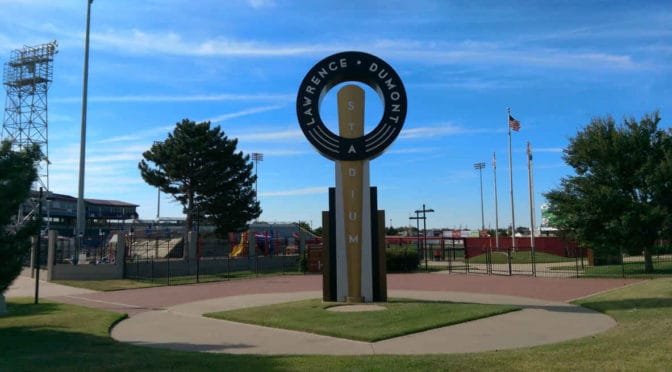
Intrust Bank arena

Wichita city leaders too cozy with developers? Yesterday I participated in a KAKE Television news story where I explained the need for pay-to-play laws in Wichita and Kansas. These laws generally restrict officeholders from participating in votes or activities that would enrich their campaign contributors. In the story I said “What I, and some of my political allies object to, is what is happening in plain sight: In that there is a relatively small group of people — and their spouses and people who work at their companies — who regularly contribute to a wide variety of city council members, both political liberals and political conservatives, because they know that they are going to be coming to the city council and asking for taxpayer money.” Officeholders and the developers who contribute deny there is a connection between contributions and votes. Curiously, these developers generally don’t make contributions to school board members, county commissioners, state legislators, or federal representatives. Actually, it’s not so curious: It’s primarily the Wichita City Council that is able to vote to give them money. I would say the contributors are acting rationally. … If there is no connection between contributions and votes or consideration, there should be no problem in getting the council to agree to some form of pay-to-pay law for Wichita. An example is a charter provision of the city of Santa Ana, in Orange County, California, which states: “A councilmember shall not participate in, nor use his or her official position to influence, a decision of the City Council if it is reasonably foreseeable that the decision will have a material financial effect, apart from its effect on the public generally or a significant portion thereof, on a recent major campaign contributor.” … KAKE correspondent Deb Farris reported that Wichita Mayor Carl Brewer doesn’t look at the list of campaign contributors. I wonder: does he send thank you letters to his contributors? … Video and story at Wichita City Leaders Too Cozy With Developers?

Obama economic strategy questioned. This year’s Nobel prize in economics went to Thomas J. Sargent of New York University and Stanford University’s Hoover Institution, and Christopher A. Sims of Princeton University. In its reporting, the Wall Street Journal explained (A Nobel for Non-Keynesians: People’s expectations about government policy make it difficult for officials to affect the economy in the ways they intend to): “The Swedish economists announcing the award emphasized, correctly, the importance of Messrs. Sargent’s and Sims’s thinking about the role people’s expectations play in economic decision making and the larger economy. But what they failed to mention is that their work has also offered empirical evidence that the school of thought known as Keynesian economics — which believes that government can turn a flagging economy around with the right combination of fiscal ‘stimulus’ (generally government spending) and monetary policy — is fallible.” In further explanation, the Journal writes: “One of Mr. Sargent’s key early contributions, along with University of Minnesota economist Neil Wallace, was the idea that people’s expectations about government fiscal and monetary policy make it difficult for government officials to affect the economy in the ways they intend to. If, for example, people get used to the Federal Reserve increasing the money supply when unemployment rises, they will expect higher inflation and will adjust their wage demands higher also. The result: The lower unemployment rate that the Fed was trying to achieve with looser monetary policy won’t happen. This conclusion was at odds with the Keynesian model, which dominated economic thinking from the late 1930s to the early 1970s. The Keynesian model posited a stable trade-off between inflation and unemployment.” The 1970s however, saw stagflation — both high unemployment and high inflation at the same time, a danger that some feel will grip us in the near future. Keynesianism, of course, is the basis of the economic policy of President Barack Obama and the reason why the economy has not recovered. … While these economists worked on national economies, does the theory of rational expectations apply to state and local governments, meaning that it is very difficult for local government officials to micro-manage their economies through intervention? I think so.

Public vs. private. One of the curious statements in Rhonda Holman’s Sunday Wichita Eagle editorial (Say ‘no’ to naysayers, October 9, 2011) was where she wrote of the “crowds increasingly assembling downtown for concerts and events.” Curious because not long ago she begrudgingly realized the cool down at the Intrust Bank Arena, writing: “Intrust Bank Arena’s strong performance during its inaugural year of 2010 couldn’t last. And it didn’t.” (Make case for arena, August 19, 2100 Wichita Eagle) I don’t know if these two editorials are at odds with each other. … I have noticed one downtown Wichita venue that seems to have a lot of concerts, that being the Orpheum Theater. That venue doesn’t suffer from government genesis and ownership as does the arena, although the arena’s management is in the hands of the private sector. As part of its restoration the Orpheum may qualify for historic preservation tax credits, a government spending program that I oppose. That subsidy, if obtained, is quite small compared to the total taxpayer funding of the arena.

Kansas tax policy. Several news outlets have reported on how hard Kansas state officials are working on crafting a new state tax policy. That worries me. The best tax policy is one that is simple and fair to all. The more tax policy is worked on, the more likely it is to contain measures designed to manage the behavior of people and business firms. This would be a continuation of the conceit that the state can manage economic growth, and contrary to the concepts of economic dynamism for Kansas, where fertile ground is created for all companies.

Petition drive is on. Last Friday citizen activists started the petition drive to give the people of Wichita a chance to vote on crony capitalism or free markets. See Our Downtown Wichita (motto: “Limited government and free markets in Downtown Wichita benefit everyone. Centralized planning and crony capitalism benefit only a few.”) for more information.

Kansas education scores mixed. From Kansas Reporter: “Kansas students’ performance on reading and math proficiency improved for the 11th consecutive year, according to Kansas State Department of Education’s latest State Report Card for schools released Tuesday. Some 87.6 percent of the students tested turned in scores in the top three of five performance levels for reading and 84.7 percent achieved similar scores in math. But two other performance yardsticks show different results. Statewide Kansas test scores on ACT college entrance exams, which are averaging 22 points out of a perfect 36, have been flat for the past five years. … Most Kansas statewide reading, writing and math scores on the National Assessment of Educational Progress, or NAEP, tests have changed little since 2000, according to the U.S. Education Department, which counts the test results as the broadest national measure of how school systems compare state by state. ‘Fourth-grade math tests have improved significantly, but that’s about it,; said Arnold Goldstein, program director for the federal Education Department’s National Center for Education Statistics.” Complete story on Kansas Reporter at Kansas education scores proved mixed picture of schools’ success.

‘Federalists’ author to appear in Wichita. On October 25th Kansas Family Policy Council is hosting an event in Wichita featuring Joshua Charles, a recent KU graduate who has teamed up with Glenn Beck to write the book The Original Argument: The Federalists Case for the Constitution Adapted for the 21st Century. The book debuted at the top of the New York Times Bestseller List in July. … KFPC says “The event will be at Central Christian Church (2900 North Rock Road in Wichita) on Tuesday October 25th at 7:00 pm. Doors will open at 6:30 pm. This is a free event and dessert will be provided for attendees.” RSVP is requested to 316-993-3900 or contact@kansasfpc.com.

Kansas gas wells appraisals. Some Kansas counties use different methods of gas well valuation for tax purposes, writes Paul Soutar in Kansas Watchdog: “The method used to appraise the tax value of gas wells in Stevens County is ‘not correct or appropriate’ according to a report commissioned for Stevens County and released at their latest meeting. The method is or has been used for at least nine years, possibly since the early 1990s, in nine Southwest Kansas counties covering much of the Hugoton gas field, the ninth highest producing field in the U.S. in 2010.” … The complete investigate report is at Report Says Gas Well Appraisal Method ‘Not Correct or Appropriate’.

Lieutenant Governor in Wichita. This week’s meeting (October 14th) of the Wichita Pachyderm Club features Lieutenant Governor Jeff Colyer, M.D. speaking on “An update on the Brownback Administration’s ‘Roadmap for Kansas’ — Medicaid Reform” … Upcoming speakers: On October 21st: N. Trip Shawver, Attorney/Mediator, on “The magic of mediation, its uses and benefits.” … On October 28th: U.S. Representative Tim Huelskamp, who is in his first term representing the Kansas first district, speaking on “Spending battles in Washington, D.C.” … On November 4th: Chris Spencer, Vice President, Regional Sales Manager Oppenheimer Funds, speaking on “Goliath vs Goliath — The global battle of economic superpowers.” … On November 11th: Sedgwick County Commission Members Richard Ranzau and James Skelton, speaking on “What its like to be a new member of the Sedgwick County Board of County commissioners?” … On November 18th: Delores Craig-Moreland, Ph.D., Wichita State University, speaking on “Systemic reasons why our country has one of the highest jail and prison incarceration rates in the world? Are all criminals created equal?”

Urban renewal. “The goal was to replace chaotic old neighborhoods with planned communities.” Planned by government, that is, with all the negatives that accompany. The fascinating video from Reason.tv is titled The Tragedy of Urban Renewal: The destruction and survival of a New York City neighborhood. Its introduction reads: “In 1949, President Harry Truman signed the Housing Act, which gave federal, state, and local governments unprecedented power to shape residential life. One of the Housing Act’s main initiatives — “urban renewal” — destroyed about 2,000 communities in the 1950s and ’60s and forced more than 300,000 families from their homes. Overall, about half of urban renewal’s victims were black, a reality that led to James Baldwin’s famous quip that “urban renewal means Negro removal. … The city sold the land for a token sum to a group of well-connected Democratic pols to build a middle-class housing development. Then came the often repeated bulldoze-and-abandon phenomenon: With little financial skin in the game, the developers let the demolished land sit vacant for years.”

{ 0 comments }

Intrust Bank Arena depreciation expense ignored

by Bob Weeks on August 19, 2011

Reports that income earned by the Intrust Bank Arena is down sharply has brought the arena’s finances back into the news. The arena, located in downtown Wichita and owned by Sedgwick County, is deemed to be a success by the county and arena boosters based on “profit” figures generated during its first year of operations. But these numbers are not an honest assessment of the arena’s financial performance.

When the numbers were presented to Sedgwick County commissioners this week, commission chair Dave Unruh said that he is “pleased that we we still are showing black ink.”

He then made remarks that show the severe misunderstanding that he and almost everyone labor under regarding the nature of the spending on the arena: “I want to underscore the fact that the citizens of Sedgwick County voted to pay for this facility in advance. And so not having debt service on it is just a huge benefit to our government and to the citizens, so we can go forward without having to having to worry about making those payments and still show positive cash flow. So it’s still a great benefit to our community and I’m still pleased with this report.”

The contention of Unruh and other arena boosters is that the capital investment of $183,625,241 (not including an operating and maintenance reserve) on the arena is merely a historical artifact, something that happened in the past and that has no bearing today. This attitude, however, disrespects the sacrifices of the people of Sedgwick County and its visitors to raise those funds.

Since it is only one year old, presumably the arena could be sold for something near its building cost, less an allowance for wear and tear. If not, then the county has a lot of explaining to do as to why it built an asset that has no market value.

But even if the arena has no market value — and I suspect that in reality it has very little value — it still has an economic cost that must be recognized, that cost being the sales tax collected to pay for it. While arena boosters dismiss this as past history, the county recognizes this cost each year, and will continue to do so for many years.

The county, however, doesn’t go out of its way to present the complete and accurate accounting of the arena’s cost. Instead, the county and arena boosters trumpet the “profit” earned by the arena for the county according to an operating and management agreement between the county and SMG, a company that operates the arena.

This agreement specifies a revenue sharing mechanism between the county and SMG. Based on the terms of the agreement, Sedgwick County received payment of $1,116,442 for the 2010 year. While described as profit by many — and there was much crowing over the seemingly large amount — this payment does not represent any sort of “profit” or “earnings” in the usual sense. In fact, the introductory letter that accompanies these calculations warns readers that these are “not intended to be a complete presentation of INTRUST Bank Arena’s financial position and results of operations and are not intended to be a presentation in conformity with accounting principles generally accepted in the United States of America.”

That bears repeating: This is not a reckoning of profit and loss in any recognized sense. It is simply an agreement between Sedgwick County and SMG as to how SMG is to be paid.

Commissioner Karl Peterjohn has warned that these figures — and the monthly “profit” figures presented to commissioners — do not include depreciation expense. That expense is a method of recognizing and accounting for the large capital cost of the arena — the cost that arena boosters dismiss.

In April Sedgwick County released that depreciation number in its 2010 Comprehensive Annual Report. The number is pretty big: $4.4 million, some four times the purported “earnings” of the arena.

Any honest accounting or reckoning of the performance of Intrust Bank Arena must take this number into account. Unruh is correct in that this depreciation expense is not a cash expense that affects cash flow. That cash was spent during the construction phase of the arena.

But depreciation expense provides a way to recognize and account for the cost of long-lived assets like buildings over their lifespan. It recognizes and respects the investment of those who paid the sales tax. When we follow standard practices like recognizing the cost of capital assets through depreciation expense, we’re forced to recognize that there’s a $4.4 million gorilla in the room that arena boosters don’t want to talk about.

Using information about arena operations contained in the operations report, we can construct what an actual income statement for the arena would look like, following generally accepted business principles. According to the statement, total operating income for 2010 was $7,005,224. Operating expenses were $4,994,488. Subtracting gives a figure of $2,010,736. This number, however, is not labeled a profit in the report. Instead, the report calls it “Increase in Net Assets Arising from Operating Activities Managed by SMG.”

An accounting of profit would have to subtract the $4.4 million in depreciation expense. Doing that results in a loss of $2,389,264. This — or something like it — is the number we should be discussing when assessing the financial performance of Intrust Bank Arena.

Fiscal conservatives — and sometimes even liberals — often speak of “running government like a business.” As an example, Unruh’s campaign website from last year states “… as a business owner he works hard to apply good business principles to County government …”

But here’s an example of conservative government leaders ignoring a basic business principle in order to paint a rosy picture of a government spending project. Unruh is not alone in doing this.

Without honest discussion of numbers like these, we make decisions based on incomplete and false information. This is especially important as civic leaders agitate for another sales tax or other taxes to pay for more public investment. The sales pitch is that once the tax is collected and the assets paid for, we don’t need to consider the cost. They contend, as is the attitude of Unruh and arena boosters, that we can just sweep it under the rug and pretend it doesn’t exist. This is a false line of reasoning, and citizens ought not to be fooled.

{ 2 comments }

This Week in Kansas. On this week’s edition of the KAKE Television public affairs program This Week in Kansas, Ken Ciboski (Associate Professor of Political Science at Wichita State University), John D’Angelo (Arts & Cultural Services Manager for the City of Wichita), and myself join host Tim Brown for a discussion of arts and government funding in Kansas. This Week in Kansas airs in Wichita and western Kansas at 9:00 am Sundays on KAKE channel 10.

Kansas taxes. A short report produced by Americans for Prosperity, Kansas shows some of the reasons why economic growth in Kansas has been sluggish: “Kansas’ state and local tax burden continues to be amongst the highest in the region.” Kansas has fewer private sector jobs than it did ten years ago. And in what should be a grave cause for alarm, Kansas was the only state to have a net loss of private sector jobs over the last year. … A table of figures illustrates that although Oklahoma kept its sales tax rate low and constant while Kansas increased its rate, tax revenue increased much more in Oklahoma. Download the report at AFP-Kansas Income Tax Policy Primer.

Wichita sales tax. Speaking of sales tax and its harmful effect, Wichita seems to want to raise its rate. Proposals have been floated for a sales tax for economic development in general, for increased transit (bus) service, for drainage projects, and for downtown projects. Boosters cite the Intrust Bank Arena as an example of a successful project paid for by a sales tax that disappeared as promised. That’s despite the dreams of Sedgwick County Commissioner Tim Norton: “Then, as that tax was nearing its end, Norton ‘wondered … whether a 1 percent sales tax could help the county raise revenue.’ (‘Norton floats idea of 1 percent county sales tax,’ Wichita Eagle, April 4, 2007)” … Boosters of the arena promote it as a financial success, and there was the presentation to the county of a check for $1,116,442 as its share of the arena’s earnings. This figure, however, does not represent any sort of “profit” or “earnings” in the usual sense. In fact, the introductory letter that accompanies these calculations warns readers that these are “special-purpose financial statements” and “are not intended to be a presentation in conformity with accounting principles generally accepted in the United States of America.” In particular, Commissioner Karl Peterjohn has warned that these figures — and the monthly “profit” figures presented to commissioners — do not include depreciation expense. That expense is a method of recognizing and accounting for the large capital cost of the arena. In April the County released that number, and I believe it has not been reported by any news media. That may be because the number is pretty big — $4.4 million, some four times the purported “earnings” of the arena. … Without honest discussion of numbers like these, we make decisions based on incomplete and false information. Don’t look for many local government leaders and officials to talk about this number, and certainly not the Wichita Eagle editorial page.

Koch criticism backfires — again. For those who follow the issue, it’s no surprise that Lee Fang, a reporter for the liberal think tank Canter for American Progress has come out with another attack on Charles and David Koch. Mark Hemingway of the Weekly Standard reports on this effort: “Think Progress reporter Lee Fang has a long history of being spectacularly wrong. However, there’s a seemingly unending thirst for his breathless demonization of the Koch brothers and other rants about corporate greed among the low IQ end of the liberal spectrum.” Fang disagrees with a recent U.S. Supreme Court decision, and he lambasts the litigators who brought the suit as “heavily financed by right-wing corporate money, particularly from Koch Industries and Walmart.” He also criticizes organizations for not dislosing their donors. Hemingway notes this: “In the case of the Koch brothers, they have been outspoken philosophical libertarians for decades. Their support of free speech over onerous campaign laws is entirely consistent and should not be surprising. However, in the case of Wal-Mart Fang is also astoundingly hypocritical. Because you know who else is a ‘Walton-Funded Group’? Lee Fang’s employer.” And the secret donations that Fang rails against so passionately? Hemingway again: “You know who else accepts ‘secret donations from individuals and corporations’? That’s right — the Center for American Progress.” … For another example of Fang’s reporting, see ThinkProgress and Lee Fang: wrong again.

Tension on debt ceiling issue. In The Wall Street Journal Kimberly Strassel writes that the current debt and spending crisis may lead to an end to farm subsidies, something she described as a “sacred federal spending cow:” “For decades, the House and Senate agriculture committees have been the last redoubts of congressional bipartisanship, liberals and conservatives united in beating back any outside attempts to cut off tens of billions annually for price supports, crop insurance, weather assistance, conservation handouts and nutrition programs. The last real stab at reform was the mid-1990s Freedom to Farm bill. Most of the changes were obliterated by subsequent bailouts and new spending.” … She describes how Arizona Congressman Jeff Flake got a limit of farm subsidies through the Appropriations Committee, but House Agriculture Committee Chairman Frank Lucas used a maneuver to block Flake’s proposal. So much for that effort at reform, blocked by a Republican. Lucas’ website promotes a conservative message, with one post criticizing bailouts. But not for farmers, it seems. … Wichita’s Mike Pompeo is mentioned: “Mr. Pompeo is waiting to see what debt package emerges and says his vote will depend on whether it contains real ‘structural’ reform. But he also tells me he doesn’t intend to let parochial interests cloud his decision. ‘I came here to be a small-government guy every day, and not just when it is spending cuts in somebody else’s district,’ he says.” … Although not mentioned in this article, Tim Huelskamp, who represents the Kansas first district, has been upfront in discussing the need to reduce or eliminate farm subsides, and so far, many farmers seem to be accepting of that. Huelskamp’s district, which covers all of western Kansas (and more), is usually second on the list of congressional districts in terms of total farm subsidies received. For 2009, that figure was $369 million.

Stossel: The Money Hole. A recent episode of John Stossel’s television program is now available on the free hulu service by clicking on The Money Hole. Writes Stossel in his introduction to the show: “We will soon spend ourselves into oblivion. But finally … movement! Budget slashing proposals from Paul Ryan, the Republican Study Committee, Ron Paul, Rand Paul and even Tim Pawlenty! But politicians and real people across the spectrum still resist change. What should government do? What’s its role? What have other countries done? The Money Hole tackles that.”

{ 1 comment }

Stossel on politicians’ promises

by Bob Weeks on January 17, 2011

Recently John Stossel produced a television show titled Politicians’ Top 10 Promises Gone Wrong. The show features segments on government programs and why they’ve gone wrong, with a focus on the unintended consequences of the programs. Particularly illuminating are the attempts by programs’ supporters to justify their worth.

Now the program is available to view on the free hulu service by clicking on Politicians’ Top 10 Promises Gone Wrong.

One of the segments on the show explained the harm of Cash for Clunkers, in which serviceable cars were destroyed so that new cars could be sold. The program simply stole sales from the months before and after the program. The mistaken idea that destruction can be a way to create new wealth is held by many who should know better, and Stossel reminds us of the New York Times’ Paul Krugman, who wrote that the terrorist attacks of September 11, 2001 “could even do some economic good” as rebuilding will increase business spending. It’s the seen vs. unseen problem, Stossel and David Boaz of the Cato Institute explain. It’s easy to see people buying new cars. It was reported on television. But it’s more difficult to see all the dispersed economic activity that didn’t take place because of the programs.

“Living wage” laws, in which people would be paid enough to live on — whatever that means — is next. While increasing wages of low-paid workers is a noble goal, increasing the cost of labor results in an entirely predictable result: less labor is demanded. Fewer people will have jobs. The Grand Canyon National Park, for example, switched to automated ticket machines. Christian Dorsey of the Economic Policy Institute, said that elimination of minimum wage laws would leave employers free to drive down wages as low as possible. But Stossel noted businesses hire employees in a competitive market, and it is that market that sets wages. Only about five percent of workers earn the minimum wage. Why do the others earn more than that? Competitive markets force employers to pay more, not laws.

A segment on “fancy stadiums” boosting the economy holds a lesson for Wichita and the Intrust Bank Arena in its downtown. The claimed benefits of these venues rarely appear, and the unseen costs are large — “at the local bar there’s one less bartender, there was one less waitress hired at a restaurant, a movie theater that had one less theaterfull. It’s handing money from your right hand to your left and declaring I’m rich.” While Wichita’s arena seems to be doing well, it’s still well within its honeymoon period. Even then, there was a month where no events took place at the arena.

A segment on the new credit card regulations, intended to protect consumers, shows that the regulations resulted in fewer people being able to get credit cards. Now these people have to go to payday lenders or pawn shops, which are much more expensive than credit cards. Arkansas once capped credit card interest at ten percent. The result was that few people in Arkansas could get a credit card, and the state became known as the pawn shop capital of America.

Ethanol is the topic of a segment. Promised as a way to solve our energy problem, many politicians of both parties support ethanol. But we’ve come to realize the problems with government support of ethanol: rising price of food, excessive use of fertilizer and fuel to produce corn, and an awareness that ethanol is more harmful to the environment than gasoline. “But it makes us feel good,” Stossel says. In Kansas, Governor Sam Brownback is firmly in favor of government support of ethanol, which Boaz called “pound-for-pound, the dumbest program ever.”

On the role of government in causing the housing bubble, Howard Husock said “Government exaggerates, rather than minimizes, the age-old impulse to greed. The government made it harder for bankers who wanted to do the right thing.” Stossel explained that bankers who wanted to stay with safe home loans lost out on profits they could earn selling high risk loans to Fannie Mae and Freddie Mac, the government-sponsored agencies.

At the end, Stossel said: “And that’s the number one promise gone wrong. These guys say they’ll be fiscally responsible. And then we elect them, and they spend more. They’re spending us into bankruptcy. There must be 10,000 harmful programs, and yet they keep creating more. Why can’t we cut them?” Boaz explained: “Every one of those 10,000 programs has a lobbyist in Washington. … They always know when the bill is up before Congress, and they send political contributions, they send people to Washington to lobby. The rest of us don’t do that. … People should be more engaged, people should be better citizens. But the fact is we have lives, and there’s no way that any normal person can know about the 10,000 programs that make up the $3.5 trillion federal budget.”

And so the programs keep growing, Stossel said, and we must pay their costs and unintended consequences forever — “Unless, there’s a new wind blowing in America. A new attitude, a new expectation that maybe Washington should do less. I hear there is. I sure hope so.”

{ 3 comments }

Perhaps an end to legislative time-wasting

by Bob Weeks on December 6, 2010

Politico reports that the practice of issuing proclamations and similar matters during sessions of the U.S. House of Representatives may end. Says the story: “Republicans are moving to get rid of House votes on symbolic resolutions and are planning to post their internal conference rules online, two minor yet politically important changes to the party’s operating guidelines. … The GOP next Wednesday is set to adopt a new set of Republican Conference rules that will place tight restrictions on who and what the House can honor, a bid to cut time they consider wasted on the floor.”

This would be a great step forward. Not only do these resolutions, etc. waste time, they serve as taxpayer-funded, continual advertisements for the glory of government and all its trappings. It happens not only in Washington, but in Topeka and other state capitals across the country. It happens at county commission meetings. It happens at city council meetings and school board meetings.

At Wichita City Council meetings, there have been cases where the meaningful business of the council has not started until nearly one hour after the start of the meeting. The hour has been consumed by proclamations, awards, remarks by council members, etc.

While this happens, citizens with business before the council wait. And wait. They’re wasting their time and money. Their attorneys, representatives, or employees may be there with them, racking up legal bills and wasting time and money while listening to the mayor or other official read proclamations.

Sometimes this period before the start of the meeting’s meaningful business is given over to business-like activities that government owns and that compete with private sector business. For example, Sedgwick County Commission meetings feature promotion of events upcoming at the Intrust Bank Arena, which the county owns. Can you imagine being the owner of a business that competes with the arena — and almost any business involved in entertainment, sports, or leisure competes for consumers’ disposable entertainment dollars — and having to listen to these advertisements, paid for by taxpayer dollars?

We need to dedicate these public meetings to public business. Members of Congress, legislators, council members, and school board members, and commissioners need to be respectful of citizens’ time, and of their own and that of the government staff that must attend these meetings.

{ 3 comments }

This Week in Kansas: Tomorrow on KAKE Television‘s “This Week in Kansas” Kansas Policy Institute President Dave Trabert will be a guest speaking about economic development in Kansas. This is an important topic as Kansas is in “whack-a-mole” mode as we — case by case — defend our industry from poaching by other states. This Week in Kansas airs at 9:00 am on KAKE channel 10. The Winfield Daily Courier has other notes on this upcoming episode.

Sue Schlapp: Wichita Eagle Opinion Line Extra today: “At a past Wichita City Council meeting, council member Sue Schlapp got on her soapbox about needing less government in our lives. Then last week she turned around and voted for the community improvement district tax for the Broadview Hotel. Is this talking out of both sides of her mouth?” I’m glad someone other than I has noticed this.

Dave Unruh campaign billboardDave Unruh campaign billboard

Unruh’s record on taxes: A reader sent in this photograph of a Dave Unruh billboard supporting his run for reelection to the Sedgwick County Commission, noting the irony of the “Lower Taxes” message. The reader may have been referring to Unruh’s support of a solid waste management fee (a tax by another name), his vote in August 2006 to increase the county mill levy, and his enthusiastic support of the tax for the downtown arena, now known as the Intrust Bank Arena. The vote for a tax increase in 2006 was in part to build the National Center for Aviation Training, said to be necessary to keep Wichita aviation companies in Wichita. Nonetheless, Cessna, Bombardier Learjet, and recently Hawker Beechcraft have found it necessary to shake down the state and local government for even more corporate welfare. Still, I don’t recommend voting for Unruh’s opponent Betty Arnold, who recently wondered where was the government stimulus for USD 259, the Wichita public school district, on which board she serves. Evidently Arnold doesn’t realize that nearly every dollar the Wichita schools spend is government money.

Arnold’s website missing: By the way, Google can’t find a website supporting Betty Arnold’s campaign, which says a lot right there.

Goyle and Pompeo: Tomorrow Kansas fourth Congressional district candidates Democrat Raj Goyle and Republican Mike Pompeo debate at Congregation Emanu-El at 7011 E. Central in Wichita. State of the State KS reports: “The debate will be moderated by KAKE-TV’s Tim Brown from This Week In Kansas and will focus on both local economic, political and foreign policy issues facing the U.S. The debate is free and begins at 10:40 am. A brunch will be served before the debate for $7.” It appears that Reform party candidate Susan Ducey and Libertarian Shawn Smith will not appear. The two minor party candidates made credible appearances on a recent KWCH televised forum.

Goyle video, polls: Speaking of Goyle, video of Goyle endorsing presidential candidate Barack Obama in Texas has surfaced. And, more bad polls for Goyle.

{ 1 comment }

Kansas sales tax increase starts today

by Bob Weeks on July 1, 2010

Today Kansans will face an added tax burden on retail purchases, as the statewide sales tax rate goes up by one cent per dollar. Touted by its backers like Kansas Governor Mark Parkinson as a “one percent” increase in the tax, it is actually an increase of (6.3 – 5.3) / 5.3 = 18.9 percent.

In some parts of the state, the combined rate will soar to over ten percent. The City of Lawrence is considering whether to require businesses to post signs advising — or warning– shoppers of the sales tax they’ll pay in stores.

The debate over the sales tax and the harm it causes was fueled by two studies that were often viewed as competing with each other, but really didn’t. One looked at the harmful effects of the tax for just one year and concluded that while the sales tax would destroy private sector jobs, a reduction in state spending would cause even more harm. Naturally, tax and spending advocates latched on to this study.

The other looked at a longer period of time and considered actual consumer response to increased taxes. It, not surprisingly, found that the sales tax would be very harmful.

The first study, besides looking at just one year, also shows evidence of faulty thinking. This study, produced by Wichita State University professor John D. Wong, contains this paragraph in its conclusion:

Second, the revenue enhancement scenario spreads the negative effects throughout the state, both geographically and across all 2.8 million residents. The effect on any individual and on any business is minor. In contrast, the spending reduction scenario severely affects a small number of state residents and businesses — state employees and those private-sector businesses that serve state employees and state government directly. The likelihood of a business failing under this scenario is much greater than in the tax increase scenario. A business failure will have a ripple effect across the economy.

In this paragraph we can find several examples of faulty economic thinking.

For example, as Kansas consumers will now have less discretionary income and may dine at restaurants less often, it’s possible that restaurants might close. More likely, however, the restaurant manager will find he doesn’t need as many employees to serve the diminished customer base, so a waiter loses his job.

These job losses, affecting just one or two people at a time and spread across the state, won’t create a business failure, as Wong mentions. There won’t be newspaper or television stories. But for the people directly harmed, I’m sure they won’t view the effect as “minor,” as Wong writes.

And Wong may have forgotten that each lost job produces a little ripple of its own.

Furthermore, when these job losses are aggregated over the state, there will be an impact. How much? Well, the sales tax is estimated by Wong to bring in $350 million, so we can use that as an estimate of the amount of money Kansans don’t have to spend at their own direction and discretion anymore.

(Wong notes that some of the sales tax will be paid by visitors to our state. Welcome to Kansas!)

We also see in the paragraph one of the primary problems with government taxation and spending. John Stossel explains:

The Public Choice school of economics calls this the problem of concentrated benefits and dispersed costs. Individual members of relatively small interest groups stand to gain huge rewards when they lobby for government favors, but each taxpayer will pay only a tiny portion of the cost of any particular program, making opposition pointless.

In this case the special interest groups include school spending advocates and state government employees. They believed they were fighting for their jobs. School spending advocates believed they were fighting for the children, too. But we ought to step back and consider the value of some of these jobs, and whether the services provided — education, for example — couldn’t be better provided in the marketplace rather than by government.

Also, we should note that school teachers and state government employees are represented by unions that spend millions advocating for their members each year. Waiters and others who will lose their jobs one at a time don’t have such representation.

So we had the powerfully-motivated special interests on one side. Then we had Governor Parkinson telling us not to worry, that in Wichita people didn’t even notice the one cent per dollar sales tax used to pay for the Intrust Bank Arena.

When you add in newspaper editorial writers like the Wichita Eagle’s Rhonda Holman, who today wrote that “No one relished raising sales taxes right now” and praised the arena sales tax, there you have the entire argument made.

Despite Holman’s claim, many people salivated at the idea of an increased sales tax, or any other tax. The governor viewed the tax increase as his legacy.

We also need to dismiss the claims of massive cuts to the Kansas budget. Recently Kansas Senate President Stephen Morris mentioned these, writing “… very difficult decisions were made to cut or reduce the $6 billion state budget by roughly $1.5 billion …”

For most people, a cut of $1.5 billion from a $6 billion budget means the state will spend $4.5 billion. But the spending bill passed by the legislature calls for spending $5.6 billion in fiscal year 2011, which starts on July 1, 2010.

Today the Eagle’s Holman makes a similar claim, mentioning “$1 billion in recent cuts to state services.”

These “budget cut” numbers make sense only when you look at planned spending, not actual spending. Even then you have to add up these phantom cuts over a period of years to get to the claims of Parkinson, Morris, Holman and other big-government spending advocates.

As the chart shows, actual spending has declined slightly, but is projected to rise during the fiscal year that starts today.

Kansas general fund spending

Over the years, we see that state spending in Kansas has risen rapidly, while at the same time our population in Kansas grows very slowly.

For the sales tax and spending increases to make economic sense, you have to believe that state government can spend money more wisely than its people can. Given the special interest group fingerprints all over this budget, that’s not going to happen.

What is the future of this sales tax? It’s scheduled to decline by 0.6 cents per dollar in three years, the remaining 0.4 cents per dollar to be used for transportation. But these taxes have a habit of failing to disappear on schedule. The supplemental note for the bill that last increased Kansas sales tax contains this: “The state sales and compensating (use) tax rate would be increased from 4.9 to 5.3 percent, effective June 1, 2002. The rates would then be reduced to 5.2 percent on June 1, 2004; and to 5.0 percent on June 1, 2005.”

As of yesterday the sales tax was was still 5.3 percent. The two scheduled reductions never took place. Sometimes promises from the Legislature don’t mean very much.

{ 5 comments }

Okay, maybe that’s a little over-hyped, but when arena cheerleader Rhonda Holman of the Wichita Eagle starts to question the operations of Intrust Bank Arena in downtown Wichita, there must be something going on.

Holman’s column of yesterday complained of lack of transparency in the arena’s operations: “But with hindsight, and with the Intrust Bank Arena open three months and generating revenue, it’s more clear all the time that county leaders gave away too much oversight authority to SMG, leaving citizens in the strange and frustrating position of having too little hard information about how their $206 million investment is doing.”

The sudden departure of arena manager Chris Presson under circumstances that can only be described as alarming will add to the concern of citizens. Well, not all citizens. Some arena boosters simply don’t care how much of a burden the arena may become to county taxpayers, as long as they have their arena.

The lack of transparency at the arena and some county commissioner’s lack of concern about this important issue has been the subject of articles on this site. See Wichita downtown arena open records failure, Wichita downtown arena contract seems to require Sedgwick County approval, and Sedgwick County keeps lease agreement secret.

{ 8 comments }

In Sedgwick County, is there slack time?

by Bob Weeks on March 18, 2010

As reported in the Wichita Eagle, the Sedgwick County Commission decided to reimburse the county for time its employees spent working on arena-related matters. The money will come from the sales tax that was collected to build the Intrust Bank Arena in downtown Wichita. The amount of money the commission decided to transfer is $1.6 million, although according to the Eagle, the total cost could reach $2.6 million.

Here’s something of concern to me in the story: “But he [Sedgwick County chief financial officer Chris Chronis] pushed for the money to remain in the arena and pavilions’ operating and maintenance reserve fund, which last month had just less than $14 million, because taking money out of the fund would drain it four years earlier than expected — in 2024.”

Evidently the county has financial projections for the arena all the way out to 2018, and possibly beyond. That is a very long time into the future, and any projections about the performance of the arena over this period would be based on assumptions that can’t be estimated with anything approaching certainty.

Projections with this precision made about events so far in the future surrounded by so much uncertainty remind me of the saying that economists use a decimal point to show they have a sense of humor.

Back to the present: Commissioner Dave Unruh told the Eagle that the county did not hire any new staff to perform work that has an estimated value of $2.6 million. My question is this: Is this evidence that there was $2.6 million of slack time in county employee’s schedules? How were they able to get this vast amount of work accomplished? Perhaps after the arena work that has occupied $2.6 million of staff time is complete, we could hire out this staff to earn revenue for the county, as it seems they will have time on their hands.

Regarding the contention that voters in 2004 were promised that no property tax money would be used on the arena, Unruh was quoted by the Eagle as saying: “I do think that we made a very strong commitment that all the sales tax money would be used for the arena and pavilions.”

It seems that now Sedgwick County voters have a new concern: When politicians make a promise, do we have to ask them if this is a regular commitment or a very strong commitment? Or are there other types of commitments that we don’t know about?

{ 3 comments }

Tax increases will cost Kansas jobs, economic freedom

March 7, 2010

As Kansas struggles to deal with a budget deficit, Democrats and even some Republicans are proposing tax increases, particularly an increase — temporary, they say — in the sales tax. A common argument advanced is that an extra one cent tax on every dollar spent will hardly be noticed. The one cent tax used to build the Intrust Bank Arena in downtown Wichita is cited as an example of a sales tax used for the common good of the people.

Read the full article →

Assessment of Wichita’s Intrust Bank Arena’s success premature

February 23, 2010

Any rational assessment of the success of the Intrust Bank Arena in downtown Wichita must realize that the arena is in its honeymoon period. Until initial enthusiasm dies down and the arena has a track record of a year or more, we simply have no idea what the financial performance of the arena will be. That’s what’s important.

Read the full article →

Intrust Bank Arena’s missing name

January 7, 2010

On the commemorative plaque outside the Intrust Bank Arena, in downtown Wichita, there’s a missing name.

Read the full article →

Ticket scalping is a market function, not a criminal activity

December 21, 2009

Yesterday’s Wichita Eagle carried an article about ticket scalping for events at the Intrust Bank Arena in downtown Wichita. Some concerts are very popular, which leads to people frustrated at two things: the inability to buy tickets when they go on sale, and then the high prices that ticket scalpers ask for tickets on the aftermarket.

I understand the frustration of the stymied ticket buyers. Who wants to pay $300 for a ticket that was sold by the arena’s box office for $50? It would be great if everyone who wanted to attend could do so for $50 — or for $5, for that matter. And that gets to the heart of the problem and why it isn’t likely to be solved: human behavior and economics.

Read the full article →

Wichita arena lands a whopper

October 30, 2009

The Intrust Bank Arena in downtown Wichita has landed NCAA women’s basketball first- and second-round tournament games in 2011.

Read the full article →

Low NBA attendance in Wichita danger sign for Intrust Bank Arena

October 14, 2009

The Intrust Bank Arena management firm SMG must be wondering what it bit off in Wichita. Last night NBA professional basketball players put sneaker to floor in Wichita for the first time in 14 years, and only an estimated 8,000 fans showed up.

Read the full article →

Downtown Wichita parking plan at odds with revitalization goals

October 12, 2009

Currently, Wichita is struggling to find enough parking spots downtown to meet the demand expected to be created by the new Intrust Bank Arena. It’s been a contentious issue, with many Wichitans skeptical of the city’s ability to supply enough parking at prices that people are willing to pay for.

But did you know that there is likely to be fewer parking spots in downtown Wichita if the firm likely to lead downtown revitalization planning has its way?

Read the full article →

Welshimer files for re-election to Sedgwick County Commission

October 9, 2009

Today, Sedgwick County Commissioner Gwen Welshimer filed for re-election to her position as a member of the commission. Her statement is below.

Welshimer, a Democrat, is so far the only candidate in that party. There are three Republicans who have either filed or are considering filing.

Read the full article →

Wichita sales tax likely to be proposed

October 9, 2009

Two recent events have led me to suspect that as part of the plan for the revitalization of downtown Wichita, we’re going to see a sales tax proposed.

Read the full article →

Wichita downtown arena parking promises not fulfilled

September 30, 2009

In 2004, as residents of Sedgwick County were considering whether to vote for a sales tax to fund the downtown Wichita arena (now known as the Intrust Bank Arena and nearly ready to open), people wondered about parking.

So on a campaign literature piece, the arena supporters made this claim: “With the proposed garage structures, more than 10,000 parking spaces will be available within a three-block radius of the Arena (compared with the Coliseum’s 4,500 spaces.)”

Today, on the eve of the arena’s opening, these parking garages don’t exist.

Read the full article →

Goody Clancy proposal for Downtown Wichita revitalization master plan

September 29, 2009

Last Friday a selection committee selected one company from four finalists to lead the planning effort for the revitalization of downtown Wichita. If some city leaders had their way, citizens of Wichita wouldn’t be able to see this document until after the city council makes a decision to follow — or not — the recommendation of the selection committee. But thanks to city manager Robert Layton’s decision, this document is now available for all to read. (Thanks also go to council member Jim Skelton, for his unsuccessful effort to release the documents.)

Read the full article →

Lutz, Hanson, Fahnestock owe Wichita an apology

September 24, 2009

In the campaign for the sales tax to build the downtown Wichita arena (Intrust Bank Arena), the idea of hosting NCAA men’s basketball games was promoted as something that would happen if voters approved the arena.

Read the full article →

DeBoer plan for Wichita downtown redevelopment largely realized

September 21, 2009

Hundreds of millions have already been spent for downtown redevelopment and what do we have to show for it? In contrast, look at the benign neglect the city has had on the thriving east and west sides of town where projects on Maize and Webb roads have prospered despite heavy property taxes.

Read the full article →

Light rail not good for Wichita

August 11, 2009

A recent letter in the Wichita Eagle by Alden Wilner of Bel Aire worries that “flat, dusty and hot” parking lots in the neighborhood of the Intrust Bank Arena (formerly known as the downtown Wichita arena) in downtown Wichita will hamper downtown revitalization.

I don’t know if this claim is true or not, but I do know that the solution Wilner proposes — “an area wide light-rail system” — would be an absolute disaster for Wichita. These systems are costly to build and operate, suffer from low-ridership almost everywhere they are built, and have many other problems.

Read the full article →

Wichita downtown arena parking problem

August 8, 2009

The Wichita Eagle editorial written by Rhonda Holman on June 29, 2009 now claims that the new Intrust Arena in downtown Wichita lacks adequate parking. This is a major change by the Eagle editorial board’s position. I have repeatedly asked county staff about the available parking in and around this soon-to-open facility since I became a commissioner in January. I have been repeatedly told by county staff that adequate parking will be available when the Intrust Arena opens next year. The most recent public assurance I have received was only a few days ago.

Read the full article →

The empty arena

June 4, 2009

Kansas City’s Sprint Center (that’s their new downtown arena) is suffering from underuse. The Atlantic article The Empty Arena tells the story. Its subtitle is “If you build it, they might not come.” Despite being managed by a well-connected and experienced management group, no professional basketball or hockey team has moved in.

Read the full article →

Sedgwick County keeps lease agreement secret

June 1, 2009

A few months ago in March, SMG, the company that is managing the Intrust Bank Arena (formerly known as the downtown Wichita arena) signed a lease with the Wichita Thunder Hockey team.

Details of that lease weren’t made available to the public. Not to Sedgwick County Commissioners, either. So the public and even elected government officials don’t know anything about this contract, except for its term of five years.

Read the full article →

More money to Wichita government

April 9, 2009

A letter in today’s Wichita Eagle places a lot of faith on things not yet seen, and in things we know don’t work.

“I think it is dumb that people are complaining about the new Intrust Bank Arena. It will bring money and tourists to Wichita, not to mention great entertainment. That means more money brought to our government, and that’s a good thing. — Caleb Beeson, Wichita”

Read the full article →

Articles of Interest

March 22, 2009

Education reform, downtown Wichita arena, Kansas smoking ban, downtown developers.

Read the full article →

Wichita downtown arena contract seems to require Sedgwick County approval

March 20, 2009

Sedgwick County, owner of the Intrust Bank Arena (the downtown Wichita arena), has a five-year contract with SMG that outsources the management of the arena.

Yesterday, SMG announced a 10.5 year lease with the Wichita Thunder hockey team. Terms of the deal weren’t disclosed, and SMG is resisting their release, as explained in Wichita Eagle reporting referred to in my post Wichita downtown arena open records failure.

Read the full article →

Wichita downtown arena open records failure

March 20, 2009

Yesterday, the company that manages the Intrust Bank Arena (the downtown Wichita arena) announced a lease with the arena’s flagship tenant, the Wichita Thunder hockey team. But we don’t know the details of the lease. Unbelievably, some Sedgwick County Commissioners and managers are okay with that.

Read the full article →

Downtown Wichita (Intrust) arena groundbreaking

December 7, 2007

On Tuesday December 4, 2007, Sedgwick County hosted the formal groundbreaking ceremony for the downtown Wichita arena. While local government leaders and news media hailed the event as a transforming event in the history of Wichita, this writer does not share their enthusiasm.

Read the full article →

Wichita News Media Coverage of Downtown Arena Issue

January 18, 2005

Other people in Wichita’s news business appeared to lack basic factual information about the arena vote. As part of its election night coverage, one prominent Wichita television news anchor interviewed Mr. Karl Peterjohn of the Kansas Taxpayers Network. Mr. Peterjohn mentioned something about how now the story moves to the Kansas Legislature. The news anchor expressed surprise to learn that the ballot issue was merely an advisory referendum instead of a binding resolution, and that the legislature would have to pass a law allowing Sedgwick County to raise its sales tax. A Wichita television news personality being so poorly informed about such a basic factual matter tells us that we shouldn’t expect important news reporting from our television stations.

Read the full article →

Prepare for sales tax-induced job effects now

December 31, 2004

Collecting the sales tax to pay for the downtown Wichita arena may produce unintended consequences.

Read the full article →