Greater Wichita Economic Development Coalition

Tax costs block progress in Kansas

by Bob Weeks on April 28, 2012

If we in Kansas and Wichita wonder why our economic growth is slow and our economic development programs don’t seem to be producing results, there is now data to answer the question why: Our tax costs are high — way too high.

Recently the Tax Foundation released a report that examines the tax costs on business in the states and in selected cities in each state. The news for Kansas is worse than merely bad, as our state couldn’t have performed much worse: Kansas ranks 47th among the states for tax costs for mature business firms, and 48th for new firms.

The report is Location Matters: A Comparative Analysis of State Tax Costs on Business.

The study is unusual in that it looks at the impact of states’ tax burden on mature and new firms. This, according to report authors, “allows us to understand the effects of state tax incentives compared to a state’s core tax system.” In further explanation, the authors write: “The second measure is for the tax burden faced by newly established operations, those that have been in operation less than three years. This represents a state’s competitiveness after we have taken into account the various tax incentive programs it makes available to new investments.”

The report also looks at the tax costs for specific types of business firms. For Kansas, some individual results are better than overall, but still not good. For a mature corporate headquarters, Kansas ranks 30th. For locating a new corporate headquarters — one that would benefit from tax incentive programs — Kansas ranked 42nd. For a mature research and development facility, 46th; while new is ranked 49th. For a mature retail store, 38th, while new is ranked 45th.

There are more categories. Kansas ranks well in none.

The report also looked at two cities in each state, a major city and a mid-size city. For Kansas, the two cities are Wichita and Topeka.

Among the 50 cities chosen, Wichita ranks 30th for a mature corporate headquarters, but 42nd for a new corporate headquarters.

For a mature research and development facility, Wichita ranks 46th, and 49th for a new facility.

For a mature and new retail store, Wichita ranks 38th and 45th, respectively.

For a mature and new call center, Wichita ranks 43rd and 47th, respectively.

In its summary for Kansas, the authors note the fecklessness of Kansas economic development incentives: “Kansas offers among the most generous property tax abatements and investment tax credits across most firm types, yet these incentives seem to have little impact on the state’s rankings for new operations.”

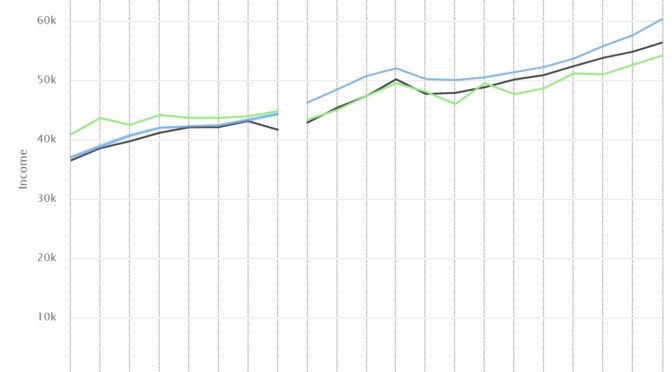
Kansas tax cost compared to neighbors. Click here for a larger version.

It’s also useful to compare Kansas to our neighbors. The comparison is not favorable for Kansas.

More evidence of failure

Recently the Greater Wichita Economic Development Coalition issued its annual report on its economic development activities for the year. This report shows us that power of government to influence economic development is weak. In its recent press release, the organization claimed to have created 1,509 jobs in Sedgwick County during 2011. According to the Bureau of Labor Statistics, the labor force in Sedgwick County in 2011 was 253,940 persons. So the jobs created by GWEDC’s actions amounted to 0.59 percent of the labor force. This is a very small fraction, and other economic events are likely to overwhelm these efforts.

In his 2012 State of the City address, Wichita Mayor Carl Brewer took credit for creating a similar percentage of jobs in Wichita.

The report by the Tax Foundation helps us understand why the economic development efforts of GWEDC, Sedgwick County, and Wichita are not working well: Our tax costs are too high.

While economic development incentives can help reduce the cost of taxes for selected firms, incentives don’t help the many firms that don’t receive them. In fact, the cost of these incentives is harmful to other firms. The Tax Foundation report points to this harm: “While many state officials view tax incentives as a necessary tool in their state’s ability to be competitive, others are beginning to question the cost-benefit of incentives and whether they are fair to mature firms that are paying full freight. Indeed, there is growing animosity among many business owners and executives to the generous tax incentives enjoyed by some of their direct competitors.”

But there is one incentive that can be offered to all firms: Reduce tax costs for everyone. The policy of reducing tax costs for the selected few is not working. This “active investor” approach to economic development is what has led companies in Wichita and Kansas escaping hundreds of millions in taxes — taxes that others have to pay. That has a harmful effect on other business, both existing and those that wish to form.

Professor Art Hall of the Center for Applied Economics at the Kansas University School of Business is critical of this approach to economic development. In his paper Embracing Dynamism: The Next Phase in Kansas Economic Development Policy, Hall quotes Alan Peters and Peter Fisher: “The most fundamental problem is that many public officials appear to believe that they can influence the course of their state and local economies through incentives and subsidies to a degree far beyond anything supported by even the most optimistic evidence. We need to begin by lowering expectations about their ability to micro-manage economic growth and making the case for a more sensible view of the role of government — providing foundations for growth through sound fiscal practices, quality public infrastructure, and good education systems — and then letting the economy take care of itself.”

In the same paper, Hall writes this regarding “benchmarking” — the bidding wars for large employers that Wichita and Kansas has been pursuing and which Wichita’s Brewer wants to step up: “Kansas can break out of the benchmarking race by developing a strategy built on embracing dynamism. Such a strategy, far from losing opportunity, can distinguish itself by building unique capabilities that create a different mix of value that can enhance the probability of long-term economic success through enhanced opportunity. Embracing dynamism can change how Kansas plays the game.”

In making his argument, Hall cites research on the futility of chasing large employers as an economic development strategy: “Large-employer businesses have no measurable net economic effect on local economies when properly measured. To quote from the most comprehensive study: ‘The primary finding is that the location of a large firm has no measurable net economic effect on local economies when the entire dynamic of location effects is taken into account. Thus, the siting of large firms that are the target of aggressive recruitment efforts fails to create positive private sector gains and likely does not generate significant public revenue gains either.’”

There is also substantial research that is it young firms — distinguished from small business in general — that are the engine of economic growth for the future. We can’t detect which of the young firms will blossom into major success — or even small-scale successes. The only way to nurture them is through economic policies that all companies can benefit from. Reducing tax rates is an example of such a policy. Abating taxes for specific companies through programs like IRBs is an example of precisely the wrong policy.

We need to move away from economic development based on this active investor approach. We need to advocate for policies — at Wichita City Hall, at the Sedgwick County Commission, and at the Kansas Statehouse — that lead to sustainable economic development. We need political leaders who have the wisdom to realize this, and the courage to act appropriately. Which is to say, to not act in most circumstances, except to reduce the cost of government for everyone.

{ 0 comments }

Yesterday’s opening of a Cabela’s store in Wichita was celebrated as a great success, but the circumstances of the store’s birth should remind us of the failure of Wichita’s economic development strategies and efforts.

We have to ask why Wichita is not able to attract retailers like Cabela’s without offering some sort of subsidy. In the current example, we are allowing Cabela’s to add 1.2 cents per dollar extra sales tax. Cabela’s keeps one cent, and 0.2 cents will be used to build a new highway exit ramp — one not seriously contemplated until Cabela’s wanted it.

This turnover of public taxation to private interests through the community improvement district (CID) program is contrary to good public policy. The power to tax is one of the most important — and harmful — functions of government. It ought to be used to pay for public goods, instead of being turned over to private benefit, as it has for Cabela’s.

At the opening ceremony, I spoke with Kansas Governor Sam Brownback and reminded him that just two weeks ago Wichita voters spoke out against special tax deals similar to the deal Cabela’s received. What is the future of these special tax deals? “I think the better approach is broad tax reduction,” he said.

While the governor was referring primarily to income taxes, there is strong evidence that Kansas needs to reduce all forms of business tax costs. The release of a report from the Tax Foundation ranking the states in business tax costs brought that into sharp focus two weeks ago. The news for Kansas is worse than merely bad, as our state couldn’t have performed much worse: Kansas ranks 47th among the states for tax costs for mature business firms, and 48th for new firms.

This raises the question: Was the CID tax giveaway truly necessary for Cabela’s to open, or is Cabela’s business model so flimsy that it requires corporate welfare to survive, or is Cabela’s simply an opportunistic company, willing to feed off taxpayers as another source of profit?

Community Improvement Districts

CIDs allow merchants to apply a higher sales tax rate to sales. The money from shoppers is collected under the pretense of government authority, but it is earmarked for the exclusive benefit of the owners of property in the CID. This is perhaps the worst aspect of CIDs. Landlord and merchants already have a way to generate revenue from their customers under free exchange: through the prices posted or advertised for their products, plus consumers’ awareness of the sales tax rates that prevail in a state, county, and city.

But most consumers may never be aware that they paid an extra tax for the exclusive benefit of the CID. If they happen to calculate the sales tax they paid, they may conclude that the high CID rate is charged all across Wichita — thereby staining our reputation.

The Wichita city council had a chance to provide transparency to shoppers by requiring merchants in CIDs to post signs informing shoppers of the amount of extra tax to be changed in the store. But CID advocates got the city council to back down from that requirement. CID advocates know how powerful information is, and they along with their allies on the city council realized that signage with disclosure would harm CID merchants. Council Member Sue Schlapp succinctly summarized the subterfuge that must accompany the CID tax when she said: “This is very simple: If you vote to have the tool, and then you vote to put something in it that makes the tool useless, it’s not even any point in having the vote, in my opinion.” She voted against the signage requirement.

Jeff Longwell (district 5, west and northwest Wichita), in explaining his vote against the signage requirement with the tax rate displayed, said he thought this information would be confusing to shoppers.

Are incentives necessary?

The age-old question is whether economic activity will occur without economic development incentives. Governor Brownback said it is a “legitimate question” as to whether Cabela’s would be here anyway.

In the case of Cabela’s, the store might not be in Wichita without incentives, as the company has shown itself to be especially eager and adept at gathering corporate welfare paid for by taxpayers. One writer concluded “For its part, Cabela’s is unabashed about its dependence on corporate socialism, even declaring in its annual report that grabbing public money is key to its business plan.”

We see elected officials and economic development bureaucracies eager to create jobs, so much so that they offer incentives that are not necessary. This leads to a cycle of dependency on city hall for economic development. That’s good for politicians and bureaucrats, but bad for everyone else.

It would be one thing if our economic development activities were working. But there’s evidence that they’re not. Recently we learned that the job-creating activities of Greater Wichita Economic Development Coalition last year resulted in a number of jobs barely more than one-half of one percent of the labor force.

That’s not a very good job. But keeping a website up to date ought to be easy. The GWEDC site, however, is terribly out of date. On a page titled Recent Relocations Highlights, the most recent item is from 2009. Have we not had any relocations since then, or does GWEDC simply not care to update and maintain its website?

A recent Wichita Eagle article, (Why isn’t Wichita winning projects?, January 22, 2012 Wichita Eagle), after listing four items economic development professionals say Wichita needs but lacks, reported “The missing pieces have been obvious for years, but haven’t materialized for one reason or another.”

If these pieces are truly needed and have been obviously missing for years: Isn’t that a startling assessment of failure of Wichita’s economic development regime?

{ 4 comments }

Last week the Tax Foundation and KMPG issued a report that gives us some insight as to why this city council may feel it is necessary to award economic development incentives like the one being considered for Epic Sports today. According to the report, our tax costs on business are high — way too high.

The news for Kansas is worse than merely bad, as our state couldn’t have performed much worse: Kansas ranks 47th among the states for tax costs for mature business firms, and 48th for new firms. The report also had some separate figures for Wichita, and the results were similar.

While many of the problems with high tax costs on business are state issues, the city’s legislative agenda calls for continued authority to use existing economic development incentives. In particular, the city this year has testified for the continued use of historic preservation tax credits. Spending on these incentive programs reward the lucky few, but increases the cost of government, and therefore taxes, for everyone else.

We need to realize that the city’s “active investor” method of targeted economic development isn’t working.

As evidence, recently the Greater Wichita Economic Development Coalition issued its annual report on its economic development activities for the year. It claimed to have to have created 1,509 jobs in Sedgwick County during 2011. But that’s only 0.59 percent of the county’s labor force. This is a very small fraction, and other economic events are likely to overwhelm these efforts, which were at great cost.

There is one incentive that can be offered to all firms: Reduce tax costs for all. The Tax Foundation report should be a shrill wake up call to the city and state that we must change our ways.

But the action the council is considering today moves us in the opposite direction. These incentives have a cost. Other businesses have to pay. That motivates many to seek incentives from the city and state, which in turn raises the cost of government and taxes. It’s a spiral that leads to ever-increasing control of economic activity by city hall.

We in Wichita need to build a dynamic economy in Wichita that is based on free enterprise and entrepreneurship rather than a government handout. This is the way we can have organic and sustainable economic development. We can start on this path today by saying no to this incentive package.

{ 0 comments }

Kansas and Wichita lag the nation in tax costs

by Bob Weeks on March 1, 2012

If we in Kansas and Wichita wonder why our economic growth is slow and our economic development programs don’t seem to be producing results, there is now data to answer the question why: Our tax rates are high — way too high.

This week the Tax Foundation released a report that examines the tax costs on business in the states and in selected cities in each state. The news for Kansas is worse than merely bad, as our state couldn’t have performed much worse: Kansas ranks 47th among the states for tax costs for mature business firms, and 48th for new firms.

The report is Location Matters: A Comparative Analysis of State Tax Costs on Business.

The study is unusual in that it looks at the impact of states’ tax burden on mature and new firms. This, according to report authors, “allows us to understand the effects of state tax incentives compared to a state’s core tax system.” In further explanation, the authors write: “The second measure is for the tax burden faced by newly established operations, those that have been in operation less than three years. This represents a state’s competitiveness after we have taken into account the various tax incentive programs it makes available to new investments.”

The report also looks at the tax costs for specific types of business firms. For Kansas, some individual results are better than overall, but still not good. For a mature corporate headquarters, Kansas ranks 30th. For locating a new corporate headquarters — one that would benefit from tax incentive programs — Kansas ranked 42nd. For a mature research and development facility, 46th; while new is ranked 49th. For a mature retail store, 38th, while new is ranked 45th.

There are more categories. Kansas ranks well in none.

The report also looked at two cities in each state, a major city and a mid-size city. For Kansas, the two cities are Wichita and Topeka.

Among the 50 cities chosen, Wichita ranks 30th for a mature corporate headquarters, but 42nd for a new corporate headquarters.

For a mature research and development facility, Wichita ranks 46th, and 49th for a new facility.

For a mature and new retail store, Wichita ranks 38th and 45th, respectively.

For a mature and new call center, Wichita ranks 43rd and 47th, respectively.

In its summary for Kansas, the authors note the fecklessness of Kansas economic development incentives: “Kansas offers among the most generous property tax abatements and investment tax credits across most firm types, yet these incentives seem to have little impact on the state’s rankings for new operations.”

Kansas tax cost compared to neighbors. Click here for a larger version.

It’s also useful to compare Kansas to our neighbors. The comparison is not favorable for Kansas.

More evidence of failure

Recently the Greater Wichita Economic Development Coalition issued its annual report on its economic development activities for the year. This report shows us that power of government to influence economic development is weak. In its recent press release, the organization claimed to have created 1,509 jobs in Sedgwick County during 2011. According to the Bureau of Labor Statistics, the labor force in Sedgwick County in 2011 was 253,940 persons. So the jobs created by GWEDC’s actions amounted to 0.59 percent of the labor force. This is a very small fraction, and other economic events are likely to overwhelm these efforts.

In his 2012 State of the City address, Wichita Mayor Carl Brewer took credit for creating a similar percentage of jobs in Wichita.

The report by the Tax Foundation helps us understand why the economic development efforts of GWEDC, Sedgwick County, and Wichita are not working well: Our tax costs are too high.

While economic development incentives can help reduce the cost of taxes for selected firms, incentives don’t help the many firms that don’t receive them. In fact, the cost of these incentives is harmful to other firms. The Tax Foundation report points to this harm: “While many state officials view tax incentives as a necessary tool in their state’s ability to be competitive, others are beginning to question the cost-benefit of incentives and whether they are fair to mature firms that are paying full freight. Indeed, there is growing animosity among many business owners and executives to the generous tax incentives enjoyed by some of their direct competitors.”

But there is one incentive that can be offered to all firms: Reduce tax costs for everyone. The policy of reducing tax costs for the selected few is not working. This “active investor” approach to economic development is what has led companies in Wichita and Kansas escaping hundreds of millions in taxes — taxes that others have to pay. That has a harmful effect on other business, both existing and those that wish to form.

Professor Art Hall of the Center for Applied Economics at the Kansas University School of Business is critical of this approach to economic development. In his paper Embracing Dynamism: The Next Phase in Kansas Economic Development Policy, Hall quotes Alan Peters and Peter Fisher: “The most fundamental problem is that many public officials appear to believe that they can influence the course of their state and local economies through incentives and subsidies to a degree far beyond anything supported by even the most optimistic evidence. We need to begin by lowering expectations about their ability to micro-manage economic growth and making the case for a more sensible view of the role of government — providing foundations for growth through sound fiscal practices, quality public infrastructure, and good education systems — and then letting the economy take care of itself.”

In the same paper, Hall writes this regarding “benchmarking” — the bidding wars for large employers that Wichita and Kansas has been pursuing and which Wichita’s Brewer wants to step up: “Kansas can break out of the benchmarking race by developing a strategy built on embracing dynamism. Such a strategy, far from losing opportunity, can distinguish itself by building unique capabilities that create a different mix of value that can enhance the probability of long-term economic success through enhanced opportunity. Embracing dynamism can change how Kansas plays the game.”

In making his argument, Hall cites research on the futility of chasing large employers as an economic development strategy: “Large-employer businesses have no measurable net economic effect on local economies when properly measured. To quote from the most comprehensive study: ‘The primary finding is that the location of a large firm has no measurable net economic effect on local economies when the entire dynamic of location effects is taken into account. Thus, the siting of large firms that are the target of aggressive recruitment efforts fails to create positive private sector gains and likely does not generate significant public revenue gains either.’”

There is also substantial research that is it young firms — distinguished from small business in general — that are the engine of economic growth for the future. We can’t detect which of the young firms will blossom into major success — or even small-scale successes. The only way to nurture them is through economic policies that all companies can benefit from. Reducing tax rates is an example of such a policy. Abating taxes for specific companies through programs like IRBs is an example of precisely the wrong policy.

We need to move away from economic development based on this active investor approach. We need to advocate for policies — at Wichita City Hall, at the Sedgwick County Commission, and at the Kansas Statehouse — that lead to sustainable economic development. We need political leaders who have the wisdom to realize this, and the courage to act appropriately. Which is to say, to not act in most circumstances, except to reduce the cost of government for everyone.

{ 3 comments }

Wichita economic development isn’t working

by Bob Weeks on February 27, 2012

Recently the Greater Wichita Economic Development Coalition issued its annual report on its economic development activities for the year. That report, along with a Wichita Eagle article from January, tells us that the traditional methods of economic development used in the Wichita area isn’t working very well.

In the Eagle article, (Why isn’t Wichita winning projects?, January 22, 2012 Wichita Eagle), after listing four items economic development professionals say Wichita needs but lacks, the reporter wrote “The missing pieces have been obvious for years, but haven’t materialized for one reason or another.”

If these pieces are truly needed and have been obviously missing for years: Isn’t that a startling assessment of failure of Wichita’s economic development regime?

While Wichita Mayor Carl Brewer was quoted in the article as saying “You hear a lot from the loud minority,” the fact is that the minority rarely wins. Six of seven members of the Wichita City Council will vote for almost any giveaway to any company, no matter how unnecessary or unwise the subsidy program is.

With two of its five members having a realistic view of government’s power to influence economic development, it’s a little tougher to push programs through the Sedgwick County Commission. But most programs make it through or don’t need the county’s participation.

The GWEDC report also shows us that power of government to influence economic development is weak. In its recent press release, the organization claimed to have created 1,509 jobs in Sedgwick County during 2011. According to the Bureau of Labor Statistics, the labor force in Sedgwick County in 2011 was 253,940 persons. So the jobs created by GWEDC’s actions amounted to 0.59 percent of the labor force. This is a very small fraction, and other economic events are likely to overwhelm these efforts.

In his 2012 State of the City address, Brewer took credit for creating a similar percentage of jobs in Wichita.

Not mentioned are the costs of creating these jobs. These costs have a negative economic impact on those who pay these costs. This means that economic activity and jobs are lost somewhere else in order to pay for the incentives.

Also, at least some of these jobs would have been created without the efforts of GWEDC. All GWEDC should take credit for is the marginal activity that it purportedly created. Government usually claims credit for all that is good, however.

GWEDC website stale and out-of-date

If GWEDC is looking for ways to improve its efforts in marketing Wichita, it might start with its own website. While the site features a high level of design sophistication, examining its contents reveals a lack of attention being paid to the site.

For example, on a GWEDC page titled Recent Relocations Highlights, the most recent item is from 2009.

The “News” page holds as its most current story one encouraging attendance at a conference that took place in 2010. The second and final story on this page notifies us that someday in the future there will be an Intrust Bank Arena in downtown Wichita. That arena has now been open for two years.

The site also promotes an RFP (request for proposal) with a deadline in 2009 — three years ago.

Anyone who comes across the GWEDC site would conclude from this negligence that this is an organization — and by extension, a city — that simply doesn’t care about its online presence.

Going forward

The danger we in Kansas, and specifically the Wichita area, face is the overwhelming urge of politicians to be seen doing something. For example, in response to the departure of Boeing, Wichita Mayor Carl Brewer called for the community to “launch an aggressive campaign of job recruitment and retention.”

It is likely that we will become susceptible to large-scale government interventions in an attempt to gain new jobs. Our best course would be to take steps to make Kansas and Wichita an inviting place for all firms to do business. The instinct of politicians such as Brewer, however, is to take action, usually in the form of targeted incentives as a way to spur economic development. GWEDC is the agency responsible for this.

We’ve seen the disappointing results — not only with Boeing, but also in a report showing that Wichita has declined in economic performance compared to other areas.

These targeted economic development efforts fail for several reasons. First is the knowledge problem, in that government simply does not know which companies are worthy of public investment. This, however, does not stop governments from creating policies for the awarding of incentives. It also doesn’t stop the awarding of incentives willy-nilly without a policy, as the Wichita City Council has done for a hotel.

This “active investor” approach to economic development is what has led to Boeing and other companies escaping hundreds of millions in taxes — taxes that others have to pay. That has a harmful effect on other business, both existing and those that wish to form.

Professor Art Hall of the Center for Applied Economics at the Kansas University School of Business is critical of this approach to economic development. In his paper Embracing Dynamism: The Next Phase in Kansas Economic Development Policy, Hall quotes Alan Peters and Peter Fisher: “The most fundamental problem is that many public officials appear to believe that they can influence the course of their state and local economies through incentives and subsidies to a degree far beyond anything supported by even the most optimistic evidence. We need to begin by lowering expectations about their ability to micro-manage economic growth and making the case for a more sensible view of the role of government — providing foundations for growth through sound fiscal practices, quality public infrastructure, and good education systems — and then letting the economy take care of itself.”

In the same paper, Hall writes this regarding “benchmarking” — the bidding wars for large employers that Wichita is sure to undertake in response to the loss of Boeing: “Kansas can break out of the benchmarking race by developing a strategy built on embracing dynamism. Such a strategy, far from losing opportunity, can distinguish itself by building unique capabilities that create a different mix of value that can enhance the probability of long-term economic success through enhanced opportunity. Embracing dynamism can change how Kansas plays the game.”

In making his argument, Hall cites research on the futility of chasing large employers as an economic development strategy: “Large-employer businesses have no measurable net economic effect on local economies when properly measured. To quote from the most comprehensive study: ‘The primary finding is that the location of a large firm has no measurable net economic effect on local economies when the entire dynamic of location effects is taken into account. Thus, the siting of large firms that are the target of aggressive recruitment efforts fails to create positive private sector gains and likely does not generate significant public revenue gains either.’”

There is also substantial research that is it young firms — distinguished from small business in general — that are the engine of economic growth for the future. We can’t detect which of the young firms will blossom into major success — or even small-scale successes. The only way to nurture them is through economic policies that all companies can benefit from. Reducing tax rates is an example of such a policy. Abating taxes for specific companies through programs like IRBs is an example of precisely the wrong policy.

We need to move away from economic development based on this active investor approach. We need to advocate for policies — at Wichita City Hall, at the Sedgwick County Commission, and at the Kansas Statehouse — that lead to sustainable economic development. We need political leaders who have the wisdom to realize this, and the courage to act appropriately. Which is to say, to not act in most circumstances.

{ 1 comment }

Wichita falls in economic performance ranking

by Bob Weeks on December 28, 2011

Recently the Milken Institute released a report examining the economic performance of metropolitan areas in the United States. The report, titled Best-Performing Cities 2011, describes itself as “The annual Best-Performing Cities index provides an objective, comprehensive measure of economic performance across metropolitan areas of the country.”

Specifically, this report “measures growth in jobs, wages and salaries, and technology output over a five-year span (2005–2010 for jobs and technology output and 2004-2009 for wages and salaries) to adjust for extreme variations in business cycles.”

On the composition of the index, the report states: “Employment growth is weighted most heavily in the index because of its critical importance to community vitality. Wage and salary growth measures the quality of the jobs being created and sustained. Technology output growth is another key element of economic vibrancy.”

Among the top 200 metropolitan areas, Wichita ranked 104th in overall performance this year, down from 72nd the year before.

In the category of one-year job growth from 2009 to 2010, Wichita ranked 199th out of the 200 largest metropolitan areas. For five-year job growth Wichita did better, ranking 63rd of 200.

Interestingly, Wichita ranks high — ninth out of 200 — in a measure of high-technology industry concentration. The description of this measure in which Wichita ranks highly is: “High-tech location quotients (LQs), which measure the concentration of the technology industry in a particular metro relative to the national average, are included to indicate a metro’s participation in the knowledge-based economy.”

Reports such as these can be useful, but can also be misunderstood or misapplied — or sometimes incorrect. For example, Wichita isn’t usually thought of as a center of concentration in high-tech industry. In a 2011 ranking of the best cities for high tech jobs produced by Joel Kotkin, Wichita didn’t make the list, which included 51 cities. That list was based on “Employment in 45 high technology manufacturing, services, and software industry sectors.”

Some will dismiss Wichita’s fall in rankings because of our heavy reliance on aviation, particularly business aviation, which was hit very hard by the recession.

Wichita — and Kansas — can take note, however, of the high performance by cities in Texas. Four of the top five are in Texas, as are nine of the top 25. There is a movement in Kansas to reduce the state’s income tax rates to make Kansas more attractive to business. Texas has no state income tax.

We should also note that Wichita’s ranking fell at a time of vigorous economic development efforts by Wichita and Sedgwick County, the major components of the Wichita metropolitan area. In his State of the City address this year, Wichita Mayor Carl Brewer spoke about Wichita’s economic development efforts. The mayor said that the city’s efforts saved 745 jobs and created 435 jobs, for a total impact of 1,180 jobs. To place those numbers in context, we note that American Community Survey data from the U.S. Census Bureau indicates the labor force in Wichita is 191,760 persons. This means that the economic development efforts of the City of Wichita affected a number of jobs equivalent to 0.6 percent of the city workforce.

This small number of jobs impacted by the city’s economic development initiatives is dwarfed by other economic events. Additionally, these efforts by the city are counterproductive — if our interest is creating a dynamic economy in Wichita. Analysis by the Kauffman Foundation finds that it is new firms — young firms, in other words — that are the primary drivers of job creation. But the economic development policies of cities like Wichita are definitely biased toward older, established firms. The cost of these economic development efforts, which are paid for by everyone — including young businesses firms struggling to grow — means that we prop up unproductive companies at the expense of the type of firms we need to really grow the Wichita economy.

Wichita is not the only component of the Wichita metropolitan area, but is certainly the driving force in the region’s economy.

Reports such as these are evidence that the economic development policies of Wichita and Sedgwick County are not working well. We need to distinguish ourselves somehow and produce greater economic growth. Kansas Governor Sam Brownback released an economic development plan that sounded some of the right notes, but in practice his administration is relying on more of the same targeted subsidies that most states and cities use.

Professor Art Hall of the Center for Applied Economics at the Kansas University School of Business has made a convincing case that Kansas needs to move away from the “active investor” approach to economic development. This is where government decides which companies will receive special treatment, be it in the form of tax abatements, tax credits, grants, tax increment financing, community improvement district special taxes, and other forms of subsidy. Being an “active investor” is the approach of the City of Wichita.

In his paper Embracing Dynamism: The Next Phase in Kansas Economic Development Policy, Hall quotes Alan Peters and Peter Fisher: “The most fundamental problem is that many public officials appear to believe that they can influence the course of their state and local economies through incentives and subsidies to a degree far beyond anything supported by even the most optimistic evidence. We need to begin by lowering expectations about their ability to micro-manage economic growth and making the case for a more sensible view of the role of government — providing foundations for growth through sound fiscal practices, quality public infrastructure, and good education systems — and then letting the economy take care of itself.”

Later, Hall writes this regarding “benchmarking” — the bidding wars for large employers that Wichita and Kansas rely on for economic development: “Kansas can break out of the benchmarking race by developing a strategy built on embracing dynamism. Such a strategy, far from losing opportunity, can distinguish itself by building unique capabilities that create a different mix of value that can enhance the probability of long-term economic success through enhanced opportunity. Embracing dynamism can change how Kansas plays the game.”

We need business and political leaders in Wichita and Kansas who can see beyond the simple imagery of a groundbreaking ceremony and can assess the effect of our failing economic development policies on the entire community. Unfortunately, we don’t have many of these.

{ 1 comment }

Wichita open records issue buried

by Bob Weeks on December 12, 2011

Update: This agenda item has been moved from the consent agenda to a regular agenda.

This week the Wichita City Council will decide whether to issue another contract to Go Wichita Convention and Visitors Bureau. The city should not issue this contract until an issue regarding the Kansas Open Records Act is resolved.

I have asked for records from Go Wichita Convention and Visitors Bureau. It refused to comply. Its reason was that it believes it is not a “public agency” as defined in the KORA. When citizens have problems with agencies refusing to comply with the law, one avenue citizens may take is to ask the local district attorney to look into the matter. When I did this, the Sedgwick County District Attorney’s office decided in favor of Go Wichita, using some contorted legal reasoning that few believe would survive judicial scrutiny. It would cost thousands of dollars for the next step.

Why Go Wichita Convention and Visitors Bureau should be subject to the Kansas Open Records Act

Here’s why the Go Wichita Convention and Visitors Bureau is a public agency subject to the Kansas Open Records Act. KSA 45-217 (f)(1) states: “‘Public agency’ means the state or any political or taxing subdivision of the state or any office, officer, agency or instrumentality thereof, or any other entity receiving or expending and supported in whole or in part by the public funds appropriated by the state or by public funds of any political or taxing subdivision of the state.”

The Kansas Attorney General’s office offers additional guidance: “A public agency is the state or any political or taxing subdivision, or any office, officer, or agency thereof, or any other entity, receiving or expending and supported in whole or part by public funds. It is some office or agency that is connected with state or local government.”

Now, apply these guidelines to Go Wichita: The most recent IRS Form 990 that is available (for the year 2009) states that the agency had total revenue of $2,651,600, with $2,266,300 coming from “fees from government agencies.” This is government, through taxation, providing 85 percent of its total income.

If we consider only “program service revenue,” which was $2,467,764, the government-funded portion of its income is 92 percent.

Does this count as being supported “in part” by public funds? Absolutely.

The Kansas Open Records Act has an exception, but I and many others believe it should not apply to this agency. There’s no rational or reasonable basis for the this agency’s assertion that it is not a public agency subject to the Kansas Open Records Act.

We should also look at the plain language of the Kansas Open Records Act, observing the intent of the Kansas Legislature as embodied in the statute: “It is declared to be the public policy of the state that public records shall be open for inspection by any person unless otherwise provided by this act, and this act shall be liberally construed and applied to promote such policy.”

Wichita claims transparency

In his “State of the City” address this year, Wichita Mayor Carl Brewer promoted the city’s efforts in accountability and transparency, telling the audience: “We must continue to be responsive to you. Building on our belief that government at all levels belongs to the people. We must continue our efforts that expand citizen engagement. … And we must provide transparency in all that we do.” Many other city documents mention transparency as a goal for the city.

I submit that in order to actually provide the level of transparency that Mayor Brewer proclaims the city should be providing, quasi-governmental agencies that are supported almost totally by tax revenue — like Go Wichita Convention and Visitors Bureau, the Wichita Downtown Development Corporation, and Greater Wichita Economic Development Coalition — need to be subject to the Kansas Open Records Act.

Until this happens, the message from the City of Wichita is clear: Accountability and transparency is handled on the city’s terms, not on citizens’ terms and the law.

Why open records are important

Here’s an example as to why this issue is important: In 2009 Mike Howerter, a trustee for Labette Community College, noticed that a check number was missing from a register. Based on his inquiry, it was revealed that the missing check was used to reimburse the college president for a political contribution. While it was determined that the college president committed no crime by making this political contribution using college funds, this is an example of the type of information that citizens may want regarding the way public funds are spent.

This is the type of information that I have requested. It is what is needed to perform effective oversight. It is what the City of Wichita has decided to avoid.

Issue is buried in consent agenda

Twice last year I appeared before the city council when the city was considering renewal of its contract with Wichita Downtown Development Corporation and Go Wichita Convention and Visitors Bureau. I asked the mayor and council that as a condition of renewing the contracts, the city ask that these agencies agree that they are public agencies as defined in the Kansas Open Records Act.

For the December 13th meeting of the Wichita City Council, the contract for Go Wichita is up for renewal again. But instead of being on a regular agenda — where it is customary for citizens to have a chance to give input to the council — the item is on a consent agenda.

A consent agenda is a group of items that are voted on with a single vote. Usually there is no discussion of the individual items on a consent agenda, unless a council member requests to “pull” an item for discussion and perhaps a vote specific to that item. Usually the items placed on consent agendas are through to be routine and non-controversial.

But a city contract for over $2 million, especially one that has been handled as a regular agenda item in years past, does not qualify as routine and non-controversial. It seems that the city wants to avoid discussion of the open records issue.

{ 1 comment }

Obama’s intercontinental railroad. Burton Folsom notices a recent speech by President Barack Obama that mentioned how America built the “intercontinental railroad.” Folsom grants Obama some slack for the gaffe — we all make them, after all — and explains to readers the most important lesson that should be learned from our experience building the transcontinental railroad: “… the story of the transcontinental railroads really is a great teaching tool for today. If we study the Union Pacific, the Central Pacific, and the Northern Pacific Railroads, we learn they all went broke after receiving a combined total of 61 million acres of land. And they ran the nation deep into debt, too. … federal spending on transcontinentals meant corruption, land grabs, and wasted taxpayer dollars. But wait. The Great Northern Railroad, which went from St. Paul to Seattle, never went bankrupt and was one of the best-built railroads in the United States. Why did the Great Northern succeed when the others failed? Because James J. Hill, the president, built his railroad with no federal subsidies. He built the Great Northern slowly and made each part profitable before expanding it further. … Hill made profits and never went bankrupt. Here is the lesson: that which is privately owned is properly cared for and is best positioned to create jobs and profits. When the government gets involved, profits vanish and quality declines. Therefore, the president is right. Let’s discuss railroad history and apply what we learn to the present day.” The article is Interfacing with Obama’s Intercontinental Railroad.

Alain festival starts. Today marks the first day of Jehan Alain, 1911-1940 — The American Festival, a three-day event celebrating the music of the French organist and composer, who died at the age of 29 fighting for his country against Germany in World War II. This three-day event is organized by Lynne Davis of Wichita State University. If you can attend only one event, I would suggest the opening recital to be performed by Davis at 7:30 pm tonight. The location is Wiedemann Recital Hall (map) on the campus of Wichita State University. … For more about Davis and WSU’s Great Marcussen Organ including photographs I took while climbing around the interior of the massive instrument, see my story from last year.

How business loves regulation and hates markets. In a chapter of the book Back on the Road to Serfdom: The Resurgence of Statism edited by Thomas E. Woods Jr., Timothy P. Carney writes about the cultural costs of corporatism: “Despite the widespread assumption that a free market is the ideal economy for big business, and that regulation checks the power of big business, more often the opposite is true. Regulation, by adding to the cost of doing business, disproportionately hurt smaller business and acts as a barrier to entry, keeping out new competitors. Likewise, government subsidies can be far more valuable, or at least more reliable, then income for consumers, for which businesses must continually fight with competitors. The dynamics of the lobbying game are crucial here. Bigger companies enjoy a greater advantage in Washington than they do in the market. Not only can bigger companies hire the better lobbyists — former lawmakers are top administration aides — and handout more in campaign contributions, but they also matter more to lawmakers. The more workers you employ and the more taxes you pay, the more lawmakers care about your well-being, desires, and wishes.” … Carney goes on to explain that big government enables political entrepreneurs to succeed over market entrepreneurs. And big companies are better equipped to be political entrepreneurs. So while the standard account is that Walmart kills small-town retailers, the reality is that Walmart is effective at political entrepreneurship in ways that mom-and-pop retailers can’t be. “An unbridled free market isn’t killing Mom and Pop; an untethered state is.” The effect of this is, he writes: “And so reading the market is no longer as valuable as reading the polls. Research and development is not as good an investment as political connections. A good lobbyist is now worth more than a good idea.” … While Carney is writing about the situation at the federal level, we see the same dynamic at work in Wichita, where the city Council and its surrogates such as the Wichita Downtown Development Corporation and Greater Wichita Economic Development Coalition have large power over the granting of government favors. Connections to the politicians and bureaucrats that control these organizations replaces market allocation and market decisions.

The Buffet rule won’t work. In a Cato daily podcast, Cato Institute Senior Fellow Alan Reynolds says “It doesn’t work. We tried it.” He’s referring to raising tax rates to collect more revenue from high-income earners. Reynolds explains that starting in 1986 and for the next 10 years the capital gains tax rate was 28 percent. But then President Bill Clinton lowered the rate to 20 percent, and Reynolds said that the stock market soared and the government was flush with cash. This, he said, was an example of lower tax rates increasing tax revenue. … Reynolds also explained that Berkshire Hathaway — the company Warren Buffet formed — was a tax avoidance device until 2003. As a holding company, it purchased companies that paid dividends, but Berkshire didn’t pay dividends itself. This practice avoided the higher dividends tax by converting dividends into capital gains. (Prior to 2003, dividends were taxed as ordinary income, which for most taxpayers was higher than the capital gains tax rate. Plus, capital gains can be deferred.) This purposeful design by Buffet belies his current contention that the wealthy should pay higher taxes.

{ 0 comments }

Sedgwick County budget: there are ways to save

by Bob Weeks on August 2, 2011

Remarks delivered to a budget hearing before the Sedgwick County Commission.

Listening to the budget hearings two weeks ago, I was struck by the reach of government into people’s lives, and to the extent that the recipients of services expect the general taxpayer to pay.

It’s one thing when we help people who are truly not able to care for themselves. While I do not believe government is the best agent for that, it’s the system we have in place for now.

For example: the g2goutside program, which offers recreational programs in the great outdoors. Is this a worthy goal? Sure, but this should not be a government program. It is recreation. Government should not be involved.

Then, a farmer said a farm bureau program helps him plan his crops and their management. Commissioners, a farm is a business. If it has need for information and management consulting advice, it should pay for its own needs, just like we expect other business firms to do.

I’m almost reluctant to say this, as these people seem to be well-meaning. But these two examples and other testimony presented that day remind me of Henry Hazlitt and what he termed the “special pleading of selfish interests.” In his book Economics in one lesson, he wrote:

While every group has certain economic interests identical with those of all groups, every group has also, as we shall see, interests antagonistic to those of all other groups. While certain public policies would in the long run benefit everybody, other policies would benefit one group only at the expense of all other groups. The group that would benefit by such policies, having such a direct interest in them, will argue for then plausibly and persistently.

Looking through the budget, it seems like Sedgwick County makes very little use of outsourcing. In fact, in 769 pages the word “outsource” or its variant is used only once. I would ask that the commissioners take notice of the city of Sandy Springs, Georgia, which outsources nearly everything the city does. It would take me a while to read the list of functions that the city outsources. This is not a small town; its population is over 90,000. We in Sedgwick County can do more with outsourcing as a way to improve service delivery at lower cost.

I also see no reason as to why the county should be supporting Wichita State University.

Regarding our economic development efforts: According to the recent report by the Greater Wichita Economic Development Coalition, 517 jobs were created through the combined economic development efforts in Sedgwick County. That’s an annual rate of 1,034 jobs. That sounds like a lot, but place this number in context. According to the U.S. Department of Labor, the labor force in Sedgwick County averaged 253,045 people in 2010. That means the number of jobs created by our economic development efforts amounted to 0.4 percent of the county’s labor force.

I would suggest that this amounts to mere statistical noise; a vanishingly small number which is overwhelmed by other events.

Furthermore, we find that despite the economic development incentives we’ve granted are often not really needed. We have two examples — one here and one at Wichita City Hall — where developers told this body that without incentives, their projects could not go forward. The Wichita example is relevant because it involved the city granting forgiveness of taxes that the country would otherwise collect.

In these cases, despite the insistence of developers that welfare was required for their projects, the projects went ahead without it.

Tomorrow I believe you will be dealing with another example of developer welfare given to someone at great cost to taxpayers, but now is not needed after all.

The statistics cited above, along with these three examples, show that money can be saved on our economic development efforts.

{ 1 comment }

Wichita Mayor Carl Brewer: State of the City 2011

January 27, 2011

Wichita Mayor Carl Brewer delivers his 2001 State of the City address.

Read the full article →

Kansas and Wichita quick takes: Monday January 17, 2011

January 17, 2011

Today: Kansas legislature website; federal health care reform costs; Wichita City Council; Sedgwick County Commission; Eisenhower on military industrial complex; Rasmussen last week.

Read the full article →

In Wichita, will Southwest save our city?

May 19, 2010

Talk that low-cost carrier Southwest Airlines might enter the Wichita market has the usual cast of government bureaucrats, centralized planning advocates, and their boosters in a tizzy

Read the full article →

Wichita economic development claims deserve scrutiny

May 2, 2010

Reports that Southwest Airlines may be considering adding service in Wichita has lead to enthusiasm for the economic development that this service would add.

Read the full article →

Wichita Convention and Visitors Bureau should follow Kansas Open Records Act

December 1, 2009

Mr. Mayor, members of the council,

I’m recommending that the city not renew its contract with the Go Wichita Convention and Visitors Bureau until that organization decides to follow the Kansas Open Records Act.

Read the full article →

Public effort should benefit all taxpayers, not a select few

August 10, 2009

A recent Wichita Eagle commentary by Doug Stanley, vice chairman of the Greater Wichita Economic Development Coalition, made the case for government to invest taxpayer money in developing “shovel-ready” sites to attract a wide range of new employers, especially large industrial and manufacturing companies. He says consultants who work with large employers on site selection give preference to communities that have made the upfront investment to save them time and obviously, a lot of money.

Read the full article →

Wichita’s economic development is expensive, risky

August 3, 2009

Sunday’s Wichita Eagle carried an op-ed piece written by Doug Stanley, vice chairman of the Greater Wichita Economic Development Coalition. As we might expect, he calls for more government involvement and management of economic development.

Read the full article →

Sedgwick County industrial park requires scrutiny

May 15, 2009

At Wednesday’s meeting of the Board of Sedgwick County Commissioners, a seemingly innocent item appeared on the meeting agenda.

Titled simply “LAND PURCHASE CONTRACT — Presented by Chris Chronis, CFO” and accompanied by a recommendation to approve the contract, this item might have slipped public notice if not for Dion Lefler’s Wichita Eagle story the day before.

Read the full article →

Sedgwick County land purchase raises questions

May 13, 2009

Wichita Eagle newspaper stories from summer 2003 tell of the City of Bel Aire‘s plans for an industrial park. Today Sedgwick County may purchase this land from the small city.

This item, described on the agenda — at least I think this is the item — simply as “Land purchase contract” has assumed a sense of urgency.

Read the full article →

Wichita Eagle’s GWEDC board membership in perspective

March 2, 2009

What is the role in public affairs of a newspaper like the Wichita Eagle? Can it wear more than one hat — making news as well as covering it?

This is not a hypothetical question.

Read the full article →

In Wichita, let’s have economic development for all

February 18, 2009

There’s probably little doubt that offering incentives to companies to move to Wichita results in some that do. And, as we’ve seen, some Wichita companies are adept at inciting rumors they might move or locate new facilities somewhere else in order to gain some advantage or incentive from local or state (or sometimes both) government.

Read the full article →

Can Wichita government investment create jobs?

February 17, 2009

Recently the president of the Greater Wichita Economic Development Coalition wrote an op-ed that engaged in a large measure of self-congratulation, while at the same time asking for even more resources. (Vicki Pratt Gerbino: Invest in recruiting, preserving area jobs, February 15, 2009 Wichita Eagle)

We need to examine whether activities of groups like the GWEDC are really needed and desirable.

Read the full article →

Marcey Gregory Letter Fact Check

October 28, 2008

A letter in the Wichita Eagle on October 26, 2008 contains a few inaccuracies — okay, lies — and I’m surprised it made it past the editors. The Wichita Metro Chamber of Commerce has said several times that Karl Peterjohn, in his interview before them, was confused about the Greater Wichita Economic Development Coalition and [...]

Read the full article →

Wichita Mayor and City Council Prefer to Work Out of Media Spotlight

August 27, 2008

In a statement read at the August 26, 2008 meeting of the Wichita City Council (see City Council Acts on Arena Area Redevelopment), Wichita Mayor Carl Brewer expressed his concern that “The naysayers have gotten too much media attention while those who are engaged and do the hard work are too often ignored and criticized.” [...]

Read the full article →

Local economic development in Wichita

November 5, 2005

There is an interesting academic paper titled “The Failures of Economic Development Incentives,” published in Journal of the American Planning Association, and which can be read here: www.planning.org/japa/pdf/04winterecondev.pdf. A few quotes from the study:

Given the weak effects of incentives on the location choices of businesses at the interstate level, state governments and their local governments in the aggregate probably lose far more revenue, by cutting taxes to firms that would have located in that state anyway than they gain from the few firms induced to change location.

Read the full article →