Economic freedom

Economic freedom means:

  • Property rights are protected under an impartial rule of law.
  • People are free to trade with others, both within and outside the country.
  • There is a sound national currency, so that peoples’ money keeps its value.
  • Government stays small, relative to the size of the economy.

Kansas freedom scorecard released

by Bob Weeks on May 20, 2013

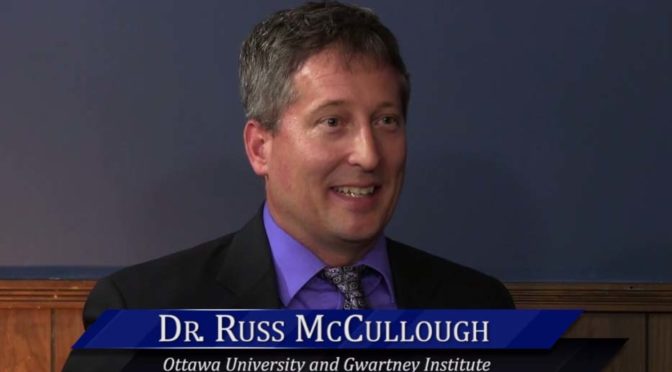
To help Kansans understand how legislators vote, Kansas Policy Institute has produced the Kansas Freedom Index for 2013.

Legislative scorecards like this are important as they let citizens know how legislators have actually voted, which is sometimes different from their campaign rhetoric, and even different from their current proclamations. Generally, scorecards include a large sampling of votes, so that no single issue paints a member into a corner.

James Franko of Kansas Policy Institute joins Bob Weeks on the Joseph Ashby Show to discuss the Kansas Freedom Index. Then, Bob runs down the scores for Wichita-area legislators.

The Kansas Freedom Index, as produced by KPI this year, is important and significant because it focuses on issues of economic freedom along with education freedom, which was added this year. So far, 45 bills have been included in the scorecard, and as the legislature is still in session and has at least two important bills to pass, there may be additions to the scorecard.

This year’s index is a continuation of the construction of indexes for past years, many of which may be found at Kansas Economic Freedom Index.

In a press release KPI president Dave Trabert said “An informed citizenry is an essential element of maintaining a free society. Having a deeper understanding of how legislation impacts education freedom, economic freedom and the constitutional principles of individual liberty and limited government allows citizens to better understand the known and often unknown consequences of legislative issues.”

He added, “Our 2012 index made clear that support of economic freedom isn’t an issue of political affiliation — the highest and lowest score in the Senate were both held by Republicans. The 2013 results bear out the same as a wide range of scores exists within both parties. Too often votes come down to parochial or personal issues and the idea of freedom is left on the legislature’s cutting room floor. Hopefully, the Kansas Freedom Index can start to recalibrate citizens and legislators towards supporting the freedoms of everyday Kansans and not be driven by politics.”

The importance of economic freedom

Milton Friedman: Capitalism and Freedom

Why is economic freedom important? Here’s what Milton Friedman had to say in the opening chapter of his monumental work Capitalism and Freedom some 50 years ago:

The Relation between Economic Freedom and Political Freedom

It is widely believed that politics and economics are separate and largely unconnected; that individual freedom is a political problem and material welfare an economic problem; and that any kind of political arrangements can be combined with any kind of economic arrangements. The chief contemporary manifestation of this idea is the advocacy of “democratic socialism” by many who condemn out of hand the restrictions on individual freedom imposed by “totalitarian socialism” in Russia, and who are persuaded that it is possible for a country to adopt the essential features of Russian economic arrangements and yet to ensure individual freedom through political arrangements. The thesis of this chapter is that such a view is a delusion, that there is an intimate connection between economics and politics, that only certain arrangements are possible and that, in particular, a society which is socialist cannot also be democratic, in the sense of guaranteeing individual freedom.

Economic arrangements play a dual role in the promotion of a free society. On the one hand, freedom in economic arrangements is itself a component of freedom broadly understood, so economic freedom is an end in itself. In the second place, economic freedom is also an indispensable means toward the achievement of political freedom.

For more about Friedman and his thoughts on economic freedom, see Milton Friedman, the Father of Economic Freedom.

Economic freedom is the most important factor in determining the well-being of people across the world. Where economic freedom exists, countries become wealthy. In introducing the Economic Freedom of the World report, its authors write: “Economic freedom has been shown in numerous peer-reviewed studies to promote prosperity and other positive outcomes. It is a necessary condition for democratic development. It liberates people from dependence on government in a planned economy, and allows them to make their own economic and political choices.”

One of the authors of the Economic Freedom of the World report, Robert Lawson, expands on the importance of economic freedom: “The big question is: Do countries that exhibit greater degrees of economic freedom perform better than those that do not? Much scholarly research has been and continues to be done to see if the index [of economic freedom] correlates with various measures of the good society: higher incomes, economic growth, income equality, gender equality, life expectancy, and so on. While there is scholarly debate about the exact nature of these relationships, the results are uniform: measures of economic freedom relate positively with these factors.

{ 0 comments }

It’s worse than President Obama saying “You didn’t build that.” Wichita Mayor Carl Brewer tells us you can’t build that — not without government guidance and intervention, anyway.

City of Wichita logoWhen President Barack Obama told business owners “You didn’t build that,” it set off a bit of a revolt. Those who worked hard to build businesses didn’t like to hear the president dismiss their efforts.

Underlying this episode is a serious question: What should be the role of government in the economy? Should government’s role be strictly limited, according to the Constitution? Or should government take an activist role in managing, regulating, subsidizing, and penalizing in order to get the results politicians and bureaucrats desire?

Historian Burton W. Folsom has concluded that it is the private sector — free people, not government — that drives innovation: “Time and again, experience has shown that while private enterprise, carried on in an environment of open competition, delivers the best products and services at the best price, government intervention stifles initiative, subsidizes inefficiency, and raises costs.”

But some don’t agree. They promote government management and intervention into the economy. Whatever their motivation might be, however it was they formed their belief, they believe that without government oversight of the economy, things won’t happen.

But in Wichita, it’s even worse. Without government, it is claimed that not only would we stop growing, economic progress would revert to a previous century.

Mayor Carl Brewer made these claims in a 2008 meeting of the Wichita City Council.

In his remarks (transcript and video below), Brewer said “if government had not played some kind of role in guiding and identifying how the city was going to grow, how any city was going to grow, I’d be afraid of what that would be. Because we would still be in covered wagons and horses. There would be no change.”

When I heard him say that, I thought he’s just using rhetorical flair to emphasize a point. But later on he said this about those who advocate for economic freedom instead of government planning and control: “… then tomorrow we’ll be saying we don’t want more technology, and then the following day we’ll be saying we don’t want public safety, and it won’t take us very long to get back to where we were at back when the city first settled.”

Brewer’s remarks are worse than “You didn’t build that.” The mayor of Wichita is telling us you can’t build that — not without government guidance and intervention, anyway.

Many people in Wichita, including the mayor and most on the city council and county commission, believe that the public-private partnership is the way to drive innovation and get things done. It’s really a shame that this attitude is taking hold in Wichita, a city which has such a proud tradition of entrepreneurship. The names that Wichitans are rightly proud of — Lloyd Stearman, Walter Beech, Clyde Cessna, W.C. Coleman, Albert Alexander Hyde, Dan and Frank Carney, and Fred C. Koch — these people worked and built businesses without the benefit of public-private partnerships and government subsidy.

This tradition of entrepreneurship is disappearing, replaced by the public-private partnership and programs like Visioneering Wichita, sustainable communities, Greater Wichita Economic Development Coalition, Regional Economic Area Partnership (REAP), and rampant cronyism. Although when given a chance, voters are rejecting cronyism.

We don’t have long before the entrepreneurial spirit in Wichita is totally subservient to government. What can we do to return power to the people instead of surrendering it to government?

Wichita Mayor Carl Brewer, August 12, 2008:

“You know, I think that a lot of individuals have a lot of views and opinions about philosophy as to, whether or not, what role the city government should play inside of a community or city. But it’s always interesting to hear various different individuals’ philosophy or their view as to what that role is, and whether or not government or policy makers should have any type of input whatsoever.

“I would be afraid, because I’ve had an opportunity to hear some of the views, and under the models of what individuals’ logic and thinking is, if government had not played some kind of role in guiding and identifying how the city was going to grow, how any city was going to grow, I’d be afraid of what that would be. Because we would still be in covered wagons and horses. There would be no change.

“Because the stance is let’s not do anything. Just don’t do anything. Hands off. Just let it happen. So if society, if technology, and everything just goes off and leaves you behind, that’s okay. Just don’t do anything. I just thank God we have individuals that have enough gumption to step forward and say I’m willing to make a change, I’m willing to make a difference, I’m willing to improve the community. Because they don’t want to acknowledge the fact that improving the quality of life, improving the various different things, improving bringing in businesses, cleaning up street, cleaning up neighborhoods, doing those things, helping individuals feel good about themselves: they don’t want to acknowledge that those types of things are important, and those types of things, there’s no way you can assess or put a a dollar amount to it.

“Not everyone has the luxury to live around a lake, or be able to walk out in their backyard or have someone come over and manicure their yard for them, not everyone has that opportunity. Most have to do that themselves.

“But they want an environment, sometimes you have to have individuals to come in and to help you, and I think that this is one of those things that going to provide that.

“This community was a healthy thriving community when I was a kid in high school. I used to go in and eat pizza after football games, and all the high school students would go and celebrate.

“But, just like anything else, things become old, individuals move on, they’re forgotten in time, maybe the city didn’t make the investments that they should have back then, and they walk off and leave it.

“But new we have someone whose interested in trying to revive it. In trying to do something a little different. In trying to instill pride in the neighborhood, trying to create an environment where it’s enticing for individuals to want to come back there, or enticing for individuals to want to live there.

“So I must commend those individuals for doing that. But if we say we start today and say that we don’t want to start taking care of communities, then tomorrow we’ll be saying we don’t want more technology, and then the following day we’ll be saying we don’t want public safety, and it won’t take us very long to get back to where we were at back when the city first settled.

“So I think this is something that’s a good venture, it’s a good thing for the community, we’ve heard from the community, we’ve seen the actions of the community, we saw it on the news what these communities are doing because they know there’s that light at the end of the tunnel. We’ve seen it on the news. They’ve been reporting it in the media, what this particular community has been doing, and what others around it.

“And you know what? The city partnered with them, to help them generate this kind of energy and this type of excitement and this type of pride.

“So I think this is something that’s good. And I know that there’s always going to be people who are naysayers, that they’re just not going to be happy. And I don’t want you to let let this to discourage you, and I don’t want the comments that have been heard today to discourage the citizens of those neighborhoods. And to continue to doing the great work that they’re doing, and to continue to have faith, and to continue that there is light at the end of the tunnel, and that there is a value that just can’t be measured of having pride in your community and pride in your neighborhood, and yes we do have a role to be able to help those individuals trying to help themselves.”

{ 0 comments }

Wichita economic development and the election

by Bob Weeks on March 26, 2013

Ballot box

As Wichitans decide their preference for city council members, voters should take a look at the numbers and decide whether they’re satisfied with our city’s performance in economic development.

As shown in the article Wichita economic statistics, Wichita is not doing well in key economic statistics. Debt has risen rapidly in recent years. Growth of private sector jobs lags far behind the nation and the state of Kansas, and government jobs have grown faster than private sector jobs. While inflation-adjusted spending per person is holding relatively steady, the city is cutting services and generally sending a message of budgetary distress.

Perhaps most astonishing: With all the public money poured into downtown redevelopment, with all the claims of new projects being competed, and with all the talk of building up the tax base, assessed valuation in downtown Wichita is declining.

In his recent State of the City Address, Wichita Mayor Carl Brewer called for increased effort and funding for economic development, specifically job creation. He, and most of Wichita’s political and bureaucratic leaders, believe that more targeted economic development incentives are needed to boost Wichita’s economy.

Whether these incentives are good economic development policy is open for debate. I don’t believe we need them. Kansas and Wichita should chart another course to increase economic freedom in Kansas. That, in turn, will make our area appealing to companies. But our local bureaucrats, most business leaders, and nearly all elected officials believe that targeted incentives are the way to attract and retain business.

Even if we believe that an active role for government in economic development is best, we have to conclude that our efforts aren’t working. In most years, the number of jobs that officials take credit for creating or saving is just a small part of the labor force, often less than one percent.

Rarely mentioned are the costs of creating these jobs. These costs have a negative economic impact on those who pay them. This means that economic activity and jobs are lost somewhere else in order to pay for the incentives.

Also, some of these jobs would have been created without the city’s efforts. All the city should take credit for is the marginal activity that it purportedly created. Government usually claims credit for everything, however.

Several long-serving politicians and bureaucrats that have presided over this failure: Mayor Carl Brewer has been on the city council or served as mayor since 2001. Economic development director Allen Bell has been working for the city since 1992. City Attorney Gary Rebenstorf has served for many years.

Wichita City Manager Robert Layton has had less time to influence the course of economic development in Wichita. But he’s starting to become part of the legacy of Wichita’s efforts in economic development.

The incumbents running for reelection to city council have been in office varying lengths of time. All, however, subscribe to the interventionist model of economic development championed by the mayor. That’s the model that hasn’t been working for Wichita.

If voters in Wichita are truly concerned about economic development for everyone, next week’s election provides an opportunity to make a positive change by bring new voices to the city council.

{ 1 comment }

Developer welfare expanded in Kansas

by Bob Weeks on March 21, 2013

Money Grabber

This week the Kansas House of Representatives considered a bill that would expand the application of tax increment financing (TIF) and community improvement district taxes. The bill, HB 2086, is not a major expansion, but is still harmful.

On Monday the bill failed to pass, with 61 members voting in favor, and 60 against. (63 votes are needed to pass a bill.)

On the following day, Rep. Scott Schwab made a motion to reconsider. If agreed to, Schwab’s motion would force another vote on the passage of the bill. The motion passed, and when the vote on the bill was tallied, it had passed with 81 votes.

Democrats who changed their votes from No to Yes are Barbara Ballard, Brandon Whipple, Ed Trimmer, Jerry Henry, Julie Menghini, Nancy Lusk, Patricia Sloop, Paul Davis, Stan Frownfelter, Tom Burroughs and Valdenia Winn.

Republicans who changed their votes from No to Yes are Dennis Hedke, James Todd, Kelly Meigs, Kevin Jones, Marty Read, Ramon Gonzalez, Scott Schwab, and Vern Swanson.

One Republican, Marc Rhoades, changed his vote from Yes to No.

The original coalition of votes that defeated the bill on Monday was a mix of free-market Republicans and Democrats. The free-market members vote against this bill because it is contrary to the principals of capitalism. Many Democrats vote against bills like this because they see it as welfare for greedy developers or other business interests. An example of the latter is Rep. Ed Trimmer, who on the Kansas Economic Freedom Index for last year scored very near the bottom in terms of voting for economic freedom.

But somehow, he and the other Democrats listed above were persuaded to change their votes.

(Click here to open spreadsheet in new window.)

{ 0 comments }

Kansas Judicial Center in snowWhile many believe that judges should not “legislate from the bench,” that is, make law themselves, the reality is that lawmaking is a judicial function. In a democracy, lawmakers should be elected under the principle of “one person, one vote.” But Kansas, which uses the Missouri Plan for judicial selection to its two highest courts, violates this principle.

A recent paper by Kansas University School of Law Professor Stephen J. Ware explains the problem with the process used in Kansas. The paper is titled Originalism, Balanced Legal Realism and Judicial Selection: A Case Study and may be downloaded at no charge. The Kansas courts that use the judicial selection described in the paper are the Kansas Court of Appeals and the Kansas Supreme Court.

At issue is whether judges are simply arbitrators of the law, or do they actually participate in the lawmaking process. Ware explains: “This realist view that statutory interpretation often involves ‘substantial judicial discretion’ and therefore constitutes ‘judicial lawmaking, not lawfinding,’ had by the 1950s, ‘become deeply rooted.’”

A “‘balanced realism,’ to use Brian Tamanaha’s appealing label, recognizes both that judges’ policy preferences have little or no influence on many judicial decisions and that judges’ policy preferences have a significant influence on other judicial decisions. Empirical studies tend to support this balanced view.” In other words, there is some role for ideology in making judicial decisions. Politics, therefore, is involved. Ware quotes Charles Gardner Geyh: “In a post-realist age, the ideological orientation of judicial aspirants matters.” And the higher the court, the more this matters.

Since judges function as lawmakers, they ought to be selected by a democratic process. In the Kansas version of the Missouri Plan, a nominating commission dominated by lawyers selects three candidates to fill an opening on the Kansas Court of Appeals or Kansas Supreme Court. The governor then selects one of the three, and the process is over. A new judge is selected. This process gives members of the state’s bar tremendous power in selecting judges.

Ware presents eleven examples of judges on the two highest Kansas courts engaging in lawmaking. In one, a workers’ compensation case, the employee would lose his appeal if the “clear” precedent was followed. Justice Carol A. Beier wrote the opinion. Ware explains:

But this is not, in fact, what Justice Beier and her colleagues on the Kansas Supreme Court did. Rather they did what Kansas Judges Greene and Russell say never happens. Justice Beier and her colleagues engaged in lawmaking. They changed the legal rule from one contrary to their ideologies to one consistent with their ideologies.

Justice Beier’s opinion doing this started by criticizing the old rule, while acknowledging that it was, in fact, the rule prior to her opinion by which the Supreme Court made new law. Here again is the above quote from Coleman, but now with the formerly omitted words restored and italicized: “The rule is clear, if a bit decrepit and unpopular: An injury from horseplay does not arise out of employment and is not compensable unless the employer was aware of the activity or it had become a habit at the workplace.”

Who decided that this rule is “decrepit and unpopular” and so should be changed? Was it the Kansas Legislature? No, it was the Kansas Supreme Court. It was judges, not legislators, who decided that this legal rule was bad policy. It was judges, not legislators, who changed the law to bring it in line with what the lawmaking judges thought was good policy.

Beier wrote in her opinion: “We are clearly convinced here that our old rule should be abandoned. Although appropriate for the time in which it arose, we are persuaded by the overwhelming weight of contrary authority in our sister states and current legal commentary.”

The result: New Kansas law, made by people selected through an undemocratic process.

In conclusion, Ware writes:

Non-lawyers who believe in the principle that lawmakers should be selected democratically need to know that judicial selection is lawmaker selection to be troubled by the Missouri Plan’s violation of this principle. Non-lawyers who do not know that judges inevitably make law may believe that the role of a judge consists only of its professional/technical side and, therefore, believe that judges should be selected entirely on their professional competence and ethics and that assessments of these factors are best left to lawyers. In short, a lawyer who omits lawmaking from a published statement about the judicial role is furthering a misimpression that helps empower lawyers at the expense of non-lawyers, in violation of basic democratic equality, the principle of one-person, one-vote.

Prospects for Kansas

In Kansas, the process for selecting judges to the Kansas Court of Appeals is governed by statute, and can be changed by the legislature and governor. Last year the House of Representatives passed a bill to reform the process, but it was blocked by Senate Judiciary Chair Tim Owens. He said “I think this is the first time I did not hear a bill because I thought it was so bad. This is a terrible, terrible bill that’s hated by the courts; it’s an attempt to take over control of the courts.”

Owens, who ranked as the least friendly senator to economic freedom in the 2012 edition of the Kansas Economic Freedom Index, lost his bid for re-election in the August primary election. Many of the other moderate Republicans who voted against reform also lost their primary election contest.

Owens, it should be noted, is an attorney, and is therefore a member of the privileged class that has outsize power in selecting judges.

Sometimes legislators are simply uninformed or misinformed on judicial selection. An example is Jean Schodorf, who lost a re-election bid in August. In an interview, she was quoted as saying “We thwarted changes to judicial selection that would have allowed the governor to have the final say in all judicial selections.”

The bill that the senate voted on, and the one that Owens killed the year before, called for Court of Appeals judges to be appointed by the governor, with the consent of the senate. It’s actually the senate that has the final say.

Newspaper editorial writers across Kansas are mostly opposed to judicial selection reform. An example is Rhonda Holman of the Wichita Eagle, who in 2010 wrote: “Some critics may have a beef with past court decisions, perhaps even a legitimate one — which is no surprise, given that judicial decisions pick winners and losers. But they also may be motivated by politics — which is a problem, given that the judiciary is supposed to be fair, impartial and independent. In the absence of a strong case for change, Kansas should stick with what works.”

With the change in composition of the Kansas Senate, the climate is more favorable for reform for the way judges are selected for the Kansas Court of Appeals. The law governing how judges for the Kansas Supreme Court are selected is in the Kansas Constitution, and would require an amendment to alter the process. Such an amendment requires a two-thirds vote in both chambers of the Kansas Legislature, and then a simple majority vote of the people.

By the way: For those who criticize the support for judicial selection reform as pure power politics, since Kansas has a conservative governor, remember this: When Professor Ware sounded the need for reform and convinced me of the need, our governor was the liberal Kathleen Sebelius. There was also a liberal senate at that time, one which would undoubtedly have rubberstamped any nominee Sebelius might have sent for confirmation.

Originalism, Balanced Legal Realism and Judicial Selection: A Case Study
By Stephen J. Ware

Abstract: The “balanced realist” view that judging inevitably involves lawmaking is widely accepted, even among originalists, such as Justice Scalia, Randy Barnett and Steven Calabresi. Yet many lawyers are still reluctant to acknowledge publicly the inevitability of judicial lawmaking. This reluctance is especially common in debates over the Missouri Plan, a method of judicial selection that divides the power to appoint judges between the governor and the bar.

The Missouri Plan is one of three widely-used methods of selecting state court judges. The other two are: (1) direct election of judges by the citizenry, and (2) appointment of judges by democratically elected officials, typically the governor and legislature, with little or no role for the bar. Each of these two methods of judicial selection respects a democratic society’s basic equality among citizens — the principle of one-person, one-vote. In contrast, the Missouri Plan violates this principle by making a lawyer’s vote worth more than another citizen’s vote.

This Article provides a case study of the clash between the inevitability of judicial lawmaking and the reluctance of lawyers to acknowledge this inevitability while defending their disproportionate power under the Missouri Plan. The Article documents efforts by lawyers in one state, Kansas, to defend their version of the Missouri Plan by attempting to conceal from the public the fact that Kansas judges, like judges in the other 49 states, inevitably make law. The case study then shows examples of Kansas judges making law. The Article concludes that honesty requires lawyers participating in the debate over judicial selection in the United States to forthrightly acknowledge that judges make law. Lawyers who seek to defend the power advantage the Missouri Plan gives them over other citizens can honestly acknowledge that this is a power advantage in the selection of lawmakers and then explain why they believe a departure from the principle of one-person, one-vote is justified in the selection of these particular lawmakers.

The complete paper may be downloaded at no charge here.

{ 1 comment }

Downtown Wichita issues not appreciated

by Bob Weeks on February 5, 2013

Once again, the Wichita Eagle editorial board misses the point regarding downtown Wichita development.

There may be some that are opposed to downtown simply because it’s downtown, or for other silly reasons. That seems to be the focus of Rhonda Holman’s editorial today.

But speaking from a perspective of economic freedom and individual liberty, it’s government interventionism in downtown that I object to. This is what harms Wichita, not the fact that people are living and working downtown or anywhere else, for that matter.

The political cronyism involved in many projects in downtown Wichita is what harms our city. When government takes from one and gives to another, everyone is worse off — other than the recipients. I understand that it’s easy to look at a subsidized project — be it downtown or elsewhere — and see people working at jobs. It’s much more difficult, however, to see the harm that the government intervention causes: Prosperity and jobs are lost due to inefficient government allocation of capital through political, not market, mechanisms. In the whole, we are worse off, not better.

If you don’t believe this — if you insist that the city government can create jobs and prosperity through its interventions, and that these have no net cost — then you have to ask why the city is not involved in more development.

It is the principled objection to government involvement that many do not understand, including, I think, the Wichita Eagle editorial board. An example: In September 2011, after I and others started a campaign to overturn a city council decision to award a tax subsidy to the Ambassador Hotel, the hotel’s lead developer asked to meet with me. In the meeting I explained that I would oppose the city’s action if applied to any hotel, located anywhere in Wichita, owned by anyone. He said that he sensed my opposition was based on principle, and I agreed.

The curious thing is that this seemed to puzzle him — that people would actually apply principles to politics.

The political allocation of investment capital in Wichita leads to problems of the appearance of impropriety, if not actual impropriety. There is a small group of people that repeatedly receive large amounts of taxpayer subsidy. These people and others associated with their companies regularly contribute to the campaign funds of city council members and candidates. These council members then vote to grant these people taxpayer-funded subsidy, year after year.

City council members also vote to award them with no-bid contracts. That’s terrible government policy. Especially when one recent contract was later put to competitive bid, and turned out to cost much less than the no-bid price. City council members, all except one, were willing to award their significant campaign contributors with an overpriced no-bid contract at taxpayer expense.

The company that won the no-bid contract was Key Construction. Its owners and executives were the sole contributors to the campaign fund of Lavonta Williams (district 1, northeast Wichita) in 2012 as she prepared to run for reelection this spring.

James Clendenin (district 3, southeast and south Wichita), also running for reelection this spring, and also having voted for the no-bid contract for Key, also received many contributions from Key and its executives in 2012. That company, along with person associated with one other company, were the sole source of Clendenin’s campaign funding that year.

Doesn’t the Wichita Eagle editorial board see a problem here? Doesn’t the newsroom?

There was a time when newspaper opinion editors crusaded against this type of behavior.

Newspaper editorial writers ought also to be concerned about how taxpayer funds are spent. The City of Wichita, however, has established non-profit organizations to spend taxpayer funds. The Wichita Downtown Development Corporation, for example, is funded almost exclusively through taxes. Yet, it claims that it is not a public agency as defined in the Kansas Open Records Act, and therefore need not fulfill records requests seeking to bring transparency as to how the agency spends its taxpayer funds. The city, inexplicably, backs WDDC in this interpretation of law that is contrary to the interests of citizens.

Secrecy of this type regarding taxpayer funds is not good public policy. There was a time when newspaper editors railed against government secrecy like this.

We need a newspaper editorial board that understands principle vs. political expediency. As a first step, let’s ask for an editorial board that recognizes these abuses of citizens and is willing to talk about them.

{ 3 comments }

Carl Brewer: The state of Wichita, 2013

by Bob Weeks on January 30, 2013

Wichita Mayor Carl Brewer, State of the City Address, January 29, 2013

Much like President Barack Obama in his recent inaugural address, Wichita Mayor Carl Brewer displayed his collectivist instincts in his “State of the City” address for 2013. His speech, as prepared, may be read here.

Opening, the mayor said “Wichita has overcome great challenges in the past and will overcome these as well, but we’ll need to work together.”

Near the close, the mayor said “THE TIME FOR ACTION IS NOW! We have reached a point where we MUST come together as a community, and create a plan that defines our priorities and the City we are to become.” And then: “For all of our differences, I have never doubted this community’s ability to come together and protect what matters most.” (The capitalization is in the mayor’s prepared text.)

But what’s really important to Wichita is economic development. Regarding that, Brewer said this:

As we struggle to compete for new businesses and new jobs, especially in light of job losses in aviation, we must face the reality that we are competing with other cities that offer economic incentives for business development and expansion. If we want to be IN the game, we need to PLAY the game, but we have no dedicated funding source for economic development. If we’re serious about finding new jobs for our people — and I am — we must change this scenario as soon as possible. Where will those incentive dollars come from? (Capitalization, again, is from the original.)

The idea of a dedicated funding source for economic development is something that many in Wichita would support. Many would oppose it, too. But instead of just lobbing rhetorical questions (Where will those incentive dollars come from?), the mayor should give us some answers. Or, at least make a specific proposal. Does the mayor recommend a sales tax increase? Or allocating specific levels of property tax to economic development? (The city is doing this on a temporary basis.) Or asking the state legislature to fund Wichita’s economic development, as we insist the legislature fund our airline subsidy program?

Whatever it is, Mayor Brewer, give us some specific ideas as to how you want to raise this money, and how you would spend it.

It’s that spending, I think, that people in Wichita have concern over. The cumulative record of Brewer, the city council, and city bureaucratic staff hasn’t inspired trust and confidence. Giving the city additional dollars to spend on economic development is not a wise investment.

For example, the mayor says that subsidizing downtown development is good economic development strategy. But we see the mayor and nearly all council members voting to give an overpriced no-bid contract to their significant campaign contributors. This happened despite the company’s large cost overruns on previous no-bid contracts awarded by the city. Is that good economic development practice?

We see the city council sitting in a quasi-judicial role, adjudicating the award of an airport construction contract when one of the parties is a significant campaign contributor. In fact, Key Construction — the company that prevailed in that decision — through its principals and executives, was the sole source of campaign funds raised by Lavonta Williams (district 1, northeast Wichita) in 2012 as she prepared to run for reelection this spring.

Key’s executives also contributed heavily to James Clendenin (district 3, southeast and south Wichita) last year. He’s running this spring, too.

At the time this airport contract was being handled, Council Member Jeff Longwell (district 5, west and northwest Wichita) was campaigning for the Sedgwick County Commission. Campaign finance reports revealed contributions from parties associated with Walbridge, a Michigan construction company. Why would those in Michigan have an interest in helping a Wichita City Council member fund his campaign for a county office? Would the fact that Walbridge is a partner with Key Construction on the new airport terminal, and that Longwell would be voting on that contract, provide a clue?

Or: A movie theater owner and business partners contribute to the mayor’s (and other) campaigns. Mayor and council vote to give a no-interest and low-interest loan and tax breaks to theater owner and his partners. Mayor goes into barbeque sauce business. Mayor’s barbeque sauce is now sold at movie theater.

Doesn’t Carl Brewer see anything wrong with this? Don’t his advisors tell him that this creates the appearance of impropriety? Does the mayor consider whether these actions make a positive impression on those who might want to invest in Wichita?

We see the city awarding economic development incentives that were not necessary for the project to proceed. It took a special election to teach the mayor and council that lesson. By the way, that unneeded and rejected incentive was awarded to the significant campaign contributors of Mayor Brewer and most council members.

We see the city taking credit for building up the tax base, yet giving away tax revenue in the form of property tax abatements, IRBs, tax increment financing, and STAR bonds.

The bureaucratic missteps: The Southfork TIF district is just the latest example.

The lack of respect for citizens’ right to know how taxpayer funds are spent is another troubling aspect of Brewer’s tenure as mayor. None of the words “accountability,” “transparency,” or “open government” were mentioned in the mayor’s address this year, as they have been in the past. No sense in calling attention to an area where the city has failed, I suppose.

All this is done in the name of economic development and jobs. But Wichita is underperforming Kansas and the nation in these areas. Under Brewer’s leadership, however, we are overachieving in the advancement of cronyism and its ills.

The record indicates that our officeholders, and those who advise them, are not worthy of our trust, and certainly not more taxes for economic development.

After last year’s State of the City speech, I noted “Wichita’s mayor is openly dismissive of economic freedom, free markets, and limited government, calling these principles of freedom and liberty ‘simplistic.’ Instead, his government prefers crony capitalism and corporate welfare.”

I also wrote: “Relying on economic freedom, free markets, and limited government for jobs and prosperity means trusting in free people, the energy of decentralized innovation, and spontaneous order. A government plan for economic development is the opposite of these principles.”

This year, the outlook for economic freedom and limited government in Wichita is gloomier than ever before. The door for those who wish to profit through cronyism is wide open. We’ll have to hope that, somehow, Wichita can learn to thrive under this regime.

{ 1 comment }

Economic development incentives questioned

by Bob Weeks on December 7, 2012

When the New York Times is concerned about the cost of government spending programs, it’s a safe bet that things are really out of control. Its recent feature As Companies Seek Tax Deals, Governments Pay High Price reports on economic development incentive programs that are costly and produce questionable benefits.

Do we know the cost of economic development incentives? No, reports the Times: “A full accounting, The Times discovered, is not possible because the incentives are granted by thousands of government agencies and officials, and many do not know the value of all their awards. Nor do they know if the money was worth it because they rarely track how many jobs are created. Even where officials do track incentives, they acknowledge that it is impossible to know whether the jobs would have been created without the aid.”

Kansas Governor Sam Brownback appears in a video that accompanies the story.

A concern of the newspaper is that the money spent on incentives could be spent on other government programs, primarily schools. My concern is that government spending on incentives is harmful to the economy. It redirects capital from productive to unproductive uses. Charles Koch recently explained:

Today, many governments give special treatment to a favored few businesses that eagerly accept those favors. This is the essence of cronyism.

Many businesses with unpopular products or inefficient production find it much easier to curry the favor of a few influential politicians or a government agency than to compete in the open market.

After all, the government can literally guarantee customers and profitability by mandating the use of certain products, subsidizing production or providing protection from more efficient competitors.

Cronyism enables favored companies to reap huge financial rewards, leaving the rest of us — customers and competitors alike — worse off.

In another article Koch wrote: “Instead of protecting our liberty and property, government officials are determining where to send resources based on the political influence of their cronies. In the process, government gains even more power and the ranks of bureaucrats continue to swell.”

We must distinguish between business and capitalism and hold business groups accountable when they fail to promote economic freedom and capitalism. An example is the Wichita Metro Chamber of Commerce. Its legislative platform reads “The Wichita Metro Chamber believes the State should practice fiscal discipline.”

But the Chamber recommends retaining several business welfare programs that are harmful to capitalism and economic freedom.

Next week the agenda for the meeting of the Wichita City Council contains six items that dish out business welfare and promote cronyism. Another item recommends approval of the city’s legislative agenda, which contains this:

ISSUE: Existing economic development tools are essential for the continued growth and prosperity of our community.

RECOMMEND: The Wichita City Council supports continuation of its 2012 legislative agenda item, calling for protection of existing economic development tools for local public-private partnerships. Among those are Tax Increment Financing (TIF) districts, Community Improvement Districts (CIDs), Industrial Revenue Bonds (IRBs) and Sales Tax Revenue (STAR) bonds.

The premise is false twice: These economic development tools are not “essential,” and Wichita is not growing and prospering, compared to other cities: “The inflation-adjusted gross domestic product for the Wichita metro area declined 0.4 percent in 2010, according to initial estimates from the federal Bureau of Economic Analysis. The decline slowed from the year before, when this measure of economic growth plummeted by 7.7 percent. … Wichita’s decline came even as GDP grew by 2.5 percent nationwide in 2010. GDP increased in 304 of 366 metro areas nationwide.” (Wichita Business Journal, Wichita’s real GDP declined in 2010 amid national recovery, database shows.)

{ 0 comments }

Charles Koch profiled in Forbes

by Bob Weeks on December 6, 2012

The new issue of Forbes features a cover story on Charles and David Koch. It is very interesting and seems a balanced and fair article, but there are a few things that stand out. (Inside The Koch Empire: How The Brothers Plan To Reshape America.)

An example: “Both Kochs innately understand that — unlike the populist appeal of their fellow midwestern billionaire Warren Buffett and his tax-the-rich advocacy — their message of pure, raw capitalism is a much tougher sell, even among capitalists.”

I think the author should have written “even among business executives” rather than capitalists. That’s because Charles Koch has been outspoken about business cronyism, in September writing in The Wall Street Journal: “Far too many businesses have been all too eager to lobby for maintaining and increasing subsidies and mandates paid by taxpayers and consumers. This growing partnership between business and government is a destructive force, undermining not just our economy and our political system, but the very foundations of our culture.”

I would imagine that most of the business leaders seeking government subsidies and mandates consider themselves capitalists. That’s a problem.

Then: the description of “pure” capitalism as raw. I think we’re starting to realize just how raw politics and government have become. Capitalism, however, is a system based on respect for property and peaceful, beneficial exchange. Tom G. Palmer in the introduction to The Morality of Capitalism explains: “Far from being an amoral arena for the clash of interests, as capitalism is often portrayed by those who seek to undermine or destroy it, capitalist interaction is highly structured by ethical norms and rules. Indeed, capitalism rests on a rejection of the ethics of loot and grab, the means by which most wealth enjoyed by the wealthy has been acquired in other economic and political systems. … It’s only under conditions of capitalism that people commonly become wealthy without being criminals.”

Often corporations are criticized by liberals as being too focused on short-term gains, that corporate raiders buy firms, gut them, chop them up, sell off assets, lay off employees, pile on debt — you know the story as used against Mitt Romney. But look at how Koch Industries operates:

Charles spent $6 billion upfront to buy Georgia-Pacific, and rather than satisfy quarterly earnings estimates or dividend-hungry investors, he immediately directed the new division’s cash flow toward paying down the $15 billion in liabilities that it inherited. …

The Koch long-game strategy is absolute: If it makes sense to them, the Kochs stay with the plan, no matter how burdensome or how long it takes. “We buy something not to milk it but to build it, to take its capabilities and add to them, and build new businesses,” [Charles] Koch says.

That sounds like a business strategy the left should embrace, not vilify.

Another curious statement by the author: “Given their strict adherence to the principals of transparent free markets, the Kochs’ secrecy seems hypocritical.” This is curious because transparency is an attribute not often associated with advocacy for free markets. Transparency is more associated with government as a desirable goal. Charles and David Koch are private citizens, not agents of government.

There’s good news near the end of the article:

The brothers’ new political emphasis in the coming year? Fighting corporate welfare.

While Obama talks about getting rid of lobbyists, Charles says, the “only way he can achieve that stated objective is to get government out of the business of giving goodies. That’s like flies to honey,” he adds. “The first thing we’ve got to get rid of is business welfare and entitlements.”

There’s much more in the article, available at Inside The Koch Empire: How The Brothers Plan To Reshape America.

{ 0 comments }

Tax increment financing district (TIF) resources

November 28, 2012

Resources on tax increment financing districts, or TIF.

Read the full article →

Refuting the attacks on Koch

November 17, 2012

What do big government politicians mean when they say, “Koch?”

Read the full article →

Obama II, from New York Times

November 8, 2012

An invigorated Obama second administration will not be good for the country, unless the president has a change of heart.

Read the full article →

Economic freedom, quickly explained

October 18, 2012

Why is economic freedom so important, and important to everyone? A video explains in one minute.

Read the full article →

Koch articles draw critics, but few factual

October 15, 2012

Two large articles in the Wichita Eagle regarding Charles and David Koch of Wichita-based Koch Industries have attracted many comments, and many are not based on facts.

Read the full article →

Kerr’s attacks on Pompeo’s energy policies fall short

October 10, 2012

An op-ed written in favor of the wind production tax credit shows just how difficult it is to replace cronyism with economic freedom.

Read the full article →

Government interventionism ensnares us all

September 25, 2012

Are those who call for an end to government subsidy programs hypocrites for accepting those same subsidies?

Read the full article →

Is money speech?

September 24, 2012

Americans have the right to free speech, but what does that include? Is money a form of speech?

Read the full article →

Wichita economic development initiatives to be announced

September 19, 2012

Tomorrow the Wichita Metro Chamber of Commerce will announce, according to the Wichita Eagle, new economic development initiatives. Past history suggests that the efforts will not be fruitful for the Wichita area. The inclinations of the parties involved in this effort are for more government intervention and less reliance on economic freedom and free markets.

Read the full article →

Charles G. Koch: Corporate cronyism harms America

September 10, 2012

When businesses feed at the federal trough, they threaten public support for business and free markets, explains Charles G. Koch.

Read the full article →

Wichita Mayor Carl Brewer on role of government

September 6, 2012

It’s worse than “You didn’t build that.” Wichita Mayor Carl Brewer tells us you can’t build that — not without government guidance and intervention, anyway.

Read the full article →

Kansas and Wichita quick takes: Thursday September 6, 2012

September 6, 2012

Debbie Wasserman Schultz lies about lying During these convention weeks, advocates on both sides have been fact-checking the other side, and charges are being made about which side is the biggest, boldest liar. But when people lie about lying … that’s a whole new level. Human Events reports on DNC chair Debbie Wasserman Schultz and [...]

Read the full article →

Economic freedom improves lives

August 31, 2012

Economic freedom, in countries where it is allowed to thrive, leads to better lives for people as measured in a variety of ways. This is true for everyone, especially for poor people.

Read the full article →

Charles Koch: The importance of economic freedom

August 17, 2012

Charles Koch explains the importance of economic freedom for everyone.

Read the full article →

In Kansas, rejecting left-wing Republicans

August 8, 2012

Kansas voters have realized that the governance of Kansas by a coalition of Democrats and left-wing Republicans has not been in the state’s best interest.

Read the full article →

Kansas traditional Republicans: The record

August 3, 2012

As Kansas Republicans decide who to vote for in next week’s primary election, moderate senate incumbents and many newspapers urge voting for those Republicans who promote a “reasonable,” “balanced,” and “responsible” approach to Kansas government. When we examine the record of the coalition of moderate Republicans and Democrats that governed Kansas for the first decade of this century, we see legislative accomplishment that not many Kansans may be aware of.

Read the full article →

Kansas auto dealers benefit from anti-competitive law

July 20, 2012

Kansas automobile dealers benefit from a law that limits the ability of competitors to form new dealerships. Consumers are harmed.

Read the full article →

Kansas reasonable: The legacy

July 19, 2012

What is the record of those who promote a reasonable, balanced, and responsible approach to Kansas government?

Read the full article →

Coalition Grades Kansas Legislators’ Support of Economic Freedom

July 13, 2012

A new scorecard released today takes a broad look at voting records and establishes how supportive Kansas state legislators were of economic freedom, limited government and individual liberty in the 2012 legislative session.

Read the full article →

Kansas Economic Freedom Index, 2012 Edition

July 12, 2012

The Kansas Economic Freedom Index identifies Kansas legislators who vote in favor of economic freedom — and those who don’t.

Read the full article →

Are you in the top 1%?

May 30, 2012

Most Americans would be surprised to learn that they are, in fact, in the top one percent of income — when the entire world is considered. It is economic freedom in America that has been responsible for this high standard of living. But America’s ranking among the countries in economic freedom has declined, and may fall further.

Read the full article →

Kansas STAR bonds vote tests beliefs in capitalism, economic freedom

May 18, 2012

An upcoming vote in the Kansas Legislature, possibly today, will let Kansans know who is truly in favor of economic freedom, limited government, and free market capitalism — and who favors crony capitalism instead.

Read the full article →

Kansas and Wichita quick takes: Thursday May 17, 2012

May 17, 2012

Today: Watchdog reporter at Pachyderm; Kansas senators vote for cronyism; Koch = big oil?; Economic freedom; We aren’t Greece … yet.

Read the full article →

Myth: Markets can solve all problems without government at all

May 15, 2012

In much of the world, perhaps all of it, the basic problem is not only that governments do too much, but also that they do too little. But as they cease doing what they ought not to do, governments should start doing some of the things that would in fact increase justice and create the foundation for voluntary interaction to solve problems.

Read the full article →

Myth: All relations among humans can be reduced to market relations

May 14, 2012

Attempting to reduce all actions to a single motivation falsifies human experience. Not all human relationships are reducible to the same terms as markets; at the very least, those that involve involuntary “exchanges” are radically different, because they represent losses of opportunity and value, rather than opportunities to gain value.

Read the full article →

Palmer, activist for capitalism, to speak in Wichita

May 11, 2012

Tom G. Palmer, activist for capitalism and editor of the new book The Morality of Capitalism, will be in Wichita on May 16th.

Read the full article →

Myth: Privatizaton and marketization in post-communist societies were corrupt, which shows that markets are corrupting

May 10, 2012

Mere “privatization” in the absence of a functioning legal system is not the same as creating a market. Markets rest on a foundation of law; failed privatizations are not failures of the market, but failures of the state to create the legal foundations for markets.

Read the full article →

Myth: When prices are liberalized and subject to market forces, they just go up

May 9, 2012

While money prices may go up in the short time when prices are freed, the result is to increase production and diminish wasteful rationing and corruption, with the result that total real prices — expressed in terms of a basic commodity, human labor time — goes down.

Read the full article →

Myth: Markets only benefit the rich and talented

May 8, 2012

When trade takes place in free markets, both parties win. Free societies also lead to the “circulation of elites,” with no one guaranteed a place or kept from entering by accident of birth. The phrase “the rich get richer and the poor gets poorer” applies, not to free markets, but to mercantilism and political cronyism, that is, to systems in which proximity to power determines wealth.

Read the full article →

Intellectuals vs. the rest of us

May 7, 2012

Why are so many opposed to private property and free exchange — capitalism, in other words — in favor of large-scale government interventionism? Lack of knowledge, or ignorance, is one answer, but there is another.

Read the full article →