Downtown Wichita revitalization

Articles about the redevelopment of downtown Wichita and its impact on the economic freedom of Wichitans.

Janet Miller corrects misinformation

by Bob Weeks on April 21, 2013

A Wichita City Council member sets out to correct misinformation, but instead makes a number of factual errors.

At last week’s Wichita City Council meeting, Council Member Janet Miller (district 6, north central Wichita) took an opportunity to correct misinformation she says was presented. It wasn’t the first time she’s done that; see On Wichita’s Exchange Place TIF, Janet Miller speaks, City council members on downtown Wichita revitalization, Wichita Old Town TIF district illustrates cost and harm of subsidy, Wichita fluoridation debate reveals attitudes of government, and At Wichita City Council, facts are in dispute for other examples of Miller attempting to correct misinformation.

It should be noted that Miller and some other council members make these statements from their perch on the city council bench. There, their statements can’t be questioned or rebutted except by other council members. That happens only rarely. It’s left to others to do that job.

Here are some examples from the most recent meeting, with video following.

On the positive economic impact to the city of the project, Miller said “For every dollar that the city invests in any part of this project the return to the public good is two point six two.” But as I detail in In Wichita, economic development policies are questioned, this is not true for this project when the large cost to the city’s debt service fund is considered, as has been the city’s policy for economic development incentives. Except: Apparently new policy has been formulated to suit the special needs of this project.

Also, the hotel received tax credits that were a cost to the state and the nation, of which Wichita taxpayers are part. These costs were not included in the cost-benefit study that Miller cited.

In promoting the benefit of the hotel, Miller said that the city retains one hundred percent of the guest tax collected by the hotel. She didn’t tell the audience that this wasn’t her preference. Miller voted for an ordinance that would have re-routed 75 percent of that tax back to the hotel, to be used in any way its owners want. But Kansas law allowed citizens to challenge the special type of ordinance that was used to implement this law. By gathering signatures and winning an election, this guest tax redirection that Miller supported was defeated. Now, she says that having no such redirection is a positive factor.

Miller also mentioned the retail space lease in the parking garage, saying it’s “being leased to a third party professional management entity who has the expertise to recruit high quality tenants,.” She added that this will result in increased tax revenue to the city.

This is true, I suppose. But it doesn’t negate what Miller voted to do for one of her long-time campaign supporters. She vote to build, at taxpayer expense, about 8,500 square feet of retail space in the garage. Then she voted to lease it to her campaign contributors for $1 per year. This space can then be rented out for, at minimum, about $127,500 annually. We don’t really know what the public purpose for this is, or why this had to be done. Except for cronyism — we’re sure of that.

Miller also said that as a council member she earns a salary that is 30 percent of her previous salary. Council members have a salary of around $35,000, which implies that Miller previously earned around $116,000. Good for her to have earned that.

Miller also carped about the referendum election in February 2012, noting that the “city” could not raise money and campaign for the project. That’s not entirely true. We saw that in November 2004 and November 2008, government officials campaigned “off the books” for the temporary county sales tax and Wichita school bond. Council members could have spoken as private individuals in favor of their position, whatever it was.

As it turned out, the Ambassador Hotel group spent four times as much as the side that won. Lack of money to get out a message was not a problem.

As far as misinformation during the campaign, I would ask readers to review the Wichita Eagle’s fact-checking article, as well as my own article Fact checking the Wichita Ambassador Hotel campaign. Additionally, the campaign site I created at dtwichita.com is still available, as are the articles on wichitaliberty.org. If Miller or anyone else is able to find an error, I will post a correction.

{ 2 comments }

Wichita downtown tax base: Rising?

by Bob Weeks on February 21, 2013

Wichita city leaders have promoted public investment in downtown Wichita as wise because it will increase the tax base.

In his State of the City Address for 2013, Wichita Mayor Carl Brewer told the audience (based on his prepared remarks):

As you know, revitalizing downtown has been a key part of growing our community in recent years, recognizing that a healthy and thriving downtown improves our ability to attract new business, keep our young people here, and expand our tax base. With $100 million in completed downtown projects in 2012 and another $115 million starting this year, we’ve made extraordinary progress toward having the downtown that Wichitans have dreamed of. … As development continues downtown, we are closer to reaching our goals of increased pride, an increased tax base, and bringing more businesses and jobs to Wichita.

The Wichita Downtown Development Corporation sold the planning process to Wichitans by making the argument that “it will grow existing tax base revenues.”

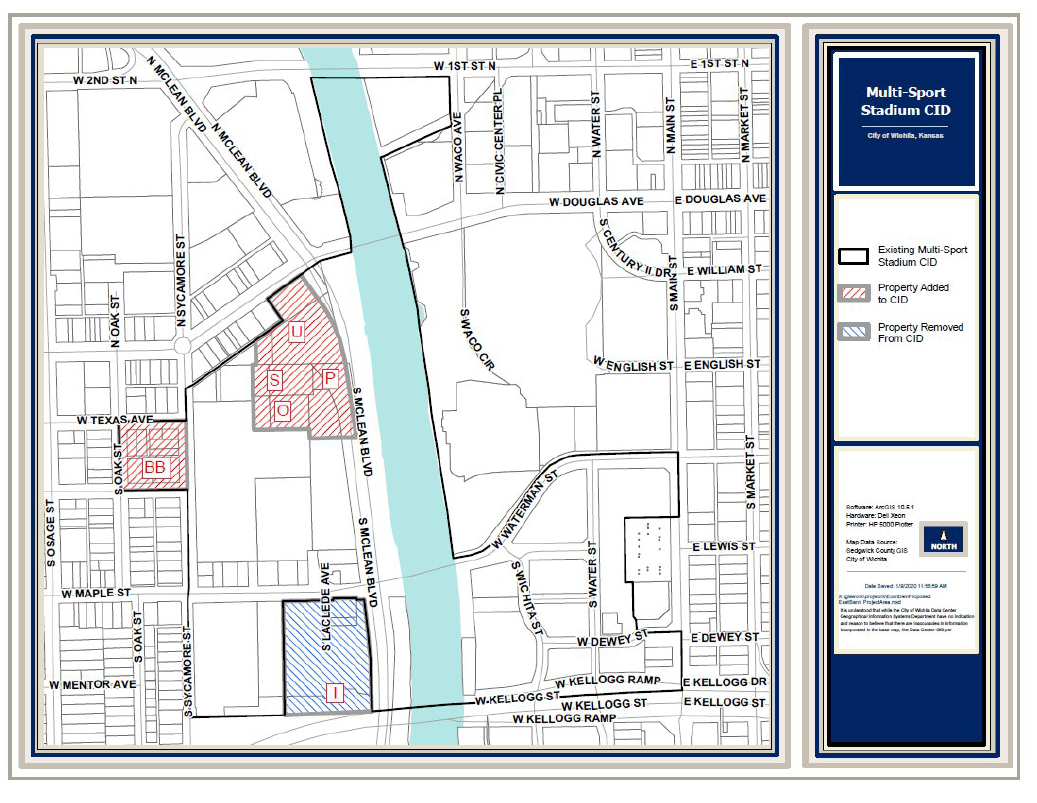
Wichita downtown self-supporting municipal improvement district (SSMID) boundary map

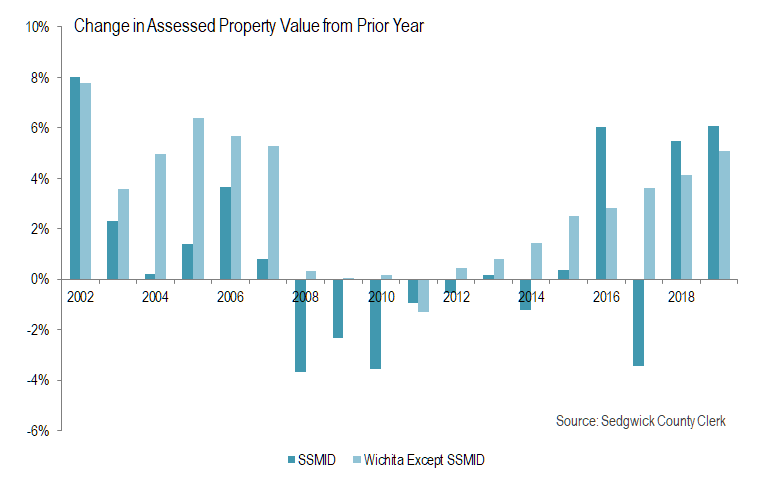
To evaluate the success of the city’s efforts, we might look at the change in assessed property valuation in downtown Wichita over past years. A way to do that is to look at the valuations for property in the Wichita downtown self-supporting municipal improvement district (SSMID). This is a region of the city that pays an additional property tax to fund the activities of the Wichita Downtown Development Corporation. Its boundaries are roughly the Arkansas River east to Washington, and Kellogg north to Central.

Assessed valuation is the basis for levying property tax. The process starts with an appraised value, which is targeted to be fair market value for the property. Then, that is multiplied by 25 percent for commercial property, or by 11.5 percent for residential property. This produces the assessed value. Multiply that by the sum of the several mill levy rates that apply to the property, and you have the total property tax for that property.

With all the new projects coming online in downtown Wichita, we should expect that the assessed valuation is rising. As someone converts an old, dilapidated property into something more valuable, appraised and assessed values should rise. As new buildings are built, new appraised and assessed value is created where before there was none (or very little). This process is the success story that Mayor Brewer and boosters of public investment in downtown trumpet, as the mayor did twice in one paragraph in his State of the City Address.

So what has happened to the assessed valuation of property in downtown Wichita, using the SSMID as a surrogate?

The answer is that after a period of increasing values, the assessed value of property in downtown has has been declining. The peak was in 2008. The nearby table holds the figures.

This is the opposite of what we’ve been promised. We’ve been told that public investment in downtown Wichita builds up the tax base.

Some might excuse this performance by noting there’s been a recession. That’s true. But according to presentations, there has been much activity in downtown Wichita. Hundreds of millions of dollars in worth, we are told.

So why isn’t the assessed valuation rising? Why is it falling during the time of huge successes?

More research is needed.

Wichita downtown self-supporting municipal improvement district (SSMID) assessed property valuation

Data can be viewed here.

{ 4 comments }

When the Wichita City Council recently received the 2012 Project Downtown Annual Report, a city council member took the opportunity to question and clarify some of the facts and figures presented in the report.

Wichita Project Downtown Annual Report 2012

In his questions, Wichita City Council Member Paul Gray (district 4, south and southwest Wichita) asked whether the amount of public investment presented did, in fact, include all public investment.

In his answer, Scott Knebel, who is Downtown Revitalization Manager, said no, not all forms of public investment were included in the figures presented in the report. He told the council that an analysis is being prepared, perhaps to be available in May.

Gray urged Knebel to be more forthcoming when reporting on the level of public investment in order to gain a better level of community buy-in: “If you truly want a greater level of community buy-in, being as forthcoming as we can with the financial analysis of these projects and truly demonstrating what we as a community are putting in through all the different public financing mechanisms available. You may not persuade the people who don’t like public participation in projects — you’re not going to change their viewpoints by that and I don’t expect you to — but the difference is you may get more trust and buy-in from the community that thinks you’re not being forthcoming and honest with them.”

Regarding Wichita news media, Gray said the media may say “‘See, it’s a 90 percent private funded ratio versus 10 percent’ which is not really the case. We’re skewing actual numbers to demonstrate our successes downtown, but I think our successes downtown speak for themselves.”

Knebel and Wichita Downtown Development Corporation President Jeff Fluhr promised to be more forthcoming with investment figures in the future.

Gray also asked about the city’s practice of building retail space and practically giving it away to developers, who can then lease the space and earn outsized returns at taxpayer expense. I reported this at the time this lease was under consideration by the city council:

According to a letter of intent approved by the city council — and sure to become law after a public hearing at a meeting of the Wichita City Council on September 13th — the city is planning to build about 8,500 square feet of retail space in a downtown parking garage. The garage is being built, partly, to serve a hotel Burk and partners are developing.

Here are the details of the deal Burk and his partners are getting from the taxpayers of Wichita: The city plans to lease this space to Burk and $1.00 per year. Not $1.00 per square foot, but $1.00 for the entire space — all 8,500 square feet.

That’s the plan for the first five years. For the next 10, the city would charge $21,000 rent per year, which is a rate of about $2.50 per square foot.

For years 15 through 20, the rent increases to $63,000, or $7.41 per square foot. At the end of this period, Burk will have the option of purchasing the space for $1,120,000, which is a cost of about $132 per square foot.

That cost of $132 per square foot is within the range of what sources in the real estate industry tell me top-quality retail space costs to build in Wichita, which is from $130 to $140 per square foot. Rents asked for that space would be from $15 to $18 per square foot per year.

Using the low figure, Burk could expect to collect about $127,500 in annual rent on space he rents for $1.00, leaving a gross profit of $127,499 for him. As the $15 rent is a net figure, Burk’s tenants will pay taxes, insurance, and maintenance.

Wichita city manager Robert Layton answered Gray by saying that real estate leasing is not an area of the city’s expertise.

Without Gray’s questions, these important matters of public policy would likely not have been brought to public attention. For mentioning these topics, Gray was — in an attempt at humor by Wichita City Council Member Pete Meitzner (district 2, east Wichita) — branded as “Debby Downer.”

Citizens might expect that as millions in public funds are invested, someone in city hall is keeping track, and that there is a plan for reporting these numbers. Citizens should ask why Mayor Brewer, City Manager Layton, and current council members are not concerned that there appears to be no such plan for accountability.

The notion of reporting that there was only $10.7 million in “public projects” in 2012 is absurd. Just one project, the Ambassador Hotel, received $15,407,075 in taxpayer funds to get started, and then was slated to receive $321,499 per year for the first five years, with smaller amounts for 22 years. Wichita voters rejected a small part of the ongoing subsidy, but the rest remained.

As to city manager Layton’s answer that the city is not experience in real estate leasing, my response is well, why then did you get involved? It’s not the first time the city has made such a sweetheart lease deal with some of the same parties. It’s become almost routine, as I reported at the time this lease was being considered:

While most citizens might be shocked at the many layers of subsidy offered to Burk, he’s accustomed to such treatment. In 2003, the city offered a similar deal to Burk and his partners for retail space that is part of the Old Town Cinema project. That deal was made with Cinema Old Town, LLC, whose resident agent is David Burk. According to the Wichita Eagle, other partners in this corporation include Wichita theater owner Bill Warren, real estate agent Steven Barrett, Key Construction and seven others.

David Wells, one of the owners of Key Construction, is a partner with Burk on the new hotel project, and Key is slated to build the garage under a process that doesn’t require competitive bidding, even though city money is used to pay for it. Note: Later the garage was put out for competitive bid.

The Old Town project let Burk and his partners lease 17,500 square feet of retail space from the City of Wichita for $1.00 per year for the first five years. Like the proposed project, that’s not $1.00 per square foot, but $1.00 per year for all 17,500 square feet.

I wonder: Is the fact that these parties — Burk, Key Construction, Bill Warren — are reliable campaign contributors to Wichita Mayor Carl Brewer and many other Wichita City Council members, does that mean anything?

Wichita Eagle reporting on this meeting is at City Council member Paul Gray questions numbers by Wichita Downtown Development.

{ 4 comments }

Lavonta Williams: ‘You don’t have to go there’

by Bob Weeks on February 6, 2013

Do not enter sign

At a Wichita City Council meeting last August, Council Member Lavonta Williams (district 1, northeast Wichita) advised taxpayers on what to do if they disagree with action taken by the council: Just don’t go there.

The topic that day was whether the council should decide to add fluoride to the city’s water, or should it let citizens vote on the matter. Williams expressed concern that if the council were to decide to fluoridate Wichita’s water, citizens would not be able to avoid ingesting the added fluoride. They wouldn’t have a choice.

By way of analogy, Williams counseled the concerned citizens: “Did you like the art that went down to WaterWalk? Maybe you didn’t. But you don’t have to go there.”

She also said we don’t have to go to the apartments that were built at WaterWalk, and we don’t have to stay at the Ambassador Hotel.

True, we can avoid these government-sponsored and subsidized places if we want to. But what Williams may have forgotten is that we can’t avoid being forced to pay for them.

Besides that, what does it say about a government where if we disagree with its actions, we’re told “you don’t have to go there”?

{ 4 comments }

Economic development in Wichita, the next step

by Bob Weeks on January 24, 2013

Critics of the economic development policies in use by the City of Wichita are often portrayed as not being able to see and appreciate the good things these policies are producing, even though they are unfolding right before our very eyes. The difference is that some look beyond the immediate — what is seen — and ask “And then what will happen?” — looking for the unseen.

Thomas Sowell explains the problem in a passage from the first chapter of Applied economics: thinking beyond stage one:

When we are talking about applied economic policies, we are no longer talking about pure economic principles, but about the interactions of politics and economics. The principles of economics remain the same, but the likelihood of those principles being applied unchanged is considerably reduced, because politics has its own principles and imperatives. It is not just that politicians’ top priority is getting elected and re-elected, or that their time horizon seldom extends beyond the next election. The general public as well behaves differently when making political decisions rather than economic decisions. Virtually no one puts as much time and close attention into deciding whether to vote for one candidate rather than another as is usually put into deciding whether to buy one house rather than another — or perhaps even one car rather than another.

The voter’s political decisions involve having a minute influence on policies which affect many other people, while economic decision-making is about having a major effect on one’s own personal well-being. It should not be surprising that the quantity and quality of thinking going into these very different kinds of decisions differ correspondingly. One of the ways in which these decisions differ is in not thinking through political decisions beyond the immediate consequences. When most voters do not think beyond stage one, many elected officials have no incentive to weigh what the consequences will be in later stages — and considerable incentives to avoid getting beyond what their constituents think and understand, for fear that rival politicians can drive a wedge between them and their constituents by catering to public misconceptions.

The economic decisions made by governing bodies like the Wichita City Council have a large impact on the lives of Wichitans. But as Sowell explains, these decisions are made by politicians for political reasons.

Sowell goes on to explain the danger of stopping the thinking process at stage one:

When I was an undergraduate studying economics under Professor Arthur Smithies of Harvard, he asked me in class one day what policy I favored on a particular issue of the times. Since I had strong feelings on that issue, I proceeded to answer him with enthusiasm, explaining what beneficial consequences I expected from the policy I advocated.

“And then what will happen?” he asked.

The question caught me off guard. However, as I thought about it, it became clear that the situation I described would lead to other economic consequences, which I then began to consider and to spell out.

“And what will happen after that?” Professor Smithies asked.

As I analyzed how the further economic reactions to the policy would unfold, I began to realize that these reactions would lead to consequences much less desirable than those at the first stage, and I began to waver somewhat.

“And then what will happen?” Smithies persisted.

By now I was beginning to see that the economic reverberations of the policy I advocated were likely to be pretty disastrous — and, in fact, much worse than the initial situation that it was designed to improve.

Simple as this little exercise may sound, it goes further than most economic discussions about policies on a wide range of issues. Most thinking stops at stage one.

We see stage one thinking all the time when looking at government. In Wichita, for example, a favorite question of city council members seeking to justify their support for government intervention such as a tax increment financing (TIF) district or some other form of subsidy is “How much more tax does the building pay now?” Or perhaps “How many jobs will (or did) the project create?”

These questions, and the answers to them, are examples of stage one thinking. The answers are easily obtained and cited as evidence of the success of the government program.

But driving by a store or hotel in a TIF district and noticing a building or people working at jobs does not tell the entire story. Using the existence of a building, or the payment of taxes, or jobs created, is stage one thinking, and no more than that.

Fortunately, there are people who have thought beyond stage one, and some concerning local economic development and TIF districts. And what they’ve found should spur politicians and bureaucrats to find ways to move beyond stage one in their thinking.

An example are economists Richard F. Dye and David F. Merriman, who have studied tax increment financing extensively. Their article Tax Increment Financing: A Tool for Local Economic Development states in its conclusion:

TIF districts grow much faster than other areas in their host municipalities. TIF boosters or naive analysts might point to this as evidence of the success of tax increment financing, but they would be wrong. Observing high growth in an area targeted for development is unremarkable.

So TIFs are good for the favored development that receives the subsidy — not a surprising finding. What about the rest of the city? Continuing from the same study:

If the use of tax increment financing stimulates economic development, there should be a positive relationship between TIF adoption and overall growth in municipalities. This did not occur. If, on the other hand, TIF merely moves capital around within a municipality, there should be no relationship between TIF adoption and growth. What we find, however, is a negative relationship. Municipalities that use TIF do worse.

We find evidence that the non-TIF areas of municipalities that use TIF grow no more rapidly, and perhaps more slowly, than similar municipalities that do not use TIF.

In a different paper (The Effects of Tax Increment Financing on Economic Development), the same economists wrote “We find clear and consistent evidence that municipalities that adopt TIF grow more slowly after adoption than those that do not. … These findings suggest that TIF trades off higher growth in the TIF district for lower growth elsewhere. This hypothesis is bolstered by other empirical findings.”

Here we have an example of thinking beyond stage one. The results are opposite of what one-stage thinking produces.

Some city council members are concerned about creating jobs, and are swayed by the promises of developers that their establishments will employ a certain number of workers. Again, this thinking stops at stage one. But others have looked farther, as has Paul F. Byrne of Washburn University. The title of his recent report is Does Tax Increment Financing Deliver on Its Promise of Jobs? The Impact of Tax Increment Financing on Municipal Employment Growth, and in its abstract we find this conclusion regarding the impact of TIF on jobs:

Increasingly, municipal leaders justify their use of tax increment financing (TIF) by touting its role in improving municipal employment. However, empirical studies on TIF have primarily examined TIF’s impact on property values, ignoring the claim that serves as the primary justification for its use. This article addresses the claim by examining the impact of TIF adoption on municipal employment growth in Illinois, looking for both general impact and impact specific to the type of development supported. Results find no general impact of TIF use on employment. However, findings suggest that TIF districts supporting industrial development may have a positive effect on municipal employment, whereas TIF districts supporting retail development have a negative effect on municipal employment. These results are consistent with industrial TIF districts capturing employment that would have otherwise occurred outside of the adopting municipality and retail TIF districts shifting employment within the municipality to more labor-efficient retailers within the TIF district.

While this research might be used to support a TIF district for industrial development, TIF in Wichita is primarily used for retail development. And, when thinking beyond stage one, the effect on employment — considering the entire city — is negative.

It’s hard to think beyond stage one. It requires considering not only the seen, but also the unseen, as Frederic Bastiat taught us in his famous parable of the broken window. But over and over we see how politicians at all levels of government stop thinking at stage one. This is one of the many reasons why we need to return as much decision-making as possible to the private sector, and drastically limit the powers of politicians and governments.

{ 0 comments }

Wichita’s Lux applies for more business welfare

by Bob Weeks on January 7, 2013

Tomorrow the Wichita City Council considers yet another layer of business welfare for The Lux, a luxury real estate development in downtown Wichita. This project, despite having already received millions in assistance from taxpayers, is not economically viable, according to city documents.

The Lux has already received the benefit of Industrial Revenue Bonds, the purpose of which, despite their name, is to relieve the Lux from paying property taxes and sales taxes.

If approved for historic preservation tax credits, the Lux could receive several millions in tax credits, which are equivalent to a cash grant. It’s likely to be approved.

These programs and actions result in taxpayers paying for the lifestyle choices of a relative few.

The assistance program the council will consider tomorrow is relatively benign. The city will allow the Lux to tap up to $1.7 million in special assessment financing. The amount owed becomes a lien in the property, and the risk of the city not being paid back is small. But this action puts our city deeper in debt, and that’s a problem.

Additionally, Wichita is taking on risk that the project’s bankers are not willing to take, even though they would also have a claim on the building if it fails. Even if the bank would loan, its interest rate would be higher than what the city charges on special assessment financing. This lower interest rate is likely the real reason for the developers claiming the need for this program.

What’s the matter with Wichita?

We have to wonder why so many projects in downtown Wichita require massive doses of taxpayer subsidy. Here’s what city documents tell us:

“The Office of Urban Development has reviewed the economic (gap) analysis of the project and determined a financial need for incentives exists based on the current market. The project lender, Intrust Bank, has advised that the bank cannot increase the loan amount, leaving a gap in funding sources that is filled by the City’s facade program.”

When the city is willing to fill in financing gaps, you can be sure that gaps will be created.

When other taxpayers have to bear the cost of incentives for the Lux and its owners, other spending and investment is reduced. While the spending on incentives is concentrated and easy to see — there will be groundbreaking and ribbon-cutting ceremonies to make sure we don’t miss it — the missing spending and investment is dispersed. The missing spending and investment is difficult to see. But it is every bit as real as this project.

In fact, this missing spending and investment is more valuable than government spending on this project. That’s because when people spend and invest on their own, they choose what is most important to them, not what is important to politicians and bureaucrats. This is a special problem in Wichita, where the mayor and city council members have a history of awarding over-priced no-bid contracts to their campaign contributors.

Sometimes these subsidies are justified by the claim that renovating historic buildings is more expensive than new construction. If that’s true, we have to recognize that investing in, or living in, a historic building is a lifestyle choice. The people who make these choices should pay themselves, just like we expect others to pay for the characteristics of the housing they choose. Likewise, building a home with granite kitchen counter tops and marble floors in the bathrooms is more expensive than a plainer home. These premium features are chosen voluntarily by the homeowner, and it is right and just that they alone should pay for them.

We should recognize historic buildings for what they are: a premium feature or amenity whose extra cost should be born solely by those who chose to own them or rent them. There’s no difference between these premium features and choosing to live in a historic building. Those who desire them choose them voluntarily, and should pay their full cost. Forcing everyone to subsidize this choice is wrong. It’s an example of a special interest gone wild. But in Wichita we call this economic development.

I wonder: After the Lux receives its millions in grants in the form of tax credits — which it is quite likely to receive — will it still have a gap at that time?

Fortunately for taxpayers the Lux does not qualify for the facade improvement grant program.

{ 0 comments }

This week there will be two dedication ceremonies for the “Waltzing Waters” display at Wichita’s WaterWalk. One is an invitation-only affair for VIPs, while the other is open to the public. While these events are promoted as celebrations, we might use this opportunity to review the history and impact of this project that has absorbed many millions of taxpayer subsidy with few results.

In 2009 a Wichita Eagle editorial started with this: “Seven years into a project that was supposed to give Wichita a grand gathering place full of shops, restaurants and night spots as well as offices and condos, some City Council members and citizens remain skeptical at best about WaterWalk’s ability to deliver on its big promises. … True, the skepticism to date is richly deserved.”

The editorial went on to report that public investment in this project has risen to $41 million.

In any case, there’s little to show for this investment. Even the proposal for the redevelopment of downtown Wichita from the planning firm Goody Clancy realizes that WaterWalk is a failure:

Indeed, Water Walk might be struggling to fill its space because it has, simply put, hit a ceiling: it is focusing on food and fun, and perhaps there is room for only one such district (Old Town) in Downtown Wichita. The Arena could help in this regard, but until the publicly subsidized Water Walk is a rousing success, it might not make sense to split the pie still further.

After all the public money put into WaterWalk, in order to get anything else, we’ll probably have to give even more. In 2010, in order to build a Marriott Fairfield Inn and Suites Hotel at WaterWalk, several subsidies were used, including a $2.5 million cash contribution from the City of Wichita. See Waterwalk hotel deal breaks new ground for Wichita subsidies. Will anything else be built at WaterWalk without similar consideration?

So taxpayers deserve a break and a celebration. Finally, the fountains, purchased in 2008 for $1.6 million, will be working. The entire fountains project cost $3.5 million, says a Wichita city document.

Waltzing Waters VIP invitation. Click here for a larger version.

But do VIPs deserve a special celebration? With drinks and hors d’oeuvres, with a desert bar after? Many of these VIPs will be the elected officials and bureaucrats responsible for WaterWalk, a project emblematic of the failure of government planning. Others will be the beneficiaries of Wichita taxpayer subsidies. They should be apologetic, not celebratory. Hopefully the expenses of this event will be borne privately, and not by taxpayers. But that brings up another issue: the pay-to-play environment that exists in Wichita.

With this glaring example of failure of a public-private partnership staring right at us in downtown Wichita, why do we want to plan for more of this? Shouldn’t we at least wait until WaterWalk is finished (if that ever happens) before we go down the path of throwing more public investment into the hands of subsidy-seeking developers?

At minimum, we ought to insist that the developers of the WaterWalk project be excluded from any consideration for further taxpayer subsidy. The WaterWalk development team: Dave Burk, Marketplace Properties, LLC; Jack P. DeBoer, Consolidated Holdings, Inc.; Gregory H. Kossover, Consolidated Holdings, Inc.; David E. Wells, Key Construction, Inc.; and Tom Johnson, CRE, WaterWalk LLC need to recognize their failure and the tremendous amount they have cost the Wichita taxpayer. Some of these parties are no longer involved in WaterWalk, but they harm they caused lingers. Some of these parties have received millions in subsidies from the city since then, including a no-bid construction contract awarded to Key Construction. When that contract was put out to public bid, city taxpayers saved $1.3 million on a $6 million project. See No-bid contracts a problem in Wichita.

Some received a no-interest and low-interest loan from the city to prop up a failing TIF district, and Burk appealed property valuations in a way that caused a tax increment financing district to fall behind.

The Wichita Eagle reported: “Downtown Wichita’s leading developer, David Burk, represented himself as an agent of the city — without the city’s knowledge or consent — to cut his taxes on publicly owned property he leases in the Old Town Cinema Plaza, according to court records and the city attorney. … Officials in the city legal department said that while Burk was within his rights to appeal taxes on another city-supported building in the Cinema Plaza, he did not have authorization to file an appeal on the city-owned parking/retail space he leases. … As for Burk signing documents as the city’s representative, ‘I do have a problem with it,’ said City Attorney Gary Rebenstorf, adding that he intends to investigate further.”

In a later story the Eagle reported “A special tax district formed by Wichita to assist in the development of the Old Town cinema project can’t cover its debt payments because the developers — including the city itself — petitioned a state court and got their property taxes reduced, records show. Now, taxpayers could be on the hook for $190,000 that had been projected to have come from within the cinema district.”

Wichita taxpayers should be relieved that at least they’re finally getting something for their investment. Let’s use this time, however, to learn the lessons of WaterWalk and centralized government planning.

{ 1 comment }

Special interest groups are likely to co-opt the government planning process started in south-central Kansas as these groups see ways to benefit from the plan. The public choice school of economics and political science has taught us how special interest groups seek favors from government at enormous costs to society, and we will see this at play over the next few years.

Sedgwick County has voted to participate in a HUD Sustainable Communities Regional Planning Grant. While some justified their votes in favor of the plan because “it’s only a plan,” once the planning process begins, special interests plot to benefit themselves at the expense of the general public. Once the plan is formed, it’s nearly impossible to revise it, no matter how evident the need.

An example of how much reverence is given to government plans comes right from the U.S. Supreme Court in the decision Kelo v. New London, in which the Court decided that government could use the power of eminent domain to take one person’s property and transfer it to someone else for the purposes of economic development. In his opinion for the Court, Justice Stevens cited the plan: “The City has carefully formulated an economic development plan that it believes will provide appreciable benefits to the community.” Here we see the importance of the plan and due reverence given to it.

Stevens followed up, giving even more weight to the plan: “To effectuate this plan, the City has invoked a state statute that specifically authorizes the use of eminent domain to promote economic development. Given the comprehensive character of the plan, the thorough deliberation that preceded its adoption, and the limited scope of our review, it is appropriate for us, as it was in Berman, to resolve the challenges of the individual owners, not on a piecemeal basis, but rather in light of the entire plan. Because that plan unquestionably serves a public purpose, the takings challenged here satisfy the public use requirement of the Fifth Amendment.”

To Stevens, the fact that the plan was comprehensive was a factor in favor of its upholding. The sustainable communities plan, likewise, is nothing but comprehensive, as described by county manager Bill Buchanan in a letter to commissioners: “[the plan will] consist of multi-jurisdictional planning efforts that integrate housing, land use, economic and workforce development, transportation, and infrastructure investments in a manner that empowers jurisdictions to consider the interdependent challenges of economic prosperity, social equity, energy use and climate change, and public health and environmental impact.”

That pretty much covers it all. When you’re charged with promoting economic prosperity, defending earth against climate change, and promoting public health, there is no limit to the types of laws you might consider.

Who will plan?

The American Planning Association praised the Court’s notice of the importance of a plan, writing “This decision underscores the importance for a community to have a comprehensive development plan formulated through a democratic planning process with meaningful public participation by everyone.”

But these plans are rarely by and for the public. Almost always the government planning process is taken over and captured by special interests. We see this in public schools, where the planning and campaigning for new facilities is taken over by architectural and construction firms that see school building as a way to profit. It does not matter to them whether the schools are needed.

Our highway planning is hijacked by construction firms that stand to benefit, whether or not new roads are actually needed.

Our planning process for downtown Wichita is run by special interest groups that believe that downtown has a special moral imperative, and another group that sees downtown as just another way to profit at taxpayer expense. Both believe that taxpayers across Wichita, Kansas, and even the entire country must pay to implement their vision. As shown in Kansas and Wichita need pay-to-play laws the special interests that benefit from public spending on downtown make heavy political campaign contributions to nearly all members of the Wichita City Council. They don’t have a political ideology. They contribute only because they know council members will be voting to give them money.

In Wichita’s last school bond election, 72 percent of the contributions, both in-kind and cash, was given by contractors, architects, engineering firms and others who directly stand to benefit from new school construction, no matter whether schools are actually needed. The firm of Schaefer Johnson Cox Frey Architecture led the way in making these contributions. It’s not surprising that this firm was awarded a no-bid contract for plan management services for the bond issue valued at $3.7 million. This firm will undoubtedly earn millions more for those projects on which it serves as architect.

The special interest groups that benefit from highway construction: They formed a group called Economic Lifelines. It says it was formed to “provide the grassroots support for Comprehensive Transportation Programs in Kansas.” Its motto is “Stimulating economic vitality through leadership in infrastructure development.”

A look at the membership role, however, lets us know whose economic roots are being stimulated. Membership is stocked with names like AFL-CIO, Foley Equipment Company, Heavy Constructors Association of Greater Kansas City, Kansas Aggregate & Concrete Associations, Kansas Asphalt Pavement Association, Kansas Contractors Association, Kansas Society of Professional Engineers, and PCA South Central Cement Promotion Association. Groups and companies like these have an economic interest in building more roads and highways, whether or not the state actually needs them.

The planners themselves are a special interest group, too. They need jobs. Like most government bureaucrats, they “profit” from increasing their power and sphere of influence, and by expansion of their budgets and staffs. So when Sedgwick County Commissioner Jim Skelton asks a professional planner questions about the desirability of planning, what answer does he think he will get? It’s not that the planners are not honest people. But they have a vested economic and professional interest in seeing that we have more government planning, not less.

And we have evidence that planners watch out for themselves. It is not disputed that this planning grant benefits Regional Economic Area Partnership (REAP). Sedgwick County Commissioner Richard Ranzau says that John Schlegel, Wichita’s Director of Planning, told him that “acceptance of this grant will take REAP to another level, because right now they are struggling, and this will help plot the course for REAP.” He said that REAP, which is housed at the Hugo Wall School of Public Affairs at Wichita State University, needs to expand its role and authority in order to give it “something to do.”

We see that REAP is another special interest group seeking to benefit itself. In this case, our best hope is that REAP engages in merely make-work, that the plan it produces is put on a shelf and ignored, and that the only harm to us is the $1.5 million cost of the plan.

By the way, did you know that Sedgwick County Commissioner Dave Unruh, who voted in favor of the plan that benefits REAP, is now chairman of REAP? Special interest groups know how to play the political game.

{ 2 comments }

For Wichita City Council, discussion is not wanted

by Bob Weeks on September 11, 2012

Governmental bodies use consent agendas for two reasons. One is to speed up the handling of issues considered to be non-controversial. Today’s meeting of the Wichita City Council had a consent agenda with 31 items. The plan was for all to be passed with a single vote. Therefore, speedy meetings.

But sometimes we see items placed on consent agendas that are of such significance that they should be placed on the regular agenda, where there is the potential of discussion. Council members will also be on record as having voted on the item independently of others.

So sometimes we see items placed on consent agendas because elected officials don’t want discussion, they don’t want their vote to be on record, and they hope the public won’t notice.

If a council member feels a consent agenda item should be discussed or debated and be voted on separately from the other items, the member can ask that the item be “pulled.” That happened today at the request of Michael O’Donnell (district 4, south and southwest Wichita). But Mayor Carl Brewer and all five other city council members disagreed. They preferred to proceed as though the issue didn’t exist, and that no time should be spent receiving information on the item.

The consent agenda item and its importance is explained at For Wichita’s Block 1 garage, public allocation is now zero parking spaces.

Wichita city officials, including Mayor Carl Brewer, say they are proud of the open and transparent city government they have created. But this episode, as well as others described in In Wichita, disdain for open records and government transparency, lets everyone know that transparency is dispensed, and accountability accepted, at the whim of the mayor and city council and their bureaucratic enablers.

On his Facebook page, Clinton Coen wrote this about his city council representative James Clendenin (district 3, southeast and south Wichita):

“I am once again ashamed of my City Councilman. Councilman Clendenin should have stood alongside his colleague, Councilman O’Donnel, and allowed a citizen to address his concerns on an agenda item. All Mr. Clendenin had to do was say “second” and Mr. Weeks could have addressed the council, provided that a majority of the council voted to allow it. Instead, Mr. Clendenin chose to censor someone that has a differing opinion. By bringing it to a vote, accountability would have been created, instead the remainder of the council chose to take the cowardly path.”

“This is the second time in recent weeks that Mr. Clendenin has done something that I am utterly appalled by.”

“The treatment of Councilman O’Donnell by the majority is childish, unnecessary and unproductive.”

{ 1 comment }

Central planning: Are we humans or pawns?

June 27, 2012

The harm of central planning to human nature is explained.

Read the full article →

In Kansas, planning will be captured by special interests

April 6, 2012

The government planning process started in south-central Kansas will likely be captured by special interest groups that see ways to benefit from the plan. The public choice school of economics and political science has taught us how special interest groups seek favors from government at enormous costs to society, and we will see this at play again over the next few years.

Read the full article →

For Wichita, no election news is good politics

March 7, 2012

Wichita city staff have time to produce news stories on everything but actual news, it seems.

Read the full article →

A Wichita shocker

March 6, 2012

The Wall Street Journal comments on last week’s election in Wichita, noting “Local politicians like to get in bed with local business, and taxpayers are usually the losers.” Purported conservatives like Pete Meitzner, James Clendenin, and Jeff Longwell ought to take notice.

Read the full article →

Wichita Eagle fact checks Ambassador Hotel campaigns

February 23, 2012

When the Wichita Eagle scrutinized the claims made by campaigns involved in the Wichita Ambassador Hotel election, a distinct difference emerged.

Read the full article →

Wichita helps out the Ambassador Hotel campaign

February 20, 2012

A page on the City of Wichita’s official, taxpayer-funded website provides information on the February 28th special election regarding a guest tax rebate for the Ambassador Hotel in downtown Wichita. While the page provides useful information, it makes a claim that is not accurate, and one which may persuade Wichita voters to vote Yes.

Read the full article →

Wichita Intrust Bank Arena profit, in perspective

February 15, 2012

When evaluating information released by Sedgwick County regarding the financial performance of Intrust Bank Arena, citizens need to look beyond the presentations made to commission members. Important facts are available, but not presented to commissioners and the public.

Read the full article →

Wichita convention business

February 15, 2012

Is the pursuit of convention business in Wichita at great expense to citizens a wise course for economic development?

Read the full article →

No-bid contracts a problem in Wichita

February 8, 2012

Wichita Eagle reporting uncovers a problem with no-bid contracts for construction projects in Wichita. This revelation illustrates these things: a Wichita City Council almost totally captured by special interests, crony capitalism on steroids, and another example of why Wichita and Kansas need pay-to-play laws.

Read the full article →

Wichita turns taxation over to private interests

December 4, 2011

In a free society with a limited government, taxation should be restricted to being a way for government to raise funds to pay for services that all people benefit from. But in the city of Wichita, taxation for private gain is overtaking our city.

Read the full article →

Wichita petition drive nears end

December 1, 2011

Wichita city leaders ought to take notice that citizens are so opposed to their actions that they will venture out in winter to gather signatures in opposition.

Read the full article →

Wichita economic development: And then what will happen?

October 14, 2011

Critics of the economic development policies in use by the City of Wichita are often portrayed as not being able to see and appreciate the good things these policies are producing, even though they are unfolding right before our very eyes. The difference is that some look beyond the immediate — what is seen — and ask “And then what will happen?” — looking for the unseen.

Read the full article →

The Wichita Eagle on naysayers: a disservice to Wichita

October 10, 2011

While the Wichita Eagle criticizes those it calls “naysayers,” it is the newspaper’s editorial board itself that is harmful to the people of Wichita and their economic freedom.

Read the full article →

Courtyard Hotel up again for tax breaks

October 10, 2011

The request for tax breaks by an Old Town Wichita hotel raises several questions of public policy, and illustrates the need for pay-to-play laws in Wichita.

Read the full article →

At Wichita City Council, facts are in dispute

September 20, 2011

Some Wichita City Council members, including Mayor Carl Brewer, criticize citizens for their use of inaccurate and misleading information. So how do the statements made by council members fare when subjected to scrutiny?

Read the full article →

In Wichita, how tax increment financing can channel tax money

September 6, 2011

The flow of tax dollars Wichita city leaders have planned for Douglas Place, a proposed hotel in Wichita, creates a mechanism where taxpayer funds are routed to a politically-connected construction firm. And unlike the real world, where developers have an incentive to build economically, the city has created incentives for Douglas Place developers to spend lavishly in a parking garage, at no cost to themselves.

Read the full article →

Kansas and Wichita quick takes: Tuesday September 6, 2011

September 6, 2011

Today: Live music example of overcriminilization, regulation in Wichita; Tax reform in Kansas; Downtown Wichita site launched; Juvenile justice system to be topic; Campaign contributions flow to Wichita’s subsidy supporters; Organ events; Urban planning in Wichita: an outside perspective.

Read the full article →

Our Downtown Wichita launched

September 2, 2011

As part of an effort to provide information about the Douglas Place project, a proposed renovation of a downtown Wichita office building into a hotel, Americans for Prosperity, Kansas has created a website. The site’s motto is “Limited government and free markets in Downtown Wichita benefit everyone. Centralized planning and crony capitalism benefit only a few.”

Read the full article →

For Wichita’s Project Downtown, goal keeps slipping

August 25, 2011

In selling a plan for the revitalization of downtown Wichita, promoters started with a promise of much private investment for just a little public investment. But as the plan proceeded, the goal kept slipping, and the first project to be approved under the final plan will probably not come close to meeting even the modest goals set by the Wichita City Council.

Read the full article →

In Wichita, historic preservation tax credits an inefficient form of developer welfare

August 22, 2011

As part of the subsidy plan for Douglas Place, a downtown Wichita hotel being proposed, developers plan to make extensive use of historic preservation tax credits to fund their project. This form of developer welfare, besides being inefficient, is largely hidden from public view.

Read the full article →

Intrust Bank Arena depreciation expense ignored

August 19, 2011

Reports that income earned by the Intrust Bank Arena is down sharply has brought the arena’s finances back into the news. The arena, located in downtown Wichita and owned by Sedgwick County, is deemed to be a success by the county and arena boosters based on “profit” figures generated during its first year of operations. But these numbers are not an honest assessment of the arena’s financial performance.

Read the full article →

Pay-to-play laws are needed in Wichita and Kansas

August 18, 2011

In the wake of scandals, some states and cities have passed “pay-to-play” laws. These laws often prohibit political campaign contributions by those who seek government contracts, or the laws may impose special disclosure requirements. But Wichita and Kansas have no such laws.

Read the full article →

For Wichita’s David Burk, subsidy machine is working again

August 18, 2011

For Wichita real estate developer David Burk of Marketplace Properties, being on the receiving end of sweetheart lease deals with the City of Wichita is becoming a habit.

Read the full article →

Wichita Mayor Carl Brewer to critics: stop grandstanding

August 17, 2011

A meeting of the Wichita City Council provided a window into the attitude of Wichita elected officials, particularly Mayor Carl Brewer. Through their actions, and by their words, we see a government that cares little for the rule of law and good government, and one that is disrespectful to citizens who call attention to this.

Read the full article →

Wichita City Council bows to special interests

August 10, 2011

Yesterday’s meeting of the Wichita City Council revealed a council — except for one member — totally captured by special interests, to the point where the council, aided by city staff, used a narrow legal interpretation in order to circumvent a statutorily required public hearing process.

Read the full article →

Wichita should reject the fads Portland has followed

August 10, 2011

Urban planners say they can make our cities more livable, our downtowns more vibrant, and our traffic calmer. The problem is that urban planners do not understand how cities work, so all of their plans often turn out disastrously wrong.

Read the full article →

Wichita city council to decide between rule of law, or rule by situation

August 8, 2011

Tuesday’s Wichita City Council meeting will provide an opportunity for the mayor, council members, and city hall staff to let Wichitans know if our city is governed by the rule of law and proper respect for it, or if these values will be discarded for the convenience of one person and his business partners.

Read the full article →

Despite allegations, Wichita’s Dave Burk remains favored

July 28, 2011

Wichita developer David Burk remains in favor at city hall despite allegations.

Read the full article →

Downtown Wichita regulations on subsidy to be considered

May 16, 2011

Policies about to be adopted by the City of Wichita means that downtown development is certain to miss out on the benefits of free markets, capitalism, and the dispersed knowledge that only markets can generate and channel.

Read the full article →

Kansas and Wichita quick takes: Monday May 16, 2011

May 16, 2011

Today: Wichita City Council this week; Wichita as art curator; Legislature fails to confront KPERS; Over 30 major news organizations linked to George Soros; Romney seen as candidate of business, not capitalism; Programs for elderly must be cut; Social Security seen as unwise, financially; Market development in Wichita.

Read the full article →

Kansas and Wichita quick takes: Friday May 6, 2011

May 6, 2011

Today: Wichita downtown sites draw little interest; KPERS; more flexibility for school funds; despite “cuts,” spending grows; Sandy Springs a model; states’ war for jobs; shale gas to be topic in Wichita; Economics in one lesson this Monday; voters favor cuts, not tax increases to balance budget; here’s the Kansas data.

Read the full article →

Government can’t be like business

April 15, 2011

Despite the claims of government and business leaders in Wichita, our city’s government can’t be run like a business.

Read the full article →