Community Improvement Districts

Developer welfare expanded in Kansas

by Bob Weeks on March 21, 2013

Money Grabber

This week the Kansas House of Representatives considered a bill that would expand the application of tax increment financing (TIF) and community improvement district taxes. The bill, HB 2086, is not a major expansion, but is still harmful.

On Monday the bill failed to pass, with 61 members voting in favor, and 60 against. (63 votes are needed to pass a bill.)

On the following day, Rep. Scott Schwab made a motion to reconsider. If agreed to, Schwab’s motion would force another vote on the passage of the bill. The motion passed, and when the vote on the bill was tallied, it had passed with 81 votes.

Democrats who changed their votes from No to Yes are Barbara Ballard, Brandon Whipple, Ed Trimmer, Jerry Henry, Julie Menghini, Nancy Lusk, Patricia Sloop, Paul Davis, Stan Frownfelter, Tom Burroughs and Valdenia Winn.

Republicans who changed their votes from No to Yes are Dennis Hedke, James Todd, Kelly Meigs, Kevin Jones, Marty Read, Ramon Gonzalez, Scott Schwab, and Vern Swanson.

One Republican, Marc Rhoades, changed his vote from Yes to No.

The original coalition of votes that defeated the bill on Monday was a mix of free-market Republicans and Democrats. The free-market members vote against this bill because it is contrary to the principals of capitalism. Many Democrats vote against bills like this because they see it as welfare for greedy developers or other business interests. An example of the latter is Rep. Ed Trimmer, who on the Kansas Economic Freedom Index for last year scored very near the bottom in terms of voting for economic freedom.

But somehow, he and the other Democrats listed above were persuaded to change their votes.

(Click here to open spreadsheet in new window.)

{ 0 comments }

Economic development incentives questioned

by Bob Weeks on December 7, 2012

When the New York Times is concerned about the cost of government spending programs, it’s a safe bet that things are really out of control. Its recent feature As Companies Seek Tax Deals, Governments Pay High Price reports on economic development incentive programs that are costly and produce questionable benefits.

Do we know the cost of economic development incentives? No, reports the Times: “A full accounting, The Times discovered, is not possible because the incentives are granted by thousands of government agencies and officials, and many do not know the value of all their awards. Nor do they know if the money was worth it because they rarely track how many jobs are created. Even where officials do track incentives, they acknowledge that it is impossible to know whether the jobs would have been created without the aid.”

Kansas Governor Sam Brownback appears in a video that accompanies the story.

A concern of the newspaper is that the money spent on incentives could be spent on other government programs, primarily schools. My concern is that government spending on incentives is harmful to the economy. It redirects capital from productive to unproductive uses. Charles Koch recently explained:

Today, many governments give special treatment to a favored few businesses that eagerly accept those favors. This is the essence of cronyism.

Many businesses with unpopular products or inefficient production find it much easier to curry the favor of a few influential politicians or a government agency than to compete in the open market.

After all, the government can literally guarantee customers and profitability by mandating the use of certain products, subsidizing production or providing protection from more efficient competitors.

Cronyism enables favored companies to reap huge financial rewards, leaving the rest of us — customers and competitors alike — worse off.

In another article Koch wrote: “Instead of protecting our liberty and property, government officials are determining where to send resources based on the political influence of their cronies. In the process, government gains even more power and the ranks of bureaucrats continue to swell.”

We must distinguish between business and capitalism and hold business groups accountable when they fail to promote economic freedom and capitalism. An example is the Wichita Metro Chamber of Commerce. Its legislative platform reads “The Wichita Metro Chamber believes the State should practice fiscal discipline.”

But the Chamber recommends retaining several business welfare programs that are harmful to capitalism and economic freedom.

Next week the agenda for the meeting of the Wichita City Council contains six items that dish out business welfare and promote cronyism. Another item recommends approval of the city’s legislative agenda, which contains this:

ISSUE: Existing economic development tools are essential for the continued growth and prosperity of our community.

RECOMMEND: The Wichita City Council supports continuation of its 2012 legislative agenda item, calling for protection of existing economic development tools for local public-private partnerships. Among those are Tax Increment Financing (TIF) districts, Community Improvement Districts (CIDs), Industrial Revenue Bonds (IRBs) and Sales Tax Revenue (STAR) bonds.

The premise is false twice: These economic development tools are not “essential,” and Wichita is not growing and prospering, compared to other cities: “The inflation-adjusted gross domestic product for the Wichita metro area declined 0.4 percent in 2010, according to initial estimates from the federal Bureau of Economic Analysis. The decline slowed from the year before, when this measure of economic growth plummeted by 7.7 percent. … Wichita’s decline came even as GDP grew by 2.5 percent nationwide in 2010. GDP increased in 304 of 366 metro areas nationwide.” (Wichita Business Journal, Wichita’s real GDP declined in 2010 amid national recovery, database shows.)

{ 0 comments }

Yesterday’s opening of a Cabela’s store in Wichita was celebrated as a great success, but the circumstances of the store’s birth should remind us of the failure of Wichita’s economic development strategies and efforts.

We have to ask why Wichita is not able to attract retailers like Cabela’s without offering some sort of subsidy. In the current example, we are allowing Cabela’s to add 1.2 cents per dollar extra sales tax. Cabela’s keeps one cent, and 0.2 cents will be used to build a new highway exit ramp — one not seriously contemplated until Cabela’s wanted it.

This turnover of public taxation to private interests through the community improvement district (CID) program is contrary to good public policy. The power to tax is one of the most important — and harmful — functions of government. It ought to be used to pay for public goods, instead of being turned over to private benefit, as it has for Cabela’s.

At the opening ceremony, I spoke with Kansas Governor Sam Brownback and reminded him that just two weeks ago Wichita voters spoke out against special tax deals similar to the deal Cabela’s received. What is the future of these special tax deals? “I think the better approach is broad tax reduction,” he said.

While the governor was referring primarily to income taxes, there is strong evidence that Kansas needs to reduce all forms of business tax costs. The release of a report from the Tax Foundation ranking the states in business tax costs brought that into sharp focus two weeks ago. The news for Kansas is worse than merely bad, as our state couldn’t have performed much worse: Kansas ranks 47th among the states for tax costs for mature business firms, and 48th for new firms.

This raises the question: Was the CID tax giveaway truly necessary for Cabela’s to open, or is Cabela’s business model so flimsy that it requires corporate welfare to survive, or is Cabela’s simply an opportunistic company, willing to feed off taxpayers as another source of profit?

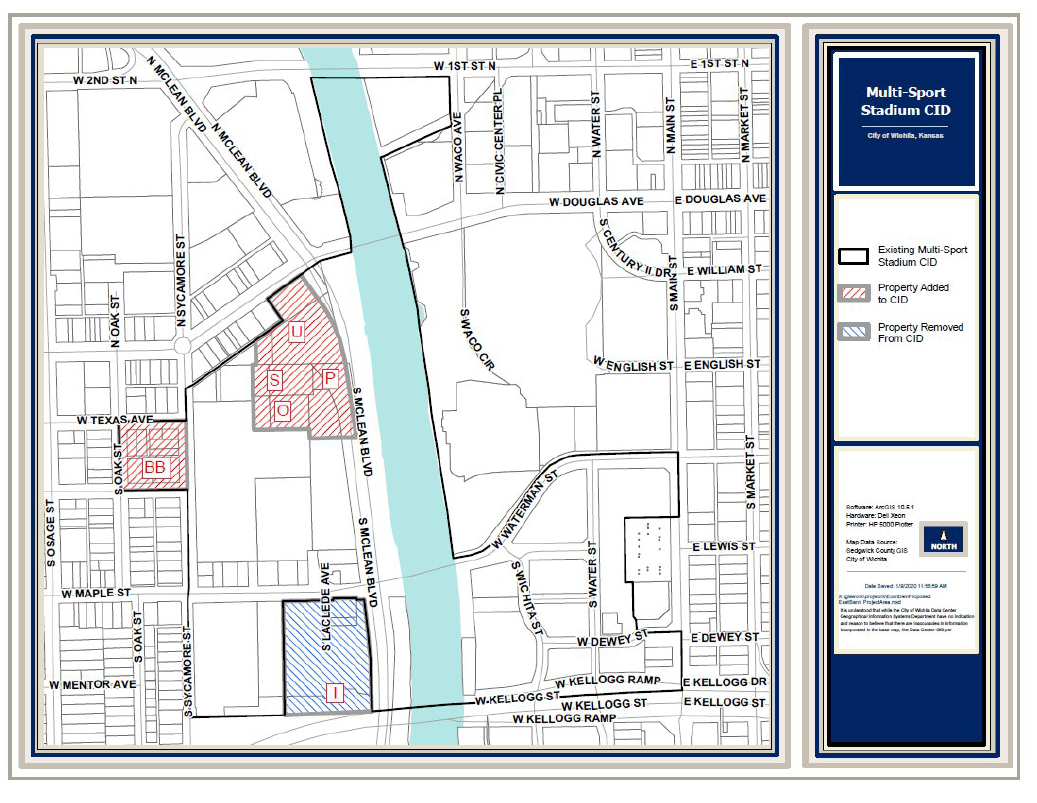
Community Improvement Districts

CIDs allow merchants to apply a higher sales tax rate to sales. The money from shoppers is collected under the pretense of government authority, but it is earmarked for the exclusive benefit of the owners of property in the CID. This is perhaps the worst aspect of CIDs. Landlord and merchants already have a way to generate revenue from their customers under free exchange: through the prices posted or advertised for their products, plus consumers’ awareness of the sales tax rates that prevail in a state, county, and city.

But most consumers may never be aware that they paid an extra tax for the exclusive benefit of the CID. If they happen to calculate the sales tax they paid, they may conclude that the high CID rate is charged all across Wichita — thereby staining our reputation.

The Wichita city council had a chance to provide transparency to shoppers by requiring merchants in CIDs to post signs informing shoppers of the amount of extra tax to be changed in the store. But CID advocates got the city council to back down from that requirement. CID advocates know how powerful information is, and they along with their allies on the city council realized that signage with disclosure would harm CID merchants. Council Member Sue Schlapp succinctly summarized the subterfuge that must accompany the CID tax when she said: “This is very simple: If you vote to have the tool, and then you vote to put something in it that makes the tool useless, it’s not even any point in having the vote, in my opinion.” She voted against the signage requirement.

Jeff Longwell (district 5, west and northwest Wichita), in explaining his vote against the signage requirement with the tax rate displayed, said he thought this information would be confusing to shoppers.

Are incentives necessary?

The age-old question is whether economic activity will occur without economic development incentives. Governor Brownback said it is a “legitimate question” as to whether Cabela’s would be here anyway.

In the case of Cabela’s, the store might not be in Wichita without incentives, as the company has shown itself to be especially eager and adept at gathering corporate welfare paid for by taxpayers. One writer concluded “For its part, Cabela’s is unabashed about its dependence on corporate socialism, even declaring in its annual report that grabbing public money is key to its business plan.”

We see elected officials and economic development bureaucracies eager to create jobs, so much so that they offer incentives that are not necessary. This leads to a cycle of dependency on city hall for economic development. That’s good for politicians and bureaucrats, but bad for everyone else.

It would be one thing if our economic development activities were working. But there’s evidence that they’re not. Recently we learned that the job-creating activities of Greater Wichita Economic Development Coalition last year resulted in a number of jobs barely more than one-half of one percent of the labor force.

That’s not a very good job. But keeping a website up to date ought to be easy. The GWEDC site, however, is terribly out of date. On a page titled Recent Relocations Highlights, the most recent item is from 2009. Have we not had any relocations since then, or does GWEDC simply not care to update and maintain its website?

A recent Wichita Eagle article, (Why isn’t Wichita winning projects?, January 22, 2012 Wichita Eagle), after listing four items economic development professionals say Wichita needs but lacks, reported “The missing pieces have been obvious for years, but haven’t materialized for one reason or another.”

If these pieces are truly needed and have been obviously missing for years: Isn’t that a startling assessment of failure of Wichita’s economic development regime?

{ 4 comments }

Wichita’s high tax hotels

by Bob Weeks on September 6, 2011

One of the strategies that two downtown Wichita hotels have pursued is to form a Community Improvement District (CID) to benefit their hotel.

CIDs are a creation of the Kansas Legislature from the 2009 session. They allow merchants in a district to collect additional sales tax of up to two cents per dollar. The extra sales tax is used for the exclusive benefit of the CID. In the case of the two hotels in downtown Wichita — Fairfield Inn & Suites Wichita Downtown and Drury Plaza Hotel Broadview — both elected to go for the full two cents of taxpayer welfare.

Now Douglas Place, a proposed hotel in Wichita, wants the same deal for itself.

To stay in these hotels, guests must now pay 15.3 percent in taxes. That’s 7.3 percent regular sales tax, 6 percent regular guest tax, and now 2 percent in CID tax. That places these hotels in a pretty high tax bracket. By way of comparison, guests staying in New Orleans hotels pay just 13.5 percent in tax. New York City hotels charge 15.4 percent, almost exactly the same as these Wichita hotels. In Las Vegas it’s 12 percent, and Overland Park tops the chart of the cities I looked at with tax of 17.6 percent added to hotel bills.

The rise of CIDs is an example of the city working at cross-purposes with itself, as many of the CIDs are for the benefit of hotels and other tourist attractions. Now we have the situation where we spend millions every year subsidizing airlines so that airfares to Wichita are low. Then we turn around and add extra tax to visitors’ hotel bills and perhaps the shops and restaurants they visit. Wichita City Council Member Jeff Longwell and others approve this as a wise strategy.

Defenders of the CID tax say it is a voluntary tax that the hotels or merchants place upon themselves. That’s true, although in some cases, such as retail stores, customers will probably not be aware of the tax until after they make their purchases, because the city decided against notifying customers of the extra CID tax in a meaningful way. Lawrence, however, has decided to require strong warning signage to inform customers about the special CID taxes they’ll pay.

Hotel guests are likely to be better informed than retail store customers about the taxes they’ll pay, as for both Wichita hotels, their reservation systems accurately reported the 15.3 percent tax as part of the total cost of staying at the hotel.

The problem is that the extra tax that CIDs collect risks giving Wichita a reputation as a high tax place to live or conduct business. We don’t have mountains, oceans, or even casinos to attract visitors and business. We do have a relatively low cost of living, which could translate into a low cost place to hold a convention or business meeting.

But the CID tax — a tax that is often targeted at visitors under the Longwell strategy — works against this advantage.

{ 1 comment }

Job creation at young firms declines

by Bob Weeks on August 1, 2011

A new report by the Kauffman Foundation holds unsettling information for the future of job growth in the United States. Kauffman has been at the forefront of research regarding entrepreneurship and job formation.

Previous Kauffman research has emphasized the importance of young firms in productivity growth. Research by Art Hall found that for the period 2000 to 2005, young firms created nearly all the net job growth in Kansas.

So young firms — these are new firms, and while usually small, the category is not the same as small businesses in general — are important drivers of productivity and job growth. That’s why the recent conclusion from Kauffman in its report Starting Smaller; Staying Smaller: America’s Slow Leak in Job Creation is troubling: “The United States appears to be suffering from a long-term leak in job creation that pre-dates the recession and has the potential to persist for an unknown time. The heart of the problem is a pullback by newly created businesses, the economy’s most critical source of job creation, which are generating substantially fewer jobs than one would expect based on past experience. … This trend has only worsened since the onset of the most recent recession. The cohort of firms started in 2009, for example, is on track to contribute close to a million jobs less in its first five to ten years than historical averages.”

The report mentions two assumptions that are commonly made regarding employment that the authors believe are incorrect:

First, policymakers’ focus on big changes in employment because of events such as a new manufacturing plant or the recruitment of a business to a community ignore the more important fact that our jobs outlook will be driven more by the collective decisions of the millions of young and small businesses whose changing employment patterns are not as easy to see or influence. Second, it is just as easy to be deluded into thinking that the jobs problem will be solved by growth in the number of the self-employed.

The importance of young firms is vital to formulating Kansas economic development policy. Kansas Governor Sam Brownback has incorporated some of the ideas of economic dynamism in his economic plan released in February. The idea of dynamism, as developed by Dr. Art Hall, is that economic development is best pursued by creating a level playing field where as much business experimentation as possible can take place. The marketplace will sort out the best firms. The idea that government economic development agencies can select which firms should receive special treatment is sure to fail. It is failing.

While the governor’s plan promotes the idea of economic dynamism, some of his actual policies, such as retaining a multi-million dollar slush fund for economic development, are contrary to the free marketplace of business experimentation and letting markets pick winning firms.

At the City of Wichita, economic development policy is tracking on an even worse direction. Among city hall bureaucrats and city council members, there is not a single person who appears to understand the importance of free markets and capitalism except for one: council member Michael O’Donnell, who represents district 4 (south and southwest Wichita).

The policy of Wichita is that of explicit crony capitalism, with city leaders believing they have the wisdom to develop policies that recognize which firms are worthy of taxpayer support. And if they want to grant subsidies to firms that don’t meet policies, they find exceptions or write new policies. Elected officials like Wichita Mayor Carl Brewer and city council member Jeff Longwell lust for more tools in the economic development toolbox.

At the Sedgwick County Commission, two of the five members — Karl Peterjohn and Richard Ranzau understand the importance of free markets for economic development. But the city has a much larger role in targeted incentives for economic development, as it is the source of tax increment financing districts, industrial revenue bonds, economic development exemptions, community improvement districts, and other harmful forms on economic interventionism.

{ 0 comments }

TIF in Louisiana. Randal O’Toole recently examined the use of tax increment financing in Louisiana. He finds this: “Property tax TIFs are limited to that portion of property taxes that are not already obligated to some specific purpose — and most property taxes are so obligated, so most if not all Louisiana TIFs rely on sales and hotel taxes instead.” This is different from Kansas, where all the property tax, except for the usually small base, benefits the TIF district exclusively. … He describes sales-tax TIFs, which we in Kansas call community improvement districts or CID. While describing them as the least objectionable form of TIF, he notes problems: Why don’t stores just raise their prices? Stores that charge extra sales tax don’t have warning signage. And: “In the end, TIF is still just a way for elected officials to hand out favors to selected developers and other special interests. There is no reason to think that cities in Louisiana that use TIF grow any faster than ones that do not. Instead, all the TIFs do is shuffle new developments around, favoring certain property owners in the TIF districts over owners outside of the TIF districts. TIF may even reduce growth as developers who don’t get TIF subsidies may decide to build elsewhere where they won’t have to compete against subsidized developments.” … All these warnings have been raised before the Wichita City Council. … California has new legislation designed to kill redevelopment districts there, which are like TID districts in Kansas. … The full article is A Different Kind of TIF.

Overland Park may see tax hike. Ben Hodge reports that Overland Park, the second largest city in Kansas and the largest in Johnson County, may increase its property tax rates. Hodge quotes a Kansas City Star editorial: “One plan from [Overland Park City Manager Bill] Ebel would boost the city’s mill levy by 46 percent and bring in more than $10 million a year in new revenue. The other option, a 41 percent increase, would create an extra $9 million annually.” To which Hodge replies: “So, those are the innovative ideas of today’s Overland Park Council: either a 41% increase, or else a 46% tax increase.” … The Overland Park Chamber of Commerce supports the proposal, which is simply more evidence of the decline of local chambers of commerce. … Hodge’s article is Between a Rock and a Tax Hike.

Medicinal cannibis to be topic. This Friday’s (July 15th) meeting of the Wichita Pachyderm Club features Dr. Jon Hauxwell, a physician from Hays, speaking on “Medicinal Cannabis.” The public is welcome and encouraged to attend Wichita Pachyderm meetings. For more information click on Wichita Pachyderm Club. Upcoming speakers: On July 22, Steve Anderson, Director of the Budget for Kansas. On July 29, Dennis Taylor, Secretary, Kansas Department of Administration and “The Repealer” on “An Overview of the Office of the Repealer.”

Employment on a long slow, slide. Wichita’s Malcolm Harris takes a look at the dismal employment numbers from last week. But, there is some better news for Wichita regarding airplane orders.

We already know it’s hot in Wichita. But now here’s proof. The Weather Channel ranks Wichita as fourth hottest city in the nation — and that’s based on weather, not economic growth or something really desirable. Wichita is also ranked as “Midwest” hottest city.

Pursuing happiness, not politics. That’s the title of the prologue to the recently-published book The Declaration of Independents: How Libertarian Politics Can Fix What’s Wrong with America by Nick Gillespie and Matt Welch, both of Reason, the libertarian magazine of “Free Minds and Free Markets.” So far, the prologue is all I’ve read, but I can tell — okay, I already knew — that these guys get it. Here’s what I mean: “In 2011, we do not equate happiness with politics; the mere juxtaposition of the words feels obscene. And for good reason: Politics, John Adams’s great-grandson Henry famously observed, ‘has always been the systematic organization of hatreds.’ Every election cycle — and we are always in an election cycle — we are urged to remember that deep down inside we really despise the opposing gang of crooks. We hate their elite (or Podunk) ways, their socialist (or fascist) economics, their reliance on shadowy billionaires with suspect agendas. In a world where mutual gains from trade have lifted a half billion people out of poverty in just the past half decade, politics is one of the last remaining zero-sum games of I win, you lose, where the victor gets to spend everyone else’s money in ways that appall the vanquished, until they switch places again after the next election. We instinctively know that our tax dollars aren’t being spent efficiently; the proof is in the post office, or the permitting offices at city hall, or the neighborhood school. We roll our eyes when President Barack Obama announces a new national competitiveness initiative in his State of the Union address just five years after George W. Bush announced a new American Competitiveness Initiative in his, or when each and every president since Richard Milhous Nixon swears chat this time we’re gonna kick that foreign-oil habit once and for all. And yet, the political status quo keeps steering the Winnebago of state further and further into the ditch.”

More ‘Economics in One Lesson.’ Tonight (Monday July 11th) Americans For Prosperity Foundation is sponsoring a continuation of the DVD presentation of videos based on Henry Hazlitt’s classic work Economics in One Lesson. The event is Monday from 7:00 pm to 8:30 pm at the Lionel D. Alford Library located at 3447 S. Meridian in Wichita. The library is just north of the I-235 exit on Meridian. The event’s sponsor is Americans for Prosperity, Kansas. For more information on this event contact John Todd at john@johntodd.net or 316-312-7335, or Susan Estes, AFP Field Director at sestes@afphq.org or 316-681-4415.

{ 2 comments }

CIDs to start collecting tax. Soon two community improvement districts in Wichita will start collecting their additional sales tax, and so a Wichita city webpage is now available to warn consumers of the extra taxes they’ll pay at these merchants. There were some — like me — who wanted the city to have a policy of stronger consumer protection, such as a sign at the entry to a merchant, but city council members recognized, as did developers, that this full disclosure would be bad for business. The website disclosure allows the city to say it’s doing its job warning consumers, but the website is such a weak form of disclosure that it is nearly meaningless. Still, it satisfies council members like Jeff Longwell, who expressed concern that Wichitans would be “confused” by signs at merchants. You see, some CIDs may charge different amounts of extra tax, and Longwell thought informing shoppers of these different rates would confuse them. It seems that Longwell doesn’t have a very high opinion of the cognitive processing abilities of the people of Wichita, and it’s not the first time he’s expressed this sentiment. A few years ago when citizens complained that documents were not made available until just hours before a city council meeting, Longwell said he doubted citizens would read them anyway. See Wichita Council Member Jeff Longwell: We Can, and Do, Read. … For more on the CID disclosure issue, see In Wichita, two large community improvement districts proposed.

Wichita City Council. This week the Wichita City Council considers these items: A facade improvement program loan is requested for a building at 1525 E. Douglas to house GLMV Architecture. This action will loan $500,000 for the purposes of sprucing up the outside of the building, with that amount, plus interest, to be paid back in the form of special assessments collected with the regular property tax. It’s similar to the special assessment financing used in new housing developments, but here applied to existing structures. Interestingly, the city documents proclaim a “gap,” meaning that “applicants show a financial need for public assistance in order to complete the project, based on the owner’s ability to finance the project and assuming a market-based return on investment.” In other words, private financing was not available, so the city steps in, and we have another example of the city investing in money-losing projects. Although it is likely the city will be paid back, the program also includes a $30,000 grant for this project. That, of course, is a gift from Wichita taxpayers made by the city council, and will not be paid back. … The council will be asked to decide whether to proceed with a new airport terminal costing $160 million and parking facilities costing $40 million. It’s said by city leaders that this will not cost Wichita taxpayers a thing. That is, unless you use the airport or paid any taxes to the federal government. Federal grants are a source of some funds for the airport, and are thought by city leaders to be free money, without cost. … On a consent agenda item, we learn that the bridge over the Big Ditch is going to cost more, as a supplemental agreement for $521,369 in additional funds for the planning of the bridge is requested. The reason, according to the city is “additional work is needed to comply with Federal requirements.” This is just the planning, not the actual construction of the bridge. So far the budget for planning and design is $5,219,145. … Also on the consent agenda is something that’s become not unusual: the need to repeal an ordinance and replace it with a corrected ordinance. … As always, the agenda packet is available at Wichita city council agendas.

Rich States, Poor States event this week. Kansas Policy Institute and the Wichita Independent Business Association are hosting a breakfast event this Friday (June 24th) featuring Jonathan Williams, one of the authors of Rich States, Poor States: ALEC-Laffer State Economic Competitiveness Index. There’s still time to RSVP. For more information, see Rich States, Poor States author to be in Wichita.

Wichita’s riverside parks to be topic. This Friday (June 24th), Jim Mason, Naturalist at the Great Plains Nature Center will have a presentation and book signing at the Wichita Pachyderm Club. Mason is author of Wichita’s Riverside Parks, published in April 2011. The public is welcome and encouraged to attend Wichita Pachyderm meetings. For more information click on Wichita Pachyderm Club. Upcoming speakers: On July 1 there will be no meeting due to the Independence Day holiday. On July 8, Dave Trabert, President, Kansas Policy Institute, on “Stabilizing the Kansas Budget.”

Pompeo noted for opposition to opposition to energy spending. Tax credits — mysterious to the general public, therefore increasingly used as a way to disguise government spending — come under attack from Chris Chocola in the Washington Examiner: “Last fall, voters sent a clear message to cut spending and get the country’s fiscal house in order. These same voters should take heed because some of the candidates they elected are suffering from temporary insanity when it comes to a classic Washington giveaway: the tax credit. Nearly 80 Republicans, many of whom ran on restoring fiscal sanity to Washington, have joined 100 liberal Democrats in sponsoring HR 1380, the New Alternative Transportation to Give Americans Solutions Act, known colloquially as the NAT GAS Act.” … The bill is a pet project of energy investor T. Boone Pickens in an effort to obtain billions in subsidy for his project to use natural gas as a transportation fuel. But, writes Chocola: “The goal should be creating a sustainable market, not a false one. It is not the role of Congress or the federal government to pick winners or losers in the broad field of energy alternatives. Backing any one industry over another distorts the market and destroys our system of free enterprise.” He criticizes those who campaigned on fiscal responsibility and support this bill. Chocola also calls out Wichita Republican U.S. Representative Mike Pompeo for his opposition to these energy tax and spending programs.

Even quicker. Open Letter to Paul Krugman: The New York Times columnist taken to task by Donald J. Boudreaux. … House GOP retreats from borrowing freeze, more Republicans drift from pledge to deny debt-limit increase without conditions. … Rasmussen poll: 70% say default is bad for economy, 56% say failure to cut spending is worse. … The Metaphysics of Contemporary Theft: “The remedy to address theft would be not more government help — public assistance, social welfare, counseling — but far less, given that human nature rises to the occasion when forced to work and sinks when leisured and exempt.” … Investor’s Business Daily: Times’ Bias Shows In Palin Email Affair. … Michael Barone: Government Looks to Past, Free Enterprise to Future: “Republicans want less government spending and more leeway for entrepreneurs to create new businesses and jobs. No one knows what innovative products and services will emerge. That’s the beauty of free enterprise, but it also makes it a hard sell politically.”

{ 1 comment }

For Wichita, Save-A-Lot teaches a lesson

by Bob Weeks on June 6, 2011

The announcement that a Save-A-Lot grocery store will proceed — contrary to the claims of developers and city staff who rely on their information — should provide a lesson that yes, economic development in Wichita can and will happen without public assistance. Additionally, examination of the public hearing for this matter before the Wichita City Council last September should teach us to be very cautious in relying on the claims of people who have a huge economic stake in obtaining public assistance.

At a city council public hearing on both the Community Improvement District and Tax Increment financing district last September, developer Rob Snyder sought public assistance in the form of a tax increment financing district (TIF) and a Community Improvement District (CID). Over a period of years, the two forms of subsidy were estimated to be worth $900,000 to the developer. The project’s total cost was presented as slightly over $2 million.

(By the way, in its recent coverage of this matter, the Wichita Eagle has an incorrect recording of events. The Eagle reported, referring to the Wichita City Council and Sedgwick County Commission: “The boards ultimately rejected the financing, despite support from some officials.” Actually, the city council unanimously approved both the CID and TIF. Then, the county commission exercised its statutory prerogative to veto the formation of a TIF district. The commission has no authority to intervene in the formation of CIDs.)

As part of his presentation to the council Allen Bell, Wichita’s Director of Urban Development explained that to be eligible for TIF, developers must demonstrate a “gap,” that is, an analytical finding that conventional financing is not sufficient for the project, and public assistance is required: “We’ve done that. We know, for example, from the developer’s perspective in terms of how much they will make in lease payments from the Save-A-Lot operator, how much that is, and how much debt that will support, and how much funds the developer can raise personally for this project. That has, in fact, left a gap, and these numbers that you’ve seen today reflect what that gap is.”

Snyder told the council that without the public assistance, there will be no grocery store: “We have researched every possible way, how do we make this project work with the existing funding that’s available to us. … We might as well say if for some reason we can’t figure out how to get this funding to go through, there won’t be a shopping center over there.”

Greg Ferris, a former city council member who lobbies local government on behalf of clients, was adamant in his insistence that the grocery store could not be built without public financing: “There will not be a building on that corner if this is not passed today. … That new building would not be built. I absolutely can tell you that because we have spent months … trying to figure out a way to finance a project in that area. A grocery store is not going to move into the Planeview area to service those people just like they didn’t move into the area at 13th and Grove until the city subsidized that with several hundred thousand dollars of city money. … What you’ve heard is misinformation. … This project just won’t happen and the people of Planeview will suffer.”

Now, we see that the financing gap has been closed, and without government assistance. The claims that a grocery store can’t be built in that neighborhood without welfare for developers have been demonstrated to be false.

Wichita Mayor Carl Brewer has referred to those who oppose government intervention like TIF and CID as “naysayers.” Here’s an example where free markets, capitalism, and economic freedom have overcome Wichita’s true naysayers: those who say it can’t happen without government intervention.

A message from John Todd: “This Wednesday (June 8th) at 2:00 pm there will be a groundbreaking ceremony for the new Planeview Save-A-Lot grocery store located on the southeast corner of George Washington Boulevard and Pawnee. This project was initially proposed with $900,000 in CID and TIF public subsidies for the developer that were approved by the Wichita City Council last fall. When the Sedgwick County Commission rejected giving the county’s portion of the TIF generated real estate taxes to the developer and away from the public treasury, the project appeared to be dead. The Wichita Eagle recently reported that the Save-A-Lot grocery store owner has now decided to develop the project on his own with his own financing. Perhaps it is appropriate for those citizens who appreciate businesses who develop market-driven projects in Wichita and Sedgwick County on their own nickel to show their appreciation to the grocery store owner/developer by attending the groundbreaking ceremony and personally thanking him.”

{ 2 comments }

Last fall the City of Wichita awarded two forms of economic development subsidy to a proposed Save-A-Lot grocery store to be built in the Planeview neighborhood. The developer of the store was able to persuade Wichita economic development officials and city council members that the store could not be built without public assistance. But now a different developer is going ahead with the project — without any of the subsidies Wichita approved, raising questions as to whether the city’s original offer of public assistance was genuine economic development, or just another instance of corporate welfare.

The subsidies approved were in the form of a tax increment financing district (TIF) and a Community Improvement District (CID). Over a period of years, the two forms of subsidy were estimated to be worth $900,000 to the developer.

Kansas law allows affected counties and school districts to veto the formation of a TIF district. The Sedgwick County Commission did just that, and the developer said he would not proceed with the project.

But now, according to Wichita Eagle reporting, a different developer is proceeding with the project, and without subsidy, according to the article. While TIF is not available, it seems the authorizing ordinance for the CID is still in effect, and could be used by the new developer, if desired.

Economic development, or corporate welfare?

That the Planeview Save-A-Lot grocery store is able to proceed, and in a larger and more expensive form than originally proposed, tells us that the arguments of its supporters — that economic development assistance was absolutely required — were not true. Actually, these arguments might have been true in the mind of Rob Snyder, the original developer. Developers who seek public subsidy have a powerful incentive to make the case to local governments that their projects need financial assistance. In this case, Snyder was able to convince Wichita city staff that there was indeed a “gap,” according to city documents, of “approximately $950,000 on a total project cost of over $2,000,000.” In other words, the purported “gap” was nearly half the total project cost.

But in the hands of a different developer, that gap has evaporated, and the project is able to stand on its own without public assistance.

We need to realize that the “gap” analysis performed by the City of Wichita is not thorough. There’s an imbalance of power in the relationship between city officials and developers. As mentioned above, developers have powerful financial motives to present their projects in a way that makes them eligible for public assistance. Government officials want these projects to happen. Economic activity is good for everyone, after all. So the motives of local economic development officials and elected representatives to turn over a lot of rocks — examining deals too closely — is weak. As a result, we’ve seen examples where outsiders brought information to the City of Wichita that would not have been considered otherwise.

In one instance a former Wichita City Council member was unhappy that the Wichita Eagle uncovered negative information about a potential recipient of Wichita public assistance.

Wichita officials and council members need to take a look at their economic development programs and decide whether the city is willing to — and wants to — distinguish between real and valid economic development programs and corporate welfare. In the case of Wichita’s public assistance offer to Rob Snyder’s Save-A-Lot grocery store, recent developments confirm what a few people suspected at the time — it was corporate welfare, plain and simple.

{ 13 comments }

Eastgate CID should not be approved in Wichita

February 28, 2011

Community Improvement Districts represent using the power of government for private benefit, and the Wichita City Council should not approve them.

Read the full article →

Kansas and Wichita quick takes: Sunday February 27, 2011

February 27, 2011

Today: Boeing tanker contract; Kansas Economic Freedom Index; elections this week; civility is lost on the Wisconsin protesters; help Wisconsin Governor Walker; Wichita city council.

Read the full article →

Kansas and Wichita quick takes: Thursday February 10, 2011

February 10, 2011

Today: Politicians’ Top 10 Promises Gone Wrong; Cabela’s to seek community improvement district tax, Kansas legislature website.

Read the full article →

Wichita again to bet on corporate welfare as economic development

February 7, 2011

The Wichita City Council may take action that promotes corporate welfare and the city’s economic development policy.

Read the full article →

Kansas and Wichita quick takes: Sunday January 16, 2011

January 16, 2011

Today: Wichita swoons over Boston attention; harm of expanding government explained.

Read the full article →

Kansas and Wichita quick takes: Tuesday January 11, 2011

January 11, 2011

Today: Legislature website still down; treasurer to ask for more information; Wichita CID proposals delayed; Longwell on citizen knowledge; State of the State tomorrow; this week at Sedgwick County Commission; changes to Kansas campaign law recommended.

Read the full article →

In Wichita, two large community improvement districts proposed

January 7, 2011

More Community Improvement Districts in Wichita indicate a sales tax increase spreading across the city, and a city government captured by special interests.

Read the full article →

Kansas and Wichita quick takes: Friday December 10, 2010

December 10, 2010

Today: “This Week in Kansas,” Cato scholar to speak on economic freedom, tea party regional blogs, tax rates still a secret, federal spending oversight, high speed rail, New York Times, taxation.

Read the full article →

Kansas and Wichita quick takes: Tuesday November 16, 2010

November 16, 2010

Today: American Majority, Community Improvement Districts, Kansas legislature, Kansas Reporter, Sam Brownback, Tea Party, Wind power, Global warming alarmism, Government spending, Wind power.

Read the full article →

Kansas and Wichita quick takes: Monday October 18, 2010

October 18, 2010

Today: Mike Pompeo, Politics, Raj Goyle, Wichita Pachyderm Club, TIF districts, Kansas fourth district, Elections, Politics, Education, School choice, Kansas state government, Community Improvement Districts

Read the full article →

Wichita’s alphabet soup of ‘tax tricks’

October 13, 2010

I want to commend the courage shown by the October 10 Sunday editorial “Get control of incentives.” It takes some intestinal fortitude to speak out against the “tax tricks” (wonderful description) that have been foisted on the city and county taxpayers already burdened by federal, state, and property taxes.

Read the full article →

In Wichita Planeview neighborhood: Yes, we have!

October 6, 2010

Developers of a proposed Save-A-Lot grocery store in Wichita’s Planeview neighborhood have made the case that without two forms of subsidy, the store won’t be profitable and won’t be built. There is a counterexample, however.

Read the full article →

Drury request for more Broadview Hotel subsidy should be rejected

October 4, 2010

Tomorrow’s meeting of the Wichita City Council features a public hearing on the creation of a Community Improvement District to benefit Drury Southwest, developer of the Broadview Hotel in downtown Wichita.

Read the full article →

Subsidy for Planeview Save-A-Lot grocery store bad for Wichita

September 30, 2010

I am troubled by what I see the Wichita city government doing to the owners of the Checkers Grocery store located near the Wichita Planeview neighborhood. At the public hearing before the Wichita City Council on September 14th, one of the Checkers owners testified that their grocery business has been serving the people of Planeview for many years. After listening to the owner’s testimony and listening to testimony presented by Planeview customers at the hearing, it appears obvious to me that the Checkers grocery store’s Planeview customer base is a vital part of their business.

Read the full article →

For Wichita city hall, ‘stakeholder’ has a narrow meaning

September 29, 2010

Recently the City of Wichita held a stakeholder meeting regarding Community Improvement Districts and the city’s policies regarding them.

While the term “stakeholder” is vague and means different things to different people, you might think that such a gathering might include representatives from the community at large. In an effort to achieve diversity, you know.

Instead, the meeting was stacked almost exclusively with those who have an interest in extracting as much economic subsidy as possible from the city.

Read the full article →

Photos of Wichita Planeview grocery stores

September 29, 2010

Supporters of a proposed Save-A-Lot grocery store in Wichita’s Planeview neighborhood claim that there are no grocery stores nearby. Therefore, the city is willing to grant over $800,000 in special tax treatment to this store. This special tax treatment — let’s call it what it is: corporate welfare is not available to the store’s competitors that already exist in the neighborhood or nearby.

But Wendy Aylworth’s research and John Todd’s photography show that the claims of the store’s supporters are not true: There are grocery stores — nice ones, too — in Planeview.

Read the full article →

Wichita City Council subsidizes pizza and doughnuts for Planeview

September 27, 2010

At the September 14th Wichita City Council meeting the public was treated to tales of the helpless nature of Wichita’s Planeview residents. It sounded as if residents are being held in an open-air prison, victims of society, greedy QuikTrip stores, and price-gouging cab companies, unable to obtain the necessities of life without trekking an entire ONE mile to get groceries! (See City OKs tax at Planeview store, Wichita Eagle, September 15, 2010)

Read the full article →

Economic development planning in Wichita on tap

September 11, 2010

Tuesday’s meeting of the Wichita City Council features four public hearings concerning Community Improvement District. One CID also will have a public hearing on its application for tax increment financing (TIF).

Read the full article →

For downtown Wichita, Mayor Brewer has a vision

August 31, 2010

In Sunday’s Wichita Eagle, Wichita Mayor Carl Brewer penned a piece that states his belief in the importance of downtown and prepares the people of Wichita for the start of a prescriptive planning process, with accompanying subsidy to politically-favored developers willing to fulfill the plan.

Read the full article →

More intervention for Wichita proposed

August 23, 2010

Tomorrow the Wichita City Council will consider accepting petitions for the formation of another Community Improvement District. In this case the applicant is the Broadview Hotel in downtown Wichita.

Read the full article →

Community Improvement Districts discussed in Wichita

July 14, 2010

At yesterday’s meeting of the Wichita City Council, council members approved the start of the process to create two Community Improvement Districts in Wichita. Yesterday’s action sets August 10 as the date for a public hearing.

Read the full article →

Wichita should follow Lawrence’s lead in tax warnings

June 25, 2010

Is there a point where sales taxes become so high that consumers need to be warned?

Sales tax is already high in the northeast Kansas college town of Lawrence, home to the University of Kansas Jayhawks. After July 1, the combined sales tax rate — state, county, and city — will be 8.85 percent.

Read the full article →

Wichita community improvement district questions unanswered

April 8, 2010

This week the Wichita city council approved the use of Community Improvement Districts. These districts are a new creation of the Kansas legislature from last year.

Read the full article →