Posts tagged as:

Austrian economics

What kind of man was Ludwig von Mises?

by Bob Weeks on March 9, 2010

in Economics

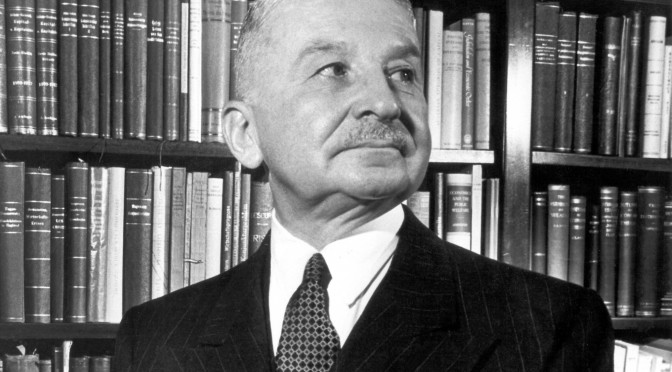
What kind of man was Ludwig von Mises? As this unique film shows, Mises (1881-1973) was a man who never stopped fighting for freedom: not when the Nazis burned his books, not when the Left blackballed him at universities, not when it seemed as if statism had won. With courage and genius, he fought big government until the day he died … in 25 books, hundreds of articles, and more than 60 years of teaching.

Mises’s battles against Communists, Nazis, and other socialists, are featured in this film, as are his ideas of Liberty.

Among his many accomplishments, Mises showed that socialism had to fail, that central banking causes recessions and depressions, that the gold standard is honest money, and that only laissez-faire capitalism is fully compatible with Western civilization.

Mises was the twentieth century’s foremost economist, and one of its most important champions of Liberty. Here is a film that does justice to this extraordinary man, and to his equally extraordinary ideas.

  • Facebook
  • Twitter
  • Delicious
  • LinkedIn
  • Technorati Favorites
  • Digg
  • Share/Bookmark

{ 3 comments }

Hayek vs. Keynes: the video

by Bob Weeks on February 11, 2010

in Economics

There’s a video concerning some obscure but vitally important ideas in economics that’s getting a lot of play on YouTube. Titled “Fear the Boom and Bust” a Hayek vs. Keynes Rap Anthem, the video tells the story about two competing theories of how the world works — the theories of John Maynard Keynes and Friedrich A. Hayek. The ideas of Keynes have been vastly more popular in mainstream economics and politics and are embraced by President Obama and his advisors. This, of course, doesn’t necessarily mean that Keynes and his followers are correct.

The video has been viewed nearly 700,000 times. Jeffrey Tucker of the Ludwig von Mises Institute has dissected the video and concludes that it’s great:

A hearty word of congratulations to Russ Roberts and John Papola for putting all this together and providing a fantastic example of how economics can be communicated to every person. It was Mises’s own view that economics should not be relegated to the classrooms but should be part of the study of every citizen. Roberts and Papola have taken his injunction very seriously and done something wonderful for Hayek, for Austrian ideas, for economics in general, and for the intellectual progress of the world.

The presentation manages to squeeze in one of my favorite quotes of Hayek: “The curious task of economics is to demonstrate to men how little they really know about what they imagine they can design.”

The theories of Austrian economists such as Ludwig von Mises, Hayek, and Murray N. Rothbard are becoming more popular as their theories offer explanatory power that Keynesian theories can’t match. Here in Wichita, Austrian ideas were recently advanced to explain the nature of the unemployment in Wichita and what might lie ahead. Malcolm Harris, Professor of Finance at Friends University in Wichita, who blogs at Mammon Among Friends, appeared last Friday on the KPTS television public affairs program Kansas Week and presented an explanation of our current woes based on Austrian principles.

Harris said that today we have a “different kind of unemployment.” He explained that credit plays a crucial role in the business cycle, something that he said we don’t hear much about today: “An overexpansion of credit causes an overexpansion of activities that cause real trouble.” Cessna, he said built many airplanes in 2007 and 2008 because there was such a credit bubble, and Cessna produced planes to meet the demand the bubble generated.

But now the bubble is over and demand has fallen. This type of unemployment, Harris said, doesn’t get solved by a stimulus package. He said this is “Austrian” unemployment, because it was the Austrian economist Hayek who explained the importance of credit in the business cycle.

Roger Garrison of Auburn University has a Powerpoint presentation that explains the difference between Keynesian and Hayekian view of economics. You may need to download a Powerpoint viewer in order to use this presentation.

  • Facebook
  • Twitter
  • Delicious
  • LinkedIn
  • Technorati Favorites
  • Digg
  • Share/Bookmark

{ 3 comments }

Money, Banking and the Federal Reserve

by Bob Weeks on November 9, 2009

in Economics

Events over the last year have placed our nation’s monetary system in focus. Or, at least it should be in sharp focus, as U.S. monetary policy and the Federal Reserve System bear much responsibility for the financial crisis and the accompanying recession. Few politicians, Ron Paul being one, are looking in the right places for the cause of the problem. His campaign to audit the Fed is a good first step.

The problems with our system of money have been known for many years. This video, dating from 1996, produced by the Ludwig von Mises Institute, explains the problem and its history. It’s 42 minutes long and well worth the time. Here’s more information from the Mises Institute:

Thomas Jefferson and Andrew Jackson understood “The Monster”. But to most Americans today, Federal Reserve is just a name on the dollar bill. They have no idea of what the central bank does to the economy, or to their own economic lives; of how and why it was founded and operates; or of the sound money and banking that could end the statism, inflation, and business cycles that the Fed generates.

Dedicated to Murray N. Rothbard, steeped in American history and Austrian economics, and featuring Ron Paul, Joseph Salerno, Hans Hoppe, and Lew Rockwell, this extraordinary new film is the clearest, most compelling explanation ever offered of the Fed, and why curbing it must be our first priority.

Alan Greenspan is not, we’re told, happy about this 42-minute blockbuster. Watch it, and you’ll understand why. This is economics and history as they are meant to be: fascinating, informative, and motivating. This movie could change America.

  • Facebook
  • Twitter
  • Delicious
  • LinkedIn
  • Technorati Favorites
  • Digg
  • Share/Bookmark

{ 3 comments }

Austrian economist Walter Block delivers a lecture that draws the parallels and differences between now and the Great Depression.

Block lays blame for the current mess squarely on the Federal Reserve System.

“Hoover was no free-enterpriser,” Block says. Neither was George W. Bush, or Ronald Reagan, for that matter.

  • Facebook
  • Twitter
  • Delicious
  • LinkedIn
  • Technorati Favorites
  • Digg
  • Share/Bookmark

{ 1 comment }

What kind of man was Ludwig von Mises?

by Bob Weeks on April 26, 2009

in Economics

What kind of man was Ludwig von Mises? As this unique film shows, Mises (1881-1973) was a man who never stopped fighting for freedom: not when the Nazis burned his books, not when the Left blackballed him at universities, not when it seemed as if statism had won. With courage and genius, he fought big government until the day he died … in 25 books, hundreds of articles, and more than 60 years of teaching.

Mises’s battles against Communists, Nazis, and other socialists, are featured in this film, as are his ideas of Liberty.

Among his many accomplishments, Mises showed that socialism had to fail, that central banking causes recessions and depressions, that the gold standard is honest money, and that only laissez-faire capitalism is fully compatible with Western civilization.

Mises was the twentieth century’s foremost economist, and one of its most important champions of Liberty. Here is a film that does justice to this extraordinary man, and to his equally extraordinary ideas.

  • Facebook
  • Twitter
  • Delicious
  • LinkedIn
  • Technorati Favorites
  • Digg
  • Share/Bookmark

{ 0 comments }

Walter Williams on the housing crisis

by Bob Weeks on April 22, 2009

in Economics

Economist Walter E. Williams explains the causes of the housing crisis. Then, why would we let these same people who caused the housing crisis take charge of health care? Short and worthwhile viewing.

  • Facebook
  • Twitter
  • Delicious
  • LinkedIn
  • Technorati Favorites
  • Digg
  • Share/Bookmark

{ 1 comment }

Articles of Interest

by Bob Weeks on April 1, 2009

in Politics

Obama’s volunteer corps, Kansas cigarette taxes, U.S. Auto industry, Austrian economics

The Rise of ObamaCorps (Americans for Limited Government) “Unless the Blue Dogs can muster enough support to halt Speaker Pelosi’s march to madness, the American taxpayer will have to pony up another $5 billion for paid ‘volunteers’ (an oxymoron if there ever was one) to politically-oriented organizations, the aims of many of which they will invariably oppose.”

Study documents historic trend of decreased state tax revenues following cigarette tax increases “This study clearly shows that raising cigarette taxes simply drives Kansas consumers to other states to purchase tobacco products,” said AFP-Kansas state director Derrick Sontag. “It clearly results in lower cigarette tax revenues, not because more people are quitting, but because people go elsewhere to avoid paying those higher per-pack taxes. … We hope this document will show to lawmakers that raising cigarette taxes is an ineffective deterrent to smoking and that it is simply unwise to fund government programs with revenue that is likely to dwindle once the new tax takes effect.”

Detroit’s Fate Sealed in West Wing (Wall Street Journal) Describes President Obama and his team’s involvement in the remaking of General Motors. “Mr. Rattner broke the news to [General Motors CEO] Mr. Wagoner at his office at the Treasury, according to an administration official. Afterward, Mr. Rattner met with Mr. Henderson, and told him he would take over as GM’s CEO.” The president plans to put some of his own staff into the auto companies. We can be sure that as the president and his team assert more control over GM and Chrysler, Congress will want to get in on the act too.

The Obama Autoworks: At GM and Chrysler, politics is now Job One (Wall Street Journal) More analysis of just how bad things are likely to get now that the American automobile industry — at least GM and Chrysler — is on the road to nationalization. “Bankruptcy or not, the larger problem here is Washington’s industrial policy. Even if Chrysler merges and GM restructures, Mr. Obama wants the companies to make the kind of cars the political class favors, whether or not consumers want to buy them. ‘The United States of America will lead the world in building the next generation of clean cars,’ the President said yesterday. He didn’t mention a goal of profitability. … Mr. Obama’s industrial policy vision runs directly counter to a strategy that would get the companies back to profitability as soon as possible. … All of which is to say that the taxpayer commitment to the Obama autoworks is only getting started.”

Austrians Can Explain the Boom and the Bust (Robert P. Murphy at the Ludwig von Mises Institute) An Austrian explanation of the recent boom and bust cycle, including the Austrian model of the structure of capital. Interest rates, as it turns out, are very important.

  • Facebook
  • Twitter
  • Delicious
  • LinkedIn
  • Technorati Favorites
  • Digg
  • Share/Bookmark

{ 1 comment }

Articles of Interest

by Bob Weeks on February 20, 2009

in Economics

25 random things about covering a capital murder trial. Wichita Eagle reporter Ron Sylvester offers surprising insights into covering a capital murder trial in a small Kansas city.

The Misdirection of Resources and the Current Recession. From a talk given by Mario J. Rizzo. “I believe that recent experience supports the claim that the economist and political philosopher Friedrich Hayek made in The Road to Serfdom in 1944. Democracy and central planning are incompatible or, at least, in deep tension.” Also some good explanation of the cause of the crisis from an Austrian perspective.

Evidence against the multiplier (Russell Roberts at Cafe Hayek). The multiplier is what’s supposed to make the stimulus work. It’s also a favorite argument of interventionism by local governments and their boosters in the field of economic development. But does it work? “The large and growing peer-reviewed economics literature on the economic impacts of stadiums, arenas, sports franchises, and sport mega-events has consistently found no substantial evidence of increased jobs, incomes, or tax revenues for a community associated with any of these things. Focusing our attention on research done by economists, as opposed to that of scholars from public policy or urban development and planning departments, we find near unanimity in the conclusion that stadiums, arenas and sports franchises have no consistent, positive impact on jobs, income, and tax revenues.” I wish we’d known of this before we built the downtown Wichita arena. Wait … we did know it. See Economic Justification of Arenas and the Downtown Wichita Arena, one of my first blog posts from October 2004.

Economic Miracle (Walter E. Williams) “The idea that even the brightest person or group of bright people, much less the U.S. Congress, can wisely manage an economy has to be the height of arrogance and conceit. Why? It is impossible for anyone to possess the knowledge that would be necessary for such an undertaking.” A fine explanation of how our economy is so complicated that it can’t be managed centrally. It’s the price system and self-interest that do the work.

Fed Up: The popular uprising against central banking (Thomas E. Woods Jr.) “It’s not surprising that arguments against the Fed are finally resonating. Since the crisis began in 2007, Fed Chair Ben Bernanke has engaged in all manner of emergency activity, much of it unprecedented and of such dubious legality that even some of those who may reject or be unfamiliar with arguments against the Fed have begun to wonder about the unaccountable power this institution wields over the economy.”

Obama Takes On Auto Crisis Without a ‘Czar’ (New York Times) “President Obama’s decision to act as his own ‘car czar’ means that in the next few months he faces decisions no American president has made since the invention of the automobile. … Even for an administration that is becoming the de facto decision maker for many of the nation’s financial institutions, it is a huge step. … In the meantime, the auto industry — like the financial industry — will essentially be run from inside the Treasury.” More nationalization of American industry. Will you buy a car designed and built by the President and Congress?

An Invitation to Debate the New Deal (Amity Shlaes). The author of The Forgotten Man: A New History of the Great Depression responds to criticism of her book. “The gist of ‘The Forgotten Man,’ which has been out for nearly two years, is that neither Herbert Hoover nor Franklin D. Roosevelt promulgated policies that worked, especially not in the sense that we use the word ‘work’ today.”

  • Facebook
  • Twitter
  • Delicious
  • LinkedIn
  • Technorati Favorites
  • Digg
  • Share/Bookmark

{ 0 comments }

An Austrian Recommendation for President Obama

by Bob Weeks on February 4, 2009

in Economics

Robert P. Murphy, author of the fine book The Politically Incorrect Guide to Capitalism lays out what President Obama and Congress can do to really fix our economy.

In this article, Murphy addresses the critics of those who oppose the proposed stimulus plan. That’s important, because many critics of the stimulus say that the government should do nothing. But doing nothing doesn’t satisfy the feeling that something has to be done. So Murphy has a list of things to do.

Also, Murphy explains, in one paragraph, the Austrian diagnosis of why there’s a problem. It’s an excellent article, available at the Ludwig von Mises Institute at Do You Austrians Have a Better Idea?

  • Facebook
  • Twitter
  • Delicious
  • LinkedIn
  • Technorati Favorites
  • Digg
  • Share/Bookmark

{ 0 comments }

The bailout reader

by Bob Weeks on January 15, 2009

in Economics

The events taking place in the financial market offer an illustration of the soundness of the Austrian theory of money, banking, and credit cycles, and Mises.org, which has long warned of precisely the scenario playing itself out today, is your source not only for analysis of these events but also the economic theory that helps explain what is happening and what to do about it. There are many thousands of articles available, and also the full text of thousands of books as well as journal articles.

The Bailout Reader at the Ludwig von Mises Institute continues to be the best place to learn about the economics behind the current crisis.

  • Facebook
  • Twitter
  • Delicious
  • LinkedIn
  • Technorati Favorites
  • Digg
  • Share/Bookmark

{ 1 comment }

I Tested My Politics

by Bob Weeks on January 7, 2009

in Role of government

I came across a test designed to place you and your political thoughts on a map of political ideologies. The test I took is here.

These tests can be fun, but in the case of this particular example, I wondered how some questions had any relevance to politics. In these tests I also find that some questions are leading and seem to be designed to get people to answer a certain way.

On this test, here are the results reported for me: “You are a Social Liberal (76% permissive) and an Economic Conservative (93% permissive). You are best described as a Libertarian.”

When my results were compared to those of famous people, I’m right alongside Thomas Jefferson, which is pretty good company. Plotted on a map of political ideologies, I’m in the libertarian area, but right near the border of anarchist.

Interestingly, whose photo do you suppose appears squarely in the socialist region? Barack Obama.

Advocates for Self-Government has a short quiz that has been cited as reliable. A quiz I would encourage everyone to take is the Are You an Austrian quiz (really an examination) at the Ludwig von Mises Institute.

  • Facebook
  • Twitter
  • Delicious
  • LinkedIn
  • Technorati Favorites
  • Digg
  • Share/Bookmark

{ 0 comments }

The New Deal in Retrospect

by Bob Weeks on December 11, 2008

in Economics

Many people refer to incoming president Barack Obama as the next FDR. The myth of Franklin Roosevelt — primarily that he cured the Great Depression through his extreme interventionism — is starting to be exposed. In this review (The Disaster Called the New Deal) of Burton Folsom’s book New Deal or Raw Deal? How FDR’s Economic Legacy Has Damaged America, David Gordon of the Ludwig von Mises Institute shows us the good and bad.

Did the New Deal cure unemployment? “In May 1939, Treasury Secretary Henry J. Morgenthau Jr., one of Franklin Roosevelt’s best friends, testified before the House Ways and Means Committee: ‘I say after eight years of this Administration we have just as much unemployment as when we started… And an enormous debt to boot.’”

Some today say that Roosevelt didn’t spend enough, that the stimulus was not powerful enough. Folsom refers to Henry Hazlitt: “Every dollar of government spending must be raised through a dollar of taxation,” Hazlitt emphasized. If the WPA builds a $10 million dollar bridge, for example, ‘the bridge has to be paid out of taxes… Therefore,’ Hazlitt observed, “for every public job created by the bridge project a private job has been destroyed somewhere else… All that has happened, at best, is that there has been a diversion of jobs because of the project.”

Reviewer Gordon has a problem with this book in that Folsom ignores Austrian economic theory, including its theory of the business cycle. Still, I believe Gordon thinks this is a book worth reading.

  • Facebook
  • Twitter
  • Delicious
  • LinkedIn
  • Technorati Favorites
  • Digg
  • Share/Bookmark

{ 1 comment }

Ron Paul says “The Austrians were right”

by Bob Weeks on December 1, 2008

in Economics

In a statement Ron Paul delivered to the United States House of Representatives on November 20, 2008, he made these points:

  1. Our government is “totally influenced by Keynesian economics.”

  2. “At least 90% of the cause for the financial crisis can be laid at the doorstep of the Federal Reserve. It is the manipulation of credit, the money supply, and interest rates that caused the various bubbles to form. ”
  3. The Federal Reserve created this problem. Why do we rely on it to fix the mess it created?
  4. “… the stage is now set for massive nationalization of the financial system and quite likely the means of production.”
  5. “Raising taxes would reveal the true cost of big government, and the people would revolt.”
  6. So the government creates money from thin air to pay for all this.

Read the entire statement at The Austrians Were Right.

  • Facebook
  • Twitter
  • Delicious
  • LinkedIn
  • Technorati Favorites
  • Digg
  • Share/Bookmark

{ 0 comments }

Walter Block on Economics in One Lesson

by Bob Weeks on December 1, 2008

in Economics

Walter Block talks about Economics in One Lesson, perhaps the most approachable book about economics. And, it’s a free-market, liberty-friendly, Austrian approach. What could be better?

In this video, Professor Block is interviewed by Jeffrey Tucker at the Ludwig von Mises Institute.

  • Facebook
  • Twitter
  • Delicious
  • LinkedIn
  • Technorati Favorites
  • Digg
  • Share/Bookmark

{ 0 comments }

The Austrian Prescription for Today

by Bob Weeks on November 26, 2008

in Economics

Murray N. Rothbard, in his book For a New Liberty: The Libertarian Manifesto, wrote a chapter that is highly relevant to the situation we face today. Unfortunately, if Rothbard’s analysis of the business cycle using Austrian economics is correct — and I believe it is — what’s going on presently in Washington, and what president-elect Barack Obama is planning, will do much more harm than good.

The chapter’s title is “Inflation and the Business Cycle: The Collapse of the Keynesian Paradigm.” In it, Rothbard explains the flaws in the Keynesian theory of the business cycle. This theory — in spite of its defects — is pretty much what our present and future administrations are following as they attempt to manage our economy. In fact, Steven Pearlstein’s column in yesterday’s Washington Post is titled Keynes on Steroids, and it contains this whopper: “Nixon’s Keynesian conversion, however, looks positively quaint compared with the fiscal and monetary stimulus that is about to be brought to bear on the U.S. and global economy. I doubt even Keynes himself could have imagined the scale and scope of what’s ahead.”

The Austrian school of economics has a different theory of the business cycle, and a different prescription for what government should do to get the country out of recession. It’s not a prescription that our leaders are likely to follow. In fact, everything they are doing, and are preparing to do, directly contravenes the Austrian prescription. Here’s what Rothbard wrote near the end of chapter 9 of For a New Liberty: The Libertarian Manifesto (I’ve added some emphasis):

What then are the policy conclusions that arise rapidly and easily from the Austrian analysis of the business cycle? They are the precise opposite from those of the Keynesian establishment. For, since the virus of distortion of production and prices stems from inflationary bank credit expansion, the Austrian prescription for the business cycle will be: First, if we are in a boom period, the government and its banks must cease inflating immediately. It is true that this cessation of artificial stimulant will inevitably bring the inflationary boom to an end, and will inaugurate the inevitable recession or depression. But the longer the government delays this process, the harsher the necessary readjustments will have to be. For the sooner the depression readjustment is gotten over with, the better. This also means that the government must never try to delay the depression process; the depression must be allowed to work itself out as quickly as possible, so that real recovery can begin. This means, too, that the government must particularly avoid any of the interventions so dear to Keynesian hearts. It must never try to prop up unsound business situations; it must never bail out or lend money to business firms in trouble. For doing so will simply prolong the agony and convert a sharp and quick depression phase into a lingering and chronic disease. The government must never try to prop up wage rates or prices, especially in the capital goods industries; doing so will prolong and delay indefinitely the completion of the depression adjustment process. It will also cause indefinite and prolonged depression and mass unemployment in the vital capital goods industries. The government must not try to inflate again in order to get out of the depression. For even if this reinflation succeeds (which is by no means assured), it will only sow greater trouble and more prolonged and renewed depression later on. The government must do nothing to encourage consumption, and it must not increase its own expenditures, for this will further increase the social consumption/investment ratio—when the only thing that could speed up the adjustment process is to lower the consumption/savings ratio so that more of the currently unsound investments will become validated and become economic. The only way the government can aid in this process is to lower its own budget, which will increase the ratio of investment to consumption in the economy (since government spending may be regarded as consumption spending for bureaucrats and politicians).

Thus, what the government should do, according to the Austrian analysis of the depression and the business cycle, is absolutely nothing. It should stop its own inflating, and then it should maintain a strict hands-off, laissez-faire policy. Anything it does will delay and obstruct the adjustment processes of the market; the less it does, the more rapidly will the market adjustment process do its work and sound economic recovery ensue.

Will our government follow Rothbard’s recommendation to do “absolutely nothing”? Absolutely not.

  • Facebook
  • Twitter
  • Delicious
  • LinkedIn
  • Technorati Favorites
  • Digg
  • Share/Bookmark

{ 2 comments }

Why Austrian Economics Matters More Than Ever

November 3, 2008

Here’s a talk recently delivered by Lew Rockwell, president of the Ludwig von Mises Institute. This organization remains the best place to learn about why our economy is in such trouble. The full speech can be read at Why Austrian Economics Matters More Than Ever. An excerpt:
I report on this not so that we [...]

Read the full article →

The Bailout Reader

September 26, 2008

The Ludwig von Mises Institute has compiled The Bailout Reader, a collection of articles relevant to the current situation.
Not all these articles are from the past few weeks, as Austrian economists have long understood the dangers of government interventionism, the fruits of which we see today.
The events taking place in the financial market offer an [...]

Read the full article →