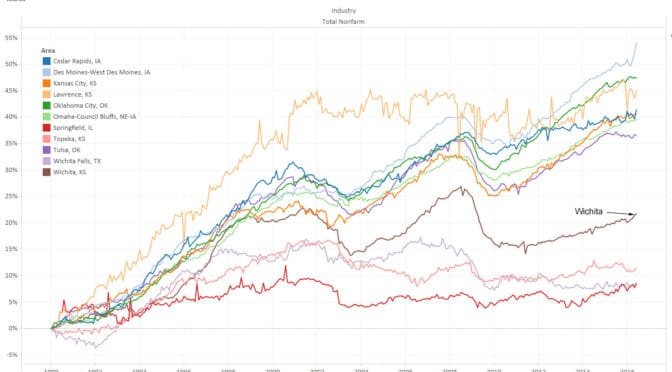
Last night I attended the weekly meeting of the Sedgwick County Pachyderm Club to hear guest speaker Davis “Buzz” Merritt, former editor of the Wichita Eagle. I’d read and reviewed his book Knightfall: Knight Ridder and How the Erosion of Newspaper Journalism Is Putting Democracy At Risk (my review is here).
His talk was based on [...]
Entries Tagged as 'Wichita news media'
Newspapers are Dying; Journalism We Hope Is Not
November 19th, 2008 · 1 Comment
Tags: Wichita news media
The Cartoon The Wichita Eagle Wouldn’t Print
October 22nd, 2008 · No Comments
Helen Cochran of Citizens for Better Education commissioned a series of political cartoons concerning the Wichita school bond issue. She’s paid to have them printed in the Wichita Eagle each Monday for the past month or so. They’re also carried on her group’s web site.
But the Wichita Eagle refused to run this week’s cartoon. Here [...]
Tags: Wichita news media
“Trash The Eagle” Website spotted
October 21st, 2008 · No Comments
I recently noticed the new website Trash The Eagle. It holds, as you might expect, some criticism of the Wichita Eagle, our state’s largest newspaper.
The site is run anonymously, although with a little sleuthing, it isn’t hard to find out who is behind this site.
Tags: Wichita news media
Should a Beat Journalist be a Layman?
October 1st, 2008 · 1 Comment
Keeping TIFs from a public tiff by Wichita Eagle business reporter Bill Wilson on the Eagle’s Business Casual blog contains some comments that are troubling to me.
In these comments, reporter Wilson wrote this: “Instead, a TIF, to this layman, actually is a government bet on the success of a development.” (emphasis added)
Now I believe that [...]
Tags: Wichita news media
The Things Wichita Eagle Columnist Mark McCormick Omits
August 18th, 2008 · No Comments
In his Wichita Eagle titled Taxpayer watchdog seems to target city, columnist Mark McCormick asks “What does Karl Peterjohn have against Wichita kids?”
His basis for asking, as developed in the column, is that since Karl Peterjohn, head of the Kansas Taxpayers Network (and now Republican nominee for the Sedgwick County Commission) opposes a bond issue [...]
Tags: Wichita news media
Wichita Eagle Reporting Bias
June 30th, 2008 · No Comments
In the article Allison to be interim director of WSU economics center, the Wichita Eagle again reveals bias in its business reporting.
Here, in reporting on the appointment of an interim director for Center for Economic Development and Business Research (CEDBR), at Wichita State University the reporter states “The center, part of the W. Frank Barton [...]
Tags: Wichita news media
Wichita Business Journal: Please Explain the Wichita School Bond Impact
June 30th, 2008 · No Comments
In an article in the June 27, 2008 Wichita Business Journal (Passage of 2000 school bond issue highlights Brooks’ legacy in Wichita), reporter Josh Funk makes another error. (The first error is explained in Wichita Business Journal: Where is the Increasing Enrollment in Wichita Schools?)
In this case, Mr. Heck claims, in his tribute to departing [...]
Tags: Wichita news media
The Wichita Eagle’s Preference For Government
June 19th, 2008 · 1 Comment
An article in the June 19, 2008 Wichita Eagle (Many businesses owners say they carry too much of local tax burden) provides an example of the frequently-expressed bias against individuality and markets, and in favor of government and its institutions.
The article, which presents much useful information, unfortunately contains this sentence: “Needless to say, taxes are essential to running the government, which provides the necessary public safety, infrastructure, education and regulation that makes business possible.”
The writer’s bias, and presumably his editor’s too, is plain to see: without government, none of the things mentioned would exist, at least not in a way that makes business possible. Starting the sentence with the idiom “needless to say” tells us that the writer believes the claim made in this sentence is self-evident and obvious.
Consider education, however. Many parents have made the decision that the product the government, or public, schools provide does not meet their needs. Through private efforts they provide very nicely for the education of their children. Further, since this article focuses on business, it is often businesses that are most critical of the quality of education that the public schools provide.
The bias in favor of government regulation needs examination. The article “Private Food Standards Gain Favor” (March 11, 2008 Wall Street Journal) starts with this: “Amid growing fears about food safety and impatience with government response, standards set by the private sector in Europe are starting to spread to other parts of the world, including the U.S.” The article describes GlobalGap, a firm that sells its private inspection services to grocers and restaurants like Wal-Mart and McDonald’s.
So what is the difference between private and government food inspection? When government food inspectors fail and people become ill or die from tainted food, politicians will inevitably say the inspecting agency was under-funded, and more money must be spent. But if a grocery store stakes its reputation on the fact that its produce is inspected by a private firm with high standards, and that inspection turns out to be faulty and tainted food slips by, the grocery store is likely to fire the inspection company. This is precisely the opposite outcome from the failure of government inspectors and regulators. Which would you rather trust to keep your food safe?
Even items that seem, by the conventional wisdom of today, to be solely the function of government can be provided by markets without government intervention. Can fire and police protection be provided through private efforts without government? Streets and highways? Writers like Murray Rothbard have made the case. The website of the Ludwig von Mises Institute is an excellent place to read about these ideas.
The difference between government and markets is the difference between coercive force and peaceful cooperation. Why would anyone prefer the former?
Tags: Wichita news media
Analysis of Wichita Eagle News Coverage
August 13th, 2007 · No Comments
I received this analysis and commentary from a friend of mine. It concerns an article that appeared on the front page of The Wichita Eagle a few months ago. I have removed mention of specific names.
I was appalled to read the front page editorial that appeared above the fold on the front page of the April 22, 2007 Wichita Eagle. Let me count some of the egregious flaws in this article:
1) The article mentions the “…a drop off of $185 million…” in state revenues but does not mention the primary reason. Let me provide it: “The new legislation setting aside $122.7 million for the school finance ‘lock-box’ and $80 million for statewide maintenance and disaster relief is primarily responsible for the large adjustment to this (revenue) source.” (source: April 19, 2007 Kansas Legislative Research State General Fund receipt revisions for FY 2007 and FY 2008, page 5). This point alone deserves a correction.
There’s $202.7 million that explains the main reason for this drop off. The money is being spent on increased state spending programs. Add to this the money that was shifted out of the general fund and over to the highway fund, “…enacted in 2004 for the Comprehensive Transportation Program reducing the amount of sales and use tax receipts deposited directly into the SGF (state General Fund)…” (ibid, page 1).
What was neglected in this article was the fact that Governor Sebelius and many legislative spending advocates want even more spending in both the current and next fiscal years. Last week Governor Sebelius proposed a $54 million increase in the current fiscal year plus $146 million in FY 2008 that begins July 1. That salient fact was missing in this article.
2) You repeat the lie that the tax cuts in 1997 and 1998 led to dramatic declines in state revenues leading to spending “cuts.” That did not occur. State General Fund expenditures in FY 2000 (1999-2000) were 4.1% above the previous year’s levels when the last of the 1995, 1997, & 1998 tax cuts phased in. The state ran into budget problems as part of the 2001 recession and the negative economic impact of the September 11 atrocities. These events were separated by several years. I have the FY 1999, 2000, 2001, & 2002 budgets if you need to revisit that fiscal history.
If you will look at past state budgets, the state has increased spending every year from 1993 to 2002. There was a decline that started during the recession in 2001 and the other events of that terrible year but this commentary tying the 1998 tax cuts to a budget shortfall four years later needs to be part of Brownlee’s operation on the editorial page and not on the news pages.
3) The tiny tax cut enacted this year at $36 million (ibid, page 1) is magnified by stretching this out over five years. This 2007 tax cut is slightly more than 1/2 of 1 percent of the state’s general fund spending this year.
If you used the same measuring tools the state’s spending it total in the billions on top of the total state spending (All Funds budget) that will far exceed $60 billion over five years (I can inflate these numbers the same way [the reporter] did, but I don’t have a front page position to have my commentary appear).
[The reporter's] article does provide some of the numbers so I could calculate the five year phase out of the franchise tax is $135 million (I did that addition) and the total for the social security tax cut over five years is only $56.9 million.
That’s a total of only $191.9 million. Where’s the other tax cuts to get to $570 million total this commentary claims? Where’s the rest of the $378 million?
This editorial commentary then ignores the earned income tax credit hike that was part of this legislation. The EITC is where the Dept. of Revenue ships tax funds out to low income Kansans. Critics view it as welfare using the tax code since these folks have no Kansas personal income tax liability. That welfare style tax break was raised a little over 13 percent in this bill.
I can only guess that the “…$570 billion in lost revenue…” must also include the unemployment tax reduction too. That would be the largest single item bulk of the “reduction.” Based on the rest of the figures you cite, the EITC would then be the next largest, if the social security reduction has only a $5.4 million price tag in 2008.
Left wing spending advocates pulled this stunt back in the 1990’s to try and magnify the size of the tax reductions during the 5 year unemployment tax moratorium from 1995-1999. Fortunately, unemployment taxes can’t be shifted into the state’s general fund budget. The mainstream Kansas press largely swallowed this as did [the reporter's] article, “…Gov. Bill Graves responded with record-setting tax breaks–an estimated $4 billion during Graves’ eight-year administration.”
Sorry: That’s $500 million a year in annual tax cuts. Graves’ first budget was FY 1994 and Gen. Fund spending was $3.111 billion. By FY 2002 Graves budget had grown to $4.466 billion or 43% increase (KS Fiscal Facts 2006, p. 23). How did these “cuts” reduce state revenues and spending? The single largest item in these calculations was the unemployment tax moratorium enacted in Graves first year as governor and excluded from the General Fund. Including this figure misleads your readers.
If you wanted to be more accurate you could point out that in nominal dollar terms Kansas had its first $3 billion General Fund Budget in 1994 and stands a good chance of enacting its first $6 billion General Fund budget for FY 2008 depending upon what the legislature does in their 2007 wrap up/veto session. That would be close to a 100% hike in nominal dollar terms.
Or you might point out that the state had its first All Funds budget exceeding $6 billion (including Medicaid and highway programs) in FY 1994 and has gone over $12 billion in the current fiscal year. Even adjusted for inflation, state spending is soaring in Kansas.
The Eagle hasn’t reported that the Tax Foundation’s latest ranking of state and local taxes as a percentage of income ranked us 15th highest among the 50 states earlier this month. That is where this state’s economic problem lies. Not with your unsourced commentary, “…lawmakers…wonder whether it’s a road map back to the budget crisis of the early 2000s, when tax cuts took effect just before a downturn in the economy and left the state scrambling to provide vital services.”
I guess that is fine in editorial commentary but it should be forbidden in news stories. Or, perhaps you could find some legislator or other elected official to make this type of assertion.
Let me add, that despite [my organization] and my best efforts, a sizable portion of the property tax cuts enacted in 1997-98 at the state level never got to taxpayers. They were grabbed by local units who raised their property taxes to offset the state reductions. So, much of the “tax cuts” never got back to the folks who paid them.
This commentary should have appeared on the editorial page. The only useful point in this piece was Rep. Jim Ward’s (D-Wichita) statement that “…We spent it…”
Tags: Wichita news media
Bias Noticed at The Wichita Eagle, Again
November 7th, 2006 · No Comments
From Karl Peterjohn, Kansas Taxpayers Network
State Senator Peggy Palmer, R-Augusta has publicly announced that she has canceled her Wichita Eagle subscription in the wake of the controversy over the Wichita Eagle’s “news” coverage of today’s election.
I have just received a second legislative email from another legislator who has told me that this legislator’s Eagle subscription is now history too. I have asked this legislator by email whether or not they would like this to be added to the public record.
In addition, Democratic candidate for the Kansas House of Representatives in the 87th district in east Wichita Rajeev Goyle has posted on his web site that he is a former Wichita Eagle employee. This is surprising news that should have been included in the Wichita Eagle’s news coverage of the legislative race. It is an outrage that this Eagle connection was not mentioned. Goyle’s Eagle ties should have been mentioned in both the news as well as in the Eagle’s editorial endorsement of Mr. Goyle.
Internet reports today indicate that Goyle was campaigning outside a voting location and confronted by a prominent GOP attorney there. That type of electioneering would certainly violate a number of election laws but he is a liberal so this trangression will probably get memory hole treatment.
What other salient facts about the candidates have not been reported? Here is another fact.
I have yet to hear any of the Wichita news media report about Phill Klines numerous endorsements by law enforcement professionals and organizations when these endorsements occurred……months ago.
It was unintentionally hilarious to hear KNSS try to report that one of the 89 sheriffs who had endorsed Kline was withdrawing his endorsement without mentioning the other 88 last week. That 88 included a majority of the Democratic Sheriffs in Kansas too.
If that would have been Morrison receiving 89 endorsements from law enforcement, that would have been front page, above the fold news. I can see the headlines, “Morrison endorsed by GOP sheriff’s”.
How many sheriffs endorsed Morrison? Is it a number greater than zero? I will never know by reading the Eagle.
A couple of weeks ago there was a national report about declining newspaper circulation. All but a few of the major newspapers including my personal favorite, the Wall Street Journal and their outstanding editorial page, reported circulation declines. The Wichita Eagle was too small to be listed in this story but a KC friend reported that the sister KS newspaper in the McClatchy chain, the KC Star, lost 5% and 4% respectively on their Sunday and daily editions in this latest report. That’s similar to circulation declines at other left wing daily newspapers like the Washington Post and NY Times.
Tags: Wichita news media
Bias Noticed at The Wichita Eagle, Again
November 7th, 2006 · No Comments
I received this message presenting more evidence of bias at The Wichita Eagle, this time in a story by reporter Deb Gruver. The boss referred to is Sherry Chisenhall, Editor.
Deb,
I don’t make a spin accusation lightly but I am sick and tired of the misleading bilge I am reading in the Eagle. I’m copying your boss to extend my complaint about spin to the management as well as the working reporter level at the Eagle. A point in your “Pinch” article rose to the top of the heap this morning and I am steamed about it.
Your article describes, “… the Center for American Progress, a nonpartisan nonprofit group…”
Bunk. That’s left wing SPIN.
The Center for American Progress is a left wing think tank…..or you could also describe it as a liberal think tank. Conversely here’s how the Eagle describes the “…conservative Heritage Foundation…” or “…the libertarian CATO Institute” if you mentioned these nonpartisan nonprofits in your news article. CATO and Heritage are equally “non partisan” although I cannot recall ever seeing “nonpartisan” or “nonprofit” used in describing either organization in the Eagle. It applies as much to them as it would Soros’ new think tank.
The Center For American Progress is one of the new, George Soros funded left wing think tanks and a cursory examination of their web site shows it being headed by former Clinton staffer John Podesta, includes a “Distinguished Senior Fellow,” Tom Daschle as well as being filled with a variety of liberal and leftist activists.
If you want to quote them: fine. Emphasizing the “non partisan” nature while not doing the same for non leftist think tanks is SPIN. Stop it.
It makes many of your knowledgeable readers mad.
Tags: Wichita news media
Bias Noticed at The Wichita Eagle
September 27th, 2006 · No Comments
I received this commentary from a person who believes he noticed some bias in reporting appearing in The Wichita Eagle.
… I visited with Eagle writer Dion Lefler regarding the language he used to describe the Sedgwick County Commission meeting the day after Sedgwick County Commissioners voted 5 to 0 to raise the mil levy. I told him politely that I had a “bone to pick” with him regarding the semantics he used in that article when he referred to our group as the “anti-tax group”. I said to him, “Whenever you use the word to describe any group as “anti” you automatically send a negative message to your readers that actually shows your personal “bias” against that particular group.” I pointed out that we are not “anti” anything, but on the contrary we are taxpayer advocates and perhaps should be referred to as the “pro-taxpayer group” or the “taxpayer advocate group”.
I asked him why he did not refer to our opponents at the hearing as the “anti-taxpayer group”. If he had done that in his article, perhaps he could have achieved the “balance” that newspapers try to achieve. He could then rightly refer to our lower tax and less government taxpayer advocate group as the “antitaxers” and our opponents, the more government and higher tax advocate group, as the “antitaxpayers.”
I pointed out to Dion that our opponents who spoke at the hearing were primarily two groups. One group represented primarily government staff people who wanted their particular program funded and their well-scripted clientele who spoke of their need and dependence on government programs to help them with their alcohol, depression, drug, mental, or senior problems. The other group wanting additional taxpayer money were six figure executives from the aircraft industry dressed in their suits and ties begging for additional largess from the public treasury (”corporate welfare”) for an industry that already receives massive taxpayer subsidies. Our group, the “taxpayer advocate group” was speaking for thousands of property taxpaying people (”widows and orphans included”) who were not present and who were not represented particularly by the people that they elected to represent them.
Dion admitted that he saw my point and that he would take it into consideration in future reporting. I hope he was serious and follows through. I believe AFP, KTN, and other taxpayer advocacy groups need to take the lead in insisting on positive and balanced reporting rather than the biased and slanted work that we have unfortunately learned to tolerate as normal.
Tags: Wichita news media
Reporting on Wichita’s New Terminal
June 29th, 2006 · No Comments
A Wichita Eagle article published on June 29, 2006 explores the need for a new terminal at the Wichita Airport. I have some issues with the reporting in this article, as it is quite biased in favor of those advocating the new terminal. When you combine people eager to spend others’ money with sloppy newspaper reporting we have a situation where reason — not to mention sanity — is not likely to prevail.
An example of the sloppy reporting is when it is noted that the existing terminal was dedicated in 1954, and the director of airports is quoted as saying the terminal “is functionally obsolete.” Never mind that the terminal has been expanded greatly and reworked and remodeled several times since then. Now I can understand the director of airports wanting a shiny new terminal to work in, perhaps even to be named for him after he retires. Neither is a good reason for building it, however.
Advocates for a new terminal say we need one because the present terminal “Doesn’t have space for adequate security.” If this defect is actually present, I recommend we close the airport immediately! We can’t have an airport without adequate security. I hope no one from out of town — certainly no terrorists, at least — is reading this article.
In the article, a photograph was captioned “Fliers must wait in line at the ticketing counter, then in another line at the checkpoint. A larger terminal, officials say, would lessen crowding.” I might ask, is there any airport where there are not separate lines for ticketing and security? Or are there plans for airports to be built that integrate check in and security? I realize that newspaper reporters are merely quoting someone, but to print a statement like this implies that a new terminal will somehow fix this problem.
Also, many people today check in at home or office through the airlines’ websites, and therefore are able to bypass the ticket counter entirely if they don’t have checked baggage.
Another photograph was captioned “The baggage claim area can get crowded very quickly, airport officials say, and there is no space available in the existing terminal to expand it.” I might remark that the baggage claim area is crowded not with travelers, but with the people who came to greet them. This is also a problem at the Wichita airport as arriving passengers depart the secure area. The throng of greeters makes it difficult to get by, sometimes. But a little remodeling might fix this.
Also, advocates say the present airport “Doesn’t give visitors a good first impression of the city.” I guess whether this is true or not depends on one’s viewpoint. When I travel, I appreciate facilities that look like they were built economically and are operated efficiently, as I know it is I, the traveler and taxpayer, who pays for these things.
Advocates claim that no local tax money will be spent to build a new terminal. They may be correct. But someone has to pay for it, be it the federal taxpayer or Wichita Airport user, and there is bound to be much local tax money spent on infrastructure improvements surrounding a new terminal. If airline tickets were itemized like hotel bills and rental car bills, showing the various taxes and charges that fliers pay, we would be more aware of who will pay, and how they will pay, for a new terminal.
We should also remember that travelers to our city pay a lot of tax. As I travel, I am very aware of the huge taxes I pay when I use hotels and rental cars. As an example, a recent hotel bill in Pennsylvania with a room rate of $109 swelled to $124 with taxes. A car rental bill there for $409 really cost $532 after taxes, fees, and other charges imposed by local governments, taxing authorities, and airports. Many local governments, ours included, use these taxes to painlessly raise revenue, they say, as locals rarely pay them. But visitors do pay them, and they leave a bitter impression about the local governments that levy them.
Tags: Wichita news media
Wichita Eagle Editorial Blog Not Recommended
June 7th, 2006 · 2 Comments
In June, 2005, the editors of The Wichita Eagle started a blog, the Wichita Eagle Editorial blog, or WE Blog.
The way this blog works it that one of the Eagle editors starts a topic, and then the public can add comments.
A small group of the posters who make these comments seem to know each others’ reputations well, and postings from this group account for nearly all the content of the blog. They have had, by my count, two social gatherings. From posts filed by the attendees, they seemed like enjoyable affairs. I was surprised to read these pleasant accounts, as on the blog, people are usually quite mean and nasty.
It usually doesn’t take very long before the posts on many topics disintegrate into name-calling, sometimes using the foulest language imaginable, language that The Eagle won’t print in the newspaper. In fact, even the editors won’t use this language themselves on the blog, although from time to time they may use these words in sanitized form.
Often when someone who has a history of posting — and therefore a reputation — posts an opinion or makes an argument, someone will point that the poster is a Democrat or a Republican, or is liberal or conservative, and therefore the opinion or argument is to be discounted. This is a common form of argument. Or someone will point out that the poster said something stupid in the past, so this is stupid, too.
Often posters use terms of art such as “BushBots,” “BushCo,” “Repukes,” and “Wingnuts” when referring to others. Conservative posters have similar terms they use, too. These terms are used as insults or to advance an argument or opinion.
Commonly, when someone presses a point a follow-up post makes the demand “show me a link.” Dutifully the original poster finds a link that supports their argument, and almost always it will be derided as coming from a source that is not valid or trustworthy because it is liberal, conservative, or has some other defect in the eyes of the poster. Sometimes entire articles are posted, almost certainly in violation of the copyright.
It is my sense that many of the topics started by the editors are calculated to allow those with left-leaning sensibilities the opportunity to launch attacks on conservatives and right-leaning posters. It does seem to me that the majority of the regulars on the blog are near the left of the political spectrum.
The left, too, seems to get the best of the conservatives much of the time. But that’s not surprising. Government, at all levels, is too big and powerful and tries to do too many things. As government overreaches, it inevitably makes mistakes, and therefore is an easy target for criticism. If the left wins political power over the next few years, it too will be on the defensive for all the misguided things that it tries to do.
When a person posts to the blog, they enter a name — real or otherwise — and an email address, again real or not. There is no security of any type, and it is therefore possible for one person to make a post using the identity of some other poster. There is no way for readers of the blog to detect that this has happened, except from an analysis of the content of the message. A few posters claim this happens regularly to them.
This lack of accountability as to the origin of the post is a problem. One’s identity is not safe, as others can post in your name. Other discussion forum systems often require some form of registration, tracing an identity back to an email address, usually, and then requiring login with a password before posting. With this, readers can be sure that something posted under a name did, in fact, come from that person.
The discussions also die prematurely in some cases. Not that the topics disappear, but after a few weeks they move to an archive section, where they can still be read and posted to, but it seems like few topics survive this archiving. So some discussions that have merit in continuation stop.
There is also the problem that the only issues that are discussed are ones that the editors decide to start a topic on, although topics can drift to any subject, and there are “open threads” that are started occasionally. Most discussion forum systems, though, have threaded topics and allow users to start topics on their own. Threaded topics would allow new threads of discussion to be split off as the flow of discussion changes. These systems also allow replies to be associated with a specific post, so that readers can easily read a reply in the context of the post that inspired it. That isn’t present with the current system the Wichita Eagle Editorial Blog uses.
A curious fact is that The Eagle has discussion boards that have many of the features that make discussion forums work better. These boards are not as popular as the blog, and seem to have their own small group of regular posters.
I do not recommend spending time reading the Wichita Eagle Editorial Blog. The mean-spirited nastiness of the bulk of the posts far outweighs the few redeeming things you might learn. The group of regular posters is so partisan, the discourse so bitter and shrill, so full of cruel sarcasm, that readers are likely to come away angry and disillusioned. In fact, a topic started today by Phillip Brownlee titled “Hard to shake faith of the faithful” points out how a person’s perspective colors their judgment of events, and how each party believes they are right, no matter what the facts and evidence show. There’s lots of evidence of this type of behavior on this blog. Still, I must confess that sometimes, like when passing a car wreck, I can’t resist taking a peek.
My preference is to reduce the power of government to the point that there is little that government does that is important enough to argue over.
Tags: Wichita news media
Public Access, or lack there of…
January 21st, 2006 · No Comments
Dear Bob’s Blog, I recently moved to wichita from chicago… a while b4 i decided to move I had completed my Comcast public access certification. Comcast is basicaly the equivalence to Cox here. Un / Fortunately I was unable to put it to any good use while in Chicago due to some circumstances…. however I was searchin around the web and came across your blog entry on the lack of public acess for the public here in wichita. I wondered if you had any luck with your letter and/or knew any sources of information on the subject. I would be willing to put forth some effort in helping our voice be heard…
Tags: Wichita news media
Randy Scholfield and Less Government
September 28th, 2005 · No Comments
In an editorial in the September 18, 2005 Wichita Eagle, Randy Scholfield wrote “Less government is a laudable goal.”
The dictionary defines laudable as “Deserving commendation; praiseworthy” or “Deserving honor, respect, or admiration.” Mr. Scholfield’s past writings don’t treat the goal of less government this way. In fact, it doesn’t seem there is a single government program that Mr. Scholfield doesn’t like and praise.
On September 13, 2004, he advocated more funding for early childhood education, writing “… the state Legislature needs to do the right thing for the state’s children and future, and invest in early childhood education.”
He seems to automatically believe that schools need more money.
He believes in government subsidies. In an editorial in The Wichita Eagle published on April 19, 2005, he wrote: “Wichita should stick to its subsidies. They’re fostering competition, not stifling it, and paying off big-time for the community by lowering airfares and boosting economic development.”
He has consistently supported the government building the downtown Wichita arena.
He advocates more government spending on arts (August 9, 2005 “Culture requires community support”).
He supports more funding for Exploration Place.
Mr. Scholfield, is there any government program you have opposed, any example that would lend credibility to your claim that less government is a laudable goal?
Tags: Wichita news media
Senator Kay O’Connor
June 12th, 2005 · No Comments
Kansas Senator Kay O’Connor, Republican from Olathe, has been in the news recently.
It has been reported that Sen. O’Connor opposes the right of women to vote. In the June 12, 2005 Wichita Eagle a letter writer repeated this assertion. On June 2, 2005, the Eagle printed an Associated Press piece by John Hanna that detailed the remarks. On June 3, 2005, the Eagle editorialized about this, opposing Sen. O’Connor.
The facts, though, are different. Sen. O’Connor denies making the remarks. The Kansas City Star, the newspaper that first reported the story, would not print her letter telling her side. Neither would that newspaper print the letters of witnesses to Sen. O’Connor’s remarks, witnesses who say she did not say what she is reported to have said.
I have met Sen. O’Connor. I admire her for her work on school choice in Kansas. She also voted against the bill allowing Sedgwick County to raise the sales tax for the downtown arena. I can understand, then, the Wichita Eagle not liking Sen. O’Connor and editorializing against her candidacy for Secretary of State, as Sen. O’Connor is a conservative, and the Eagle’s editorial board seems quite liberal and in favor of big government. I would ask the editorial writers, though, to investigate these alleged remarks before citing them again. The Eagle is a newspaper, after all, and it should do some reporting of its own.
Following is a piece that details the Sen. O’Connor matter, and tells us more about the news media in Kansas.
Tags: Wichita news media
Revolving Door Between Press and Government Turns Again
May 3rd, 2005 · No Comments
Mr. Van Williams, Wichita Eagle city hall reporter for the past three years, will become Wichita’s public information coordinator.
I believe there needs to be a tension between the press and the government officials it covers. The press needs to hold officials accountable. It needs to dig deep to uncover facts officials don’t voluntarily concede. It needs to ask them tough questions. It needs to make them angry from time to time.
Would the City of Wichita hire someone who had been doing that?
Tags: Wichita news media
Book Review: Knightfall
April 26th, 2005 · No Comments
Knightfall: Knight Ridder and How the Erosion of Newspaper Journalism Is Putting Democracy At Risk
Davis Merritt
Amacom Books, 2005
The theme of this book, written by a former editor of The Wichita Eagle is that over the past few decades, the business of making newspapers has changed from a business unlike any other to a business just like all others, and we are not well served by this change.
I think the most important quote from the book is this:
With a handful of exceptions, American newspapers are being eroded, their traditional values subverted, their journalistic resources stripped away, their dedication to public service and local communities hallowed out, leaving a thin shell of public relations gimmicks that pretend to be public service and entertainment that pretends to be news.
Newspapers are important. They provide the common set of information that we, as a democracy, can use to work through the issues that face us. Although most people now get news from television and Internet sources, the basis for much of this news content is newspapers.
How is newspaper journalism different from journalism that happens to be in a newspaper? The answer is that newspaper journalism is “not shaped by a limiting technology,” such as a television broadcast; it values completeness over immediacy, it is lengthier and deeper than other sources of journalism, its goal is relevance rather than entertainment, and opinion and analysis is presented separately from news.
What has changed?
External changes have worked against newspapers. The baby boomer generation has not read newspapers with the same frequency as their parents. The fact that most newspapers are now publicly owned means that Wall Street pushes for ever-increasing profits. Newspapers, Mr. Merritt says, are a long-term investment and don’t fare well in today’s short-term investment climate. Technology changes, including the Internet, have been difficult for newspapers to adapt to.
Internal changes have occurred, too. The “creeping corporatism” of the national chains such as Knight Ridder has distanced newspapers from their local communities. The rise of Management By Objective (MBO) in the newsroom has caused editors to make journalistically unwise decisions. Finally, and perhaps most importantly, the wall that has separated the journalism side from the business side of the newspaper business has all but crumbled.
Is there a solution on the horizon that will bring back the great tradition of newspaper journalism across America? Mr. Merritt presents several possible solutions, but I have the sense that he doesn’t place much hope that any will succeed in the near future.
I recommend this book to anyone who wants to understand newspapers and their important role in our country.
Reading this book has helped me understand why our local newspaper is the way it is, which is to say I understand why it so poorly serves our community. It also reinforces my belief that I should spend less time watching television news and spend more time reading the important newspapers of our country: The Wall Street Journal, The New York Times, The Washington Post, The Los Angeles Times, and The Christian Science Monitor. All these newspapers place their content on the Internet through their web sites. The Wall Street Journal costs $6.95 monthly, but the other newspapers are free to read, although you may have to register.
Links to material about this book: Publisher’s page with excerpt, excerpt at Poynter, excerpt at Authorviews.com.
Tags: Wichita news media
Another Letter To The Editor
April 25th, 2005 · No Comments
Last time I wrote a letter to the Wichita Eagle for publication, I said that I learned my lesson, which was that I needed to be brief. I didn’t learn this lesson well.
This Sunday The Eagle printed a letter I submitted, and a large section in the middle was omitted. This omitted material was the entire basis of my argument. As before, here is what I submitted, and what The Eagle printed.
Tags: Wichita news media
Wichita Eagle Says “AirTran Subsidies Foster Competition”
April 19th, 2005 · No Comments
In an editorial in The Wichita Eagle published on April 19, 2005, Randy Scholfield writes: “Wichita should stick to its subsidies. They’re fostering competition, not stifling it, and paying off big-time for the community by lowering airfares and boosting economic development.”
Competition, if it is to be meaningful, needs to be fair. It is not fair when one participant has a huge head start in the form of a government subsidy. The Eagle recognizes this when it suits their purpose. When endorsing Sam Brownback for reelection, this newspaper said “He includes in the former his stepped-up fight against the European subsidies of Airbus that have put Boeing and its workers in Wichita at competitive disadvantage.”
Competition occurs when independent decision-makers, looking at the array of choices available to them, freely make their own decisions. With the AirTran subsidy, we have the City of Wichita (and now apparently Sedgwick County), by using their power to tax, making a decision for us in favor of AirTran. This is not competition.
Mr. Scholfield, the one subsidy I might support is one that would provide an alternative to the Wichita Eagle! Would you consider that to foster competition in the market for daily newspapers in Wichita?
Tags: Wichita news media
Why is the Wichita News Media Not Interested?
March 12th, 2005 · No Comments
This is a version of a letter that I have been sending to (mostly) Wichita-area newspapers, television stations, and radio stations. Some have expressed some interest and have even assigned reporters to look into this, but so far no stories have appeared.
February 11, 2005
Sherry Chisenhall
The Wichita Eagle
Dear Ms. Chishenhall,
I am writing to express my concern over the lack of reporting on some important issues regarding the downtown Wichita arena tax.
My research has uncovered several findings, which I summarize here:
1. The WSU Center for Economic Development and Business Research study does not include depreciation costs, even though Government Accounting Standards Board Statement 34 requires governments to depreciate their assets. Incredibly, the CEDBR at WSU was not aware of this requirement when they prepared the study that was used to promote the proposed arena. They admitted this when I called it to their attention.
2. The WSU study did not allow for the substitution effect. This is the term used to describe what research has found: that much of the new economic activity such as bars and restaurants that might appear around a downtown arena would be bars and restaurants that have moved from other parts of the city. There is little or no new economic activity, just movement of existing activity. Mr. Ed Wolverton, President of the Wichita Downtown Development Corporation, admitted this oversight in a television news story.
3. Arena proponents cite economic benefit as a reason why the community as a whole should pay for the construction and operation of the arena. I have found no research that supports the claim of economic benefit. There is, however, ample research to the contrary. For example, in a paper titled “Professional Sports Facilities, Franchises and Urban Economic Development” (UMBC Economics Department Working Paper 03-103) by Dennis Coates and Brad R. Humphreys of the University of Maryland, Baltimore County we find this quote:
“Siegfried and Zimbalist (2000) recently surveyed the growing literature on retrospective studies of the economic impact of sports facilities and franchises on local economies. The literature published in peer-reviewed academic journals differs strikingly from the predictions in ‘economic impact studies.’ No retrospective econometric study found any evidence of positive economic impact from professional sports facilities or franchises on urban economies.”
I created a handout I made for the legislators that provides more information. A link to it is here:
http://wichitaliberty.org/files/Sedgwick_County_Legislative_Delegation_2005-02-05.pdf
There has been much recent news about the financial performance of publicly-owned institutions. Often government leaders proclaim their ignorance about what the facts of the matter were, and then your newspaper has to editorialize about government leaders not doing due diligence before committing to projects. Mr. Brownlee wrote such an editorial just this week.
Here we have a final opportunity to examine the issues involving the wisdom of a taxpayer-built arena before it is too late. I am not asking that you believe what I have said just on my say-so. I believe, however, that the people of our town would appreciate someone with the skill and experience of your reporters performing an investigation to see if they reach the same conclusions I have.
Tags: Wichita news media
A Letter to the Editor is Edited
March 7th, 2005 · No Comments
I wrote a letter to the editor of The Wichita Eagle for publication. It was published today, March 7, 2005.
I have learned a lesson: my letter was much too long. I don’t fault the Eagle for editing for space reasons. I do think, though, that my letter has a much different meaning in its edited form. You can be the judge. I have created a document that shows, side-by-side, my original letter and the published letter. The link is here: http://wichitaliberty.org/files/Letter_of_2005-03-07_Edited.pdf
Tags: Wichita news media
Wichita News Media Coverage of Downtown Arena Issue
January 18th, 2005 · No Comments
On the November 2, 2004 ballot the voters of Sedgwick County approved an additional one percent sales tax to fund an arena in downtown Wichita.
I opposed the taxpayers funding an arena for this reason: Proponents claimed that the arena would pay for itself (and be a good ting for Wichita) through various forms of economic benefit, both direct and spillover. But I found no research that supported this claim, except for one report prepared by the Center for Economic Development and Business Research at Wichita State University. I was able to find, however, much research that showed that these facilities rarely provide the promised benefit. Therefore, to ask all the taxpayers to pay for something that benefits just a few is not right.
The Wichita news media, in my opinion, did a woeful job covering the issues relating to the arena. In particular, it seemed as through the Wichita Eagle had as its corporate mission the passage of the arena tax. The Eagle did print many letters and “Opinion Line” comments that oppose the arena, and they still do even today. But the clear editorial stance was to press for passage of the arena tax.
As an illustration of the bias on the Eagle’s editorial page, consider this example: Mr. Phillip Brownlee, opinion editor for the Eagle, wrote an editorial that said the true cost of the Kansas Coliseum renovations would be $122 million instead of $55 million because of interest costs. I wrote a letter that said that since some of this money wouldn’t have to be paid until the distant future, we should consider the effects of the time value of money and inflation. Mr. Brownlee wrote to me and said that I was correct, and my letter was published.
At the time I assumed that Mr. Brownlee, probably having majored in journalism in college, wasn’t aware of the time value of money and things like that. After the election, though, someone told me, and I confirmed by reading his biography on the Eagle’s website, that Mr. Brownlee was a certified public accountant in a previous career. A person with that type of education and experience certainly does know about the time value of money. We have to ask, then, why Mr. Brownlee would disregard such an important factor when editorializing.
Eagle reporter Mr. Fred Mann, in an article titled “Arena’s financial impact cloudy” published on September 5, 2004, provided good information about the doubts surrounding facilities such as these. This article, however, appeared nearly two months before the election, and I saw little coverage of these issues again. I uncovered much other research (most of it is posted in my blog) and supplied it to reporters at the Eagle, but they didn’t act on it.
Other people in Wichita’s news business appeared to lack basic factual information about the arena vote. As part of its election night coverage, one prominent Wichita television news anchor interviewed Mr. Karl Peterjohn of the Kansas Taxpayers Network. Mr. Peterjohn mentioned something about how now the story moves to the Kansas Legislature. The news anchor expressed surprise to learn that the ballot issue was merely an advisory referendum instead of a binding resolution, and that the legislature would have to pass a law allowing Sedgwick County to raise its sales tax. A Wichita television news personality being so poorly informed about such a basic factual matter tells us that we shouldn’t expect important news reporting from our television stations.
KSN Television had a panel show a week before the election. The members of the panel were Wichita Mayor Carlos Mayans, Sedgwick County Commissioner Ben Sciortino, and Wichita Downtown Development Corporation President Ed Wolverton. Each has been quite clear and outspoken in their support of the proposed downtown arena. I do not remember the media panel members asking very many tough questions. I wrote to several people at KSN pleading for some balance either on the guest panel or the media panel.
I supplied most local television stations and radio stations with some of the research that I found. This was information that could be verified independently if the reporters chose to do so. It made a compelling case against taxpayer-funded facilities like the proposed downtown Wichita arena. Nearly everyone I showed it to wondered why this information wasn’t being reported. But I had difficulty gaining the attention of anyone in the Wichita new business.
One exception is Mr. Erik Runge of KWCH Television. He interviewed me, independently verified some of my research, interviewed someone else with an opposing view, and prepared three different segments that were broadcast about a week before the election. I thought he did a good job.
I also appeared as an arena opponent on the radio show “Sports Daily” on KFH Radio. I had heard the hosts advertise for someone to appear on their show as an arena opponent. I applied and appeared for 30 minutes.
Why did the Wichita news media do such a poor job covering the arena tax issues? I do not know. But it is easy to be swept up in the excitement of a new facility. The arguments that arena supporters used seem to make sense until you investigate their truthfulness. It took a lot of effort to uncover contradictory evidence. I suspect that many didn’t look very hard and therefore never found what I did, or if they did find it, since it said what they didn’t want to hear, they ignored it.
Tags: Wichita news media
Stretching Figures Strains Credibility
January 15th, 2005 · No Comments
I recently read that the Wichita Airport’s economic impact was estimated at $1.6 billion per year. I thought this seemed high, so I investigated further.
I became aware of this study prepared by the Center for Economic Development and Business Research at Wichita State University, available here: Wichita Mid-Continent Airport Economic Impact.
By reading this study I learned that the employees of Cessna and Bombardier — 12,134 in total — are counted in determining the economic impact of the airport. Why? To quote the study: “While it might appear that manufacturing businesses could be based anywhere in the area, both Cessna and Bombardier require a location with runways and instrumentation structures that allow for flights and flight testing of business jet airplanes.” This is true, but it is quite a stretch to attribute the economic impact of these employees to the airport.
For one thing, if we count the economic impact of the income of these employees as belonging to the airport, what then do we say about the economic impact of Cessna and Bombardier? We would have to count it as very little, because the impact of their employees’ earnings has been assigned to the airport.
Or suppose that Cessna tires of being on the west side of town, so it moves east and starts using Jabara Airport. Would Cessna’s economic impact on Sedgwick County be any different? I think it wouldn’t. But its impact on the Wichita airport would now be zero. Similar reasoning would apply if Cessna built its own runway.
Or it may be that someday Cessna or Bombardier will ask Sedgwick County for some type of economic subsidy, and they will use these same economic impact dollars in their justification. But these dollars will have already been used, as they were attributed to the airport.
To its credit, the WSU study does provide some figures with the manufacturing employees excluded. The impact without the manufacturing employees included is estimated at $183 million, or about 11 percent of the $1.6 billion claimed earlier.
It is a convenient circumstance that these two manufacturers happen to be located near the airport. To credit the airport with the economic impact of these companies — as though the airport was involved in the actual manufacture of airplanes instead of providing an incidental (but important) service — is to grossly overstate the airport’s role and its economic importance.
Of course the airport is important to Wichita. We should seek to measure its impact sensibly instead of stretching to attribute every dollar possible to it. When advocates of any cause manufacture figures like the $1.6 billion economic impact, it casts doubt on other arguments they advance.
Links referred to:
Wichita Mid-Continent Airport Economic Impact http://webs.wichita.edu/depttools/depttoolsmemberfiles/cedbr/AirportImpact.pdf
Tags: Wichita news media