From the category archives:

Wichita and Kansas schools

This week Kansas school spending advocates gathered in Topeka for a march and rally at the Kansas Capitol. Kansas Watchdog’s Paul Soutar takes a look at some of the speakers’ claims and the underlying facts. Read the story and watch video at Debunking Myths in the School Funding Debate.

  • Facebook
  • Twitter
  • Delicious
  • LinkedIn
  • Technorati Favorites
  • Digg
  • Share/Bookmark

{ 1 comment }

For those who believe in the principle of self-ownership, taxes are a violation of that principle. But to those who depend on government for their funding, taxes are viewed differently. To them, any move to reduce taxes is viewed as a cost to government. People who value economic freedom, however, view tax cuts as the government allowing citizens to keep more of what is rightfully theirs.

The Kansas National Education Association (or KNEA, the teachers union) is one such organization that believes that cutting taxes is a cost to Kansas state government instead of a benefit to citizens. Yesterday’s issue of KNEA’s “Under the Dome Today” provides an example of this type of thinking:

The most interesting statement of the day came from Rep. Richard Carlson (R-St Mary’s) who told the committee, “In six and a half hours of debate on the House floor yesterday, not one motion was made to increase taxes so this is where we are.” Carlson himself did offer a tax amendment during that six and a half hours of debate. Carlson’s motion was to eliminate the corporate income tax — a motion which, had it passed, have cost the state in the neighborhood of $250 million!

  • Facebook
  • Twitter
  • Delicious
  • LinkedIn
  • Technorati Favorites
  • Digg
  • Share/Bookmark

{ 3 comments }

Kansas long-term debt per person

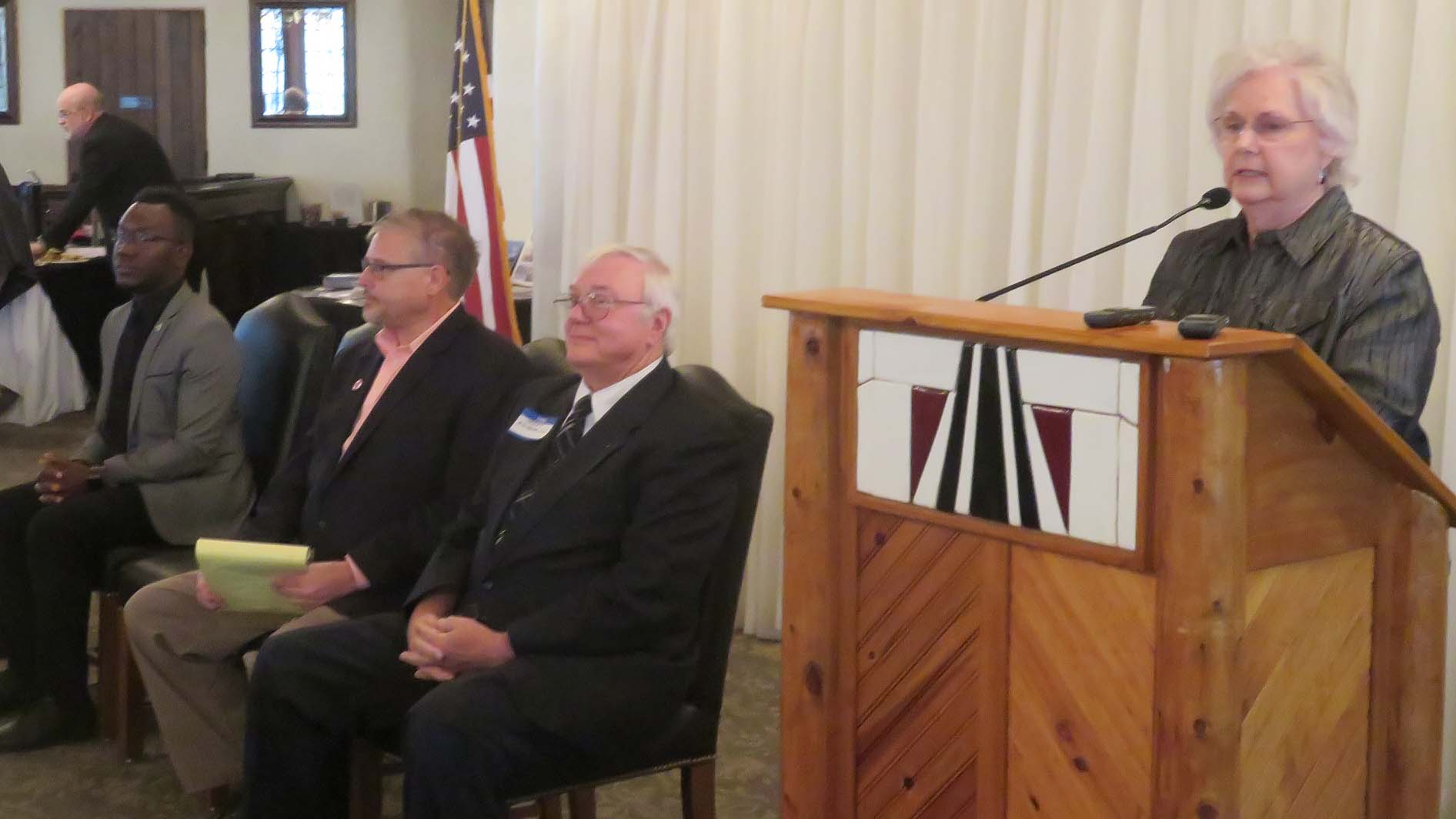
Today in Topeka supporters of more taxes for Kansas public school spending marched from the headquarters of Kansas National Education Association (or KNEA, the teachers union), to the Kansas Capitol, where they heard from speakers including Governor Parkinson. The crowd, braving the windy and cold weather, was estimated at 1,000 by the Topeka Capital-Journal.

The theme of the rally — besides more taxes and more spending — was the chant “We want what’s right, not what’s left!” I don’t think the participants detected the irony.

Kansas Senator Anthony Hensley, a Topeka Democrat and a schoolteacher, said that keeping class sizes small, keeping quality teachers, and making sure that all children have an equal opportunity to succeed are the right things to do. Early childhood education and more technology are needed. He advocated for increasing state funding of Kansas schools instead of reliance on local property taxes.

He said that investment in education is less expensive than paying to house prisoners.

Kansas Governor Mark Parkinson acted as cheerleader for the crowd. He said that the outcome of the school funding battle will define the type of state we want to be: “Do we want to be a state that tears down our schools and refuses to fund education for our schoolchildren, or do we want to be a state that lifts up our schools, lifts up our teachers, and provides an education for every kid?”

He asked whether we wanted to be a state where only the children of the wealthy can get a good education. He urged the group to go into action by emailing, writing, and calling legislators. He said the message to give them is not only to support education, as all legislators say they support education. Instead, Parkinson said to ask them: “Will you raise taxes to save schools?”

He said we can do this — saving schools, presumably — with just a one cent increase in the sales tax. He said that the “so-called economists” on the right will say that a one cent sales tax will tear down our economy. He referred to the Sedgwick County sales tax used to build the Intrust Bank Arena, saying that people told him they didn’t know when the tax went on and off, claiming that no one noticed it. “Where are our priorities? If we can raise taxes one cent to build an arena, surely we can raise taxes on cent to help every schoolchild.”

Several speakers stressed the importance of education for the future well-being of our economy and country.

Analysis

The Kansas teachers union’s role in this rally is ironic to the point of absurdity, as it has been one of the major impediments to improving public schools. A recent letter in the Wall Street Journal described how the teachers union and its rules has harmed Topeka schools.

School spending supporters spend a lot of time talking about investing in education. But spending on public education is not really investing. It’s simply government spending on government schools. It results in jobs being transferred from the productive private sector to the unproductive public sector.

We must also disagree with the governor when he minimizes the impact of a sales tax on the economy. Despite the governor’s contention — I’ll chalk it up to rhetorical excess — I certainly noticed when the Sedgwick County sales tax started and stopped. A sales tax increase does result in lost private sector jobs. It results in lost economic freedom, as explained in Tax increases will cost Kansas jobs, economic freedom.

If a sales tax increase could be used to fund increased spending on schools without harming the economy, why stop at a one cent increase? Why not three or four cents? Or ten cents on the dollar? As we’ve seen, no amount of increased spending will satisfy the school spending lobby, at least not until all private sector wealth is transferred to the government.

Finally, for those who are willing to cast the lot of Kansas schoolchildren with the current system, consider the Adequate Yearly Funding website created to support this rally. The creator of this site, apparently Noah Slay, a third grade teacher and one of the rally organizers and speakers, evidently doesn’t know how to correctly form the plural of a word like “logo.” Twice the site erroneously creates the plural form of this noun using the greengrocer’s apostrophe: “If you’re creative and enjoy creating interesting and catchy slogans and logo’s …”

Related: Kansas school spending rally examined in video, story.

  • Facebook
  • Twitter
  • Delicious
  • LinkedIn
  • Technorati Favorites
  • Digg
  • Share/Bookmark

{ 23 comments }

Today in Topeka about one thousand supporters of higher taxes for more Kansas public school spending rallied at the Kansas Capitol. Their march on the statehouse started at the headquarters of the Kansas National Education Association (or KNEA, the teachers union), and KNEA president Blake West spoke at the rally. It’s quite ironic that the teachers union would be so involved in a rally for the improvement of Kansas schools, for as the following letter from the March 12 Wall Street Journal tells us, the teachers union has been a primary factor in the destruction of public education, in this case, the Topeka public schools.

Early on in my 42-year career teaching in public schools, my principals actually took reading groups, helped with math, were present in classrooms, halls, lunch rooms and on playgrounds. They came into one’s classroom unannounced and stayed sometimes for half a day, and they were taking notes. Their background was in teaching and they knew what they were looking for. By the time I retired, the union had required an administrator to give three to four days advance notice, right down to which period he’d be observing. Yearly evaluations became nothing more than a check sheet, and everyone got about the same score.

Our nation has some of the finest teachers in the world, and a goodly number of the worst. Unless and until teachers are evaluated based on what they accomplish, nothing will change.

Cherrie Wiese
Topeka, Kan.

  • Facebook
  • Twitter
  • Delicious
  • LinkedIn
  • Technorati Favorites
  • Digg
  • Share/Bookmark

{ 10 comments }

A new report by the Kansas Policy Institute provides some insight into the voracious appetite of the Kansas school spending lobby for taxpayer dollars: There’s never enough.

In A Kansas Primer on Education Funding, Volume III: Analysis of K-12 Spending in Kansas this story is told:

So the rumors of school funding wars persist, with legislators and taxpayers asking “how much is enough?” and schools pressing for more money with no real end in sight. Speaker Pro Tem Arlen Siegfreid (R-Olathe) shared with me a conversation he had with Mark Tallman, Assistant Executive Director/Advocacy for the Kansas Association of School Boards (KASB), which illuminates the dynamics at play:

Early last session Mark Tallman and I engaged in a conversation about the budget and school spending. During the conversation the difficulty of increasing school spending as ‘required’ by Montoy was juxtaposed against the need to cut school spending by the same percentage as other portions of the State budget. During our discussion I asked Mr. Tallman if we (the State) had the ability to give the schools everything he asked for would he still ask for even more money for schools. His answer was, “Of course, that’s my job.”

We’ve known for some time that the appetite for money by the school spending lobby can’t be satisfied. In 2007, when the Wichita school board voted to raise taxes I wrote this:

Lynn Rogers, then the USD 259 (the Wichita public school district) school board president, and Connie Dietz, then vice-president of the same body, attended. There had been a proposal to spend an additional $415 million over the next three years on schools. Asked if this would be enough to meet their needs, the Wichita school board members replied, “No.”

At least Rogers was not lying. Much more Kansas state spending than that was approved, and true to his word, the Wichita Board of Education still found it necessary this week to raise taxes so the public schools could have even more money.

  • Facebook
  • Twitter
  • Delicious
  • LinkedIn
  • Technorati Favorites
  • Digg
  • Share/Bookmark

{ 2 comments }

At a meeting last week of the Kansas Senate Assessment and Taxation committee, a Kansas school superintendent said cutting his pay and auditing his district are not the answers to Kansas budget problems.

Mike Mathes, superintendent of Seaman Unified School District 354 told Kansas Senator Karin Brownlee that he chose to “do what was necessary to get to the top of my profession. I believe I earn every penny I make.” He added that he didn’t believe the members of the legislature should take a pay cut, either.

He said he would not accept a pay increase until the budget crisis is over.

Earlier, Mathes responded to a question about the small number of Kansas school districts that participated in a voluntary audit program. He said that his district has been auditing its efficiency since he became superintendent eight years ago. He said that he looked at the audit of the Derby school district, a district close in size to his, and his district has done most of what the audit recommended for Derby.

Analysis

Generally, the meaning of the word “audit” means an independent examination and evaluation. When a district self-audits, as Mathes says his district has, it’s not an independent audit. Further, audits are specific to an organization, such as the Derby school district. The results of it may not apply to Mathes’ district, and there may be things that can be done in Mathes’ district that an audit of a different school district can’t detect.

  • Facebook
  • Twitter
  • Delicious
  • LinkedIn
  • Technorati Favorites
  • Digg
  • Share/Bookmark

{ 2 comments }

Last week the Kansas House Education Budget Committee heard testimony on HB 2728. The key provision of this bill is that Kansas school districts would be required to have a minimum of 10,000 students. It also requires conforming to a common chart of accounts, and that school finance information be placed on the internet.

Kansas Senator Chris Steineger, a Democrat from Kansas City, testified as neutral on the bill. He said that Kansas is “bottom-heavy” in terms of the number of governmental units, and school districts are part of these. He said that in the business world, mergers and consolidations take place every day as companies seek to become stronger and more competitive. Voluntary consolidation can be haphazard. He advocated for a business-like approach.

Kansas State Board of Education Member Walt Chappell testified as a proponent of the bill. He said this is a time to “think outside the box.” We need to make good use of the limited resources we have, he said. This reorganization is not a new concept, he said, as it has been thought through for years.

“We’re in a real financial bind,” Chappell said. After Montoy (the Kansas Supreme Court decision in 2005 that ordered increased spending on schools), he said we’ve been spending more that we have revenue coming in. The Montoy spending amounted to an extra $1 billion, and that’s not sustainable. A second factor is that we’ve hired 6,000 new employees in Kansas school districts, with only 2,000 of those being teachers. He said that $587 million went to non-instructional staff.

Chappell said that the goal of the bill is not to close schools and shut down small towns. “We need to make best uses of the resources we already have.” The goal is to not duplicate administrative services and non-instructional activities and staff. We should reduce those expenses and put more money in the classroom for the teachers and the kids. This bill would would give students an opportunity for a balanced curriculum, with opportunities for vocational education or college prep. Teachers would be able to do just one or two class preparations instead of four or five. “Right now our teachers in small schools, many of them are stretched thin. They have to prepare for several different subjects in each day. It’s very hard for them.”

We’re trying to find a way to optimize instructional and non-instructional resources so that we don’t duplicate services, Chappell said. This could lead to savings of $300 million per year.

Chappell said that based on research from school superintendents who have examined this issue, savings are found not by closing schools, not by shutting down small Kansas towns, but by making sure that you don’t duplicate services and resources for administrative and non-instructional activities.

Chappell said that only about half of school district employees are teachers. By becoming more efficient in administrative tasks, more resources could be spent on teachers. Removing duplication of effort is the key to this goal.

The 10,000 student minimum size of the new school districts is important. There are many small school districts in Kansas, he said. A large district creates a large and sustainable tax base. Small school districts are not able to offer a sustainable curriculum. Large districts are also able to obtain the benefits of the division of labor. Finally, combining two very small districts to create a district that’s still very small doesn’t do much to realize the efficiencies of a larger district.

Chappell’s written testimony is available at Kansas School Reorganization Testimony.

Testifying as an opponent to this bill, Kansas Association of School Boards lobbyist Mark Tallman said “School districts are not merely administrative units. They are units of government.” He expressed concern that the administrative office, where school board meetings are held, would be far away from many people.

Tallman showed a map of a hypothetical large district in northwestern Kansas, which he said would encompass 16,000 square miles. This district would lose $21 million in low-enrollment weighting. He presented evidence that the savings in administrative costs would not be large. He also said that since teachers in larger school districts are paid more, the teachers in the new, large districts would need to be paid more. He also said there’s no evidence that these larger districts would improve students achievement.

Linda Kenne, superintendent of the Victoria school system, said that the bill does not mention the word “child.” She urged the committee to replace the word “school district” with the word “children” in the proposed legislation, saying that this changes the connotation of the bill. She said that education is not an expense, it is an investment.

Bill Bohne, vice president of USD 449 school board (Easton, in Leavenworth County), said that the goal of consolidation is to save money, not improve education. He said that consolidation, in fact, will cost money. He referenced a Kansas Association of School Boards document that said that teacher pay will move to that of the highest district. Differences in the textbooks used will result in more cost.

He also claimed that the regional education service centers created by this bill would violate the Kansas Constitution, going so far as to say this bill makes local boards of education a “sham.” He also said that the accounting provisions of the bill would violate the Kansas Constitution. He said this about the changes: “In effect, you have removed us from the general supervision of the state board.”

Bohne said that his district has no desire to join with USD 453 (Leavenworth) schools, which he said has much lower performance.

In conclusion, Bohne stated: “Kansas public education has a national ranking many other states are envious of — we are ranked seventh in National Assessment of Educational Progress (NEAP) scores. And if we compare ourselves internationally, Kansas is ranked sixth in the world in fourth grade math and eighth in the world in 8th grade math.” He said that the future of our education is sacrificed by this bill.

In questions, Representative Gene Rardin asked Chappell about how his claimed savings of $300 million is more than a legislative post audit study said might be achieved. Chappell replied that the study looked at smaller levels of consolidation that what this current bill provides for. He also reiterated that the bill is not about closing schools. He said that the savings are in the areas of bus scheduling, payroll, food service, and maintenance of buildings, for example. He referred to the Kennedy and Little study, which found savings of $1,000 to $2,000 per student.

Chappell also said that the NAEP scores tell us that only one in three students are proficient, notwithstanding Bohne’s claim.

KASB’s Tallman backed up Bohne’s claim of the ranking of Kansas schools by citing an analysis that showed Kansas students doing very well compared to international students. Committee member Arlen Siegfreid made this remark about this claimed lofty performance of Kansas schools on the international stage: “I’m also a little amazed that we managed to lose a lawsuit on the suitability of funding of education while we’re hitting those numbers.”

Written testimony in support of this bill was provided by two former Kansas school officials, and is available at Morris L. Reeves testimony on Kansas School Reorganization and Gary W. Norris Testimony on Kansas School Reorganization .

Analysis

Tallman’s contention that school districts are “units of government” is at odds with most public school officials, who bristle at the use of the term “government schools.” This hearing also lets us know that KASB uses NAEP scores when it suits their cause. Otherwise, it dismisses them as not meaningful. The biggest problem for Kansas schools spending advocates is the discrepancy between the rapidly rising Kansas state assessment scores and the flat or slowly rising NAEP scores.

Bohne — the Easton school board member — made some claims about the constitutionality of the bill that are not reasonable, in my opinion. His claims that consolidation will increase cost instead of reducing it are not based on actual evidence.

Consolidation is a controversial issue, no doubt about it. The school spending lobby, lead by KASB’s Tallman and Kansas National Education Association (or KNEA, the teachers union) resists any change, no matter how beneficial it might be. In the issue of KNEA’s Under the Dome Today that covered this hearing, we see the appeal to emotion instead of reason: “in northwest Kansas, 18 counties would need to merge together as one district!” The newsletter also asks: “which towns will die? How many hours will kids spend on buses? How many miles will our high school students have to drive to reach the new high school?”

  • Facebook
  • Twitter
  • Delicious
  • LinkedIn
  • Technorati Favorites
  • Digg
  • Share/Bookmark

{ 2 comments }

At yesterday’s meeting of the board of USD 259, the Wichita public school district, members heard descriptions of district policy on how a reduction in force — layoffs, in other words — world be accomplished if the district decides to use this method of reconciling its budget.

Several speakers, including superintendent John Allison, remarked how unfortunate it was that on a night the district recognized excellence in teaching, it also discussed methods of reducing the number of teachers.

Board member Betty Arnold, now a candidate for the Sedgwick County Commission, said she was troubled by the possibility of laying off a promising first-year teacher when more senior teachers who might be on a disciplinary plan would be protected. Allison said that was the policy of the district’s contract with the teachers union, and a change would have to be negotiated.

Allison said that new teachers who might be laid off might leave Kansas or the teaching profession altogether. This, combined with upcoming retirements, creates a “real problem for ourselves” far beyond the implications of this year and next year. A short-term budget issue can blossom into a long-term problem, he said.

Board member Lynn Rogers said that a $25 million cut in wages, combined with potentially more cuts in other school districts in the county, harms the business community. State officials, he said, have “been willing to give the shop away and not look forward to the future.”

Arnold said she reads in the newspapers about incentives being given to employers. “The district is an employer. Where is our incentive?”

Analysis

Government spending is paid for by the private sector, as government — at least the Wichita school district — has no way to create money of its own. Therefore, every dollar the school district spends is a dollar taken from the productive private sector. This leads to a reduction of economic activity and jobs in the private sector. Contrary to the argument of board member Rogers, government jobs like those in the Wichita public school system do not generate wealth or prosperity.

Government spending also leads to a loss of economic freedom, as the ability of people to buy the goods and services they value is reduced by the spending of government. Consider especially the case of low and moderate income families struggling to pay private or religious school tuition for their children, and then being told they must pay even more taxes to feed the government school spending machine, something they personally have no use for.

There may be those who think that government spending is more productive or efficient than private sector spending. This may be the case for a limited set of public goods. Education, however, is not such a good, as the private sector has a record of delivering education effectively and efficiently.

Board member Arnold, in wondering out loud about the whereabouts of the government school district’s incentive, might choose to become aware of these facts: First, some of the incentives given to employers take the form of escape from paying some taxes. This is in recognition that taxes reduce economic activity. Regarding this, Arnold might want to recall that the school district is exempt from paying all or nearly all taxes. So there’s no taxes to abate with economic incentives.

Second, granters of economic development incentives make the case that the new employment increases the prosperity of a region. There’s the possibility of that as long as the jobs being subsidized are private sector jobs. But when the jobs being subsidized are government jobs, no stimulative effect occurs.

In fact, it is folly to say that it would be possible to provide an incentive to government jobs. Since they are totally paid for by taxpayers, there is no way to reduce the cost of government employees like private sector incentive programs are designed to do. Any reduction in employment cost would simply be born by the taxpayers who pay for cost of the incentives.

Superintendent Allison’s concerns about a short-term budget problem causing long term problems should lead us to wonder why the district doesn’t make use of millions in fund balances the district holds. School spending advocates criticize those who advocate use of these fund balances by noting that the balances are not a long-term solution to school finance problems. That’s true. They are a short-term fix, which, as we now see, is what the superintendent says the district needs.

Finally, we must note the irony of the Wichita school district building new schools and classrooms at the same time it can’t afford to keep the teachers it has.

  • Facebook
  • Twitter
  • Delicious
  • LinkedIn
  • Technorati Favorites
  • Digg
  • Share/Bookmark

{ 10 comments }

When asked about levels of spending on public schools, Americans are likely to vastly underestimate the amount that schools spend.

That’s the finding of Is the Price Right? Probing American’s knowledge of school spending, a 2007 survey project produced by EducationNext, a project of the Harvard Kennedy School of Government.

Here are the findings on school spending estimates:

How well informed is the public about these financial commitments? Not very. Among those asked without the prompt listing possible expenses, the median response was $2,000, or less than 20 percent of the true amount being spent in their districts. Over 90 percent of the public offered an amount less than the amount actually spent in their district, and more than 40 percent of the sample claimed that annual spending was $1,000 per pupil or less. The average estimate of $4,231 reflects the influence of a small percentage of individuals who offered extremely high figures. Even so, the average respondent’s estimate was just 42 percent of actual spending levels in their district.

Even when promoted with a range of possible spending amounts, people still greatly underestimated the amount of spending.

The study also asked about teacher salaries and found that people also underestimated them, although not by the large factor observed with school spending. There is also discussion of whether subgroups performed better than others in their knowledge of facts about school spending.

In conclusion, the study states:

In sum, Americans think that far less is being spent on the nation’s public schools than is actually the case. The vast majority of the public thinks we spend amounts that can only be described as minuscule, and almost 96 percent of the public underestimate either per-pupil spending in their districts or teacher salaries in their states. … At this point, though, one matter seems certain: whatever motivates people’s concerns about school finance, it is not sound information about what is actually being spent.

To read the full article, click on Is the Price Right? Probing American’s knowledge of school spending.

Related: When informed, attitudes toward public school spending change.

  • Facebook
  • Twitter
  • Delicious
  • LinkedIn
  • Technorati Favorites
  • Digg
  • Share/Bookmark

{ 2 comments }

Next week there’s going to be a march on the Kansas statehouse asking for more spending on Kansas schools. In support of the march and the plea for more spending, a group has created a website titled Adequate Yearly Funding.

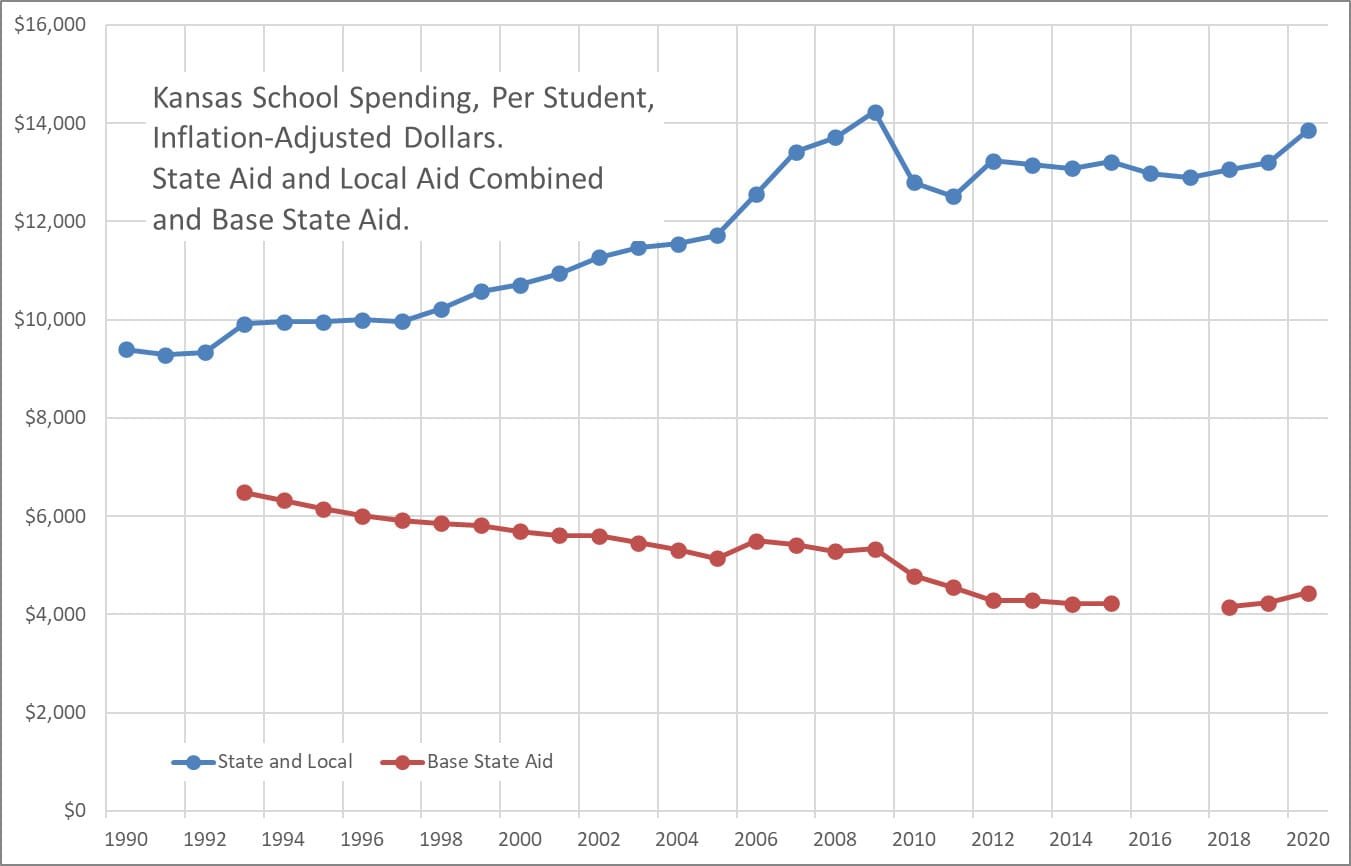
In an effort to make a factual case for more school funding, the page presents the fact that since 1992, base state aid per pupil in Kansas has increased from $3,600 to $4,012, an increase of 11%. The page illustrates how the cost of other things has increased by larger factors.

The problem with these facts is that they are incomplete. Base state aid per pupil is just part of the Kansas school funding formula. If we look at total funding by the state of Kansas we get quite a different picture.

I don’t have figures back to 1992, so I’ll start with the 1998 school year. Base state aid in that year was $3,720, so the increase to $4,012 — the current number — is 8%.

When considering total state funding, we go from $4,533 to $6,292 during the same period. That’s an increase of 39%. But the school spending lobby wants you to believe the increase is only 8%.

If we consider total school spending, the increase is from $7,222 to $12,225, which is an increase of 69%. Again, the school spending lobby wants you to look at just the 8% increase. According to them the rest of the increase is to be ignored.

The chart below illustrates the numbers. While base state aid increased only slightly, both total state aid and total spending increased much more rapidly.

We have to ask this question: Are those who use figures like this to make the case for more school spending merely misinformed, or are they deliberately misleading citizens and legislators?

Kansas school spending

By the way: since the Adequate Yearly Funding site is in support of education, is it being too picky to expect proper use of words and language? Twice the site erroneously creates the plural form of a noun: “If you’re creative and enjoy creating interesting and catchy slogans and logo’s please email them …” Then there’s this: “We now have approval to hold our march on capitol grounds, Ann Mah one of our area legislators (and great advocate for education) has graciously sponsored the march.”

  • Facebook
  • Twitter
  • Delicious
  • LinkedIn
  • Technorati Favorites
  • Digg
  • Share/Bookmark

{ 1 comment }

A bill has been introduced in the Kansas House of Representatives which would require consolidation of small school districts and increase the ability to manage schools through common accounting standards and information availability.

The bill, which is HB 2728 “an act concerning school districts; relating to the reorganization thereof,” has been assigned to the Kansas House Education Budget committee.

Highlights of the act include the requirement that a school district have a full-time equivalent enrollment of at least 10,000 students. A “school district re-organization commission” of 11 members would draw the boundaries of the new districts. Each of the districts would be governed by a seven-member board.

The bill lists a number of the duties of the newly-formed regional education centers. Many are aimed at efficiency and removing duplication of effort.

One of the provisions of the bill is that the new districts will use a statewide uniform accounting and reporting system based on a uniform chart of accounts. Further, the bill mandates reform of school district’s data-gathering and sharing effort. A section of the bill prefaced with this statement: “The purpose of this section is to allow any person desiring to obtain, analyze and compare financial and performance data of school districts the ability to do so.”

Furthermore, “Such system shall be an internet-based data reporting system which is freely available and accessible.”

Other information on this bill is at Consolidation Heats Up.

  • Facebook
  • Twitter
  • Delicious
  • LinkedIn
  • Technorati Favorites
  • Digg
  • Share/Bookmark

{ 1 comment }

Last year Secretary of Education Arne Duncan created a program named “Race to the Top” which would make grants to states that are willing to make certain reforms. Two such reforms prominently mentioned by Duncan and President Barack Obama are charter schools and merit pay for teachers.

We now know that Kansas was not selected to receive a grant, at least not in the first round. Kansas had applied for $166 million.

Kansas is falling behind the rest of the states in the types of innovation that Race to the Top was designed to promote. Specifically, the Kansas charter school law is weak. Anyone wishing to start a charter school must seek approval of the local school district. Most school districts in Kansas, especially the Wichita district, are hostile towards any lessening of the government school monopoly. As a result, there are very few charter schools in Kansas. It is likely that this played a role in the decision not to award a grant to Kansas.

Kansas is also unlikely to implement any sort of merit pay for teachers. As I reported last year in Kansas school establishment rejects reform: “In particular, the document Teaching in Kansas Commission: Final report, makes it clear that teacher merit pay in Kansas is not desired unless it is so watered-down as to be meaningless.”

Besides resisting merit pay, the Kansas National Education Association (or KNEA, the teachers union) is also opposed to charter schools. The national teachers union is too, as the Wall Street Journal reported last year: “NEA President Dennis Van Roekel told the Washington Post last week that charter schools and merit pay raise difficult issues for his members, yet Education Secretary Arne Duncan has said states that block these reforms could jeopardize their grant eligibility.”

It turns out that the prediction of Secretary Duncan was fulfilled. Kansas, with a teachers union that blocks reform at every step, is failing to keep up with innovations in education. Kansas should implement these reforms for their own good.

  • Facebook
  • Twitter
  • Delicious
  • LinkedIn
  • Technorati Favorites
  • Digg
  • Share/Bookmark

{ 2 comments }

Last night USD 259, the Wichita public school district, held two meetings with the public seeking ideas on how to deal with a budget shortfall. I attended the meeting at Southeast High School.

In an opening presentation, Wichita school board member Connie Dietz presented a series of charts that explained some facts about Wichita school revenue and expenditures. For revenues, 57.1% comes from the state, 15.9% from the federal government, and 27% from local taxpayer.

Expenditures fall into two categories: unrestricted funds, which comprise 40.5% of spending, and restricted funds, which are 59.5%.

School district leaders like to portray themselves as hamstrung by the restricted funds. “We can not use that money for anything except for what it has been designated for,” Dietz said. An example given of a restricted fund expenditure is KPERS, the school district retirement system. Whether this money comes from a restricted or unrestricted fund makes little difference. It’s an expense the district must pay.

As a Kansas Watchdog story explains: “districts do receive [restricted funds] and have control over how it is spent. They are required to provide special education services but they do have discretion to decide what to spend in providing the services. They also have discretion to delay or reduce the cost of certain capital projects. A complete breakdown of expenditures deemed to be ‘restricted’ was not provided.”

On a slide showing the trend of per-pupil funding, the figures used were the base state aid per pupil, which is about $4,000 at this time. That’s misleading, as base state aid is only part — a relatively small part — of total school funding. For example, for the 2008 to 2009 school year, base state aid per pupil was $4,400. But the Wichita school district, according to Kansas State Department of Education figures, received $7,918 per student after various weightings were applied. That’s 80% more than the base state aid figure.

Total spending that year was $12,370 per student. It’s these large figures that the school spending lobby does its best to hide.

It’s not uncommon for the school spending lobby and its supporters to do what they can to hide the magnitude of spending on schools. They’ll also do their best to exaggerate the effects of any slowdown in the rapid rate at which spending has been increasing. This was demonstrated by Rep. Melody McCray-Miller at a recent legislative forum in Wichita. She disputed the total amount of spending by the Wichita school district. Wichita board of education member Lanora Nolan disputed these same figures at a Wichita Pachyderm Club meeting. Also see Wichita schools on the funding decrease.

Dietz claimed that funding has been going down at the time that the cost of living has been going up rapidly. The fact is that inflation has been quite low for many years. In fact, last year prices actually declined, and social security recipients didn’t receive a cost of living adjustment because of this.

Dietz promoted the success that the Wichita schools have achieved over the years. Math scores, she said are up 24% since 2000, and reading scores are up 19% over the same period. But upward trend in these scores, which are from the Kansas state-administered tests, can’t be reconciled with scores on the National Assessment of Educational Progress over the same time. That test, which can’t be manipulated by Kansas school bureaucrats, shows only slight increases — in some cases decreases — in scores.

The NAEP scores are for the entire state, not just the Wichita school district. But Wichita’s results mirror the trend of the state. So how is it that Kansas tests show rapid improvement, but NAEP tests do not?

It’s an important question, as school spending advocates use the purported linkage between increased spending and increased performance on the Kansas tests as proof the spending works. But if the Kansas tests are not a reliable and valid measure of student learning — and that appears to be the case — the argument of the school spending lobby breaks down.

School spending advocates like Dietz and the rest of the Wichita school board say that the education of Kansas schoolchildren is vital for the economic future of our state and country. I agree. The questions I have are these: Are Kansas schools performing as well as Kansas school bureaucrats claim? Is a government monopoly the best way to educate Kansas schoolchildren?

  • Facebook
  • Twitter
  • Delicious
  • LinkedIn
  • Technorati Favorites
  • Digg
  • Share/Bookmark

{ 4 comments }

Here’s a citizen-contributed report from one of last night’s meeting of the board of USD 259, the Wichita public school district, with the public seeking ideas on how to deal with a budget shortfall. There were two meetings, one at Southeast High School, and one at West High School. This is a report from someone who attended the meeting at Southeast. “Artficial turf” or “Astroturfing” refers to a political tactic where an established and organized political group — say the Wichita school spending lobby — creates a false impression of grassroots concern and interest in an issue.

As I pulled into the parking lot I was shocked. Nearly the entire student lot was full — with nice vehicles. The last meeting I attended attracted only 15 people. This one was clearly abnormally popular. School personnel were lining the hallways greeting attendees cheerfully. At the table we were given handouts listing all the State Legislators representing the territory of the Wichita School District — both House and Senate, including their photographs, email addresses, phone numbers, names of schools within their district boundaries, information on how to contact them in Topeka, how to address them, a full color printout of charts showing USD 259 source of funds, and impact of another cut on per-pupil funding level (listing only the state monies of course and making it look like we are about to drive off a cliff and nose-dive into the ground — what a graph!), a bright green colored paper giving us steps to do to contact our Legislators in both the House and Senate, what to say, how to say it, and then that we discuss this with our neighbors, other parents, and family members and encourage strong schools because they are the foundation for a strong Wichita. Encourage other parents, friends and family members to join our advocacy work, and also a yellow paper listing all the schools in the district and their addresses, and another white piece of paper to fill out telling what we value in the Elementary School program, the Middle School program, the High School Program, and Other Programs and services, plus a place to supply our name, address, email, phone number, and school.

Loaded down with printed paper (which the school must have spent a lot of money on) we started in the Auditorium and were then herded to “small group meetings” conducted by district personnel in various rooms of the school. Here we were told to tell them what we valued most in each of the sectors of the school district, while one employee wrote the items with a magic marker on a Giant paper tablet, and the other employee acted as cheerleader, constantly goading us to think of “More, More” and ever “MORE” that we valued. Page after page trying to think of all the wonderful programs of the school district. I looked around the huge oversized, spacious, impeccably decorated library where we sat and saw group after group with their 2 district employees and their giant tablets.

Here’s our group’s complete list, starting from the first thing named regarding the District’s Elementary School Program:

(NOTE: I threw in a mention of the important free condom distribution and the digital clocks, since they’d already brought up the child care centers for the teenage parents)

Elementary School

O.T. (Occupational Therapy) and P.T. and Speech Therapy, Nurses, Counselors, Child Study Team, Visually Impaired — Specialized Programs, Magnet Schools, Playgrounds, Latch Key

Middle School

Music and Performing Arts, Foreign Language, Counselors, Social Workers, Athletics (both in school and extra-curricular), Band, Art and Technology, JROTC, pre-IB, S.R.O.s (School Resource Officers), Alternative Facilities (like Wells), Para-educators, Special Education, Busing (one man commented that out of 40 buses 3/4 of them have one or two kids on them), Availability of Computers, Technology, Administrators. Clerical, National Academic League (N.A.L.), Science Olympiad, Artificial Turf, Speakers / Presenters, Custodians, Elective Courses,
Lunchrooms, Free Breakfast, Free Lunch

High School

Music and Performing Arts, Special Ed, Sports Programs, Photography, Drivers Ed for Regular and Special Ed Students, College Prep Coursework, Classes to teach them how to write Resumes and fill out applications for Scholarships, Choice to be on a Career track (like at Northeast you can either be in the Law Program or Visual Arts Program), Alternative Schools and Programs, Volunteer Programs for parents, grandparents, Field Trips, JROTC, Child Development Centers in High School, Classes for Unwed Mothers and Unwed Fathers, Parenting Classes, Free Condom Distribution, Nurses, Art, Circle of Friends, Sex Ed Programs, Classes that teach them to budget their money, Finance, Economics, Civics (I said Constitution of the United States, but she wrote down “Civics”), C.B.I. (Community-based Involvement), Student-rights Clubs and Extracurricular Activities, The Big Do (like at East High School), General Clubs, digital clocks because people can’t read analogue clocks, small class size, Open and Honest Communication, Parent Assist, Diversity, Foreign Languages, Free/reduced Lunches, Parent/Teacher Resources,
Environmental Safety, Facilities Maintenance, Global Warming, Parent/Teacher Resource Center, Food Services, Print (is that where we get our books that are delivered to us?), Grounds Maintenance, Instructional Coaches, Parent Involvement, Peer Consultants, Watchdog Dads (at Minneha School the dads come in and say “I grew up this way”), Security, Volunteers, Time clocks and accountability, Bigs in Schools.

The District is going to compile all this, we were told, and use it in their budget. Right. I believe that.

I couldn’t help but pick up, during this session, that, from the jargon being used and the questions of most the people in the group toward the person with the permanent marker, that I was in the midst of a pseudo-employee meeting, so I decided to conduct an unofficial poll. Aas soon as we were told to return to the auditorium, I casually asked each adult what school they worked at. Out of about 40 people there were only two who said they didn’t work for the school district, and one of these said he works for the Derby School District. Across from me sat a teacher from Minneha Elementary and her husband. School after school attendees named, and usually they reciprocated by asking me what school I worked at. Instead of answering I moved to the next person. One teacher became alarmed that I wouldn’t tell her what school I worked at. She began following me telling people “She’s asking everyone where they work, but she won’t say where she works!”

Outside the auditorium, a man approached me specifically, wearing his employee badge, both arms outstretched toward me, told me he was Eric Filippi of Southeast High and asked my name and where I worked. I guess my asking the Astroturf questions was getting on someone else’s nerves. I continued to the auditorium without providing my name.

Back in the Auditorium the three Board members directing the meeting — Connie Dietz, Betty Arnold, and Kevas Harding — told us “we aren’t looking for a cut list.” And that we must start calling our Legislators TONIGHT. When they offered mics to the floor, audience members commented or asked questions. Here they are, numbered:

1) Has the school district had done any studies on the kids now in 4th grade to see how all day kindergarten had helped them (note the biased preconceived conclusion in the question).

2) I just spent the last 45 minutes in a group that said basically “they like everything.” We need to cut $25 million. Wouldn’t it be better to focus on what we’re willing to give up vs. what we want?

3) Was the 1% sales tax for the Arena any big deal? No because we’re so excited that Elton John and Billy Joel are coming to town!

My comments:

4) Regarding the 1% sales tax for the Arena — it was a tax levied during a robust economic time. How many of us took Economics in college? What happens when you raise taxes in a recession? It drags the economy down, and then the schools will be short again. Please do not ask your Legislators to raise taxes in a recession. You will lose your job. It’s the government that’s adding jobs now. Private sector jobs are shrinking. How many of you here (in the audience) work for the government? About half of the people in the audience raised their hands. I then said,”This includes the school district too.” A few more hands went up. Kevas Harding got on the mike and kept asking me if I had a question. I said I’d like the freedom to speak. The lady in the aisle who had handed me the microphone kept trying to take it back from me. I asked people to please NOT ask their legislators to raise taxes.

Now it was time for slap-down dissent. Subsequent comments:

5) I would appreciate it if you would not bring politics into my son’s education, a 1% sales tax is not going to hurt you. I’d pay a penny for my son’s education.

(This gentleman obviously didn’t realize the whole topic of the evening was politics and the board members brought politics — and tax increases– into his child’s education.)

6) Not only did I take Economics in College, but I teach Economics …

Connie Dietz “It’s real easy, give us the money, we’ll withdraw the lawsuit.” We as a school district just don’t have the same capability as the city. We can’t go charge more for parking tickets …” “We’re at 60% free or reduced lunch. So we’re really limited as to places we can go …”

7) I want to thank you for soliciting community input.

8) Can’t you just cut salaries 5%? Dietz: No. Both teachers and classified employees are represented by unions and we’d have to go back through that whole bargaining process.

9) As a first year teacher I hear fear from people about losing your jobs — you should be worried about your kids. Our kids are the future. I don’t want my program to be cut. I don’t want my intelligence insulted by being asked if I took an Economics class.

10) Chris Thompson: What programs will be cut if we have to cut programs? Betty Arnold: No we’re not there yet. These are decisions your Legislator is making. They hear a lot from a school board. If you have concerns, express those to your Legislators.

11) Sarcastic comment: “I also think it’s very important that we take Economics classes. If you (directed at me) get up here and make a statement like that, I want to know where your data comes from!”

12) As a recent college graduate I understand the correlation between Extracurricular Activities and Graduation Rate….And the purpose of public education is to create a whole well-rounded individual.

13) Are you looking at a 4 day week? Connie Dietz: “Yes.”

14) In your family when things get tough you cut out non-essentials. Why aren’t you looking at cutting? Connie Dietz: The State put a mandate on us that we have to do all our testing by computer this year, and didn’t give us any money for it. I’m not so sure anything I said was a non-essential.

15) I guess I was misled about the reason for tonight. I was here to advocate for music. I’m here for the 1% sales tax also. Connie Dietz: The studies are out there showing correlation between extracurricular (fine arts and athletics) and graduation rate.

16) I was here to advocate for Fine Arts (she’s wearing a powder-blue, hooded sweatshirt saying “EAST ACES.”) I took my children out of Maize School District and put them in East because East has a commitment to Fine Arts that Maize just doesn’t have (BIG applause from audience.)

17) I never worked for the school district. I have taught a couple college courses if you want to hold that against me … Anyone who thinks there’s scads and scads of money in the public schools to cut, “you’re relusional.”

Kevass J. Harding gave the final speech from the School Board: “… motivation to be in school. I would not have been the first generation to become not only a Bachelor’s Degree, not only a Master’s Degree, but a Doctorate Degree. If you do not know who your Legislator is … call them. We want them to hear from the public. The more you learn, the more you earn. And this gem: “To make our economy a better place, that there will never be another recession.”

As I walked out of the building I watched these well-dressed professionals in their long dress coats, their fancy footwear, and their proud swagger walking to their fine automobiles without a care in the world. 15,000 people in our community have lost their jobs, but these people with a guaranteed income, sucking the rest of us dry, haven’t a clue how tough it is out there. And so, they’re going to bleed Janey and Mikey to reward the Big Bertha wasteful 259, where there will be no salary cuts, and no program cuts, and of course the most important — artificial turf.

  • Facebook
  • Twitter
  • Delicious
  • LinkedIn
  • Technorati Favorites
  • Digg
  • Share/Bookmark

{ 15 comments }

In my article Wichita schools: why so many employees? I illustrated the rise in the number of USD 259, the Wichita public school district, employees per student. The number of students per certified employee has been dropping rapidly, from 13.7 students per employee to 10.9 over a period of 12 years. In percentage terms, that’s 20.4%.

Someone asked about all Wichita school district employees. I gathered some numbers from the district’s comprehensive annual report for the 2007-2008 school year. (The report for the 2008-2009 school year, the most recent complete year, should have been posted in December 2009, according to the district’s website. It’s not there as of this writing.)

Here’s a chart using these figures:

Wichita school employees per student

For the 1998-1999 school year, there were 8.55 Wichita public school students for each employee. For 2007-2008, that number dropped to 6.74 students per employee. That’s a decrease of 21% over a period of nine years, meaning that employee costs per student have been rising rapidly.

  • Facebook
  • Twitter
  • Delicious
  • LinkedIn
  • Technorati Favorites
  • Digg
  • Share/Bookmark

{ 5 comments }

Wichita schools: why so many employees?

February 28, 2010

Tomorrow evening USD 259, the Wichita public school district, is holding two meetings seeking input from the public on budget matters.

Perhaps someone will ask a few questions about why spending has been increasing so fast. The number of students for each employee would be a good question. The chart below shows the trend for the number of students (full-time equivalent) for each certified employee.

Read the full article →

Wichita schools seek public input on budget priorities

February 28, 2010

On Monday, the Wichita public schools board of education will be holding two meetings seeking input from the public on school budgets.

Read the full article →

Andover schools advocacy website not complete, accurate, or balanced

February 25, 2010

The Andover Parent Legislative Council has created a website and wiki in support of the Andover, Kansas public school system (USD 385). This site, titled Andover Parent Legislative Council, is described as helping Andover schools “through legislative advocacy.” Andover parents wishing for complete facts and a balanced approach will need to supplement their research with other reading.

Read the full article →

Kansas school spending study finds $717 million in potential savings

February 22, 2010

A new study on K-12 spending in Kansas concludes that schools statewide are spending as much as $717 million more than is necessary, and that implementing the “best practices” of more efficient districts could eliminate the need to raise taxes or cut spending on other essential services.

Read the full article →

Missing from Kansas school financing debate

February 16, 2010

As Kansas struggles to find funding for its public schools and other functions of government, we’re losing an opportunity to examine our schools and see if they’re performing as well as they should, both financially and academically. Here are some issues not being discussed:

Read the full article →

Kansas school spending advocates exaggerate employment losses

February 11, 2010

Yesterday I reported how Kansas school spending advocates lie about facts in order to score political points with their constituencies. Today we again see how the school spending lobby distorts facts, this time in a very substantial way concerning an important matter.

Read the full article →

Ad spotlights Kansas school spending

February 11, 2010

A television advertisement is calling attention to some facts that Kansas school spending advocates don’t want you to know.

Read the full article →

To Kansas school spending advocates, criticism comes fast and loose

February 10, 2010

As the debate over the funding of Kansas public schools goes on, sometimes facts get lost in the shuffle, and school spending advocates sometimes invent “facts” in order to score political points by criticizing those working to bring inconvenient facts to light.

Read the full article →

Kansas school consolidation: it won’t be the first time

February 3, 2010

An issue that some promote as a way to make Kansas schools more efficient and save money is school consolidation. It’s not the first time schools in our state have gone through consolidation.

Kansas Senator Chris Steineger, who is a Democrat representing Kansas City, recently asked the Kansas Legislative Research Department for information about school consolidation in Kansas. The memo that KLRD produced is below, and here are some interesting facts.

Read the full article →

Kansas teachers union makes it easy to ask for money

January 29, 2010

Thanks for Kansas Liberty for uncovering an effort of the Kansas National Education Association (or KNEA, the teachers union) to make it easy for school spending advocates to ask for more tax money.

Read the full article →

For Kansas teachers union, fund balances are an illusion, not a solution

January 21, 2010

Today’s edition of Under the Dome Today — that’s the house organ of the Kansas National Education Association or (KNEA, the teachers union) — contains a story with the headline “Anti-Government Group launches another attack on public education.”

A more accurate headline might read “School spending advocacy group refuses to acknowledge budget solution that Kansas Deputy Education Commissioner Dale Dennis says could be used.” But that’s a tad wordy.

Read the full article →

Bill would allow Kansas school districts to increase local tax levy

January 21, 2010

Kansas Senate Bill 385, introduced by John Vratil, Senate Vice President and Republican from Leawood, would let Kansas school districts increase their local property tax levies beyond what is currently allowed.

Read the full article →

Kansas school spending advocate on the numbers

January 18, 2010

Appearing yesterday on KPTS Television’s Ask Your Legislator, a member of the Kansas House of Representatives spoke about K-12 school funding.

Jim Ward, a Democrat representing southeast Wichita, said school spending advocates are saying “We’re in a worse place that we were before the lawsuit, because now we have less money than we did in 2006.” He also mentioned that inflation means these dollars are worth less today than at that time.

Examining actual figures from the Kansas State Department of Education lets us investigate the reality underlying the claims of school spending advocates.

Read the full article →

On Wichita school board, are only supporters’ opinions welcome?

January 14, 2010

At this week’s meeting of the Wichita school district board, member Lynn Rogers criticized the Wichita Eagle for printing a story that include criticism by an opponent from the 2008 bond issue campaign without disclosing his involvement in that campaign.

Read the full article →

Lawsuits and tax increases not necessary to fund Kansas schools

January 11, 2010

A recent commentary by Kansas State Board of Education member David Dennis said educators “…just ask that they (legislators) make their decisions based on accurate information, with the future of our students in mind. “We completely agree, and just ask that educators do the same. Unfortunately, some have been making their case for tax increases and lawsuits with a healthy dose of inaccurate and/or misleading information.

Read the full article →

Wichita school chief makes plea to Wichita-area legislators

January 7, 2010

This afternoon, Wichita school superintendent John Allison appeared before the South-central Kansas legislative delegation, explaining Kansas school finance as it applies to the Wichita school district, and offering justification for deciding to join the lawsuit demanding the state spend more on schools.

Referring to base state aid per pupil, which has been cut several times in the past year for a total of 9.5 percent (depending on who’s doing the arithmetic), Allison said that base aid is the funding with which the district funds regular education, and the funds with which the district has the greatest latitude. Other funds are restricted, and have fewer options.

Read the full article →

Wichita school board approves suit for more funding

January 5, 2010

Kansas Watchdog has a thorough report on the action at last night’s meeting of the Wichita school board, where the district decided to join in a lawsuit against the people of Kansas. Click on Wichita School Board Approves Spending Up to $250,000 to Sue for More Funding for the story.

Read the full article →

Kansas schools should not sue

January 4, 2010

Remarks to be delivered to the January 4, 2010 meeting of the Wichita public school board.

Before considering a lawsuit against the citizens of the State of Kansas, there are several things this school district and Kansas schools should do to make it through the current fiscal situation.

Read the full article →

Opposition to Wichita public schools proposed lawsuit against Kansas

January 4, 2010

Superintendent John Allison, President Barbara Fuller, and members of the USD 259 Wichita Public School Board: My name is John Todd. I am here to speak as a private citizen, and a resident living in the Wichita Public School District who pays both USD 259 school taxes and Kansas state taxes.

I agree with testimony presented earlier by Bob Weeks, Karl Peterjohn, and the other speakers who voiced opposition to your proposed tax funded lawsuit.

Read the full article →

Statement opposing Kansas tax funded lawsuits

January 4, 2010

As the parent of children attending Wichita Public Schools I am here tonight as a citizen, a taxpayer, a parent, and not as a county commissioner.

The news reports that I have seen indicate that the Wichita school board is about to join another lawsuit against the state of Kansas. The news reports indicate that this will cost $5 per pupil or about $250,000 in tax funds. However, the news reports did not indicate if this was a total cost, or just an annual cost. I believe that the total cost of school lawsuits that sue for higher taxes needs to be included in the record. I would appreciate an answer to this question.

Read the full article →

What’s missing from the Dennis editorial on Kansas school funds

January 3, 2010

Today’s Wichita Eagle carries an editorial by Kansas School Board member David Dennis taking issue with claims that Kansas schools have money that can be spent.

At issue is the claim made by the Kansas Policy Institute and Kansas School Board member Walt Chappell that Kansas schools have hundreds of millions in funds that could be put to use to meet the current shortfall. See Districts Have Funds To Meet Projected $100 Million Shortfall for an explanation.

Read the full article →

New Kansas test scores not good news

January 3, 2010

Kansas school spending advocates point to years of rising test scores as evidence that increasing school spending in Kansas has been a good investment. They also use this as a reason as to why school spending should not be cut further, and that taxes in Kansas ought to be increased to pay for additional school spending.

But there’s a problem. The test scores that school spending advocates use — tests administered by the state of Kansas — are almost certainly misleading.

Read the full article →

Wichita schools on the funding decrease

January 2, 2010

How much has Wichita and Kansas public school funding decreased?

It depends on who you ask, and the context, too.

Read the full article →

KNEA uses incomplete funding data to argue for tax hikes

December 15, 2009

In a story illustrated with several charts, Kansas Liberty shows that the Kansas National Education Association or (KNEA, the teachers union), is not to be trusted when talking about Kansas school finance.

Read the full article →

Senator Steve Abrams to present topics in Kansas education

December 14, 2009

At this Friday’s meeting of the Wichita Pachyderm Club, Kansas Senator Dr. Steve Abrams, Republican from Arkansas City. Abrams served 14 years on the Kansas State Board of Education. In 2008 he was elected to the Kansas Senate from the 32nd district, which covers all of Cowley and Sumner counties, and a small portion of Sedgwick County around and including the city of Mulvane.

Read the full article →

Kansas Policy Institute releases ‘Kansas Primer on Education Funding’

December 14, 2009

Recently the Kansas Policy Institute (formerly known as the Flint Hills Center for Public Policy) released “A Kansas Primer on Education Funding.” This is a four-volume set of research, with volumes one and two available at present.

Read the full article →