From the category archives:

Wichita city government

In Sunday’s Wichita Eagle, Wichita Mayor Carl Brewer penned a piece that states his belief in the importance of downtown and prepares the people of Wichita for the start of a prescriptive planning process, with accompanying subsidy to politically-favored developers willing to fulfill the plan.

The mayor used the word “vibrant” twice. Asking citizens question like “Would you like to have a vibrant downtown?” is meaningless. Who doesn’t? It’s only when the question is accompanied by context that citizens can start to understand how they should answer.

For example, in the mayor’s article, he mentions the use of special assessment financing that funded suburban infrastructure, and that this is not sufficient for downtown needs. This statement reveals a misunderstanding by the mayor about the various forms of financing that might be used to help development.

Special assessment financing means that the city spends money to build something, like the new street to serve a site where someone wants to build a house or a shopping center. The cost of this street, plus interest, is added to the property’s tax bill over a period of years. The property owner doesn’t get anything for free.

But in the forms of financing that the mayor and city hall planners favor for downtown, developers do get something for free. Under tax increment financing (TIF), developers get to use their property taxes to pay for the same infrastructure that everyone else has to pay for. That’s because in TIF, the increment in property taxes are used to pay off bonds that were issued for the exclusive benefit of a development. Or, as in the case with a new form of TIF called pay-as-you-go, the increment in property taxes are simply given back to the developer. (Which leads to the question: why even pay at all?)

Some deny that TIF does not directly enrich the developer. They’ll make arguments such as “it’s only used for infrastructure and eligible expenses” or “it’s not lending, it’s bonding” or “it wouldn’t happen but for TIF” or the biggest lie: TIF doesn’t have any cost. But despite these claims, TIF has a cost, and it does directly enrich the developer. That’s its entire purpose; its reason for being. If TIF didn’t enrich the developer, how does it change something that is claimed to be not economically feasible into something that is?

While city leaders say that public participation in the revitalization of downtown is to be limited, we should be cautious and skeptical. Goody Clancy planners have said that public participation will be limited to TIF. This is bad in its own right and should be opposed on its merits.

We need to be skeptical of the mayor and downtown planners because there isn’t enough TIF money available to do what they want to do. I fully expect a citywide sales tax, probably in the amount of one cent per dollar, to be proposed for the benefit of downtown subsidized developers. City leaders speak fondly of such a tax that Oklahoma City has used for many years.

City leaders have already shown themselves to be not averse to imposing additional sales taxes in Wichitans and our visitors, having granted several Community Improvement Districts the ability to charge up to an additional two cents per dollar sales tax. This means that when visitors check out of the Fairfield Inn in downtown Wichita, they’ll be faced with a sales tax rate of 9.3 percent. That’s in addition to the six percent guest tax, which in the case of this hotel is collected for the exclusive benefit of itself, rather than funding general government and tourism activities.

More community improvement districts are in the works. Wichita may soon be peppered with them.

No faith in free markets means no faith in people

The unwillingness of Wichita city leaders to let Wichitans freely decide where they live, and Wichita businesses freely decide where to locate, is a sign of lack of confidence in free markets and the people of Wichita. Because Wichitans do not choose to live and locate their business firms where politicians like Carl Brewer and Janet Miller — to name just two — and city hall bureaucrats like Wichita city manager Bob Layton and Wichita economic development director Allen Bell want them to, they deliver a slap in the face. It appears in the form of a vision backed up by planning, regulation, and the power to dish out favorable tax treatment, as outlined above.

Once formed, a vision is a powerful force. Randal O’Toole, author of The Best-Laid Plans: How Government Planning Harms Your Quality of Life, Your Pocketbook, and Your Future has written about visionaries and government planning:

The worst thing about having a vision is that it confers upon the visionary a moral absolutism: only highly prescriptive regulation can ensure that the vision overcomes an uncaring populace responding to a free market that planners do not really trust. But the more prescriptive the plan, the more likely it is that the plan will be wrong, and such errors will prove extremely costly for the city or region that tries to implement the plan.

An example of planning that many see as having gone wrong is the government planning that led to growth on the city’s fringes. An example that helped make this possible is the government’s decision to build the northeast expressway also known as K-96. Acts of government like this are claimed to have caused the demise of downtown, the very situation that planners now want to correct.

With government making “mistakes” (their claim, not mine) like this on a grand scale, why are we willing to trust that politicians and bureaucrats are making correct decisions now? Especially when you look at the campaign finance reports of most city council members and see the same names giving repeatedly to all council members, with these same names appearing repeatedly before the council asking for their subsidy. This is not a decision making process that gives citizens confidence.

It bears repeating: the existence of the downtown planning process tells Wichitans they’ve made a mistake in where they chose to buy a home or build a business. Not only will Wichitans have to pay for what they freely chose, they’re going to be asked to pay again so that those with purportedly superior vision can have their way.

{ 19 comments }

Tomorrow the Wichita City Council will consider accepting petitions for the formation of another Community Improvement District. In this case the applicant is the Broadview Hotel in downtown Wichita.

This hotel is already the recipient of potentially $4.75 million in Kansas historic preservation tax credits. Despite the name of the program, the tax credits are in effect a grant of money to the developers.

Now the hotel seeks permission to charge extra sales tax for its own benefit.

The action the council may take tomorrow is on the consent agenda, as noticed by the Wichita Eagle’s Brent Wistrom. The consent agenda is usually reserved for non-controversial items. It’s likely that many more CIDs will be proposed, so many that accepting petitions requesting their formation is now considered a routine item of business.

Each CID, however, must have a public hearing. But already council members have indicated they are ready to approve all CIDs, and council members are not receptive to opposition, if a televised overheard whispered remark by one council member is any indication.

Separately a proposed downtown Wichita grocery store gets government assistance. Announced by the Kansas Department of Commerce, the Exchange Market & Deli in downtown Wichita can receive $2.5 million in government stimulus financing. The bonds are exempt from federal income taxes, and the federal government pays 45 percent of the interest. It’s part of President Obama’s stimulus program.

The project this grocery store is attached to — Exchange Place — is the beneficiary of over $10 million in Wichita tax increment financing. That is, if the developers, Real Development, can close on their financing of a nearby project. That financing has been delayed several times.

Each of these projects is another example of increasing government intervention in the future of downtown Wichita. Each represents a loss of economic freedom to Wichitans, as the city council uses taxes to override the decisions that thousands of Wichitans have made as to where to live and locate their business. Some of the city council members that consistently vote for these interventions describe themselves as conservative.

{ 6 comments }

Yesterday’s action by the Wichita City Council in approving two Community Improvement Districts signals a new era in increased intervention in free markets by Wichita politicians and bureaucrats.

CIDs are a creation of the Kansas Legislature from the 2009 session. They allow merchants in a district to collect additional sales tax of up to two cents per dollar. The extra sales tax is used for the exclusive benefit of the CID.

Although at past city council meetings some members seemed as though they might view the districts with skepticism, there was little meaningful discussion, and no council members voted against the formation of the districts.

The mayor and city council members are unable — or unwilling — to consider the harmful effects of their interventions in creating special tax districts.

Or, it might be that some strategic campaign contributions helped city council members make up their minds. While I believe that Council Member Lavonta Williams is an honest and honorable council member, we have to be concerned when campaign contributions are made by people who know they will be asking the council for special treatment and favor, as Christian Ablah did yesterday.

He got what he wanted from the council. Wichita taxpayers lost.

The city looks silly when it jumps through hoops to conform to laws that shape the way it conducts economic development. As I urged the council:

Let’s stop distinguishing between “eligible costs” and other costs. When we use a term like “eligible costs” it makes this process seem benign. It makes it seem as though we’re not really supplying corporate welfare and subsidy to the developers.

As long as the developer has to spend money on what we call “eligible costs,” the fact that the city subsidy is restricted to these costs has no economic meaning.

Suppose I gave you $10 with the stipulation that you could spend it only on next Monday. Would you deny that I had enriched you by $10? As long as you were planning to spend $10 next Monday, or could shift your spending, this restriction has no economic meaning.

The issue of high-tax districts being a consumer protection issue didn’t resonate with the council, either. There are several council members who normally would be in favor of exposing greedy merchants who overcharge people, but not in this case. Maybe it’s the campaign contributions again.

Even pointing out how the city works at cross-purposes with itself doesn’t work. We spend millions every year subsidizing airlines so that airfares to Wichita are low. Then we turn around and add extra tax to visitors’ hotel bills, with Vice Mayor Jeff Longwell and the Wichita Eagle editorial board approving this as a wise strategy.

People remember high taxes. I don’t think it’s a good strategy to establish high-tax districts designed to capture extra tax revenue from visitors to our city.

But perhaps the simplest public policy issue is this: If merchants feel they need to collect additional revenue from their customers, why don’t they simply raise their prices? Why the roundabout process of the state collecting extra sales tax, only to ship it back to the merchants in the CID?

No one at Wichita city hall wants to talk about this, at least in public.

Next month the city will hold public hearings for three proposed CIDs in addition to the two approved yesterday. I suspect that the next year will see many more proposed.

With each intervention like this — not to mention each TIF district, STAR bond, industrial revenue bond with accompanying tax abatement, forgivable loan, EDX property tax exemption, historic preservation income tax credit, and other programs — Wichita and Kansas move farther away from the principles of economic freedom that have created prosperity, and move closer to a centrally planned economy. Those have not worked out well.

{ 5 comments }

Tomorrow’s meeting of the Wichita City Council will consider starting the process for the approval of three Community Improvement Districts in Wichita.

CIDs are a creation of the Kansas Legislature from the 2009 session. They allow merchants in a district to collect additional sales tax of up to two cents per dollar. The extra sales tax is used for the exclusive benefit of the CID.

CIDs may work in one of two ways: First, the city might sell special obligation bonds, give the money to the applicant, and pay off the bonds with the extra sales tax that is collected.

The other way is “pay-as-you-go,” in which the extra sales tax is sent to the applicant as it is collected.

Tomorrow’s city council meeting will accept petitions by property owners in the proposed CIDs and set dates for public hearings, usually around 30 days in the future.

The first of the proposed CIDs is the Bowllagio project at Kellogg and Maize Road. This is proposed to be a pay-as-you-go CID, meaning that the city will not issue bonds. The applicant proposes to collect the full two cents per dollar extra tax for up to 22 years.

The second is a development in the 2600 block of north Maize Road titled Central Park Place Development. The applicant proposes collecting an additional one cent per dollar for up to 22 years on a pay-as-you-go basis.

The third project is Planeview Grocery Store Project at George Washington Blvd. and Pawnee in southeast Wichita. This applicant proposed to collect two cents per dollar extra sales tax on a pay-as-you-go basis. This applicant also proposes creating a tax increment financing (TIF) district.

According to city documents, a goal of this project is to provide “affordable access to grocery shopping to the underserved Planeview area.” But if affordability is a goal of this project, we have to question the wisdom of adding two cents per dollar spent to the grocery bills of low income people.

Community Improvement Districts and public policy

There are several public policy issues surrounding Community Improvement Districts that deserve consideration.

First, the extra sales tax collected in these districts needs to be considered from a consumer protection perspective. How will shoppers in these districts learn that they are going to be paying extra sales tax? While some shoppers may not care, certainly low-income shoppers need to stretch their grocery dollars. Asking them to spend two cents extra per dollar doesn’t seem like the city is watching out for the best interests of its citizens.

Then there’s the “tax our visitors” strategy of council member and Vice Mayor Jeff Longwell and some other council members. Since the extra sales taxes in some CIDs like a hotel will largely be paid by visitors, it’s a wise economic development strategy, they say.

We need to consider, however, the effect of these high sales tax districts on visitors to Wichita. Will they be happy with their decision to visit Wichita once they learn of the high taxes on their hotel or restaurant bill? Will they mistakenly assume that these high taxes apply to the entire city? When corporate expense accounting sees the high taxes charged in Wichita, will they want to send business here again?

But perhaps the simplest public policy issue is this: If merchants feel they need to collect additional revenue from their customers, why don’t they simply raise their prices? Why the roundabout process of the state collecting extra sales tax, only to ship it back to the merchants in the CID?

No one at Wichita city hall has an answer for this question.

{ 7 comments }

At yesterday’s meeting of the Wichita City Council, council members approved the start of the process to create two Community Improvement Districts in Wichita. Yesterday’s action sets August 10 as the date for a public hearing.

CIDs are a creation of the Kansas Legislature from last year. They allow merchants in a geographic district to collect additional sales tax of up to two cents per dollar. The extra sales tax is used for the exclusive benefit of the CID. More background may be read in the article Wichita community improvement districts should have warning signs.

In my remarks to the council, I asked the city to consider consumer protection and education regarding CIDs. I noted that just by crossing a street and shopping within the boundaries of a CID, consumers will have to pay higher sales tax. How would consumers know this in advance?

Council member Paul Gray noted that by crossing a street, consumers might enter a different municipality and have to pay more sales tax. While this is true — the neighboring city of Andover is considering a one-cent city sales tax — the Wichita city council can’t control what its neighbors do. But it can control what happens within the boundaries of Wichita.

Gray said that he didn’t want to create community improvement districts and then handicap them with further government regulation. I agree. But the proper way to avoid this extra regulation is to avoid government intervention in the first place by forging the creation of community improvement districts.

But perhaps the most important public policy issue is this: If merchants feel they need to collect additional revenue from their customers, why don’t they simply raise their prices? Why the roundabout process of the state collecting extra sales tax, only to ship it back to the merchants in the CID?

City council members and city staff did not provide an answer to this question.

Gray did not vote on this measure as a family member is employed by the business seeking this CID. Council member Lavonta Williams was absent. All other council members voted to approve the petition and set a public hearing on August 10.

Wichita Eagle reporting on this issue is at Public hearings set on sales tax districts at WaterWalk and Central and Oliver. Wichita Business Journal reporting is at City Council moves forward on two CIDs.

{ 0 comments }

At today’s meeting of the Wichita City Council, council members may approve the start of the process to create two Community Improvement Districts in Wichita.

CIDs are a creation of the Kansas Legislature from last year. They allow merchants in a geographic district to collect additional sales tax of up to two cents per dollar. The extra sales tax is used for the exclusive benefit of the CID.

In Wichita, one CID is limited to a Fairfield Inn hotel being built downtown. That CID proposes to collect an additional two cents per dollar sales tax. The second is a retail and office development of about two blocks at Central and Oliver that asks to collect an additional one cent per dollar.

There are a few problems associated these CIDs. One is this: How will potential tenants of a CID know that they will have to charge their customers higher sales tax? I asked this question earlier this year at a council meeting, and no answer was given.

But more importantly, how will consumers considering purchases from a merchant located in a CID know that they’ll have to pay higher sales tax?

The City of Lawrence is considering how to deal with this problem. Normally I’m cautious of adopting ideas coming out of Lawrence, although that is where I received my university education.

In Lawrence the mayor and some city council members are concerned for the welfare of consumers, according to reporting in the Lawrence Journal-World. According to the article: “Commissioners said they have heard multiple concerns from residents who fear they may buy products at locations without knowing they are paying the extra tax.”

That’s a problem. Most people are generally aware of their state’s sales tax rate, and of that in the city where they live. But shoppers are just starting to realize that different stores in a city may charge different sales tax rates. And it’s not in the interest of merchants located in CIDs to publicize that their customers will spend more by shopping in a CID.

So mandated warning signs might be the answer to this issue of consumer protection and education.

Some might say this isn’t much of a problem, as the extra sales tax is just one or two cents. But it’s more than that. It’s an additional one or two cents per dollar spent. Since the sales tax in Wichita is now 7.3 cents per dollar, an increase of one cent per dollar is 13.7 percent more paid in sales tax.

Or, in the case of the Wichita hotel CID, it’s two cents per dollar, or 27.4 percent more sales tax.

Proponents of economic development tools like CIDs often attempt to justify their use by arguing that the proceeds can be used only for certain eligible costs. Because of this restricted use, it’s not like we’re simply giving money to the CID, they argue.

This type of doublespeak actually makes sense to some people. But as long as the CID proceeds pay for something that developers must pay for anyway, these restrictions have no meaningful economic effect.

It’s as if I gave someone $100 with the stipulation that it can be spent only on Mondays. Who could deny that I have not enriched that person by $100, even considering the restriction? As long as the person was going to spend at least $100 on any Monday, the restriction is without meaning.

Some on the Wichita city council, like council member and Vice Mayor Jeff Longwell contend that since some taxes — like the extra sales tax on hotel rooms in a CID — are paid mostly by visitors to Wichita, they’re a wise economic development strategy.

We ought to consider, however, that once visitors to Wichita examine their hotel bills and realize how much sales tax they’ve paid, they’re not going to feel happy about Wichita. The high sales tax rate expressed on the hotel bill may give visitors the impression that is the sales tax that applies to the entire city. Is that the impression we want to leave with our visitors?

Or, if visitors realize they paid extra tax by staying in a hotel located in a certain geographical district, they may regret their decision. They may also wonder why a city allows certain merchants to collect tax at such a high rate.

I have one question: If merchants feel they need to collect additional revenue from their customers, why don’t they simply raise their prices?

Is the answer as simple as this: that it’s preferable for merchants to blame the state for high prices?

{ 3 comments }

As Wichita moves towards the release of the plan for the revitalization of its downtown, urban planners — both local and out-of-town — tell us that there’s a big demand for downtown living. People are tired of suburban living, they say. The recent draft presentation by the city’s planning firm Goody Clancy contained bullet points like “who favor living and working in vibrant downtowns” and “and they are part of broad demographic trends that are much more ‘downtown friendly’ …e.g., almost two-thirds of Wichita’s households include just one or two people.”

Or, as “uber-geographer” Joel Kotkin wrote in the Wall Street Journal this week: “Pundits, planners and urban visionaries — citing everything from changing demographics, soaring energy prices, the rise of the so-called ‘creative class,’ and the need to battle global warming — have been predicting for years that America’s love affair with the suburbs will soon be over.”

But as Kotkin later writes: “But the great migration back to the city hasn’t occurred.”

Kotkin cites some figures showing the decline in the market for downtown condos in a few cities, and concludes “Behind the condo bust is a simple error: people’s stated preferences.” He shows some figures that support his contention that “Demographic trends, including an oft-predicted tsunami of Baby Boom ‘empty nesters’ to urban cores, have been misread.”

These demographic trends are behind the analysis that Goody Clancy uses to promote its vision for downtown Wichita. Kotkin’s research ought to give us concern that downtown visionaries are leading Wichita down a path that really isn’t there.

Kotkin issues a note of caution for urban planners: “The condo bust should provide a cautionary tale for developers, planners and the urban political class, particularly those political ‘progressives’ who favor using regulatory and fiscal tools to promote urban densification. It is simply delusional to try forcing a market beyond proven demand.”

What does this mean for Wichita? Wichita’s planners and leaders are promoting a light-handed approach to downtown development, saying, for example, that public financing will be only for public purposes. But Wichita has a history of heavy-handed interventionism in markets, using economic development tools of all types. And as the mayor recently said at a council meeting, he’s recently learned of new types of incentive programs that other cities are using.

So I think Wichita’s leaders definitely will use the “regulatory and fiscal tools” that Kotkin warns of. It’s only without government intervention that we’ll know whether Wichitans really prefer suburban, downtown, or other forms of living. Urban planners and city hall bureaucrats can’t tell us that.

The Myth of the Back-to-the-City Migration

The condo bust should lay to rest the notion that the American love affair with suburbia is over.

Pundits, planners and urban visionaries—citing everything from changing demographics, soaring energy prices, the rise of the so-called “creative class,” and the need to battle global warming—have been predicting for years that America’s love affair with the suburbs will soon be over. Their voices have grown louder since the onset of the housing crisis. Suburban neighborhoods, as the Atlantic magazine put it in March 2008, would morph into “the new slums” as people trek back to dense urban spaces.

But the great migration back to the city hasn’t occurred. Over the past decade the percentage of Americans living in suburbs and single-family homes has increased. Meanwhile, demographer Wendell Cox’s analysis of census figures show that a much-celebrated rise in the percentage of multifamily housing peaked at 40% of all new housing permits in 2008, and it has since fallen to below 20% of the total, slightly lower than in 2000.

Continue reading at the Wall Street Journal (subscription required) or at Kotkin’s website.

{ 11 comments }

Recently planning firm Goody Clancy presented the master plan for the revitalization of downtown Wichita. This plan is in “draft” form, meaning that input is being solicited, with revisions appearing in the final version expected to be ready in September.

In order that citizens may become familiar with the draft plan, the Wichita Downtown Development Corporation, the City of Wichita, and Visioneering Wichita will present the plan at a series of community meetings. The schedule is:

July 7: Atwater Neighborhood City Hall (2755 E. 19th St. N.)
July 8: Evergreen Library (2601 N. Arkansas)
July 12: Haysville Public Library (210 S. Hays)
July 13: Bel Aire City Hall (7651 E. Central Park Ave.)
July 14: Derby City Hall (611 Mulberry)
July 19: 1st United Methodist Church (330 N. Broadway) Meredith Room
July 20: WSU Metroplex (5015 E. 29th St. N.) Entrance C
July 21: Sedgwick County Extension (7001 W. 21st St.)

All meetings begin at 7:00 pm.

{ 1 comment }

Next spring Wichita and other cities in Kansas will hold elections for city council members, school board members, and perhaps mayor.

The filing deadline for candidates is January 25, 2011 at noon. The primary election is on March 1, and the general election is April 5.

These elections are non-partisan, meaning that candidates don’t run as members of a political party. Instead, the top two vote-getters in the primary advance to the general election.

The election calendar is a problem. Kansans presently have their political attention focused on our August primary, in which there are many hotly-contested battles. After that comes the November general election, which is likely to feature several races that generate intense interest and participation. Then comes the Thanksgiving and Christmas holiday season, when few want to think about politics.

Right after that is the filing deadline for city elections, and then quickly, the primary and general elections. It’s a schedule designed for incumbents.

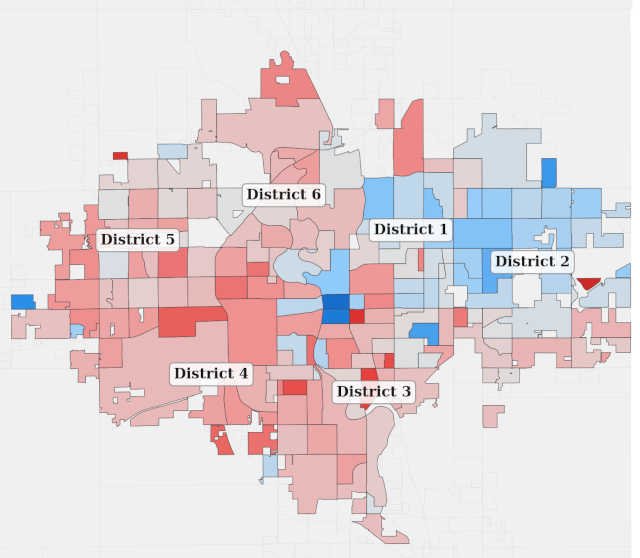
In Wichita, there are three city council positions and the mayorship that are up for election. In district two, (click here for a map of districts), which is primarily the east side of Wichita, incumbent council member Sue Schlapp can’t run again because of the law limiting council members and the mayor to two four-year terms.

In district four — south and southwest Wichita — Paul Gray has also served two terms and can’t run again.

In district five — west and northwest Wichita — incumbent council member and Vice Mayor Jeff Longwell is in his first term and can run again if he chooses. He hasn’t revealed his plans publicly.

Mayor Carl Brewer is also in his first term and can run again. I’ve not heard him reveal his plans.

So far three candidates have publicly declared their intent to run. Former Executive Director of the Sedgwick County Democratic Party Jason Dilts has been actively running for the fourth district position for several months.

In April securities broker and tea party activist Lynda Tyler announced her intent to run in district five against Longwell.

Last week Galichia Heart Hospital CEO Steve Harris threw his hat in the ring for city council district two.

There are others — well-known and not — that are considering running.

Expect these issues to dominate the campaigns: First, downtown development — especially how to pay for it — is likely to be a dominant topic, as the Goody Clancy final plan is scheduled to be completed this fall. We can expect tremendous amounts of campaign funds to be directed to those candidates who favor taxpayer support and subsidy for politically-favored developers.

As many Wichita political and civic leaders speak admiringly of the city sales tax that has funded downtown redevelopment in Oklahoma City, we might even see a sales tax question on the primary or general election ballot.

The issue of taxpayer-funded economic development — whether downtown or elsewhere — may receive discussion too. Both Longwell and Brewer believe that Wichita doesn’t have enough “tools in the toolbox” for dishing out subsidy and tax breaks.

Water is likely to be an issue too, as Wichita’s water rates are going up.

{ 15 comments }

Is there a point where sales taxes become so high that consumers need to be warned?

Sales tax is already high in the northeast Kansas college town of Lawrence, home to the University of Kansas Jayhawks. After July 1, the combined sales tax rate — state, county, and city — will be 8.85 percent.

Lawrence has two districts where an extra one cent per dollar is added to that. Like Wichita, Lawrence is considering creating Community Improvement Districts, where merchants add up to another two cents per dollar in sales tax. The proceeds of that extra sales tax go to the exclusive benefit of the district.

In Lawrence, therefore, the sales tax in some parts of town could reach 10.85 percent. On in round numbers, eleven cents per dollar spent.

That has the mayor and some city council members concerned, according to reporting in the Lawrence Journal-World. According to the article: “Commissioners said they have heard multiple concerns from residents who fear they may buy products at locations without knowing they are paying the extra tax.”

That’s a problem. Most people are generally aware of their state’s sales tax rate, and of that in the city where they live. But shoppers are just starting to realize that different stores in a city may charge different sales tax rates. A Kansas Reporter story has more on this.

So the issue is this: should high-tax zones be required to post signage warning shoppers that they’ll pay more sales tax by shopping there?

Some in Lawrence are worried that the signs are bad for business, both within the high-tax districts, but also for the city as a whole. I think they’re right: taxes — and the realization thereof — are bad for business and consumers.

In Wichita, the only community improvement district approved so far is for a hotel. According to Wichita City Council Member and Vice Mayor Jeff Longwell, the fact that the extra sales tax will be paid almost exclusively by visitors to our city is a wise economic development strategy.

With or without signs warning of high sales tax districts, local shoppers will eventually learn where these districts exist. Our out-of-town visitors, however, probably won’t learn of the high tax rates until they receive their bill. Then, one of two realizations will set in: They’ll either curse themselves for staying at a hotel in a special high-tax district, or they they may form an impression that sales tax is very high in the entire City of Wichita or State of Kansas.

Either way, Longwell’s soak-the-visitors tax strategy isn’t likely to make Wichita many friends.

{ 2 comments }

The recent presentation of the draft master plan for the revitalization of downtown Wichita gave Wichitans a preview of the forms of public assistance that Goody Clancy recommends the city use. The plan may be viewed at the Wichita Downtown Development Corporation website.

It is a given, according to Goody Clancy, that downtown development will require public subsidy. Here’s an example as to why it is necessary: One of the issues with downtown development, especially in Wichita according to Goody Clancy, is “land acquisition & land lease issues.” It is contended that land ownership is fragmented, and assembling parcels for development is difficult. Therefore, public assistance is required.

The shakiness of this argument can be seen by examining recent events in Wichita. Earlier this year, a developer wanted to build a hotel in the downtown WaterWalk area. There are no land acquisition issues there. The city assembled that property — using eminent domain as a tool — some years ago. There is one owner. Yet, the hotel still required massive subsidy to make it economically feasible, according to the developer and Wichita city staff.

In a Wednesday morning workshop on the issue of public funding, a Goody Clancy consultant hinted at a legislative solution to the land acquisition problem. No more details were given, but solutions to problems like this usually involve the use of eminent domain.

Public assistance is proposed to be used only for those items that have a public purpose. The primary use is likely to be public parking. According to the logic of Goody Clancy consultants, if public funds pay for a parking garage located between an apartment building and an office building, that really doesn’t benefit just those two properties. Instead, it benefits everyone. It’s a public amenity. It’s infrastructure.

Nevermind that anywhere but downtown, people have to pay for their own parking. Homeowners build garages and driveways at their own expense. Developers build parking lots on their own.

While “structured parking” — that’s planner-speak for multi-story parking garages — is more expensive to build per parking spot than surface lots, that’s no reason for the public to pay.

The forms of public assistance mentioned as available for use include, at the state and national level: historic preservation tax credits, low income housing tax credits, new market tax credits, STAR bonds, brownfield grants, livable city grants, and transportation funds.

At the local level, programs mentioned include capital investment, tax increment financing (TIF), community improvement districts (CID), facade loans/grants, low interest loan pools, and land.

The last item refers to the fact that Goody Clancy considers it an advantage that the City of Wichita owns a lot of land downtown, as it can control the timing and features of development.

Missing from this list is any mention of a direct tax to fund downtown redevelopment. But downtown leaders admire the city sales tax used to fund development in downtown Oklahoma City, and some have privately told me that a sales tax would be good for downtown Wichita. I expect to see a sales tax proposed in Wichita, as I don’t believe there is enough funding available through the sources mentioned above to do all that downtown boosters will want to do.

Supporters of a sales tax for downtown subsidies will use the Intrust Bank Arena as an example of a successful project funded through a sales tax. They’ll say, as did Kansas Governor Mark Parkinson this year, that people didn’t even notice the one cent per dollar sales tax. It’s harmless, they will contend, despite evidence to the contrary. Not to mention that pronouncement of the arena as a sustainable success story is premature.

Goody Clancy proposes that projects qualify for public assistance through a point system, which is reported on in a Wichita Business Journal article. By meeting established criteria, developers would earn — or not earn — points. Earning a certain level of points would be necessary for the city to consider the application for public assistance, and the number of points earned would help the city justify pouring public assistance into a project. Presumably the point system could help the city rank and prioritize projects that are competing for limited funds.

Further considerations the city would use in deciding which projects to subsidize include, according to the presentation: team experience, financial qualifications, references, project economics, and public/private leverage ratio.

The problem is that any point system the city would use would be a system that meets political criteria, not market criteria. We must realize that the incentives and motivations of politicians and city hall bureaucrats are very different from the incentives and constraints that control behavior in markets. As Gene Callahan explains:

The Public Choice School has pointed out another force … Strong incentives exist for politicians to favor special-interest groups at the expense of the general public. Those upon whom benefits are concentrated are motivated to campaign hard for those benefits.

Specifically, for downtown redevelopment to be successful, we need to have development that is profitable for the private sector, considering all costs. By subsidizing certain developers according to political criteria the city ignores and distorts the dictates of markets, and capital is misapplied. People make decisions for wrong reasons using incorrect information.

While some city council members openly speak of the “free market” with disdain and other members pay it lip service only, we must remember that the free market consists of, in Wichita’s case, hundreds of thousands of consumers making decisions every day about where they want to live, work, and play. These decisions are made based on the individual preferences of each person, supplemented by the information the price system supplies.

The price system is the best way we have to communicate the relative value of things. Hayek explains its importance:

Fundamentally, in a system in which the knowledge of the relevant facts is dispersed among many people, prices can act to coordinate the separate actions of different people in the same way as subjective values help the individual to coordinate the parts of his plan.

The price system is a wonderful, almost miraculous system that, as Hayek writes, coordinates the actions of millions. It allows for the process of economic calculation which is at the heart of capitalism. The lack of economic calculation based on a price system is the reason why socialism fails everywhere it is tried. Callahan summarizes what Mises showed the world:

Mises showed that socialism is incapable of achieving an efficient use of society’s resources, because its economic planners have no means by which to perform economic calculation.

The point system that Goody Clancy proposes to dish out subsidy is a bypass of the price system and economic calculation. It substitutes the judgment of central planners for free people coordinating activities through the price system. Wichitans should reject this idea.

{ 0 comments }

This Friday (June 18) Vicki Pratt Gerbino, president of the Greater Wichita Economic Development Coalition, will address members and guests of the Wichita Pachyderm Club.

The Greater Wichita Economic Development Coalition, also known as GWEDC, is responsible for economic development in the Wichita area, such as recruitment and retention of “economic driver industries” in Wichita and Sedgwick County.

All are welcome to attend Wichita Pachyderm Club meetings. The program costs $10, which includes a delicious buffet lunch including salad, soup, two main dishes, and ice tea and coffee. The meeting starts at noon, although it’s recommended to arrive fifteen minutes early to get your lunch before the program starts.

The Wichita Petroleum Club is on the ninth floor of the Bank of America Building at 100 N. Broadway (north side of Douglas between Topeka and Broadway) in Wichita, Kansas (click for a map and directions). You may park in the garage (enter west side of Broadway between Douglas and First Streets) and use the sky walk to enter the Bank of America building. The Petroleum Club will stamp your parking ticket and the fee will be only $1.00. Or, there is usually some metered and free street parking nearby.

{ 0 comments }

Last October the City of Wichita selected the Boston firm Goody Clancy to develop a plan for the revitalization of downtown Wichita. Now the draft master plan is ready, and will be presented to Wichitans on Monday June 14.

The Wichita Downtown Development Corporation wrote in a message: “The Downtown Master Plan Team has been researching, analyzing the market, listening to the community and incorporating public feedback since November. Goody Clancy will present strategies for achieving the vision, identifying resources and the type of activity and development for Downtown Wichita. Following the presentation there will be a question and answer session with the planning team. People may RSVP for the meeting at info@downtownwichita.org or to (316) 264-6005.”

The event will be on Monday, June 14, at the Scottish Rite Temple at 332 E. 1st Street (northwest corner First and Topeka). The event starts at 5:30 pm with a reception and light refreshments. The actual presentation is from 6:00 pm to 8:00 pm.

The WDDC also announced three planning workshops to be held on Wednesday June 16. The schedule for these are

8:00 am to 9:30 am: Enabling Downtown Development
3:30 am to 5:00 pm: Creating Transportation Choices
5:30 am to 7:00 pm: Creating Unique Places

These events will be held in the Bank of America Theatre at 100 North Broadway, basement level.

The WDDC says: “Following the public meetings on June 14th and 16th, the Downtown Wichita Development Corporation, Visioneering Wichita and the City of Wichita will make presentations to groups throughout the regional community for additional public input. The Downtown Master Plan Team will incorporate the feedback gathered at the June and July presentations. The final plan will be presented in September. To request a presentation, please contact Nancy Moore at 316-264-6005. ”

{ 1 comment }

Yesterday’s meeting of the Wichita City Council featured a lengthy public hearing for a proposed west-side entertainment development known as Bowllagio. Bowllagio is planned to have a bowling and entertainment center, a boutique hotel, and a restaurant owned by a celebrity television chef.

The developers of this project propose to make use of $13 million in STAR bond financing. STAR bonds are issued for the immediate benefit of the developers, with the sales tax collected in the district used to pay off the bonds. The project also proposes to be a Community Improvement District, which allows an additional two cents per dollar to be collected in sales tax, again for the benefit of the district.

The Kansas STAR bond process calls for several steps: First, a local governing body, like the City of Wichita, must approve the concept and set boundaries for the project. This is what yesterday’s agenda item called for. If approved by the council, the Kansas Secretary of Commerce would examine the project to see if it meets statutory criteria. If the Secretary approves the project, the city is then required to prepare a project plan and hold another public hearing concerning whether to adopt the project plan. The project plan must be passed by a two-thirds supermajority of the council.

One of the elements of the project plan, according to the 2010 Kansas Legislator Briefing Book, is a “marketing study conducted to examine the impact of the special bond project on similar businesses in the projected market area.” The effect of Bowllagio on existing Wichita-area businesses was a major source of concern for both council members and citizens speaking at the public hearing.

Speaking during the public hearing, Ray Baty, who is manager of a Wichita bowling center, said Bowllagio is not a new concept, but rather one that would compete with existing programs already in Wichita. The C.A.T.S. system, a training system promoted by Bowllagio developers, is actually a portable system, Baty said.

He contended that introduction of Bowllagio to the market will not grow the market for bowling, but will further divide the existing market, resulting in a loss of revenue and profit for existing bowling centers. He said that bowling centers lose six percent of their customers each year, a trend that he said is national.

Frank DeSocio, owner of several bowling centers in Wichita, told the council that the bowling training promoted by Bowllagio developers already happens in Wichita at the present. He mentioned five full-time bowling teachers and coaches already working in Wichita bowling centers.

He added that Wichita does very well in obtaining and hosting tournaments, mentioning 17 PBA live televised tournaments that took place in Wichita, 10 regional events, a BPA womens’ open, six intercollegiate championships that were televised live, and numerous Kansas state high school championships.

“Everything the Maxwell Group [developer of Bowllagio] claims they want to do is already being done in Wichita by the current bowling centers,” qualifying that he’s speaking only of the bowling side of the Bowllagio proposal, not the restaurants.

In my remarks to the council, I mentioned that Wichita has had examples of restaurants or other establishments being announced — sometimes by the mayor in his annual state of the city address — but then the development failed to materialize. I expressed concern that we might commit to a large amount of STAR bond financing based on big plans that never advance beyond some small initial stage.

Susan Estes told the council that “this is an extremely profound day” for the City of Wichita. She asked will the city help one business owner over another business owner in the same industry? She said that Bowllagio has some unique aspects, but it is a bowling alley. Its other entertainment features are also available in Wichita. We are using tax money to compete against existing businesses, she said.

In response to a question by a homeowner in the project area, the mayor, indicating he believed he speaks for the council, said the council would not support using eminent domain to remove the homeowner from his home.

During discussion by council members, a subject of controversy was whether approving project boundaries and forwarding the application to the Secretary of Commerce constitutes an endorsement of the project by the City of Wichita. Some council members wanted to pass an ordinance that would establish the boundaries of the district, and then have the Secretary decide whether the project meets the statutory requirements for a STAR bond project. Wichita economic development director Allen Bell mentioned that the council’s endorsement of the project might be a factor the Secretary would consider in determining whether to approve the project.

A question from Council Member Lavonta Williams elicited Bell’s further opinion that the Secretary is “looking for a signal from the council” regarding its support for the project. Lack of local support, he added, would be taken in a “negative way.” Council Member Paul Gray agreed with this assessment.

Vice Mayor Jeff Longwell disagreed, saying that all the Secretary needs is a geographic boundary for the proposed project. He contended that the process starts with setting the boundaries, and that other questions are difficult or impossible to answer without doing this. There are too many unknowns, he added, to give this project a formal endorsement at this time.

Longwell also mentioned a report that showed that the south-central region of Kansas, which includes Wichita, receives fewer state economic development funds, relative to population, than the northeast Kansas region. He said we needed to “equal the playing field.”

Longwell said he didn’t want to put together a package that would harm existing businesses, saying he wouldn’t vote for the project if an independent study showed that result would happen.

Council Member Jim Skelton asked about the property taxes the development would pay. Bell replied that the property taxes should increase by a large amount, as the land is vacant now and is planned to receive $95 million of development. He said that while STAR bonds and Community Improvement District financing is proposed for this development, the plan does not include property tax abatements, industrial revenue bonds, tax increment financing, or any other diversion of property taxes.

Council Member Janet Miller asked if the Kansas STAR bond statutes prohibited adding these other types of incentives to the project. The answer, according to Bell, is that these programs could be added on to this development, as has been done in some Kansas STAR bond districts.

Later Miller referred to the “lack of information to make an education decision about the project.” She wondered why the developers would not spend “one-tenth of one percent of their $50 million dollar investment” ($50,000) to produce the studies that would give the council the information it needs to decide whether to send the project to the Secretary of Commerce with its support.

When City Manager Bob Layton suggested a delay to gather more information from the developers, council members readily agreed. Layton said that city staff will visit with the developers, looking for an approach that will make council members comfortable with proceeding, addressing some of the information needs expressed today.

Due to scheduling, Layton said that this matter would need to appear on next week’s agenda, or there would be a one month delay before it could be considered at a council meeting.

The council voted unanimously to defer the item for one week, and to keep open the public hearing.

Analysis

An important issue to many council members is the potential harmful affect of Bowllagio on existing businesses, particularly bowling centers. Miller’s suggestion that the developers spend the money to have an independent assessment of this performed is entirely sensible.

But I don’t think a study of that scope can be performed in one week. As it is now, the city will probably rely on information provided by the developers. It must be recognized that they have a $13 million incentive to produce information favorable to their cause. In his remarks, Gray recognized that proof that Bowllagio will not harm existing businesses will not come from “somebody advocating for the project.” It would require a third-party, independent analysis, he said.

As of now, it is difficult to see how information that will satisfy council members can be produced by next week’s meeting.

In my opinion, the local bowling center operators are justifiably concerned that a subsidized competitor will harm their business. They were able to show that many of the purportedly unique aspects of the Bowllagio concept are already available in Wichita, and have been for some time.

Further, it’s not only direct competitors such as bowling centers that we need to be concerned for. Since the development is proposed to include a Mexican restaurant, what will its impact be on existing Mexican restaurants? And not only restaurants offering that cuisine, but all other restaurants?

In a broader sense, a subsidized business competes with all other businesses in the market for employees and other goods and services that all business firms purchase.

Longwell’s contention that we can still “kill” the project at a later date if reports come back showing negative impact on local businesses is, in my opinion, an empty promise. If the Kansas Secretary of Commerce approves this project, it would be very difficult for the council to vote against Wichita receiving $13 million in state tax dollars, especially in light of Longwell’s argument that the Wichita area doesn’t receive nearly enough of this economic development money.

While council members such as Schlapp say they’re in favor of free markets, she and the other council members nearly always vote in favor of intervention in markets. The fact that the city council members have so many questions about the proposal tells us that this plan is, in fact, a form of centralized planning by government.

As I remarked to the council, developments such as this are portrayed as a success story, in that someone has confidence in Wichita because they’re investing here. But I wonder why these people won’t invest in Wichita unless they receive millions in payments or tax forgiveness from the city, county, school board, and/or state.

Aren’t the real heroes in Wichita the people — many of them small business owners — who invest in Wichita without the benefit of TIF districts, tax abatements, STAR bonds, or other forms of subsidy or incentive?

These people, besides facing subsidized competition, additionally have to pay the taxes that make the subsidies to others possible.

Regarding the mayor’s statement that eminent domain will not be supported for this project: Kansas law does not prohibit the use of eminent domain to acquire property in a STAR bond district (K.S.A. 12-17,172).

If the city wants to assure property owners that their property will not be subject to seizure by eminent domain, the city can add language to that effect in the ordinance. With four city council positions — including the mayorship — up for election next spring, it’s possible that a future city council might not be opposed to the use of eminent domain. This change could take place during the time Bowllagio developers are acquiring property. An ordinance would help prevent this from happening.

Similarly, if it is not the intent of the developers to seek additional forms of subsidy such as tax increment financing or property tax abatements, appropriate language could be added to the authorizing ordinance.

{ 12 comments }

Friday’s groundbreaking of a new Warren Theater and renovation of the existing theater in west Wichita provide an opportunity to revisit some of the public policy issues surrounding Wichita city government and its intervention in the economy in the name of economic development.

Wichita Mayor Carl Brewer and Vice Mayor Jeff Longwell claim that the economic development incentives or subsidies offered to Warren do not cost Wichita taxpayers anything.

Reading comments left to stories at various media outlets, there is definitely a problem with citizens understanding the nature of the city’s industrial revenue bond program. There is no money being lent by the city, as many citizens seem to believe. Instead, the benefit of the program is the escape from paying property taxes and possibly sales taxes. The fact that tax forgiveness is mixed in with a private loan or bond purchase is definitely a source of confusion. The city should seek to simplify this program, if it intends to continue this practice.

But what about the claim that tax forgiveness does not cost other taxpayers? Will the new theater make use of city services such as fire and police protection? Will employees of the theater send their children to public schools? Vice mayor Longwell says that the city is not adding new police officers because of the new theater, so there is no additional cost for police protection. At the margin, that may be true — each additional house or building does not require a new policeman be hired. But at some time, additional city services and personnel will be required.

The city’s practice of liberally granting tax abatements goes against the constant refrain that we must “build up the tax base.” The city’s position is that by “investing” in tax breaks, the city will gain more revenue in the future.

The fallacy of the city’s investment philosophy can easily be seen. When the city grants tax abatements, there is a cost-benefit analysis that accompanies the proposal. The rationale of this analysis that by giving up tax revenue now, more will flow in at some future time.

That’s the source of the fallacy. The return to the city and other governmental units is more tax revenue. Is it the purpose of the city to generate more and more tax revenue? Is it productive to grant one taxpayer favored status so that other hapless taxpayers can be soaked instead?

When a business invests, it does so in order to increase its productive capacity so that it can earn higher future profits, those profits — or losses — being the measure of success of the investment. Government has no ability to calculate profit and loss, and therefore has no way to judge whether its investment has been wise and productive.

There is also, of course, the concept that private business investment is voluntary, while the action the city takes is not voluntary. Citizens must comply.

The companies that receive tax breaks are often prominent companies that ask for large tax abatements. It is worth considerable time and effort — and campaign contributions — for these companies to pursue these benefits. Small companies, however, often don’t fit into the various programs the city has. Instead, they face additional taxes to pay for the taxes the city doesn’t collect when it grants incentives and subsidies.

Recently Alan Cobb wrote of the harm that targeted incentives cause, using Detroit as an example: “While state and local government poured incentives into the Big Three’s trough, the marginal costs of doing business for everyone else crept up.” See Wichita targeted economic development should end.

An aspect of the incentive or subsidy package granted in this case is a fixed, negotiated, growth in property taxes the renovated theater will pay. There are a few points that deserve discussion. First, the base taxable value for the theater is the present value. The theater owner, however, is spending several million dollars on a renovation of that theater. This, according to the Sedgwick County Appraisers Office, would increase the taxable value of the theater by a large amount.

But based on the deal struck with the City of Wichita, this increase in value will not figure into the base taxable value and therefore, will not affect the taxes (PILOT, actually) the theater owner will pay.

Further, the rate of growth in value, 2.3 percent per year, is lower than what might be expected for commercial property to increase in value in many years. This fixed, predictable rate of growth is reminiscent of last year’s Proposition K proposal. The Wichita Eagle rejected this proposal, editorializing: “Over time, this system could result in significant disparities and a disconnect from actual market values, thus likely violating the Kansas Constitution’s requirement of a ‘uniform and equal basis of valuation.’”

But in this case one politically-favored business was able to receive this benefit. These special deals breed justifiable cynicism and distrust of not only City Hall politicians and bureaucrats but businesses that seek this form of pork-barrel spending through the tax system.

Finally, the payments the existing theater will make are not taxes, but payment in lieu of taxes, or PILOT. These payments are different in character from regular property taxes. Instead of falling under the Kansas property tax law regarding payment and possible sale of the property to pay taxes if the taxpayer falls behind for long enough, PILOTS are more in the form of a contract between the city and the taxpayer. If the taxpayer were to fail to pay, the city would have to sue for breach of contract. If the city should prevail in such a suit, it would stand in line with other creditors instead of taking a preferred position as in a tax sale.

This is, of course, assuming the city would choose to pursue such a lawsuit. Nothing would require it to do so. As the city has in the past bailed out this theater owner with a no-interest and low-interest loan, we could easily imagine the city deciding to let these missing or late PILOT payments slide by.

This too assumes that failure to pay PILOT payments as agreed would become public knowledge. The Sedgwick County Treasurer’s office prints lists of delinquent property taxpayers. There is no corresponding list of delinquent PILOT payments.

{ 10 comments }

Southwest Airlines topic of Wichita Eagle article

June 1, 2010

Sunday’s Wichita Eagle carried a story featuring local elected officials’ reaction to the possibility that Southwest Airlines would start service to Wichita.

Read the full article →

Wichita won’t release Southwest Airlines report

May 28, 2010

Research produced for the City of Wichita by a taxpayer-supported university won’t be made available to the public until a later date.

The report, produced by the Center for Economic Development and Business Research at Wichita State University, may provide analysis of the feasibility and economic impact of Southwest Airlines entering the Wichita market.

Read the full article →

North Dakota TIF video informative, reminiscent of Wichita

May 25, 2010

The North Dakota Policy Council has a video on YouTube that explains the mechanics of tax increment financing (TIF) districts and the public policy problems associated with TIF.

Read the full article →

Wichita parks and recreation chief to address Pachyderms

May 24, 2010

This Friday the Wichita Pachyderm Club features as its program Doug Kupper, who is Director of Parks and Recreation for the City of Wichita.

Read the full article →

In Wichita, will Southwest save our city?

May 19, 2010

Talk that low-cost carrier Southwest Airlines might enter the Wichita market has the usual cast of government bureaucrats, centralized planning advocates, and their boosters in a tizzy

Read the full article →

Wichita economic development to be topic of meeting

May 16, 2010

This Monday (May 17), economic development tools and incentives in Wichita will be discussed at a meeting sponsored by the Kansas chapter of Americans for Prosperity.

Read the full article →

Wichita economic development claims deserve scrutiny

May 2, 2010

Reports that Southwest Airlines may be considering adding service in Wichita has lead to enthusiasm for the economic development that this service would add.

Read the full article →

Wichita mayor speaks on economic development

April 27, 2010

At last week’s Wichita City Council meeting, Mayor Carl Brewer spoke in favor of the city’s economic development policy, specifically as it related to a downtown Wichita development partly financed with tax increment financing, or TIF.

Read the full article →

Wichita Exchange Place project passes

April 27, 2010

At today’s meeting of the Wichita City Council, final approval of the city’s involvement in a downtown Wichita development passed.

Read the full article →

On Wichita’s Exchange Place TIF, Janet Miller speaks

April 26, 2010

Last week’s meeting of the Wichita City Council featured a message from Council Member Janet Miller that illustrated her firm belief in centralized government planning for the purposes of economic development. It also contained a material mistake in the understanding of the facts of the project.

Read the full article →

Wichita’s Jeff Longwell on TIF districts, tax abatements

April 23, 2010

Is a tax increment financing (TIF) district a tax abatement? Wichita city council member Jeff Longwell, now Wichita’s vice-mayor, doesn’t think so. During this week’s city council meeting, Longwell said this in explaining his support of a TIF district created for the benefit of Real Development: “One of the things that people I think need to understand is that this is not a tax abatement.”

Read the full article →

Tax increment financing is not free money

April 19, 2010

Cato Institute Senior Fellow Randal O’Toole has written extensively on the subject of urban planning, development, and tax increment financing (TIF) districts. The following article contains many points that the Wichita City Council may wish to consider as it considers expansion of a downtown Wichita TIF district at tomorrow’s council meeting.

Read the full article →

Wichita proposed tax increment financing district subject of news

April 18, 2010

Today’s Wichita Eagle carries two news stories regarding the proposed expansion of a downtown Wichita tax increment financing (TIF) district. The front-page story Condo vote key to downtown Wichita growth and the additional story Owners report mixed views of developers provided background on the vote the Wichita City Council may make at Tuesday’s 9:00 am meeting.

Read the full article →

Taxpayer-funded development in Wichita opposed

April 18, 2010

After the formal presentation I personally complemented the Minnesota Guys and thanked them for what they were doing downtown. They assured me that their redevelopment work in our downtown would be completed without government incentives, and I assured them that they would have my support as long as they stayed out of the public treasury.

Read the full article →

Tax increment financing questions topic at Wichita city council meeting

April 15, 2010

On Tuesday the Wichita city council heard a request by Real Development for a $2.5 million increase in tax increment financing on a downtown project. Discussion during the meeting revealed how little is known about the numbers that the city uses in deciding whether to participate in the project. Numbers that don’t make sense, plus the fact that the applicant has not responded to the city’s request for new numbers, indicate that this proposal should be rejected.

Read the full article →

Wichita Larksfield Place bonds should not be issued

April 13, 2010

Today’s meeting of the Wichita city council will have a public hearing concerning the issuance of health care facilities revenue bonds for Larksfield Place, a decidedly high-end retirement and assisted living center in east Wichita.

Read the full article →

Wichita Exchange Place TIF should be rejected

April 12, 2010

Tomorrow’s meeting of the Wichita city council will feature a public hearing as to whether a tax increment financing district that benefits Real Development should be modified.

Read the full article →

Wichita city hall silent on handling of ethics issue

April 11, 2010

On Tuesday the Wichita city council will hold a public hearing regarding a request by Real Development for a $2.5 million increase in tax increment district financing. While this proposal should be opposed on its merits, there is reason to give extra scrutiny to this matter. That’s because Real Development employs the services of Wichita public relations executive Beth King. What matters to public policy is that last year she and Wichita City Manager Robert Layton began a dating relationship which continues to the present.

Read the full article →

Wichita community improvement district questions unanswered

April 8, 2010

This week the Wichita city council approved the use of Community Improvement Districts. These districts are a new creation of the Kansas legislature from last year.

Read the full article →

Wichita economic development incentives discussed

April 6, 2010

At today’s meeting of the Wichita city council, economic development incentives were a topic of discussion.

Read the full article →

Wichita targeted economic development should end

April 5, 2010

Is the City of Wichita able to choose which companies are worthy of taxpayer assistance for the purposes of economic development?

Read the full article →

Wichita Warren Theater IRB a TIF district in disguise

April 4, 2010

On Tuesday the Wichita City Council will consider an economic development incentive for a local business. The process the city is using to grant this incentive bypasses the scrutiny that accompanies the formation of TIF districts while providing essentially the same benefit.

Read the full article →

Will the real robber barons please stand up?

March 30, 2010

At the April 13th meeting of the Wichita City Council a request from downtown developer Real Development will be made for an additional $2.2 million taxpayer subsidy for its condo project Exchange Place, located at Douglas and Market. With two weeks to go before this public hearing there is still time for council members to read The Myth of the Robber Barons by Burton Folsom. Folsom’s easy-to-read 134-page narrative lays out the case for entrepreneurship in America and can be read in one evening. It’s a history lesson worth reading by all.

Read the full article →

Detroit, corporate welfare and Wichita’s future

February 28, 2010

Recently The Eagle printed an article by Molly McMillin, a well-respected aviation and business reporter.

The question asked throughout the article is one that Wichita leaders and citizens have been asking for some time: What can we do to prevent Wichita from falling into the hole that is Detroit?

A simple answer is to continue throwing money and other goodies to keep the aviation companies. A better answer is we need to get rid of the notion that our elected officials and others have so much forethought to know what will or won’t be successful in 20 or 50 years. They don’t.

Read the full article →

Destination ICT rollout presents a look at the future of Wichita

February 23, 2010

Yesterday Rebecca Ryan of Next Generation Consulting presented “Destination ICT.” This is a program designed to “attract and retain talent to Wichita.” It’s sponsored by Young Professionals of Wichita which is an initiative of the Wichita Metro Chamber of Commerce.

Read the full article →

David Burk, Wichita developer, overreaches

February 14, 2010

Today’s Wichita Eagle contains a story about a well-known Wichita real estate developer that, while shocking, shouldn’t really be all that unexpected.

The opening sentence of the article (Developer appealed taxes on city-owned property) tells us most of what we need to know: “Downtown Wichita’s leading developer, David Burk, represented himself as an agent of the city — without the city’s knowledge or consent — to cut his taxes on publicly owned property he leases in the Old Town Cinema Plaza, according to court records and the city attorney.”

Some might say it’s not surprising that Burk represented himself in the way the Eagle article reports. When a person’s been on the receiving end of so much city hall largess, it’s an occupational hazard.

Read the full article →