From the category archives:

Education

One of the problems with forming public policy is the lack of information possessed by the general public, and, sometimes, even by elected officials. A recent research report published by the Hoover Institution titled Educating the Public measures the problem.

Importantly, this report shows the changes in people’s attitudes after they receive correct information.

I’ve experienced the lack of information about basic facts myself. Last year a colleague and I conducted some “man-on-the-street” interviews during the bond issue campaign. Very few people knew how much the Wichita school district spent. Most estimated levels of spending less than half of actual spending.

It’s not just the public. Elected officials like Rep. Melody McCray-Miller and Wichita school board member Lanora Nolan have disputed the total amount of spending by the Wichita school district when presented with the actual figures.

The following excerpt from the press release gives more information.

When Provided with Accurate Information, Public Support for Increased Spending on Schools and Teacher Salaries Declines, Researchers Find

Cambridge — The better informed people are, the more likely they are to oppose increased school spending. That is a key finding in a newly released survey, “Educating the Public,” conducted by Education Next and the Program on Education Policy and Governance (PEPG) at Harvard University. The survey is posted on the Education Next website: www.educationnext.org. (The direct link to the study is Educating the Public.)

Survey results indicate that if the public is given accurate information about what is currently being spent on public schools, their support for increased spending and their confidence that more spending will improve student learning both decline. Education researchers William G. Howell of the University of Chicago and Martin R. West of Brown University also found that knowing how much the average teacher earns lowers support among the general public for salary increases.

To understand how public opinions shift, Howell and West embedded a series of experiments within the Education Next/PEPG survey by dividing respondents into randomly chosen groups: some were simply asked their opinion about school spending and teacher salaries, while others were first provided with accurate information about each of these issues.

The average per-pupil spending estimate from respondents to the 2008 Education Next/PEPG survey was $4,231, and the median response was just $2,000; but for these respondents, local average spending per pupil at the time exceeded $10,000. When told how much the local schools were spending, support for increased spending dropped by 10 percentage points, from 61 percent to a bare majority of 51 percent.

Howell and West find that these differences in opinion based on exposure to key information are consistent across a wide range of socioeconomic backgrounds, views about the local public schools, and political ideologies.

“It’s clear that the American public is quite willing to update its views in light of new information about public schools,” Howell and West said.

Interestingly, note Howell and West, differences also appear among teachers, whom one might believe already have deeply entrenched and well-informed views about public education. Whereas 35 percent of teachers not specifically informed of spending levels claimed that spending should “greatly increase,” only 22 percent of those who were told the amount of money spent to educate a child in their district thought so. Additionally, 29 percent of uninformed teachers expressed strong confidence that increased spending would boost student learning. When exposed to the current spending in their district, however, that confidence dropped by 9 percent.

As with per-pupil expenditures, the public significantly underestimates how much their states pay public school teachers. On average, Education Next/PEPG survey respondents underestimated average teacher salaries in their state by more than $14,000, nearly one-third of the actual average salaries of $47,000.

  • Facebook
  • Twitter
  • Delicious
  • LinkedIn
  • Technorati Favorites
  • Digg
  • Share/Bookmark

{ 1 comment }

The inevitability of parental choice

by Bob Weeks on June 4, 2009

in Education

By Howie Rich

A year ago, the nation’s largest newspaper wrote in an editorial that it was time to “move beyond vouchers” in the debate over America’s educational future.

Although it did not reject any particular solution outright, the paper’s recommendation at the time was that America focus its energy and attention on less controversial education reforms. In other words, it was a victory for those who have spent years — and expended untold taxpayer resources — in an effort to demonize parental choice and its supporters.

Then, two weeks ago, USA Today suddenly changed its tune.

Not only did the paper enthusiastically embrace parental choice — it also roundly criticized our nation’s teachers’ unions for “protecting failing schools.”

“Twenty million low-income school kids need a chance to succeed,” the USA Today editorial board wrote. “School choice is the most effective way to give it to them.”

What caused the turnaround?

While there’s certainly no shortage of reasons, the initial impetus for the shift appears to stem from President Barack Obama’s rank hypocrisy in closing an effective parental choice program in Washington D.C. to new applicants.

“Teacher unions, fearing loss of jobs, have pushed most Democrats to oppose vouchers and other options that invite competition for public schools,” the USA Today editorial board wrote. “Put another way, they oppose giving poor parents the same choice that the president himself — along with his chief of staff and some 35% of Democrats in Congress — have made in sending their children to private schools.”

Of course, it’s not just about failing schools and low-income students. It’s about giving all parents a choice in their child’s academic future, no matter where they live.

With each passing day, the mountain of evidence attesting to the futility of our nation’s failed status quo grows higher. Correspondingly, in those rare instances where choice has been permitted to take root and flourish, its success is undeniable.

According to the most recent data from the Organisation for Economic Cooperation and Development (OECD), America’s per pupil expenditure on public education is the highest of any industrialized nation in the world.

Unfortunately, we are not receiving anywhere near a commensurate return on our investment.

On the most recent Program for International Student Assessment (PISA) test, American students scored well below the average of other industrialized nations on both the math and science portions of the exam – just as they did the last time the tests were administered. And the time before that.

And in a telling nod to the sort of institutional incompetence that has long plagued our public system, America’s reading scores on the most recent PISA exam had to be thrown out due to a printing error by the company that the U.S. Department of Education hired to administer the tests.

But our crisis is much bigger than poor standardized test results and bureaucratic errors. Over 12,000 schools across America currently rate as failing or below average — with hundreds of thousands of children trapped inside of them. Of course, each year when organizations like “Teach for America” try to place talented, highly-motivated college graduates in teaching positions within higher-risk school districts, their efforts are always rebuffed by the unions.

Each year, the purveyors of this country’s education monopoly continue failing children at a record clip – and yet in a perfect example of precisely what’s wrong with our system, they are rewarded for their poor performance with additional taxpayer resources.

In fact, according to President Obama’s plan — the more children you fail, the more money you get.

This self-perpetuating cycle serves no one. It doesn’t serve our children, it doesn’t serve their parents, and it doesn’t serve the best interests of our country.

Nor are we well-served by pretending that our “average” public schools are meeting the needs of most middle income children.

In an increasingly competitive global economy, we cannot afford to maintain a failed status quo on one hand and mediocrity on the other.

USA Today’s acknowledgment of this fact – and its support for parental choice – is yet another example of the inevitable march toward a system of education that promotes true academic achievement, a system built around a competitive, parent-driven marketplace where schools are held accountable for their performance.

The author is Chairman of the Parents in Charge Foundation.

  • Facebook
  • Twitter
  • Delicious
  • LinkedIn
  • Technorati Favorites
  • Digg
  • Share/Bookmark

{ 0 comments }

School choice is a civil rights issue

by Bob Weeks on June 4, 2009

in Education

Why does America tolerate this?

In his commentary Dumbest Generation Getting Dumber, Walter E. Williams reports on some new research about our public schools:

McKinsey & Company, in releasing its report “The Economic Impact of the Achievement Gap in America’s Schools” (April 2009) said, “Several other facts paint a worrisome picture. First, the longer American children are in school, the worse they perform compared to their international peers. In recent cross-country comparisons of fourth grade reading, math, and science, US students scored in the top quarter or top half of advanced nations. By age 15 these rankings drop to the bottom half. In other words, American students are farthest behind just as they are about to enter higher education or the workforce.” That’s a sobering thought. The longer kids are in school and the more money we spend on them, the further behind they get.

Williams reports that for black and Latino students, the situation is far worse, with these students being two or three years behind in learning. It’s such a problem that even traditional black leadership is noticing:

Al Sharpton called school reform the civil rights challenge of our time. He said that the enemy of opportunity for blacks in the U.S. was once Jim Crow; today, in a slap at the educational establishment, he said it was “Professor James Crow.” Sharpton is only partly correct. School reform is not solely a racial issue; it’s a vital issue for the entire nation.

We need the type of competition in education that school choice provides. In Kansas, the public school lobby — firmly opposed to even the gentlest of reforms such as charter schools — retains its firm grip.

Wichita and Kansas schools claim years of rising test scores. But when we get test results that the Kansas school bureaucracy doesn’t control, we find that test scores are flat. There’s a discrepancy there that needs investigation.

In the meantime, schoolchildren, especially minority children, remain stuck in a failing system.

  • Facebook
  • Twitter
  • Delicious
  • LinkedIn
  • Technorati Favorites
  • Digg
  • Share/Bookmark

{ 1 comment }

Education reformer to speak in Wichita

by Bob Weeks on May 11, 2009

in Education

Noted education activist and reformer John Taylor Gatto will be appearing in Wichita on May 22.

Gatto will present an insider’s perspective on problems within public schools.

He is the author of The Underground History of American Education: A Schoolteacher’s Intimate Investigation Into the Problem of Modern Schooling, which may be read online at the preceding link.

The event will be held at Northfield School of the Liberal Arts, 701 E. 37th St. North in Wichita. The time is Friday May 22, at 10 a.m.. (Click on a Google map to the location.)

  • Facebook
  • Twitter
  • Delicious
  • LinkedIn
  • Technorati Favorites
  • Digg
  • Share/Bookmark

{ 0 comments }

In voucher debate, who can we believe?

by Bob Weeks on February 12, 2009

in Education

Two articles appearing close together in the same prominent newspaper illustrate the problem in trying to make sense of school choice programs.

These articles are Voucher plan would help sponsor, not students (February 4, 2009 Atlanta Journal-Constitution), which is opposed to vouchers, and Will School vouchers improve public education? Yes: New studies show all students’ scores rise (February 12, 2009, same newspaper).

Here’s an example: The pro-voucher article contains these paragraphs:

A second 2008 study, this one by the Federal Reserve Bank of New York, analyzed two phases of the Milwaukee voucher program and showed student achievement increased with the availability of school choice.

When the Milwaukee program was initially launched between 1990 and 1996, there were never more than 1,500 students using a voucher. That’s because the state forbade children from using the scholarship to attend a religious school, and the voucher amount was very small.

After Wisconsin court rulings declaring vouchers constitutional, changes were made to the program. Milwaukee pupils were then allotted a $4,900 voucher and could apply that to a secular or religious school of their parents’ choice. That enabled more families to participate in the program.

The New York Fed study found no effects of vouchers —- positive or negative —- on any students when the Milwaukee voucher program did not provide much competition or choice. However, once students were given larger voucher amounts, once students could choose from a variety of schools, and once public schools actually faced competition, then students using the vouchers and students who remained in public school both earned higher test scores. This study confirms a 2003 study on this topic by Stanford University economist Caroline Hoxby. (emphasis added)

From reading this, you’d conclude that vouchers are good for all students, for both those who use a voucher, and those who don’t.

Then, read this in the anti-voucher article:

An ongoing five-year examination of the nation’s oldest voucher program, the Milwaukee Parental Choice Program, uncovered little difference in test scores between voucher recipients and their public school counterparts …

It’s difficult to reconcile these two authors. Both pieces present additional conflicting evidence to support their authors’ position.

The author of the anti-voucher article accuses a supporter of vouchers in Georgia of “[proposing] to dismantle public education.” If your goal is to preserve public education at all costs, then I suppose that vouchers and other school choice programs are a threat. These programs, however, don’t threaten publicly-funded education. They do, however, pose a risk to the power of the existing education bureaucracy and teachers unions, and that’s why newspaper editorialists — allies to these forces — continue to oppose school choice programs.

  • Facebook
  • Twitter
  • Delicious
  • LinkedIn
  • Technorati Favorites
  • Digg
  • Share/Bookmark

{ 1 comment }

Stimulus bill payoff to wrong education interests

by Bob Weeks on February 8, 2009

in Education

The Wall Street Journal analyzes some of the earmarks in the stimulus bill, and finds that specific provisions for spending are going to be wasted — except that they payoff special interests:

“The Milwaukee Public School system, for example, would receive $88.6 million over two years for new construction projects under the House version of the stimulus — even though the district currently has 15 vacant school buildings and declining enrollment. … The Milwaukee situation is instructive for another reason. The city is home to the country’s oldest and largest school voucher program, which provides public funds for children to attend private schools. … Yet language in the stimulus bill expressly prohibits any dollars from going toward financial assistance to students attending private schools. In other words, Milwaukee can use the money to build schools it doesn’t need, but not to expand education programs that are producing better outcomes for disadvantaged kids. … That $142 billion is little more than a huge stimulus to the teachers unions and lousy school districts to keep doing exactly what they’ve been doing.”

See A Spending Education: Milwaukee gets money for unneeded schools.

  • Facebook
  • Twitter
  • Delicious
  • LinkedIn
  • Technorati Favorites
  • Digg
  • Share/Bookmark

{ 0 comments }

Is 65 Percent the Solution?

by Bob Weeks on January 22, 2009

in Education

At the Kansas Education blog, a post titled Is 65 Percent the Solution? examines some of the arguments and policy considerations surrounding the popular proposal that schools must spend at least 65 percent of their funds in the classroom.

Whatever that — “in the classroom” or on “instruction” — means. And that’s part of the point. Determining what counts as expenditures in the classroom versus (allegedly wasteful) administration is somewhat arbitrary.

Besides — and the post mentions this — markets provide a powerful incentive for firms to operate not only efficiently, but effectively, too.

I believe that market competition provides the incentive and imperative for firms to organize themselves in the way that will best meet the needs of their customers. Under market competition, it might turn out that in some cases, under some circumstances, it might be best for students if more was spent on administration and management. Laws that dictate how school funds should be spent would prevent this discovery from being made.

The public schools, isolated from competition, don’t face these incentives. They organize themselves based on their own needs rather than the needs of their customers. I don’t think there’s much way to change that except for schools to face market competition, and they resist that in every way.

  • Facebook
  • Twitter
  • Delicious
  • LinkedIn
  • Technorati Favorites
  • Digg
  • Share/Bookmark

{ 0 comments }

Jay P. Greene discusses a news study examining charter schools:

The researchers look at whether attending a charter high school in Chicago and Florida increases the likelihood that students would graduate high school and go on to college. The short answer is that it does. … This study comes on the heels of positive results from Caroline Hoxby’s random-assignment evaluation of charter schools in New York City.

Read Greene’s entire analysis of the study (and find a link to the study itself) in his post Charter School Students More Likely to Graduate High School, Attend College.

  • Facebook
  • Twitter
  • Delicious
  • LinkedIn
  • Technorati Favorites
  • Digg
  • Share/Bookmark

{ 0 comments }

Charter Schools Can Close the Education Gap

by Bob Weeks on January 13, 2009

in Education

We don’t have these, to my knowledge, in USD 259, the Wichita public school district, and there are very few in Kansas. Across the country, however, charter schools are making a difference, particularly in addressing the needs of urban and high-poverty students.

Joel I. Klein, chancellor of the New York City Department of Education, and Rev. Al Sharpton, president of the National Action Network, wrote an open letter to president-elect Barack Obama in the Wall Street Journal. In it they “second [his] belief that school reformers must demonstrate an unflagging commitment to ‘what works’ to dramatically boost academic achievement — rather than clinging to reforms that we ‘wish would work.’”

The coalition these two writers formed, the Education Equality Project (EEP), seeks to greatly narrow, if not eliminate, the achievement gap. It seeks to do so by what turns out to be a radical measure: “EEP seeks to ensure that America’s schools provide equal educational opportunity, judged by one measuring stick: Does a policy advance student learning? It’s an obvious litmus test. Yet the current K-12 school system is designed to serve the interests of adults, not children.”

How can this be radical — advancing student learning? Isn’t that what schools should be doing?

The reform paths that most public schools take are not ones that work. The characteristics of teachers, it turns out, is the most important factor in learning. (See Wichita Public School District’s Path: Not Fruitful for more.)

“Finally, our coalition also promotes the development and placement of effective teachers in underserved schools and supports paying them higher salaries. By contrast, we oppose rigid union-tenure protections, burdensome work rules, and antiquated pay structures that shield a small minority of incompetent teachers from scrutiny yet stop good teachers from earning substantial, performance-based pay raises.”

In Wichita, it appears that there are no proposals to pay teachers based on factors that make a difference in student learning. Instead, pay is based solely on education credentials earned and longevity — two factors shown to make no difference in student leaning. (Some researchers report a negative correlation between these factors and student learning.) Even a proposal a few years ago to offer teachers working in high-poverty schools a $1,500 bonus went nowhere.

The Wall Street Journal article is Charter Schools Can Close the Education Gap.

  • Facebook
  • Twitter
  • Delicious
  • LinkedIn
  • Technorati Favorites
  • Digg
  • Share/Bookmark

{ 0 comments }

Video Reveals Uninformed Citizenry

by Bob Weeks on December 10, 2008

in Education

Utah Education Facts has released a video that illustrates the startling lack of information possessed by the average citizen. This video was made in Utah and uses Utah’s facts, but I’ve made some similar videos in Wichita, and the results are similar.

People are mostly uninformed about basic facts. School districts use this to their advantage in order to push through their agendas. Citizens naively assume that everything their school district does is “for the children.”

Here’s a link to the video: How much do we know about our education system?

  • Facebook
  • Twitter
  • Delicious
  • LinkedIn
  • Technorati Favorites
  • Digg
  • Share/Bookmark

{ 1 comment }

Obama Deserves a Scarlet “H” for Hypocrisy

by Bob Weeks on November 25, 2008

in Education

At the Goldwater Institute, Clint Bolick exposes Barack Obama as another in a long line of politicians that deny school choice to the masses, but exercise it themselves:

During the campaign, Obama stated that school choice doesn’t work. If he believes that, why not simply send the girls to whatever school the District of Columbia bureaucracy happens to assign them to?

The answer is obvious: As a parent, Obama knows that school choice does work. And studies show it especially works for low-income families, not only expanding precious educational opportunities for children in failing schools but also boosting performance of low-performing public schools by forcing them to compete for students and dollars.

(From Obama deserves a scarlet “H” for hypocrisy.)

Linda Chavez writes on the same topic in Obama’s School Choice.

  • Facebook
  • Twitter
  • Delicious
  • LinkedIn
  • Technorati Favorites
  • Digg
  • Share/Bookmark

{ 0 comments }

Obama’s Education Transformation

by Bob Weeks on November 20, 2008

in Education

At one time it seemed like Barack Obama might be an education reformer. He was actually booed when speaking before the National Education Association for his support of merit pay for teachers. But after observing Obama’s recent actions, Liam Julian, writing in the National Review Online piece Hoping for Change in Education? comes to this conclusion: “So far, it seems, tradition trumps change.”

  • Facebook
  • Twitter
  • Delicious
  • LinkedIn
  • Technorati Favorites
  • Digg
  • Share/Bookmark

{ 0 comments }

This press release spotlights the fact that charter schools operate much more efficiently than to public schools. Kansas could save money and increase parent satisfaction if our state had more charter schools. The education establishment in Kansas — the teachers unions, administrators, and school boards — are happy with as few charter schools as possible, and they spend significant sums lobbying for laws that suppress charter schools. Meanwhile, students, parents, and taxpayers suffer.

Buckeye Institute Study: Public Charter Schools Help Students and Save Tax Dollars

Columbus — The Buckeye Institute today released a study showing public charter schools provide a great value to Ohio’s K-12 education system. Report co-authors Matthew Carr and Beth Lear found closing existing public charter schools will result in reduced per pupil spending levels in each of the “Big 8″ city school systems. Significant property tax increases would be required to maintain current per student funding levels.

The report examined the financial impact of public charter schools on the finances of nearby traditional public schools. Specifically, it analyzed the implications for taxpayers in each of Ohio’s “Big 8″ city school systems if the charter school program were discontinued and all students returned to their residentially assigned traditional public schools.

The study is available at http://www.buckeyeinstitute.org/charterschools.pdf.

“The public relations war against educational choice by Ohio’s government school bureaucracy has often focused on how alternative schools are financed,” report co-author Matthew Carr said. “Our research carefully examined claims made regarding public charter school finance and its financial impact on nearby traditional public school districts.”

“Public charter schools are not funded by local property tax dollars,” co-author Beth Lear added. “This fact is often overlooked by school choice opponents. Our findings should help inform the ongoing educational choice debate.”

The report’s major findings include:

Ohio’s public charter schools do not, in any instance, receive funds raised by school district property taxes.

Public charter schools operate with substantially less revenue per student in each of the “Big 8″ city school systems. The largest difference is in Youngstown, where charter schools operate with an average of $7,126 less per student. The smallest difference is in Canton, where charter schools operate with an average of $1,809 less per student.

Every “Big 8″ city school system receives a net gain in revenue, on average, for each student choosing to attend a charter school. The largest gains are in Cincinnati, where each student departing for a charter school provides the district an increase of $4,030. The smallest gains are in Canton, where each student departing for a charter school provides the district an increase of $918.

The return of public charter students to each “Big 8″ city school district would result in a net per pupil loss of revenues for the district. As a result, these districts would face either lower per pupil spending levels or significant property tax increases to maintain current spending levels. The largest tax increase would be required in Youngstown (roughly $3,200 per $100,000 of home valuation). The smallest increase would be required in Akron (roughly $300 per $100,000 of home valuation).
“Big 8″ refers to Akron, Canton, Cincinnati, Cleveland, Columbus, Dayton, Toledo and Youngstown city schools. The Buckeye Institute for Public Policy Solutions is a nonpartisan research and educational institute devoted to individual liberty, economic freedom, personal responsibility and limited government in Ohio.

  • Facebook
  • Twitter
  • Delicious
  • LinkedIn
  • Technorati Favorites
  • Digg
  • Share/Bookmark

{ 0 comments }

A recent Wichita Eagle Editorial Blog post mentioned charter schools in Arizona. A comment writer wrote “Arizona found out, ‘Charter schools tend to be fly by night’ schools operated by entrepreneurs looking for new profit centers at the giant expense of the public school system.”

I looked for evidence that Arizona had trouble with charter schools. I found an Education Week article from 2004 (Progress, Problems Highlighted In Arizona Charter Study) which seems to present balanced news about Arizona charter schools.

It appears that there have been a few problems with charter schools. Certainly not a tendency, as the comment writer suggested.

In fact, it would be difficult to imagine that there could be widespread dissatisfaction with charter schools that would last for any length of time. That’s because, even though charter schools are still government schools, the students that attend them are there by choice. And if the charter school doesn’t meet their needs, they have another choice: return to the regular public school system.

Contrast this with the existing public school system. It operates, at least in Kansas, with a government-granted monopoly on the use of public funds for the provision of schooling. Parents who are not satisfied with these schools have little recourse unless they have enough money to move somewhere else, or unless they can afford private or parochial school tuition — and they’ll still have to pay to support a system they now realize they can’t use.

This type of monopoly power is considered unjust and immoral when wielded by private industry, but is somehow acceptable when possessed by government.

This leads to another complaint expressed, obliquely, by the comment writer: these charter schools are looking to make a profit! I wonder if this writer knows that in the absence of a government-granted monopoly of the type that the public schools in Kansas enjoy, the only way a business can earn a profit is by satisfying customers, and doing so efficiently. And businesses have to earn that profit. They have no guaranteed source of revenue, as do government agencies. They have no stream of customers forced to use their service, as do the public schools.

Finally, the comment writer states that charter schools operate at the “giant expense of the public school system.” Two points: Charter schools are part of the public school system. They could be in Kansas, if we had a better charter school law. Also, charter schools typically receive much less funding per student than do the regular public schools. They almost always operate more efficiently, and therefore save money.

  • Facebook
  • Twitter
  • Delicious
  • LinkedIn
  • Technorati Favorites
  • Digg
  • Share/Bookmark

{ 17 comments }

School Choice Resource Center Now Open

by Bob Weeks on September 24, 2008

in Education

I’ve created a small portal of information and links about school choice. I hope to expand this as I become aware of more school choice resources and success stories. Particularly, I want to include more information about school choice initiatives in Kansas.

The link to the page is here: School Choice Resource Center.

  • Facebook
  • Twitter
  • Delicious
  • LinkedIn
  • Technorati Favorites
  • Digg
  • Share/Bookmark

{ 0 comments }

A Monopoly by Any Other Name

August 16, 2007

What’s in a name? Apparently, to a government school monopoly, it’s everything.

Last month, Pittsburgh Public Schools announced the district would be dropping the word “Public” from its name in order to avoid the negative connotation often associated with public schools. A paid marketing consultant helped develop the plan, which will also result in renaming the individual schools themselves.

Read the full article →

Adjusting the Testing Gap

June 20, 2007

In the July 25, 2006 Wall Street Journal Charles Murray has a commentary titled “Acid Tests” which describes how the way that the No Child Left Behind program uses test scores is misleading. Actually, misleading is too mild a word. The subtitle of Murray’s article is “No Child Left Behind is beyond uninformative. It is deceptive.”

How are the performance measures that are the yardstick of the success of No Child Left Behind deceptive? By adjusting what states use to measure “proficiency,” states can appear to be closing the gap between different groups of students. In Texas, the gap between the percentage of white and black students that passed a test was at one time 35 percentage points. Now it is only ten. Does that mean the gap in true student learning and performance has decreased?

The answer, Murray says, is we can’t tell from the data we have. Perhaps Texas made the test easier, or changed the definition of passing, or “taught to the test.” Any of these could explain the narrowing of the gap. As Mr. Murray wrote: “If there really was closure of the gap, all that Texas has to do is release the group means, as well as information about the black and white distributions of scores, and it will easy to measure it.”

The fact is that these tests, administered by the individual states, are subject to manipulation that is not in the best interests of schoolchildren:

Question: Doesn’t this mean that the same set of scores could be made to show a rising or falling group difference just by changing the definition of a passing score? Answer: Yes.

At stake is not some arcane statistical nuance. The federal government is doling out rewards and penalties to school systems across the country based on changes in pass percentages. It is an uninformative measure for many reasons, but when it comes to measuring one of the central outcomes sought by No Child Left Behind, the closure of the achievement gap that separates poor students from rich, Latino from white, and black from white, the measure is beyond uninformative. It is deceptive.

You can learn more about deceptive testing from a recent study performed by The Civil Rights Project at Harvard University. A press release titled “Testing the NCLB: Study shows that NCLB hasn’t significantly impacted national achievement scores or narrowed the racial gaps” is at http://www.civilrightsproject.harvard.edu/news/pressreleases/nclb_report06.php.

The Charles Murray article may be read here: http://www.opinionjournal.com/editorial/feature.html?id=110008701

Read the full article →

Curious Logic

March 22, 2007

There’s something about our nation’s capital that converts many leading Democrats to school choice. But in most cases this extends only to their own children — not to the millions of children in failing public schools.

Read the full article →

Bureaucracy vs. something that works

February 3, 2007

Here’s how the education bureaucracy and teachers unions won out over students in the creation of the No Child Left Behind Act:

Read the full article →

Market forces and teacher (mis)-education

January 30, 2007

In a system governed by market forces, teacher pay would be based on how well students learn, not how many superfluous degrees teachers accumulate

Read the full article →

Minimum wage price controls hurt Kansas

December 7, 2006

This article presents compelling evidence that raising the minimum wage is not in the best interests of low-wage workers.

Read the full article →

Adjusting the testing gap

July 25, 2006

Charles Murray has a commentary titled “Acid Tests” which describes how the way that the No Child Left Behind program uses test scores is misleading.

By adjusting what states use to measure “proficiency,” states can appear to be closing the gap between different groups of students. In Texas, the gap between the percentage of white and black students that passed a test was at one time 35 percentage points. Now it is only ten. Does that mean the gap in true student learning and performance has decreased?

Read the full article →

Even the New York Times recognizes testing fraud

July 3, 2006

A New York Times editorial titled “The School Testing Dodge” realizes that nearly all states report student achievement scores, as measured by their own tests, that are much higher than what the same students do on the federal National Assessment of Educational Progress exam.

Read the full article →

No Child Left Behind Leaving Many Behind

May 11, 2006

Recently an Associated Press article reported how the test scores of some two million children aren’t being counted, due to a loophole in the No Child Left Behind Act. (See ‘No Child’ loophole misses millions of scores at CNN, April 18, 2006.)

Read the full article →

A declaration of independence from public schools

March 13, 2006

Mary Moberly, a young woman just 15 years old, wrote this piece. She lives in Manhattan, Kansas. I have been reading her two websites for the past few months, ever since I saw that she referred to a post on this website.

If you look at her two websites, Tea and Crumpets Zine and Just Go Boil Something, you will discover her wide-ranging interests and accomplishments, both remarkable for someone so young. I particularly recommend her essay What Makes a Well-Educated Person?

Read the full article →

School choice helps those best who have least

March 8, 2006

An article in the March 2, 2006 Wall Street Journal by Katherine Kersten of the Minneapolis Star Tribune tells of the large numbers of African-American families in Minneapolis who send their children to charter schools or to schools in other districts, thanks to Minnesota law that allows district-crossing.

Read the full article →

The wonderful and frightening uncertainty of competition

March 2, 2006

Take education. Bureaucrats like to say, you will go to this school, because we said so, and you will be taught according to this program, because we said so and we know best. Those of us with confidence in markets think you could do better deciding for yourself. Neither the bureaucrats nor the freedom lovers can judge what’s in your interest better than you can. One big difference is, we know what we don’t know, while they think they know everything.

Read the full article →

Schoolchildren Will Be Basically Proficient

March 1, 2006

A few months ago I wrote how most states, when testing their schoolchildren, post results such as “80% of our state’s students are proficient in reading or math,” but when tested by the National Assessment of Educational Progress (NAEP), the number judged proficient falls to 30% or so. (See Every State Left Behind.) It was noted that local education officials are eager to tell parents and taxpayers that students are doing well. The NAEP test hasn’t felt such pressure.

Now a commentary in the February 27, 2006 Wall Street Journal by Chester E. Finn, Jr. and Diane Ravitch tells us that under No Child Left Behind (NCLB), which uses the NAEP tests — not the state tests — to measure student progress, there is pressure to water down the NAEP test so that more students test at the proficient level.

Read the full article →

Lack of Literacy is Threat to Liberty

February 13, 2006

Writing in a recent commentary, Stephen M. Lilienthal of the Free Congress Foundation expresses concern over the literacy skills of recent college graduates. The findings of some recent studies are quite troubling.

Read the full article →

Book Review: Separating School & State: How to Liberate America’s Families

January 7, 2006

Public schools are a great intrusion on liberty. Attendance is compulsory, as is paying for the public schools. Could the government devise a better way to expand its influence? “Despite the claim of moral neutrality, public education is linked to a particular set of values, namely, the values of the modern welfare, or social-service state. Those values include moral agnosticism (erroneously called tolerance), government activism, egalitarianism, ‘welfare rights’ to taxpayer largess, collectivism, and a watered-down version of socialism that looks much like the economic theory of the 1930s known as fascism.

Read the full article →

Book Review: Education Myths: What Special-Interest Groups Want You to Believe About Our Schools and Why it Isn’t So

January 6, 2006

Education policy, says Jay P. Greene, is dominated by myths. Myths aren’t lies. They’re intuitive, they seem to be true, and we want them to be true. There is probably some evidence supporting the myth. But if the myth isn’t true, if it isn’t accurate, and we make policy decisions based on the myth, we create disastrous results. As important and expensive as public education is, this means we need to examine myths and discard those that don’t truthfully describe the world.

Read the full article →

On Paul Mirecki

December 31, 2005

There are two aspects to the Paul Mirecki matter that I haven’t seen discussed, or discussed only in passing.

Read the full article →

Every state left behind

November 30, 2005

In Kansas, according to Standard & Poor’s Statewide Education Insights, about 60% to 70% of students are proficient in reading, as evaluated by the Kansas state reading test. But on the National Assessment of Educational Progress tests, only 33% to 35% of Kansas students are proficient. A similar discrepancy exists in the math test scores.

Read the full article →

Book review: Class Warfare

November 26, 2005

In Lake Wobegon, “every child is above average,” Garrison Keillor says. In my personal experience, I can’t think of any parents I know who don’t have children who are not gifted or doing much better than average. After learning about the theory of Multiple Intelligences in chapter four of this book, I now know why all children are gifted.

Read the full article →

How one school found a way to spell success

October 22, 2005

In the October 14, 2005 Wall Street Journal, Daniel Henninger wrote about an elementary school in Little Rock, Arkansas that experienced a remarkable turnaround in student achievement. This poor school, where 92% of the students live at or below the poverty level, was able to increase its scores on an achievement test by 17% in one year.

Read the full article →

How teaching math is politicized in public schools

June 22, 2005

The Wall Street Journal, in an article titled “Ethnomathematics” (June, 20, 2005, available at this link, although registration may be required) tells us of the transformation of mathematics from a universal language and tool for understanding and problem-solving to a “tool to advance social justice.”

Read the full article →

Corruption in the Public Schools: The Market Is the Answer

June 11, 2005

Corruption in the Public Schools: The Market Is the Answer
by Neal McCluskey
Click here to read the article.

This is an excellent article that shows how free markets can provide the best education for our children.

On the surface, it would seem that having government bureaucrats in charge of educating children would produce good results. For a time in America, it did. But not now. As Milton Friedman said in his commentary “Free to Choose” published in the Wall Street Journal on June 9, 2005:

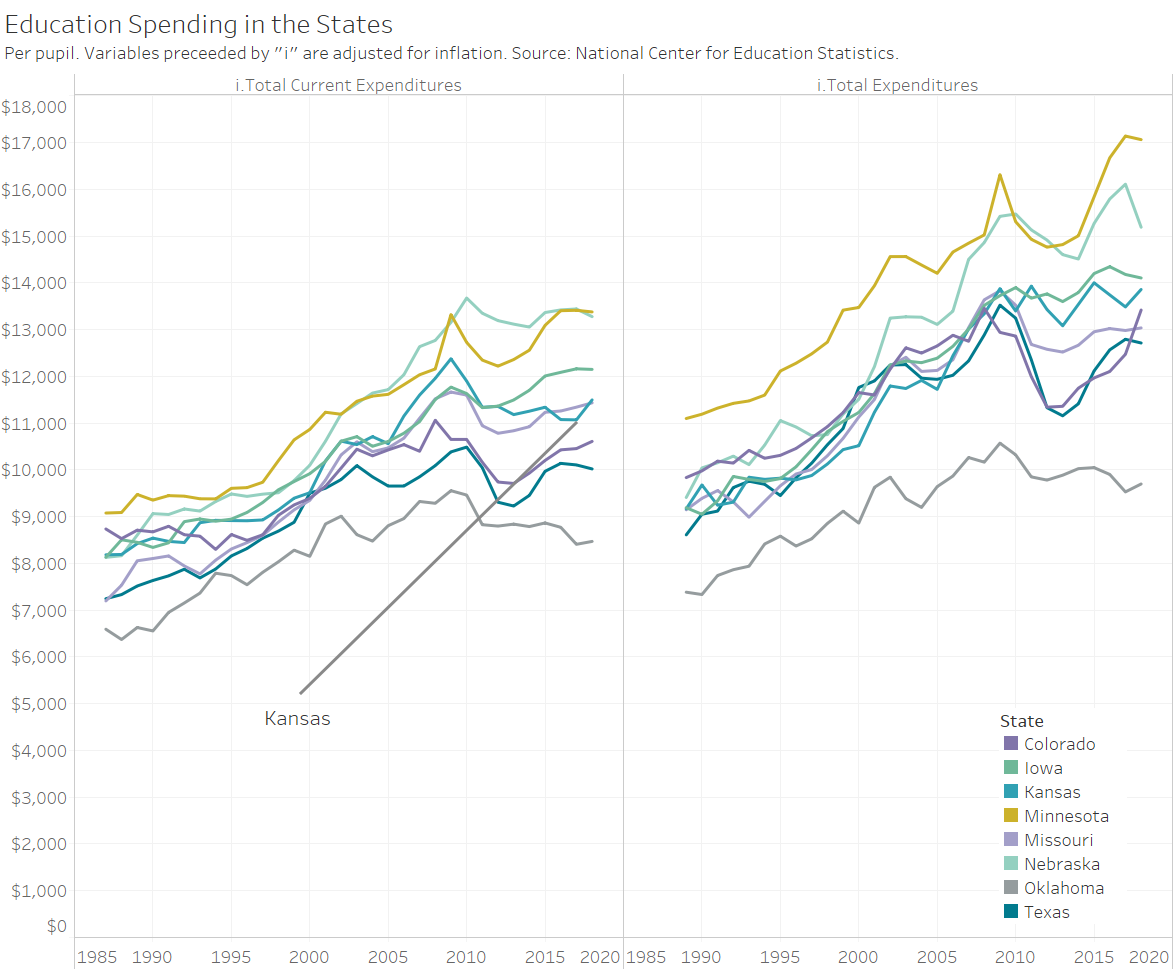
“A Nation at Risk” stimulated much soul-searching and a whole series of major attempts to reform the government educational system. These reforms, however extensive or bold, have, it is widely agreed, had negligible effect on the quality of the public school system. Though spending per pupil has more than doubled since 1970 after allowing for inflation, students continue to rank low in international comparisons; dropout rates are high; scores on SATs and the like have fallen and remain flat. Simple literacy, let alone functional literacy, in the United States is almost surely lower at the beginning of the 21st century than it was a century earlier. And all this is despite a major increase in real spending per student since “A Nation at Risk” was published.

Read the full article →

The school productivity crisis

June 11, 2005

As the Kansas Legislature prepares to meet to consider school financing, it is a good time to reflect upon the state of our public schools.

Read the full article →

Beneath the Radar

June 11, 2005

Beneath the Radar
by Richard Nadler

On June 3, the Supreme Court of Kansas issued a ruling requiring the state legislature to appropriate an additional $853 million per year to Kansas schools, K-12. The basis of the decision, said a unanimous court, was a clause in the Kansas Constitution: “The legislature shall make suitable provision for finance of the educational interests of the state.”

The increase equals roughly 20% of the state’s entire general revenue budget.In comes at the end of a fifteen year period during which Kansas’ expenditure per pupil doubled, exceeding the rise in consumer prices by 29%.

In 1973, the U.S. Supreme Court refused, in San Antonio Independent School District v. Rodriguez, to “equalize” school spending. No trend better illustrates judicial activism than the steady stream of state school finance decisions that followed. From Connecticut to California, liberal courts have broken legislative budgets and spending caps.“Equalization” has served as a pretext for tax increases in some states, and for attacking local control of schools in others.Indeed, “school finance litigation” has become a multi-billion dollar business, commanding its own corps of specialty lawyers and expert witnesses.

Read the full article →

Wearing a Black Robe to Make Sausage

June 10, 2005

Wearing a Black Robe to Make Sausage
by Bob L. Corkins
April 22, 2005

Want to create new laws without legislators? Then watch the Kansas Supreme Court for the next few weeks to see how it’s done.

Like pride for trophies on a mantle, trial lawyers boast of cases where they convinced a court to declare the birth of a new duty. Persuade a jury that somebody owes a responsibility to someone else, even if there’s no agreement, precedent, or statute providing a basis, then collect damages after showing the duty was breached.

If the decision holds up on appeal – Presto! – a new law is born. You don’t even need to mess with a jury when a single judge is tabbed as the official “finder of fact”.

Plaintiff school districts found just the judge they were hoping for when they filed their billion dollar Montoy v. State case challenging the fairness of Kansas’ K-12 education funding plan. The trial judge ruled that the state aid formula was both inequitable and under-funded. The Kansas Supreme Court now appears ready to uphold that result, but with one major twist in reasoning.

Any discrimination of our laws is traditionally evaluated with the Constitution’s Equal Protection Clause. In the Montoy trial court’s opinion, disparities in K-12 funding caused “a clear denial of equal protection of the laws in contravention of both the United States and Kansas Constitutions”.

Read the full article →

More from Rep. Frank Miller

June 10, 2005

A press release from Kansas House Member Frank Miller, Republican from Independence.


Further Regarding The Sebelius Court Order
June 9, 2005

Thank you for your many responses to my last press release. I appreciate getting both those that agree with me as well as those that disagree with me. The responses are running about half agree and half disagree, however most of the “disagrees” are from educators. The pile of agree responses cut across a broad range of constituents in my district. As far as my meetings with individuals, the consensus is running almost 100% agree that the Sebelius Court has overstepped its authority. Let’s face it – most voters want to hold their elected legislators responsible for making laws, levying taxes, and appropriating funding. Who wants to have a few non-elected judges make these kinds of decisions?

Some have asked me “have we read the Constitution” – the answer is “YES”. Some say the legislature must obey the Sebelius court if they have a genuine concern for the children – the answer is “we do”, but we also have a concern for the parents of the children, and for those couples who have no children and retired citizens. The amount of tax that comes out of the pockets of the parents also hurts the children.

Read the full article →